Posts tagged Coalition of Immokalee Workers

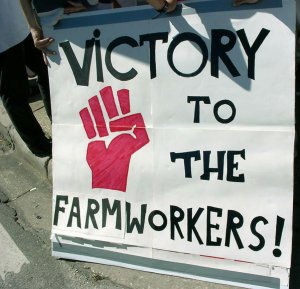
¡Sí se puede! Victory for the Coalition of Immokalee Workers in the Burger King penny-per-pound campaign

It’s a busy day today, especially on the activist front, so I won’t have much to add by way of comment until I’ve had a bit of time to sit down and breathe. But I just got this news via e-mail and it made me so happy that I had to post something to share the good news as soon as possible:

WASHINGTON – May 23, 2008 - The Coalition of Immokalee Workers (CIW) and Burger King Corp. (NYSE:BKC) today announced plans to work together to improve wages and working conditions for the farmworkers who harvest tomatoes for the BURGER KING® system in Florida.

BKC has agreed to pay an additional net penny per pound for Florida tomatoes to increase wages for the Florida farm workers who harvest tomatoes. To encourage grower participation in this increased wage program, BKC will also fund incremental payroll taxes and administrative costs incurred by the growers as a result of their farmworkers’ increased wages, or a total of 1.5 cents per pound of tomatoes.

BKC also joins other fast-food industry leaders and the CIW in calling for an industry-wide net penny per pound surcharge to increase wages for Florida tomato harvesters.

Together, BKC and the CIW have also established zero tolerance guidelines for certain unlawful activities that require immediate termination of any grower from the BURGER KING® supply chain. The BKC/CIW collaboration additionally provides for farmworker participation in the monitoring of growers’ compliance with the company’s vendor code of conduct.

John Chidsey, chief executive officer of Burger King Corp., said, We are pleased to now be working together with the CIW to further the common goal of improving Florida tomato farmworkers’ wages, working conditions and lives. The CIW has been at the forefront of efforts to improve farm labor conditions, exposing abuses and driving socially responsible purchasing and work practices in the Florida tomato fields. We apologize for any negative statements about the CIW or its motives previously attributed to BKC or its employees and now realize that those statements were wrong. Today we turn a new page in our relationship and begin a new chapter of real progress for Florida farmworkers.

For more than 50 years, BKC has been a proud purchaser and supporter of the Florida tomato industry. However, if the Florida tomato industry is to be sustainable long-term, it must become more socially responsible. We, along with other industry leaders, recognize that the Florida tomato harvesters are in need of better wages, working conditions and respect for the hard work they do. And we look forward to working with the CIW in the pursuit of these necessary improvements. We also encourage other purchasers and growers of Florida tomatoes to engage in dialogue with the CIW in support of driving industry-wide socially responsible change.

Lucas Benitez of the CIW added, The events of the past months have been trying. But we are prepared to move forward, together now with Burger King, toward a future of full respect for the human rights of workers in the Florida tomato fields. Today we are one step closer to building a world where we, as farmworkers, can enjoy a fair wage and humane working conditions in exchange for the hard and essential work we do everyday. We are not there yet, but we are getting there, and this agreement should send a strong message to the rest of the restaurant and supermarket industry: Now is the time to join Yum! Brands, McDonalds, and Burger King in righting the wrongs that have been allowed to linger in Florida’s fields for far too long.

U.S. Senator Richard Durbin (IL-D): I applaud Burger King for announcing today that it will be providing an extra penny per pound to the tomato pickers of Immokalee, Florida and establishing a zero-tolerance policy for worker abuses in the region. Today’s announcement is a major step forward in improving the wages and working conditions of the Immokalee workers. I call on other purchasers of the region’s tomatoes and the Florida Tomato Growers Exchange to join Burger King and do the right thing for these workers.

U.S. Senator Bernie Sanders (VT-I): I have been to Immokalee and seen first-hand the conditions for farm workers there, perhaps the most exploited workers in America. I am very pleased that Burger King has agreed to help the tomato pickers who have worked for too long for too little. I know that this has been a long and hard road for Burger King, and I believe the American people will appreciate what they are doing. I hope now that other corporations will join Burger King, McDonalds and Yum Brands in doing the right thing.

The CIW has ended its campaign against BKC and its franchisees and will work with the company to further foster improvements and sustainable changes throughout the Florida tomato industry. The CIW and BKC will also work together toward development of an industry-wide vendor code of conduct and increased worker wages through encouragement of full buyer and grower participation.

— Coalition of Immokalee Workers Breaking News (2008-05-23): Burger King Corp. and Coalition of Immokalee Workers to Work Together

See also:

May Day 2008

There will be a time when our silence will be more powerful than the voices you strangle today!

—Last words of August Spies (1887-11-11), immigrant, anarchist, and Haymarket martyr

Fellow workers:

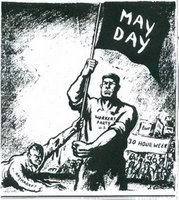
Today is May Day, or International Workers’ Day, a holiday created by Chicago workers—most of them anarchists—to honor the memory of the Haymarket martyrs and to celebrate the struggle of workers for freedom, for a better life, and for control over the conditions of their own labor. It was created during the radical phase of the struggle for an eight-hour day: after legislative campaigns by the Knights of Labor and the National Labor Union failed, labor radicals in Chicago — organizers like Albert Parsons, Lucy Parsons, August Spies — declared that workers should take matters into their own hands, in the form of direct action on the shop floor. Workers would no longer try to get an eight-hour day by promising a useful and compliant voter base in return for patronage from politicians. To get an eight-hour shift, workers would make their own: in many shops, workers in the International Working People’s Association would bring their own whistle to work and blow it at the end of an eight hour shift — at which point most or all of the workers on the floor would just get up and just walk off, like the free people they were, whether or not the boss demanded more hours of labor. At the height of the struggle, they organized a General Strike, in defiance of the bosses and in spite of repeated violence from the Law.

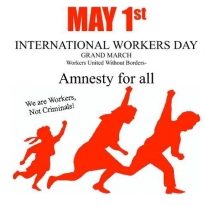
Today is also the third annual day of rallies, strikes and marches against the criminalization of immigrant workers. A day which immigrant workers have chosen for actions against the bigotry of nativist bullies, the violence of La Migra, and the political system of international apartheid, as contemptible as it is lethal. A day to proudly proclaim We are not criminals and We are not going anywhere, to demand the only political program that recognizes it — open borders and unconditional amnesty for all undocumented workers.

And it is a joy for me to read that today is also a day of strikes against the bosses’ war in Iraq, which will shut down all the sea ports on the west coast of the United States, as an act of defiance against the State war machine and against the worthless political opportunists who promise to end it while voting, over and over again, to sustain it:

Amid this political atmosphere, dockworkers of the International Longshore and Warehouse Union have decided to stop work for eight hours in all U.S. West Coast ports on May 1, International Workers’ Day, to call for an end to the war.

This decision came after an impassioned debate where the union’s Vietnam veterans turned the tide of opinion in favor of the anti-war resolution. The motion called it an imperial action for oil in which the lives of working-class youth and Iraqi civilians were being wasted and declared May Day a no peace, no work holiday. Angered after supporting Democrats who received a mandate to end the war but who now continue to fund it, longshoremen decided to exercise their political power on the docks.

— Jack Heyman, San Francisco Chronicle (2008-04-09): Longshoremen [sic] to close ports on West Coast to protest war

The Longshore workers have the explicit support of postal workers in New York and San Francisco, and I hope this will be only the beginning of ongoing, widespread industrial action to end a war that political action — even after two election cycles, after hundreds of millions of dollars, after countless hours of lobbying and electioneering, after a change in government, and with the backing of an overwhelming supermajority of the populace — has proven completely incapable of ending.

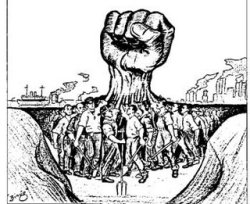
This is May Day as it is and ought to be. A Day of Resistance against the arrogance and power of bosses, bordercrats, bullies, and the Maters of War, who would harass us, intimidate us, silence us, exploit us, beat us, jail us, deport us, extort us, and do anything else it takes to stop us from coming into our own. A day to celebrate workers’ struggles for dignity, and for freedom, through organizing in their own self-interest, through agitating and exhorting for solidarity, and through free acts of worker-led direct action to achieve their goals, marching under the banners of We are all leaders here and Dump the bosses of your back. A day to remember:

There Is Power In A Union

There is power, there is power,
In a band of working folk,
When we stand
Hand in hand.

—Joe Hill (1913)

Radio Bilingüe has a list of immigration marches and rallies across the country today. I plan to be at the mitin in Las Vegas tonight:

  • Las Vegas immigrant rights mitin (rally)
  • Tonight, May 1, 2008, 7:00 PM
  • Federal Courthouse, 333 Las Vegas Blvd S.

Meanwhile, in the news, some useless idiot is wandering around Washington proclaiming Law Day, accosting hundreds of millions of complete strangers to tell them to put on ceremonies in praise of his own power to do the beating, jailing, deporting, etc. In Istanbul, organized workers marched to Taksim Square in defiance of the Turkish government, which has declared their free assembly illegal, and which has deployed government riot cops to attack them with firehoses and tear gas. In Harare, organized workers are holding rallies today to call attention to the devastating effect of the government’s hyperinflationary money monopoly on workers’ wages—and an apparatchik of the Zimbabwean government—one of the most violently anti-worker governments in the world—is taking the opportunity to wear a concerned expression and assure that Government would at all times endeavour to make sure that workplaces were monitored through inspections to minimize hazards that might injure or kill them. (No word yet on whether the hazards the inspectors will be inspecting for include the Zimbabwe Republic Police or the Central Intelligence Organization.) We must never forget what this band of creeps and fools is doing their best to remind us of — that the State is the most deadly weapon of our enemies, and that it is a weapon that we will never be able to wield for ourselves without chaining ourselves to politics and destroying the very things we meant to fight for.

In this season and in these days, in the midst of Babel during its most raucous festival—when so much of what we see and hear are the endless shouts of professional blowhards who know of no form of social change other than political change, and who know of no site of political change other than the gladiatorial arena of electoral politics, and who seem to know of no form of electoral politics other than polling, horse-trading, and endlessly shouting about a series of nomenklatura-contrived issues, which boil down to little more than a media-facilitated exchange of racist, sexist, ageist, and authoritarian barbs among the nomenklatura-approved serious candidates—it’s important to remember that, in spite of all the noise and spectacle, the most significant events for labor and for human freedom are happening in the streets of cities all over the country and all over the world, where workers are organizing among themselves, demanding their rights, fighting for their lives, and defying or simply bypassing the plutocrats and their so-called laws. In the U.S.A., while the punch-drunk establishmentarian labor movement reels from one failure to another, some of the most dynamic and successful labor struggles in the past few years have been fought by a grassroots union organized along syndicalist lines without NLRB recognition, using creative secondary boycott tactics which would be completely illegal if they had submitted to the regulatory patronage of the Wagner-Taft-Hartley system. There is a lesson here—a lesson for workers, for organizers, for agitators, and anti-statists. One we’d do well to remember when confronted by any of the bosses—whether corporate bosses or political, the labor fakirs and the authoritarian thugs styling themselves the vanguard of the working class, the regulators and the deporters and the patronizing friends of labor all:

Dump the Bosses Off Your Back

Are you cold, forelorn, and hungry?
Are there lots of things you lack?
Is your life made up of misery?
Then dump the bosses off your back!

—John Brill (1916)

Happy May Day, y’all.

Elsewhere Today:

Further reading:

Solidaridad

Coalition of Immokalee Workers marches in Miami

Fellow workers:

Right now, the Coalition of Immokalee Workers are marching in the streets of Miami, as part of their campaign to win wage increases for tomato pickers whose tomatoes are bought by Burger King. Here’s why.

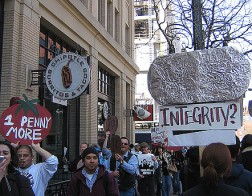
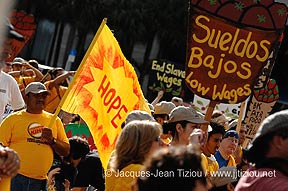
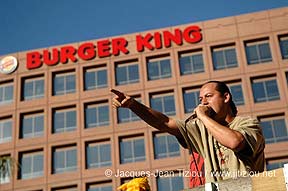
Today, farmworkers from Immokalee, Florida and their religious, labor, and student allies are marching 9 miles through the streets of Miami to the world headquarters of Burger King.

Today we march because there is a human rights crisis in the fields of Florida. Tomato pickers who harvest tomatoes for the fast-food industry face sweatshop conditions every day, including sub-poverty, stagnant wages (pickers earn about $10,000/year on average and a per-bucket piece rate that has not changed significantly since 1978) and the denial of basic labor rights.

Today we march because to earn minimum wage for a 10-hour day, a tomato picker in Florida must harvest over TWO AND A HALF TONS of tomatoes.

Today we are marching because, in the most extreme cases, farmworkers face conditions of modern-day slavery. We have seen five slavery operations in the fields brought to the federal courts since 1997, helping to liberate over 1,000 workers and sending 10 employers to prison.

Today we march because Burger King contributes directly to farmworkers’ poverty through its high-volume purchasing practices, for decades demanding the cheapest tomatoes possible but never demanding fair treatment or just wages for the people who harvest those tomatoes.

Today we are marching because we have hope. In the past years farmworkers and consumers have united to bring Yum Brands (the world’s largest restaurant corporation) and McDonald’s to the table to help improve tomato pickers’ wages and working conditions.

Today we march because, in the wake of these changes, we stand on the threshold of a more modern, more humane agricultural industry in Florida. Yet, facing this historic opportunity, Burger King has responded with lies and excuses to not take responsibility.

Today we are marching to say ENOUGH.

Today we are marching for the dignity of workers, consumers, and our communities alike.

JOIN US as we demand justice. Rally at Burger King headquarters this afternoon, 3:30 to 6:00, at Blue Lagoon Drive and NW 57 Ave.

Coalition of Immokalee Workers (2007-11-30): Why We March

Migrant farmworkers in southern Florida spend every workday picking tomatoes by hand for 10 to 12 hours at a stretch, at a piece rate of $0.40–$0.45 for every 32 pound bucket that they fill (or about 1¼ to 1½ pennies per pound of tomatoes picked). Since that piece rate hasn’t changed since 1978, farmworker’s real wages have actually fallen by more than two thirds over the past three decades, thanks to the combination of the farm bosses’ efforts to stonewall wage increases and the Federal Reserve’s efforts to keep the market safe for finance capital by eating up the value of other people’s wages.

The Coalition of Immokalee Workers, a farmworkers’ union founded in 1993 and organized along community workers’ council lines, has been working to change all that. They are mostly immigrants from Mexico, Central America, and the Caribbean; many of them have no legal immigration papers; they are pretty near all mestizo, Indian, or Black; they have to speak at least four different languages amongst themselves; they are often heavily in debt to coyotes or labor sharks for the cost of their travel to the U.S.; they get no benefits and no overtime; they have no fixed place of employment and get work from day to day only at the pleasure of the growers; they work at many different sites spread out anywhere from 10–100 miles from their homes; they often have to move to follow work over the course of the year; and they are extremely poor (most tomato pickers live on about $7,500–$10,000 per year, and spend months with little or no work when the harvesting season ends). But in the face of all that, and across lines of race, culture, nationality, and language, the C.I.W. have organized themselves anyway, through efforts that are nothing short of heroic, and they have done it as a wildcat union with no recognition from the federal labor bureaucracy and little outside help from the organized labor establishment. By using creative nonviolent tactics that would be completely illegal if they were subject to the bureaucratic discipline of the Taft-Hartley Act, the C.I.W. has won major victories on wages and conditions over the past two years. They have bypassed the approved channels of collective bargaining between select union reps and the boss, and gone up the supply chain to pressure the tomato buyers, because they realized that they can exercise a lot more leverage against highly visible corporations with brands to protect than they can in dealing with a cartel of government-subsidized vegetable growers that most people outside of southern Florida wouldn’t know from Adam.

The C.I.W.’s creative use of moral suasion and secondary boycott tactics have already won them agreements with Taco Bell (in 2005) and then McDonald’s (this past spring), which almost doubled the effective piece rate for tomatoes picked for these restaurants. They established a system for pass-through payments, under which participating restaurants agreed to pay a bonus of an additional penny per pound of tomatoes bought, which an independent accountant distributed to the pickers at the farm that the restaurant bought from. Each individual agreement makes a significant but relatively small increase in the worker’s effective wages — about $100 more per worker per year in the case of the Taco Bell agreement — but each victory won means a concrete increase in wages, and an easier road to getting the pass-through system adopted industry-wide, which would in the end nearly double tomato-pickers’ annual income.

Since the victory in the McDonald’s campaign, the C.I.W. have turned their attention from the Clown to the Crown, and Burger King Inc. has mostly followed the same path as Yum! Brands and McDonald’s did. First they ignored them. Then they stonewalled them. Then they tried to make up some excuses, and had a P.R. flack make an ill-considered little funny about how distressed farmworkers should apply for a job at their stores. (If I recall correctly, that same exact joke was recycled from Taco Bell.) Unfortunately, before moving on to the inevitable last step — in which they cave, the C.I.W. wins, the farm workers get a bonus, and the fast food chain gets to issue a press release patting themselves on the back for their humanitarian buying standards — Burger King has decided to make a detour through some dirty anti-labor joint maneuvers with the Florida tomato growers’ cartel.

The Florida Tomato Growers’ Exchange is a cartel and legislative lobby which represents more than 90% of Florida’s tomato growers. It has recently set out to destroy the pass-through system. Since the bonuses are paid by the buyers, the system costs the farm bosses nothing to implement, and I’m not entirely clear what their interest is here (although, if I had to guess, they are probably worried that widespread success for the system would raise workers’ expectations about pay and conditions). Burger King and the cartel recently teamed up on a joint P.R. campaign intended to convince the eating public that farm workers are actually richer than most minimum-wage workers, and besides which the farm bosses pay for charity houses and scholarships for their poor kids. (The basis for their argument is a comparison of estimated hourly wages. Of course, the reliability of those hours, or the total annual income, is never mentioned.)

Meanwhile, the F.T.G.E. and Burger King have endorsed the cartel’s yellow-dog auditing agency, S.A.F.E. Reps from Burger King and the tomato cartel have also teamed up with a Republican state congressman to discredit the C.I.W., by claiming that the set-up looks fishy, denouncing nonviolent protest and consumer boycotts as extortion, and then insinuating that the pass-through system is little more than a channel for graft, and that C.I.W. is pocketing a skim. Since they have no empirical evidence for this claim, they have relied on innuendo and unsubstantiated soundbites, and they have refused to give any backing for their claims, while steadfastly ignoring the offers of participating restaurants, who dismiss the claim, to explain how the system works.

Meanwhile, Reggie Brown, the tomato cartel’s professional spokesdick, has invoked the spectre of federal prosecution, claiming that the C.I.W.’s voluntary pass-through system somehow violates federal antitrust and racketeering laws. Brown has also denounced the freely bargained agreements as un-American, apparently because they organized bosses’ divine right to control the terms of wage negotiations with no input from workers organizations or, for that matter, their customers. The cartel has publicly warned its members not to participate, and, behind the scenes, they have apparently threatened any member who participates in the penny-per-pound pass-through system with a $100,000 fine. As a result, while Taco Bell and McDonald’s are still willing to participate in the bonus system, all of the growers have, as of now, announced that they will not participate next year.

Well, fine. If they want to play hardball, let them play hardball. Workers are more than capable of hitting that hardball right back. The main danger, at this point, is that, with spokesdick Brown’s muttered fulminations about federal prosecution and the bosses’ enlistment of state government creeps on their side, this fight may get kicked from creative, nonviolent industrial action, over into the stifling atmosphere of legal and regulatory action. As long as the C.I.W., and the workers and consumers acting in solidarity with them, keep away from political action, we have all the resources we need to beat them. The Taco Bell boycott was won, after years of stonewalling, through fight-to-win tactics like working with sympathetic students to get Taco Bell franchises booted out of campus dining halls. This fight can be won through more of the same, and better. Never forget that the workers are more powerful with their hands in their pockets than all the weapons and property that the plutocrats have to attack us. As Robin Blumner writes in the St. Petersburg Times:

The coalition initially tried to convince the growers to pay the added penny but they wouldn’t budge, so the group sought to enlist fast-food giants instead. Go to the major buyers who have reputations to uphold and have them pay the penny. It was a brilliant stroke.

Consumers tend to respond well to a company they think is socially responsible, and the converse is true.

… According to [C.I.W. rep Julia] Perkins, there are growers willing to help their workers secure this additional wage but the exchange is standing in the way.

Both Yum Brands and McDonald’s say they are committed to their agreement with the coalition. It appears that for now, however, things are on hold until the coalition and these companies can figure out a way around the intransigence of the exchange.

This is how it often is in labor fights: Employers dig in so hard that even an extra penny - one that they’re not even paying - is too much to ask. No wonder they can’t find Americans to do this work.

In the meantime, the coalition is trying to convince Burger King Corp. to come aboard, and is planning a demonstration at its headquarters in Miami on Friday. Keva Silversmith, a Burger King representative, says that the Florida growers have a right to run their business how they see fit.

I guess expending the $250,000 it would cost Burger King is simply too much for a company that is paying its CEO $2.35-million a year.

Okay consumers, sic ‘em.

— Robin Blumner, St. Petersburg Times (2007-11-25): At a penny per pound, a little adds up to a lot

Further reading:

May Day 2007

We Have Fed You All for a Thousand Years

We have fed you all for a thousand years,
And you hail us still unfed,
Though there’s never a dollar of all your wealth
But marks the workers dead.
We have yielded our best to give you rest,
And you lie on crimson wool;
But if blood be the price of all your wealth
Good God we have paid in full.

There is never a mine blown skyward now
But we’re buried alive for you;
There’s never a wreck drifts shoreward now
But we are its ghastly crew.
Go and reckon our dead by the forges red,
And the factories where we spin;
If blood be the price of your cursèd wealth
Good God we have paid it in.

We have fed you all for a thousand years—
For that was our doom, you know,
From the days when you chained us in your fields
To the strike a week ago.
You have taken our lives, and our husbands and wives,
And called it your legal share;
But if blood be the price of your lawful wealth
Good God we bought it fair.

—First printed by the Industrial Workers of the World in 1908. Words by an anonymous proletarian, tune by Rudolph von Leibich

Fellow workers:

Today is May Day, or International Workers Day, a holiday created by Chicago workers—most of them anarchists—to honor the memory of the Haymarket martyrs and to celebrate the struggle of workers for freedom, a better life, and determination of the conditions of their own labor. It’s also the second annual day of strikes and marches for immigrant workers’ rights. May Day is and ought to be a day of resistance against the arrogance and power of the plutocrats. A day to celebrate workers’ struggles for dignity, and for freedom, through organizing in their own self-interest, through agitating and exhorting for solidarity, and through free acts of worker-led direct action to achieve their goals, marching under the banners of We are all leaders here and Dump the bosses off your back . A day to cheer immigrant workers struggling for their own freedom, in defiance of the attempts by La Migra and freelance nativist bullies to silence and intimidate them, marching under the banners We are not criminals, and We are not going anywhere. A day to remember:

There Is Power In A Union

There is power, there is power,
In a band of working folk,
When we stand
Hand in hand.

—Joe Hill (1913)

In honor of the day, it’s a pleasure to recommend some reading from anti-state radicals—from a history of May Day’s American roots at The Agitator (Lauritz, not Balko), to Kevin Carson’s Organized Capital vs. Organized Labor, to Sheldon Richman’s column Labor’s Right to a Free Market. And I’d especially like to recommend Kevin’s simply brilliant earlier column, The Ethics of Labor Struggle: A Free Market Perspective. Kevin’s and Sheldon’s columns do an especially good job of showing the gulf between the managerial style of establishmentarian business unionism—so familiar to us in these the waning days of Babylon, with Wagner and Taft-Hartley carefully arranged to bring the established unions into the web of State privilege and State regulation—with the older, state-free tradition of wildcat unionism that May Day celebrates. Here’s Kevin Carson:

First of all, when the strike was chosen as a weapon, it relied more on the threat of imposing costs on the employer than on the forcible exclusion of scabs. You wouldn’t think it so hard for the Misoids to understand that the replacement of a major portion of the workforce, especially when the supply of replacement workers is limited by moral sympathy with the strike, might entail considerable transaction costs and disruption of production. The idiosyncratic knowledge of the existing workforce, the time and cost of bringing replacement workers to an equivalent level of productivity, and the damage short-term disruption of production may do to customer relations, together constitute a rent that invests the threat of walking out with a considerable deterrent value. And the cost and disruption is greatly intensified when the strike is backed by sympathy strikes at other stages of production. Wagner and Taft-Hartley greatly reduced the effectiveness of strikes at individual plants by transforming them into declared wars fought by Queensbury rules, and likewise reduced their effectiveness by prohibiting the coordination of actions across multiple plants or industries. Taft-Hartley’s cooling off periods, in addition, gave employers time to prepare ahead of time for such disruptions and greatly reduced the informational rents embodied in the training of the existing workforce. Were not such restrictions in place, today’s “just-in-time” economy would likely be far more vulnerable to such disruption than that of the 1930s.

More importantly, though, unionism was historically less about strikes or excluding non-union workers from the workplace than about what workers did inside the workplace to strengthen their bargaining power against the boss.

The Wagner Act, along with the rest of the corporate liberal legal regime, had as its central goal the redirection of labor resistance away from the successful asymmetric warfare model, toward a formalized, bureaucratic system centered on labor contracts enforced by the state and the union hierarchies.

It’s time to take up Sweeney’s half-hearted suggestion, not just as a throwaway line, but as a challenge to the bosses. We’ll gladly forego legal protections against punitive firing of union organizers, and federal certification of unions, if you’ll forego the court injunctions and cooling-off periods and arbitration. We’ll leave you free to fire organizers at will, to bring back the yellow dog contract, if you leave us free to engage in sympathy and boycott strikes all the way up and down the production chain, boycott retailers, and strike against the hauling of scab cargo, etc., effectively turning every strike into a general strike. We give up Wagner (such as it is), and you give up Taft-Hartley and the Railway Labor Relations Act. And then we’ll mop the floor with your ass.

— Kevin Carson, The Ethics of Labor Struggle: A Free Market Perspective

That’s just a sampling. You really must read the whole thing.


Meanwhile, in the news, some creep in Washington is wandering around proclaiming Loyalty Day and demanding our renewed allegiance; and while the punch-drunk official unions are begging the government for more favors, the captains of industry are begging the government to keep a tight leash on free association. But the most significant events for labor and for human freedom are happening beyond the noise and spectacle of that gladiatorial arena, in the streets of cities all over the country where workers demand their rights in defiance of the so-called immigration law, and in unrecognized, grassroots unions organized along syndicalist lines, where workers have won concrete gains from the biggest corporations in their industry by operating through the use of creative secondary boycotts. There is a lesson here—a lesson for workers, for organizers, for agitators, and anti-statists. One we’d do well to remember when confronted by any of the bosses—whether corporate bosses or political, the labor fakirs and the authoritarian thugs styling themselves the vanguard of the working class, the regulators and the deporters and the patronizing friends of labor all:

Dump the Bosses Off Your Back

Are you cold, forelorn, and hungry?
Are there lots of things you lack?
Is your life made up of misery?
Then dump the bosses off your back!

—John Brill (1916)

Further reading: