Geekery Today: posts tagged Firebombing

Bomb after bomb (posted 26 December 2007)

Last weekend, CounterPunch featured Howard Zinn’s introduction to elin o’Hara slavick’s book of cartographic drawings of American aerial bombing, Bomb after Bomb. I agree with Mark Brady that this is one of the best things that Zinn has ever written. Some of the most important stuff in the essay has to do with patriotism, the conflation of the country with the State, and the criminality of aerial warfare as such. A sample:

We have had enough experience, with the Nuremberg trials of the Nazi leaders, with the bombings carried out by the Allies, with the torture stories coming out of Iraq, to know that ordinary people with ordinary consciences will allow their instincts for decency to be overcome by the compulsion to obey authority. It is time therefore, to educate the coming generation in disobedience to authority, to help them understand that institutions like governments and corporations are cold to anything but self-interest, that the interests of powerful entities run counter to the interests of most people.

This clash of interest between governments and citizens is camouflaged by phrases that pretend that everyone in the nation has a common interest, and so wars are waged and bombs dropped for national security, national defense, and national interest.

Patriotism is defined as obedience to government, obscuring the difference between the government and the people. Thus, soldiers are led to believe that we are fighting for our country when in fact they are fighting for the government — an artificial entity different from the people of the country — and indeed are following policies dangerous to its own people.

My own reflections on my experiences as a bombardier, and my research on the wars of the United States have led me to certain conclusions about war and the dropping of bombs that accompany modern warfare.

One: The means of waging war (demolition bombs, cluster bombs, white phosphorus, nuclear weapons, napalm) have become so horrendous in their effects on human beings that no political end— however laudable, the existence of no enemy — however vicious, can justify war.

Two: The horrors of the means are certain, the achievement of the ends always uncertain.

Three: When you bomb a country ruled by a tyrant, you kill the victims of the tyrant.

Four: War poisons the soul of everyone who engages in it, so that the most ordinary of people become capable of terrible acts.

Five: Since the ratio of civilian deaths to military deaths in war has risen sharply with each subsequent war of the past century (10% civilian deaths in World War I, 50% in World War II, 70% in Vietnam, 80-90% in Afghanistan and Iraq) and since a significant percentage of these civilians are children, then war is inevitably a war against children.

Six: We cannot claim that there is a moral distinction between a government which bombs and kills innocent people and a terrorist organization which does the same. The argument is made that deaths in the first case are accidental, while in the second case they are deliberate. However, it does not matter that the pilot dropping the bombs does not intend to kill innocent people — that he does so is inevitable, for it is the nature of bombing to be indiscriminate. Even if the bombing equipment is so sophisticated that the pilot can target a house, a vehicle, there is never certainty about who is in the house or who is in the vehicle.

Seven: War, and the bombing that accompanies war, are the ultimate terrorism, for governments can command means of destruction on a far greater scale than any terrorist group.

These considerations lead me to conclude that if we care about human life, about justice, about the equal right of all children to exist, we must, in defiance of whatever we are told by those in authority, pledge ourselves to oppose all wars.

—Howard Zinn, Introduction to elin o’Hara slavick’s Bomb after Bomb

Read the whole thing.

(Via Mark Brady @ Liberty & Power 2007-12-15.)

One man’s reductio (posted 1 September 2006)

Here’s widely-published, reportedly libertarian columnist Walter Williams on the need for political will in the War on Terror:

Does the United States have the power to eliminate terrorists and the states that support them? In terms of capacity, as opposed to will, the answer is a clear yes.

Think about it. Currently, the U.S. has an arsenal of 18 Ohio class submarines. Just one submarine is loaded with 24 Trident nuclear missiles. Each Trident missile has eight nuclear warheads capable of being independently targeted. That means the U.S. alone has the capacity to wipe out Iran, Syria or any other state that supports terrorist groups or engages in terrorism — without risking the life of a single soldier.

Terrorist supporters know we have this capacity, but because of worldwide public opinion, which often appears to be on their side, coupled with our weak will, we’ll never use it. Today’s Americans are vastly different from those of my generation who fought the life-and-death struggle of World War II. Any attempt to annihilate our Middle East enemies would create all sorts of handwringing about the innocent lives lost, so-called collateral damage.

Such an argument would have fallen on deaf ears during World War II when we firebombed cities in Germany and Japan. The loss of lives through saturation bombing far exceeded those lost through the dropping of atomic bombs on Hiroshima and Nagasaki.

Walter E. Williams (2006-08-23): Will The West [sic] Defend Itself?

I’d like to thank Mr. Williams for helping to illustrate an important point about logical inference.

Two of the most important rules of inference are the modus ponendo ponens (pq. p. ∴ q) and the modus tollendo tollens (pq. ~q. ∴ ~p). Something that people often don’t realize is how the very same reasoning could be used to set up either a modus ponens or a modus tollens in the last step. Here’s an example drawn from real life. Walter Williams argues:

  1. If there were something wrong with slaughtering hundreds of thousands of innocent people in the name of military victory today, there would have been something wrong with the Allied governments’ massacre of half a million or more innocent people in the name of military victory during the firebombing campaigns of World War II. (lemma)
  2. There was nothing wrong with the Allied governments’ massacre of half a million or more innocent people in the name of military victory during the firebombing campaigns of World War II. (premise)
  3. Therefore, there must be nothing wrong with slaughtering hundreds of thousands of innocent people in the name of victory today. Q.E.D. (M.T. 1, 2)

But someone or another just might use the same line of inferences that Williams drew in order to establish a different conclusion:

  1. If there were something wrong with slaughtering hundreds of thousands of innocent people in the name of military victory today, there would have been something wrong with the Allied governments’ massacre of half a million or more innocent people in the name of military victory during the firebombing campaigns of World War II. (lemma)
  2. There is something wrong with slaughtering hundreds of thousands of innocent people in the name of military victory today. (premise)
  3. Therefore, there must be something wrong with the Allied governments’ massacre of half a million or more innocent people in the name of military victory during the firebombing campaigns of World War II. You dick. (M.P. 1, 2)

For some people’s argumentative purposes the Allied war effort in World War II is not so much just as the paradigm for justice itself; like the meter stick in Paris, it doesn’t even make sense to say that it is just, because the possibility that it even might have been less than just is simply unintelligible. Those who have a less reverent view of the single most destructive total war in the history of the entire world may not share the same premises. And thus may draw quite a different conclusion. I’m just sayin’.

I’d like to thank the War Party for offering yet another opportunity for an important lesson on informal logic.

Update 2006-09-02: Commenter Adam B. pointed out that the full Latin name for modus tollens is the modus tollendo tollens, not modus ponendo tollens as I’d originally written. This has been fixed in the text.

Further reading:

War and manhood (posted 31 July 2006)

(Links via Dulce Et Decorum Est 2006-07-31 and comments on Tennessee Guerrilla Women 2006-07-30.)

Here is a view of war and manhood from the bottom of the ranks.

I came over here because I wanted to kill people.

Over a mess-tent dinner of turkey cutlets, the bony-faced 21-year-old private from West Texas looked right at me as he talked about killing Iraqis with casual indifference. It was February, and we were at his small patrol base about 20 miles south of Baghdad. The truth is, it wasn’t all I thought it was cracked up to be. I mean, I thought killing somebody would be this life-changing experience. And then I did it, and I was like, All right, whatever.

He shrugged.

I shot a guy who wouldn’t stop when we were out at a traffic checkpoint and it was like nothing, he went on. Over here, killing people is like squashing an ant. I mean, you kill somebody and it’s like All right, let’s go get some pizza.

At the time, the soldier’s matter-of-fact manner struck me chiefly as a rare example of honesty. I was on a nine-month assignment as an embedded reporter in Iraq, spending much of my time with grunts like him — mostly young (and immature) small-town kids who sign up for a job as killers, lured by some gut-level desire for excitement and adventure. This was not the first group I had run into that was full of young men who shared a dark sense of humor and were clearly desensitized to death. I thought this soldier was just one of the exceptions who wasn’t afraid to say what he really thought, a frank and reflective kid, a sort of Holden Caulfield in a war zone.

But the private was Steven D. Green.

Andrew Tilghman, Washington Post (2006-07-30, B01): I came over here because I wanted to kill people.

When Tilghman met Green, Green was angry and disillusioned about the war. He seethed about the old men’s demands for restraint (We’re out here getting attacked all the time and we’re in trouble when somebody accidentally gets shot?), and about the meaninglessness of this war:

See, this war is different from all the ones that our fathers and grandfathers fought. Those wars were for something. This war is for nothing.

Quoted by Andrew Tilghman, Washington Post (2006-07-30, B01): I came over here because I wanted to kill people.

Those who cannot remember the past are condemned to repeat it. Green was wrong about the wars that our fathers and grandfathers fought. Or any other war fought by men in the name of the National Manhood. Meanwhile, here is another view of war and manhood, from the top of the ranks:

The Wars Our Fathers and Grandfathers Fought

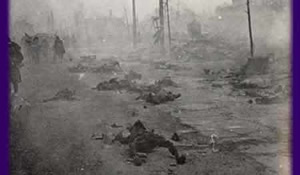
photo: burnt corpses lie in a ruined street

Aftermath of the Tokyo firebombing, 10 March 1945

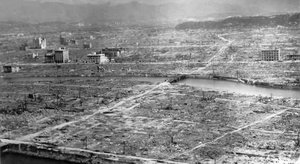
photo: an aerial view of Hiroshima, leveled

Aftermath of the atomic bombing of Hiroshima, 6 August 1945

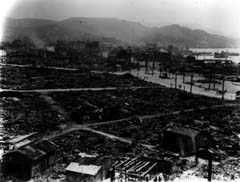
photo: leveled houses around the Nagasaki railroad station

Nagasaki railroad station

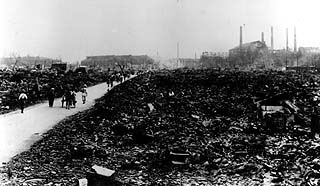
photo: a ruined residential neighborhood, with all the homes burnt or toppled

Iwakawa-machi residential neighborhood, Nagasaki

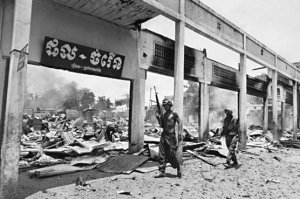
BombingOfSnuol.jpg

Aftermath of U.S. bombing of Snuŏl, Cambodia on 3 May 1970.

AUSTRALIA intervened to stop key US military strikes against Saddam Hussein’s regime in Iraq, fearing they might constitute a war crime.

Major General Maurie McNarn, then a brigadier and commander of Australian forces in Iraq, on several occasions played a red card against the American plans, which included hits on individuals. His objections drew anger from some senior US military figures.

In one instance, Major General McNarn vetoed a US plan to drop a range of huge non-precision bombs on Baghdad, causing one angry US Air Force general to call the Australian a pencil dick.

However, US military command accepted Major General McNarn’s objection and the US plans were scrapped.

The revelation of how Australia actively and successfully used its veto power in the 2003 invasion of Iraq is contained in a new book on the US-Australian alliance, The Partnership, by The Weekend Australian’s foreign editor, Greg Sheridan.

… The book reveals that Major General McNarn — now the head of the Defence Intelligence Organisation — delivered a great shock to the US when he first used the red card and then put his objections to the proposed US military strike in writing.

Shit, exclaimed one American when he saw the document. What if this leaks? Major General McNarn replied that if the US did not take the illegal action, it would not matter.

As coalition forces prepared plans to take Baghdad, Major General McNarn vetoed three of five proposed US Air Force weapon systems — mostly huge bombs — on the grounds that they were not accurate for a radius of less than 16m and, as a result, were unsuitable for use in a built-up area.

Cameron Stewart, The Australian (2006-07-29): Aussie veto stopped US war crimes

There are of course two stories here. The first story, the one emphasized by the news report, is that the Australian general halted the U.S. generals’ plans to indiscriminately bomb Baghdad—which would have made the war even more of an abattoir for Iraqi civilians than it became even with the more restrained bombing. The second story is that the U.S. generals made plans to indiscriminately bomb Baghdad. Plans they were invested in, and plans they were enraged to see blocked.

Evildoers (posted 4 January 2006)

For the past week, there’s been a lot of hubbub over All Things Beautiful’s Ten Worst Americans challenge. For a lot of reasons, I don’t have a comprehensive list, and I’m not that keen on the whole project (there’s lots of evil and ugliness in the world without going out of your way to seek it out, compile it, and cross-index it; I have no idea what the criteria would be for choosing ten people as more evil than any others; and I think that most of us are already far too fascinated with and fixated on demonology as it is). So I don’t have a Worst Ten list to provide. But I do have a list of additions that I think ought to be there, if lists are to be made. Coming out for the left-liberal corner we have Ampersand at Alas, A Blog (2005-12-27) with a list of seven villains, Patrick at Tiberius and Gaius Speaking… with a list of ten, and Glenn Greenwald and Hypatia at Unclaimed Territory (2005-12-28) with another ten to throw on the barbie. With the exception of Glenn’s silly inclusion of Harry Blackmun, they are pretty much right, as far as it goes, but there are some notable names that I notice tend to get left out. I suggested some additions at Alas and some dishonorable mentions at Tiberius and Gaius, which have been followed up with some debate.

Here’s my contribution of evildoers. I make no attempt to be comprehensive — there are lots of truly rotten people who aren’t on the list, mainly because they are mentioned elsewhere. But these folks are truly rotten, and often overlooked — sometimes because they get shoved out of the way by contemporary contenders that contemporary writers tend to give disproportionate space to, sometimes because the villains are overlooked by pop history anyway, and sometimes simply because political blinders prevent their names from being given serious consideration. The interesting thing is that the blinders rarely constitute defenses of their deeds — although in at least two of the three cases I discuss with Patrick that is what’s happening. It’s just that, for whatever reason, some folks whose crimes are readily admitted, if mentioned, aren’t thought of when you sit down thinking Who should I put down as a terrible evil-doer? I have some ideas about the reasons behind that, but I’d be interested to hear what you think in comments, too.

In any case, here’s my unordered list of overlooked evildoers, cobbled together from my suggestions elsewhere:

  • Harry S. Truman. He ordered or approved the murders of 500,000 - 1,000,000 Japanese civilians over the course of half a year in 1945.

  • Curtis LeMay. He carried out the murder of 500,000 - 1,000,000 Japanese civilians over the course of half a year in 1945. He planned and carried out the low-altitude firebombing of Kobe, Tokyo, and 65 other Japanese cities. A nuclear maniac who explicitly denied that there were any innocent bystanders in war, went on to coin the phrase bomb them back into the Stone Age (in reference to the Vietnam War), and went on to become George Wallace’s running mate in 1968, on a platform of white supremacy and more militant anticommunism. During World War II, he repeatedly indicated his belief that the Japanese deserved wholesale slaughter of civilians, and his own public statements and the reminiscences of the soldiers who served under him reveal him as simply reveling in death and destruction.

  • Franklin Delano Roosevelt, a pseudo-leftist demagogue who created the military-industrial complex; imprisoned political opponents; seized sweeping censorship powers; pandered to the worst sorts of racism, first in his political alliances with arch-segregationist Dixiecrats and then in whipping up war fever for war against Japan; ordered internment of Japanese-Americans; happily allied with, propagandized for, and consigned 1/2 of Europe to the totalitarian terror of, Joseph Stalin; and became one of the three men who came the closest to becoming a dictator in the United States.

  • Woodrow Wilson, unreprentant liar and war-monger, KKK fan, arch-segregationist, ardent anti-feminist. His published academic work delighted in white supremacist myth-making; his warmongering drew the United States needlessly into one of the worst and most senseless wars in world history; he built a slave army with the second federal draft in American history, and shredded civil liberties with abandon, happily imprisoning political opponents both during and after the War and presiding over the devastating Palmer Raids. Wilson is one of the three men who came the closest to becoming a dictator in the United States.

  • George Fitzhugh, who fused the worst elements of statist utopian socialism with a nostalgic view of feudal hierarchy to provide the most militant theoretical defense of white supremacy and race slavery in the prewar South. He authored Slavery Justified, Sociology in the South, and Cannibals All!.

  • William Tecumseh Sherman, one of the inventors of modern scorched-earth warfare, ravager of the South and murderer of Southern civilians. Sherman followed up his most famous role by pursuing genocidal campaigns against the Plains Indians and Indians in the Southwest from 1869 until his retirement in 1884.

  • James Eastland, the militant white supremacist Senator from Mississippi, mad dog McCarthyist, and founding father of the White Citizens Councils.

  • In addition to another Alas commenter’s suggestion of Larry Flynt, I’d also like to add Chuck Traynor, the pimp / pornographer / rapist / batterer / slave-driver who forced Linda Boreman into Deep Throat (among other pornography) and played an instrumental role in founding the mass-market, above-ground film pornography industry in the U.S. through repeated filmed rapes.

  • Sergio Méndez reminded me that Ronald Reagan certainly needs a mention, yet he seems notoriously absent from many of the lists. I mention him here not because I think he’s often overlooked on lefty lists of rotten people, but rather because I think the primary reasons to include him — his complicity in the formation of the death squads of El Salvador and the plainly genocidal massacre of some 200,000 Indians in Guatemala — is often overlooked in favor of a frankly silly focus on his contributions to the rhetoric of the contemporary Right in America.

The exercise, whatever its demerits, does seem to be a good conversation-starter. What do you think?

A day that will live in infamy (posted 9 August 2005)

The easiest way to begin is with the numbers.

Some 60 years ago today, at 11:02 in the morning, the American B-29 bomber dropped a 10,200 pound plutonium bomb (nicknamed Fat Man) over the city of Nagasaki, a tourist destination, industrial center and sea-port in southwestern Japan with a population of about 230,000. The bomb exploded about 500 yards above Nagasaki, creating a fireball, a shockwave, and a massive burst of radiation. Some 74,000 civilians — about 1/3 of the population of Nagasaki — were burned alive, crushed to death by the shockwave, or sickened and died over the next few months due to severe radiation poisoning (the burning away of their internal organs by intense radiation) and cancer.

Three days before, with no prior warning, a B-29 bomber had dropped an enriched uranium bomb over Hiroshima, an industrial center in western Japan, with a population of about 255,000. The bomb had exploded about 670 yards above the city. 80,000 civilians were burned alive or crushed to death by the explosion. By the end of 1945, another 60,000 people died due to severe radiation poisoning and cancer, raising the death toll to about 140,000—about 55% of the city’s population.

One of the reasons that Hiroshima and Nagasaki were chosen as targets is that they were considered to be good sites to demonstrate the killing power of the Bomb: they had been mostly untouched during the six months of low-altitude firebombing of Japanese cities. The first major raid of that campaign was the firebombing of Tokyo in the middle of the night on March 9-10, 1945. 334 American B-29 bombers raced over the city at about 7,000 feet, and dropped about 1,700 tons of napalm bombs. It is estimated that about 100,000 civilians were burned to death in one (1) night. Over the next 6 months, from March 10 to Japan’s surrender on August 15, over 100 Japanese cities were firebombed; about 500,000 civilians were burned to death.

All told, the firebombing and nuclear attacks and conventional air raids on Japan killed somewhere between 800,000 and 1,000,000 Japanese civilians over the course of half a year.

Then there are the names.

portrait: LeMay

Curtis LeMay

portrait: Stimson

Henry L. Stimson, Secretary of War

press photo: Truman

Harry Truman, President

The B-29 Bockscar, which incinerated one third of the people of Nagasaki, was piloted by Major Charles Sweeney. The actual dropping of the bomb was carried out by the plane’s bombadier, Captain Kermit Beahan.

The B-29 Enola Gay, which incinerated over half of the people of Hiroshima, was piloted and commanded by Colonel Paul Tibbets. The plane’s bombadier, Major Thomas Ferebee, dropped the bomb over Hiroshima.

Sweeney, Beahan, Tibbets, and Ferebee were members of the XXI Bomber Command, directed General Curtis LeMay. LeMay opposed the nuclear attacks, but he directed it under orders from Secretary of War Henry L. Stimson and President Harry S. Truman, who had made the decision to use atomic weapons in order to terrorize Japan into unconditional surrender. LeMay was also the architect of the low-altitude firebombing campaign, acting on advice and research from his subordinate, Lt. Col. Robert McNamara.

We will never know the names of most of the 1,000,000 or so civilians who were killed in the onslaught. The Japanese government was in disarray in the closing months of the war, and many of the records were consumed by the flames along with the lives of the victims.

Then there are the statements of intent.

The purposes of the bombing was to achieve victory through catastrophic bloodshed and terror. LeMay, when asked about his bombing campaigns, stated There are no innocent civilians, so it doesn’t bother me so much to be killing innocent bystanders. (He also mused, later, I suppose if I had lost the war, I would have been tried as a war criminal.) The interim committee deciding to drop the bomb stated, on May 31, 1945, that we could not give the Japanese any warning before the atomic bombing of Hiroshima. About 24 hours before the incineration of Nagasaki, U.S. planes began dropping leaflets all over Japan, threatening more destruction but naming no targets that could be evacuated. The leaflets did not reach Nagasaki at all until August 10, the day after it was destroyed. The leaflets read:

TO THE JAPANESE PEOPLE:

America asks that you take immediate heed of what we say on this leaflet.

We are in possession of the most destructive explosive ever devised by man. A single one of our newly developed atomic bombs is actually the equivalent in explosive power to what 2000 of our giant B-29s can carry on a single mission. This awful fact is one for you to ponder and we solemnly assure you it is grimly accurate.

We have just begun to use this weapon against your homeland. If you still have any doubt, make inquiry as to what happened to Hiroshima when just one atomic bomb fell on that city.

Before using this bomb to destroy every resource of the military by which they are prolonging this useless war, we ask that you now petition the Emperor to end the war. Our president has outlined for you the thirteen consequences of an honorable surrender. We urge that you accept these consequences and begin the work of building a new, better and peace-loving Japan.

You should take steps now to cease military resistance. Otherwise, we shall resolutely employ this bomb and all our other superior weapons to promptly and forcefully end the war.

Shortly before the leaflets were dropped, Harry Truman also publicly declared his aims: It was to spare the Japanese people from utter destruction that the ultimatum of July 26 was issued at Potsdam. Their leaders promptly rejected that ultimatum. If they do not now accept our terms, they may expect a rain of ruin from the air the likes of which has never been seen on this earth.

Of course, no specific warning was given to the civilians of Nagasaki, at any point.

After the war, Truman defended his decision to burn nearly 1,000,000 civilians to death on the grounds that it was necessary to secure the unconditional submission of Japan to surrender and occupation without a costly marine invasion of the home islands.

Then there are the effects. For most of these there are no words.

photo: burnt corpses lie in a ruined street

Aftermath of the Tokyo firebombing, 10 March 1945

photo: an aerial view of Hiroshima, leveled

Aftermath of the atomic bombing of Hiroshima, 6 August 1945

photo: body of a burn victim

A boy caught by the bombing in Hiroshima

photo: a photo of the mushroom cloud rising over Nagasaki, taken from ground level in the city

The explosion and mushroom cloud, seen from ground level in Nagasaki on 9 August 1945.

photo: leveled houses around the Nagasaki railroad station

Nagasaki railroad station

photo: a shattered clock, stopped at 11:02 AM

A clock from Nagasaki, stopped at 11:02 AM

photo: a woman with the pattern of her kimono burnt into her back

A woman caught by the bombing in Nagasaki

photo: a ruined residential neighborhood, with all the homes burnt or toppled

Iwakawa-machi residential neighborhood, Nagasaki

Here are some facts you do not need to remind me of today: that the government of the Empire of Japan launched a war of aggression against American territory and killed both American military and civilians; that they conducted a brutal war of conquest against China in which hundreds of thousands of civilians were mercilessly tortured and killed; that some fanatical elements of the military regime wanted to fight the United States down to the last man. That’s all true, but it’s quite beyond the point. None of these vicious acts by a vicious government justifies doing this to people, to civilians who had no meaningful role in either the decision-making or in the fighting. Nothing could. If you want to make a plea on behalf of terror-bombing, fine; do so. But not here. I’ll post again tomorrow or in a couple days, and we can argue there about the merits and demerits of burning 1,000,000 innocent people alive when you think you can get good results from it. But for now, the dead deserve at least a day of quiet mourning.

Today there’s a memorial for the victims standing in the Hiroshima Peace Park, with an inscription that reads Rest in peace, for this mistake will not be repeated. Let us remember the dead, and pray that those words are true.

Further reading