Posts tagged May Day

Happy Labor Relations Day

Today is the first Monday of September, which in the United States and Canada (and only in the United States and Canada) is recognized as Labor Day. In this secessionist republic of one, Labor Relations Day is marked as a day of mourning. It is a bogus holiday, celebrated by the establishmentarian union bosses and originally fabricated by the federal government in 1894. The declaration was signed into law by President Grover Cleveland, as an election-year sop to the working class, six days after he had deployed the Army and the U.S. Marshals to break the Pullman Strike. It is celebrated today at the behest of state and federal governments, and the business unionists at the AF of L and Change to Win (sic), who, after all, have always been happy to suck up to State power in the name of a juicy private-public partnership. The real labor holiday in the United States is, of course, International Worker’s Day, celebrated each year on May Day, a wildcat holiday declared by labor radicals and celebrated not by edicts handed down from on high but by common consent of workers who just refused to show up for work on their holiday.

As much as I enjoy celebrating labor radicalism, today is not the day for it; today belongs to the establishmentarian unionists and the government labor bureaucracy and the bosses who use union patronage as a means of control over workers. They made it and they can have it. In honor of this Gilded Age bait-and-switch, I offer the following thought, reprinted in Benjamin Tucker’s Instead of a Book, and now available online at the Fair Use Repository:

The recent strike at Carmaux, France, was followed by an agitation for compulsory arbitration of disputes between capital and labor. There was a lively fight over it in the French Chamber, which fortunately had the good sense to vote the measure down. Of all the demands made upon government in the interest of labor this is perhaps the most foolish. I wonder if it has ever occurred to the laborers who make it that to grant their desire would be to deny that cherished right to strike upon which they have insisted so strenuously and for so many years. Suppose, for instance, a body of operatives decide to strike in defence of an interest which they deem vital and to maintain which they are prepared and determined to struggle to the end. Immediately comes along the board of arbitration, which compels strikers and employers to present their case and then renders a decision. Suppose the decision is adverse to the strikers. They are bound to accept it, the arbitration being compulsory, or suffer the penalty,—for there is no law without a penalty. What then has become of their right to strike? It has been destroyed. They can ask for what they want; a higher power immediately decides whether they can have it; and from this decision there is no appeal. Labor thus would be prohibited by law from struggling for its rights. And yet labor is so short-sighted that it asks for this very prohibition!

— Benjamin R. Tucker, Liberty, November 19, 1892.

Elsewhere, at Hit and Run, BTS wonders:

I never quite understood why most mainline libertarians despise unions so. Don’t workers have as much a right to free association as the next guy?

In reply, Franklin Harris informs us us that:

In theory, yes, but I really doubt unions in anything like their current form could exist without the legal protections given them by the government — laws that force businesses to recognize and deal with unions once they have organized.

Kevin Carson has an excellent reply, which you should read in its entirety. For myself, I’d just like to say that I also doubt unions in anything like their current form could exist without the legal protections given them by the government. That’s one of the chief reasons labor unionists should want those legal protections abolished. Without that legal patronage, it’s much more likely that unions would exist in something more like the form they existed in for the sixty-odd years that they existed from the beginnings of the American labor movement until the establishment of government-regulated unionism in 1935. Which would be quite a step forward, not backward, for organized labor.

Are you cold, forelorn, and hungry?
Are there lots of things you lack?
Is your life made up of misery?
Then dump the bosses off your back!

—John Brill (1916)

Updated 2007-09-04: Fixed an inaccuracy. Don’t forget Canada!

May Day 2007

We Have Fed You All for a Thousand Years

We have fed you all for a thousand years,
And you hail us still unfed,
Though there’s never a dollar of all your wealth
But marks the workers dead.
We have yielded our best to give you rest,
And you lie on crimson wool;
But if blood be the price of all your wealth
Good God we have paid in full.

There is never a mine blown skyward now
But we’re buried alive for you;
There’s never a wreck drifts shoreward now
But we are its ghastly crew.
Go and reckon our dead by the forges red,
And the factories where we spin;
If blood be the price of your cursèd wealth
Good God we have paid it in.

We have fed you all for a thousand years—
For that was our doom, you know,
From the days when you chained us in your fields
To the strike a week ago.
You have taken our lives, and our husbands and wives,
And called it your legal share;
But if blood be the price of your lawful wealth
Good God we bought it fair.

—First printed by the Industrial Workers of the World in 1908. Words by an anonymous proletarian, tune by Rudolph von Leibich

Fellow workers:

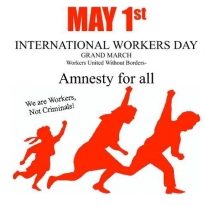
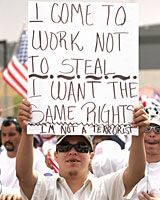
Today is May Day, or International Workers Day, a holiday created by Chicago workers—most of them anarchists—to honor the memory of the Haymarket martyrs and to celebrate the struggle of workers for freedom, a better life, and determination of the conditions of their own labor. It’s also the second annual day of strikes and marches for immigrant workers’ rights. May Day is and ought to be a day of resistance against the arrogance and power of the plutocrats. A day to celebrate workers’ struggles for dignity, and for freedom, through organizing in their own self-interest, through agitating and exhorting for solidarity, and through free acts of worker-led direct action to achieve their goals, marching under the banners of We are all leaders here and Dump the bosses off your back . A day to cheer immigrant workers struggling for their own freedom, in defiance of the attempts by La Migra and freelance nativist bullies to silence and intimidate them, marching under the banners We are not criminals, and We are not going anywhere. A day to remember:

There Is Power In A Union

There is power, there is power,
In a band of working folk,
When we stand
Hand in hand.

—Joe Hill (1913)

In honor of the day, it’s a pleasure to recommend some reading from anti-state radicals—from a history of May Day’s American roots at The Agitator (Lauritz, not Balko), to Kevin Carson’s Organized Capital vs. Organized Labor, to Sheldon Richman’s column Labor’s Right to a Free Market. And I’d especially like to recommend Kevin’s simply brilliant earlier column, The Ethics of Labor Struggle: A Free Market Perspective. Kevin’s and Sheldon’s columns do an especially good job of showing the gulf between the managerial style of establishmentarian business unionism—so familiar to us in these the waning days of Babylon, with Wagner and Taft-Hartley carefully arranged to bring the established unions into the web of State privilege and State regulation—with the older, state-free tradition of wildcat unionism that May Day celebrates. Here’s Kevin Carson:

First of all, when the strike was chosen as a weapon, it relied more on the threat of imposing costs on the employer than on the forcible exclusion of scabs. You wouldn’t think it so hard for the Misoids to understand that the replacement of a major portion of the workforce, especially when the supply of replacement workers is limited by moral sympathy with the strike, might entail considerable transaction costs and disruption of production. The idiosyncratic knowledge of the existing workforce, the time and cost of bringing replacement workers to an equivalent level of productivity, and the damage short-term disruption of production may do to customer relations, together constitute a rent that invests the threat of walking out with a considerable deterrent value. And the cost and disruption is greatly intensified when the strike is backed by sympathy strikes at other stages of production. Wagner and Taft-Hartley greatly reduced the effectiveness of strikes at individual plants by transforming them into declared wars fought by Queensbury rules, and likewise reduced their effectiveness by prohibiting the coordination of actions across multiple plants or industries. Taft-Hartley’s cooling off periods, in addition, gave employers time to prepare ahead of time for such disruptions and greatly reduced the informational rents embodied in the training of the existing workforce. Were not such restrictions in place, today’s “just-in-time” economy would likely be far more vulnerable to such disruption than that of the 1930s.

More importantly, though, unionism was historically less about strikes or excluding non-union workers from the workplace than about what workers did inside the workplace to strengthen their bargaining power against the boss.

The Wagner Act, along with the rest of the corporate liberal legal regime, had as its central goal the redirection of labor resistance away from the successful asymmetric warfare model, toward a formalized, bureaucratic system centered on labor contracts enforced by the state and the union hierarchies.

It’s time to take up Sweeney’s half-hearted suggestion, not just as a throwaway line, but as a challenge to the bosses. We’ll gladly forego legal protections against punitive firing of union organizers, and federal certification of unions, if you’ll forego the court injunctions and cooling-off periods and arbitration. We’ll leave you free to fire organizers at will, to bring back the yellow dog contract, if you leave us free to engage in sympathy and boycott strikes all the way up and down the production chain, boycott retailers, and strike against the hauling of scab cargo, etc., effectively turning every strike into a general strike. We give up Wagner (such as it is), and you give up Taft-Hartley and the Railway Labor Relations Act. And then we’ll mop the floor with your ass.

— Kevin Carson, The Ethics of Labor Struggle: A Free Market Perspective

That’s just a sampling. You really must read the whole thing.


Meanwhile, in the news, some creep in Washington is wandering around proclaiming Loyalty Day and demanding our renewed allegiance; and while the punch-drunk official unions are begging the government for more favors, the captains of industry are begging the government to keep a tight leash on free association. But the most significant events for labor and for human freedom are happening beyond the noise and spectacle of that gladiatorial arena, in the streets of cities all over the country where workers demand their rights in defiance of the so-called immigration law, and in unrecognized, grassroots unions organized along syndicalist lines, where workers have won concrete gains from the biggest corporations in their industry by operating through the use of creative secondary boycotts. There is a lesson here—a lesson for workers, for organizers, for agitators, and anti-statists. One we’d do well to remember when confronted by any of the bosses—whether corporate bosses or political, the labor fakirs and the authoritarian thugs styling themselves the vanguard of the working class, the regulators and the deporters and the patronizing friends of labor all:

Dump the Bosses Off Your Back

Are you cold, forelorn, and hungry?
Are there lots of things you lack?
Is your life made up of misery?
Then dump the bosses off your back!

—John Brill (1916)

Further reading:

May Day 2006: A Day of Resistance

Let us sink such differences as nationality, religion, politics, and set our eyes eternally and forever toward the rising star of the industrial republic of labor; remembering that we have left the old behind and have set our faces toward the future. There is no power on earth that can stop men and women who are determined to be free at all hazards. There is no power on earth so great as the power of intellect. It moves the world and it moves the earth.

— Lucy Parsons (1905): Speech to the Industrial Workers of the World

From last year’s commemorative post:

Today is May Day, or International Worker’s Day: a day to celebrate the long, hard struggle of workers for freedom, self-determination, and a better life. The day originated during the heady days of the Eight Hour Day campaign in the late 19th century, a campaign led not by bureaucratic union bosses, much less by Marxist thugs, but by ordinary workers agitating and organizing amongst themselves. Most of them were anarchists, and their struggle was as much against State power as it was against the bosses (part of the reason for May Day commemorations, mind you, is to remember the Haymarket martyrs, anarchists murdered by the state of Illinois).

— GT 2005-05-01: May Day, May Day

From Kevin Carson’s commemorative post from last year:

May Day, the international holiday of the socialist and workers’ movements, is popularly viewed in the U.S. as that commie holiday. It’s commonly associated with big parades and displays of military hardware on Red Square, and exchanges of fraternal greetings between leaders of the USSR and its satellites.

In fact, though, it’s a holiday that started in the U.S., and is as American as apple pie. In 1884, the Federation of Organized Trades and Labor Unions, predecessor of the AFL, called for a nationwide general strike in favor of the eight-hour day. It was to be introduced on May 1, 1886. The political strife resulting directly from that movement included the Haymarket bomb and the subsequent police and judicial riot. The celebration of May Day as a worker’s holiday dates back to that movement.

The foreign and communist associations of May Day, in the popular mind, are in large part the outcome of an elite propaganda campaign in the U.S. U.S. ruling circles attempted to identify the assorted workers’ and populist movements, in popular consciousness, with foreign radicalism, “unAmericanism,” and “Red Ruin.” This campaign finally paid off in the War Hysteria and subsequent Red Scare of the Wilson administration, which was used as an opportunity to suppress (via mass arrests, criminal syndicalism laws, etc.) organizations as diverse as the I.W.W., the Non-Partisan League, and the Farmer-Labor Party. Thanks to the war propaganda, the Palmer Raids and the quasi-private vigilantism of groups like the American Legion, socialism largely ceased to exist as a mass-based movement in the U.S. Around the same time, Congress designated May 1 as Loyalty Day.

— Kevin Carson, Mutualist Blog (2005-04-29): May Day Thoughts: Individualist Anarchism and the Labor Movement

Which is not to say that the Bolsheviks and the business unionists weren’t more than happy to play along, and lay claim to this day (and labor radicalism as a whole) as if it were their idea, or their rightful heritage. Hell, the pro-government trade union bosses and the nostalgic apparatchiks are still using it to mill about in public, longing for the good old days of tanks and commissars and ballistic missiles hauled down the street:

MOSCOW (AFP) — Tens of thousands of people marched through central Moscow on Monday to celebrate May Day in peaceful demonstrations organized by pro-government trade unions and Communists nostalgic for Soviet times.

About 25,000 trade union members called for a social state, holding balloons and flowers, according to police spokesman, Viktor Biryukov, quoted by ITAR-TASS news agency.

Several thousand Communist Party supporters also marched from the Lenin monument on October Square to a bust of Karl Marx near Red Square, carrying red flags and portraits of Stalin, an AFP reporter at the march said.

— USA Today (2006-05-01): Trade unions, Communists march through Moscow on May Day

We know, or if we don’t know we damned well should by now, what the Bolshevik cannibal-empire really meant for trade unions and for ordinary workers. To hell with that, and to hell with any holiday that celebrates it. But we also know, or if we damned well should by now, that this holiday isn’t theirs to ruin. As I said last year:

One of the (many) crimes of the state socialists in the 20th century was their wholesale theft of May Day; what had been and properly remains a day for celebrating the free actions of ordinary workers became, in the bloody talons of the so-called workers’ states, a day for celebrating socialist God-Kings and hideous parades of military power. The folks over at Catallarchy have gone so far as to name May Day a Day of Remembrance for the victims of state Communism. What they are doing is important. The Moloch of Marxist-Leninism consumed more victims than any other power that the world has known in history—through mass executions, through unbelievable mass starvation, through pestilence, through death camps, through war. History is important and memory is political; the stories are harrowing but they need to be told. But I do not think that May Day is the day for the solemn observations. I think that this gives the butchers too much credit. Marxist-Leninism stole May Day from anarchists, from workers, like it stole everything else it ever gained in the 20th century. It did its best to silence its victims, like it did to silence all its other victims, with a bullet to the head and piles of pirated loot to parties and unions that would toe the Bolshevik line. I will not give up May Day to them any more than I will give Juneteenth up to William Tecumseh Sherman or give Easter up to the Holy Inquisition. (If you’re looking for a day of remembrance, I’d suggest the 6th of March, the day that the Kronstadt massacre began.) But today is the International Workers’ Day, not the State’s day—meaning neither the bureaucratic-managerial state so beloved of the conservative AFL-line unions, nor the blood-soaked workers’ states (a contradiction in terms).

— GT 2005-05-01: May Day, May Day

May Day is and ought to be a Day of Resistance, of defiance against the arrogance and exploitation of the bosses — whether corporate or political. A day to celebrate workers’ struggles for dignity, and for freedom, through organizing in their own self-interest, through agitating and exhorting for solidarity, and through free acts of worker-led direct action to achieve their goals. So what a real joy it is to see May Day 2006 honored through general strikes across the country, demanding freedom and respect for immigrant workers:

It is being billed as The Great American Boycott 2006. Tomorrow, international labour day in the US, thousands or perhaps millions of people are expected to join in a nationwide boycott to protest against proposals that would toughen existing immigration laws.

Under the slogan No work, no school, no sales, no buying, the boycott will be accompanied by marches and protests across the country. Organisers hope that it will build on the unexpected scale of the anti-immigration reform protest held at the end of March, which saw around half a million people take to the streets of Los Angeles and helped push the immigration debate to the top of the political agenda.

Protesters have been galvanised by the passage of a bill in the House of Representatives in December that focused on tougher restrictions on illegal immigrants without offering any route to legality.

Today’s protests will include events in 72 American cities, 25 of them in California, as well as Mexico, where a boycott of US goods and services is planned. Subcomandante Marcos and his Zapatista rebel movement have promised to hold a rally outside the US embassy in Mexico City.

The biggest US demonstrations are expected to take place in New York, Chicago — where estimates suggest that around 300,000 people will turn out — and Los Angeles, where two demonstrations are planned, each of which could attract 500,000 people, according to police estimates.

— The Guardian (2006-05-01): US protesters stage one-day boycott over immigrant bill

From FOX40 KTXL in Sacramento:

We’re here to make a statement, said Catalina Hernandez, an environmental specialist who brought her niece and nephew to one of the Los Angeles marches. All these people didn’t just appear here overnight. We’ve been here all this time.

Many of the demonstrators were like Juana Teresa Kouyoumdjian, 35, who by 5 p.m. had spent eight hours marching through Los Angeles with her brother, Enrique Orellana, 36, and still faced a long trek back downtown to their car.

Quitting wasn’t an option because I want to fight to the very end, said Kouyoumdjian, who is now legal after illegally coming to the United States from El Salvador 16 years ago.

The boycott’s economic power was evident at the Los Angeles and Long Beach harbors, where despite being the nation’s largest port complex few trucks were rolling. In all, traffic was off 90 percent, said Theresa Adams Lopez, spokeswoman for the Port of Los Angeles.

… In California’s agricultural heartland, immigrant farmworkers took the day off to march and rally in towns throughout the San Joaquin Valley.

Several hundred farmworkers marched in downtown Porterville, 70 miles southeast of Fresno, waving American flags. Outside town, groves still holding some of the winter’s orange crop were empty of workers.

We’ve got to help all the people living here without papers, said Samuel Jimenez, 54, a Mexican farmworker who lives Porterville.

— FOX 40 KTXL-TV Sacramento (2006-05-01): Immigration Rallies Draw Thousands

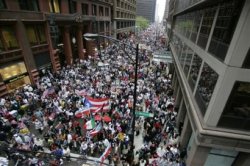
Chicago, May Day 2006

From the Associated Press, via Forbes online:

More than 1 million mostly Hispanic immigrants and their supporters skipped work and took to the streets Monday, flexing their economic muscle in a nationwide boycott that succeeded in slowing or shutting many farms, factories, markets and restaurants.

From Los Angeles to Chicago, Houston to Miami, the Day Without Immigrants attracted widespread participation despite divisions among activists over whether a boycott would send the right message to Washington lawmakers considering sweeping immigration reform.

We are the backbone of what America is, legal or illegal, it doesn’t matter, said Melanie Lugo, who with her husband and their third-grade daughter joined a rally of some 75,000 in Denver. We butter each other’s bread. They need us as much as we need them.

Two major rallies in Los Angeles attracted an estimated 400,000, according to the mayor’s office. Police in Chicago estimated 400,000 people marched through the downtown business district.

Tens of thousands more marched in New York, along with about 15,000 in Houston, 50,000 in San Jose and 30,000 more across Florida. Smaller rallies in cities from Pennsylvania and Connecticut to Arizona and South Dakota attracted hundreds not thousands.

In all, police departments in more than two dozen U.S. cities contacted by The Associated Press gave crowd estimates that totaled about 1.1 million marchers.

The mood was jubilant. Marchers standing shoulder-to-shoulder filmed themselves on home video and families sang and chanted and danced in the streets wearing American flags as capes and bandanas. In most cities, those who rallied wore white to signify peace and solidarity.

In Los Angeles, the city streets were a carpet of undulating white that stretched for several miles, with palm trees and grass-covered medians poking through a sea of humanity. Marchers holding U.S. flags aloft sang the national anthem in English as traditional Mexican dancers wove through the crowd.

In Chicago, illegal immigrants from Ireland and Poland marched alongside Hispanics as office workers on lunch breaks clapped. In Phoenix, protesters formed a human chain in front of Wal-Mart and Home Depot stores. Protesters in Tijuana, Mexico, blocked vehicle traffic heading to San Diego at the world’s busiest border crossing.

Many carried signs in Spanish that translated to We are America and Today we march, tomorrow we vote. Others waved Mexican flags or wore hats and scarves from their native countries. Some chanted USA while others shouted slogans, such as Si se puede! Spanish for Yes, it can be done! Others were more irreverent, wearing T-shirts that read I’m illegal. So what?

— Gillian Flaccus, Forbes.com (2006-05-01): Update 26: 1M Immigrants Skip Work for Demonstration

Immigration creeps have mostly been muted today, but this is driving them up the wall, because they knowexactly what it means:

Make no mistake. This day is about confrontation, intimidation, and extortion. No American, no person who hopes to be an American, should embrace an action that has criminals demanding that their law breaking be overlooked and even celebrated.

—Kleinheider, Volunteer Voter weblog, quoted by david, the view from below (2006-05-01): Immigrant Action Reaction

Of course, there’s no actual extortion involved in refusing to work for a day; workers are not your servants, not even immigrant workers, and declining to freely give their work for a day is not forcing you to give up anything that was yours to begin with. But you’re damned right that this is about confrontation, and you’re damned right that it’s about defying the law.

You express a great deal of anxiety over our willingness to break laws. This is certainly a legitimate concern. … One may well ask: How can you advocate breaking some laws and obeying others? The answer is found in the fact that there are two types of laws: There are just and there are unjust laws. I would be the first to advocate obeying just laws. One has not only a legal but a moral responsibility to obey just laws. Conversely, one has a moral responsibility to disobey unjust laws. I would agree with Saint Augustine that An unjust law is no law at all.

— Martin Luther King Jr. (1963-04-16): Letter from Birmingham Jail

And it is an unjust law: neither you nor the government has any right to commandeer the lives and livelihoods of innocent workers to satisfy your Law-and-Order hang-ups, or your theo-national power trip.

But this is ultimately beside the point anyway. Even if failing to learn English was a dreadful threat to the prospects of liberty; even if not celebrating Veterans’ Day or Flag Day or Arbor Day were an ominous step towards totalitarianism, it would provide absolutely no justification whatever for using force to stop people from traveling to property where they are welcomed by the owner (either out of hospitality, or because they pay rent, or because they are prepared to buy it for themselves). Certain kinds of bad thoughts may very well be corrosive to liberty, but there’s no libertarian justification in restraining, beating, shooting, detaining, jailing, or exiling somebody just for having bad thoughts. Neither you nor the government has any right to force people off of property onto which they have been invited, even if you think that their presence is a looming danger to the future of liberty in America, unless they have actually done or threatened real violence to somebody else. Vices are not crimes, and only crimes can justly be resisted by force.

— GT 2006-03-31: Libertarians Against Property Rights: You Will Be Assimilated Edition

What we are witnessing today, and have been witnessing for the past few weeks, is nothing less than an explosively growing freedom movement. A freedom movement bringing millions into the streets, bringing together labor militancy and internationalism. And it is being done in defiance of the violence of La Migra, the bullying bigotry of the nativist creeps, and the condescending hand-wringing of the sympathetic politicos. It is exactly what May Day was made for. And exactly what the kind of creeps behind the Loyalty Days of the world — whether state-communist or state-capitalist — fear the most: ordinary people standing together, celebrating together, free, happy, irreverant, and unafraid.

There will be a time when our silence will be more powerful than the voices you strangle today!

—Last words of August Spies (1887-11-11), immigrant, anarchist, and Haymarket martyr
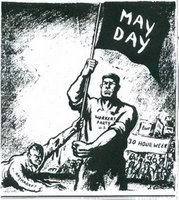
Happy May Day.

Past commemorations

Further reading: immigration and events today

Further reading: the meaning of May Day

Further reading: from Geekery Today

May Day, May Day

Today is May Day, or International Worker’s Day: a day to celebrate the long, hard struggle of workers for freedom, self-determination, and a better life. The day originated during the heady days of the Eight Hour Day campaign in the late 19th century, a campaign led not by bureaucratic union bosses, much less by Marxist thugs, but by ordinary workers agitating and organizing amongst themselves. Most of them were anarchists, and their struggle was as much against State power as it was against the bosses (part of the reason for May Day commemorations, mind you, is to remember the Haymarket martyrs, anarchists murdered by the state of Illinois).

One of the (many) crimes of the state socialists in the 20th century was their wholesale theft of May Day; what had been and properly remains a day for celebrating the free actions of ordinary workers became, in the bloody talons of the so-called workers’ states, a day for celebrating socialist God-Kings and hideous parades of military power. The folks over at Catallarchy have gone so far as to name May Day a Day of Remembrance for the victims of state Communism. What they are doing is important. The Moloch of Marxist-Leninism consumed more victims than any other power that the world has known in history—through mass executions, through unbelievable mass starvation, through pestilence, through death camps, through war. History is important and memory is political; the stories are harrowing but they need to be told. But I do not think that May Day is the day for the solemn observations. I think that this gives the butchers too much credit. Marxist-Leninism stole May Day from anarchists, from workers, like it stole everything else it ever gained in the 20th century. It did its best to silence its victims, like it did to silence all its other victims, with a bullet to the head and piles of pirated loot to parties and unions that would toe the Bolshevik line. I will not give up May Day to them any more than I will give Juneteenth up to William Tecumseh Sherman or give Easter up to the Holy Inquisition. (If you’re looking for a day of remembrance, I’d suggest the 6th of March, the day that the Kronstadt massacre began.) But today is the International Workers’ Day, not the State’s day—meaning neither the bureaucratic-managerial state so beloved of the conservative AFL-line unions, nor the blood-soaked workers’ states (a contradiction in terms). As I said last year:

May Day is a celebration of the original conception of the labor movement, as expressed by anarchist organizers such as Albert Parsons, Lucy Parsons, Benjamin Tucker, and others: a movement for workers to come into their own, by banding together, supporting one another, and taking direct action in the form of boycotts, work stoppages, general strikes, and the creation of workers’ spaces such as local co-operatives and union hiring halls. The spirit was best expressed by John Brill’s famous exhortation to Dump the bosses off your back—by which he did not mean to go to a government mediator and get them to make the boss sit down with you and work out a slightly more beneficial arrangement. Dump the bosses off your back! meant: organize and create local institutions that let you bypass the bosses. Negotiate with them if it’ll do some good; ignore them if it won’t. The signal achievements of the labor movement in the late 19th and early 20th century were achievements in this spirit: the campaigns that won the 8 hour day and the weekend off in many workplaces, for example, emerged from a unilateral work stoppage by rank-and-file workers, declared by the Federation of Organized Trades and Labor Unions, and organized especially by the explicitly anarchist International Working People’s Association, after legislative efforts by the National Labor Union and the Knights of Labor failed. The stagnant, or even backsliding, state of organized labor over the past half century is the direct result of government colonization and the ascendency of government-subsidized unions.

— GT 2004-05-01: Free the Unions (and all political prisoners)!

I don’t really have much to add to what I said before; you can get most of what I would have said by reading what I did say last year. All that I have to add is that the labor news this year has proved it again: when workers free themselves of the State, workers win.

[The Coalition of Immokalee Workers’ victory in the Taco Bell boycott campaign is] also — although you won’t hear this as much — a major victory for government-free, syndicalist labor organizing. The CIW is not a bureaucratic government-recognized union; as a form of organizing it’s far closer to an autonomous workers’ syndicate or a local soviet (in the old sense of a democratic, community-based workers’ council, not in the sense of the hollow state apparatus that the Bolsheviks left after the party committees seized power at bayonet-point). Of course, not having the smothering comfort of the US labor bureaucracy to prop them up has often made things harder on the CIW; but it’s also made them freer, and left them free of the restraints on serious and innovative labor activism that have held the government-authorized union movement back for the past 60 years. (Example: the strategic decision to target Taco Bell in the first place—that is, the whole damned campaign that allowed the Immokalee workers to win such a huge improvement in their standard of living—was a secondary boycott, and so would have been illegal under the terms of the Taft-Hartley Act and the Landrum-Griffin Act. But since the CIW doesn’t need a permission slip from the NLRB to engage in direct action, they won the day—not in spite of, but because of their freedom from government restraints on labor organizing.

— GT 2005/03/23: El pueblo unido jamás será vencido!

(You can read more at GT 2005/03/23: El pueblo unido jamás será vencido! and GT 2005/03/30: Anarquistas por La Causa.)

Dump the bosses off your back. Free the Unions—and all political prisoners!

Free The Unions (and all political prisoners)

Today is May Day, or International Worker’s Day: an international day for celebrating the achievements of workers and the struggle for organized labor.

You might have thought that the proper day was Labor Day, as traditionally celebrated on the first Monday in September. Not so; the federal holiday known as Labor Day is actually a Gilded Age bait-and-switch from 1894. It was crafted and promoted in an effort to throw a bone to labor while erasing the radicalism implicit in May Day (a holiday declared by workers, in honor of the campaign for the eight hour day and in memory of the Haymarket martyrs). As a low-calorie substitute for workers’ struggle to come into their own, we get a celebration of labor … so long as it rigidly adheres to the AFL-line orthodoxy of collective bargaining, appeasement, and power to the union bosses and government bureaucrats. That this holiday emerged and solidified at exactly the same historical moment as the unholy alliance of conservative (statist, nativist, racist, and misogynist) unionism with corporate barons and the Progressive regulation movement is no coincidence. That AFL-line unions continue to use Labor Day as a chance to co-opt the historic successes of radical, libertarian unions in campaigns such as the fight for the eight-hour day or the five-day week is no coincidence, either.

Too many of my comrades on the Left fall into the trap of taking the Labor Day version of history for granted: modern unions are trumpeted as the main channel for the voice of workers; the institutionalization of the system through the Wagner Act and the National Labor Relations Board in 1935, and the ensuing spike in union membership during the New Deal period, are regarded as one of the great triumphs for workers of the past century.

You may not be surprised to find out that I don’t find this picture of history entirely persuasive. The Wagner Act was the capstone of years of government promotion of conservative, AFL-line unions in order to subvert the organizing efforts of decentralized, uncompromising, radical unions such as the IWW and to avoid the previous year’s tumultuous general strikes in San Francisco, Toledo, and Minneapolis. The labor movement as we know it today was created by government bureaucrats who effectively created a massive subsidy program for conservative unions which followed the AFL and CIO models of organizing—which emphatically did not include general strikes or demands for worker ownership of firms. Once the NRLB-recognized unions had swept over the workforce and co-opted most of the movement for organized labor, the second blow of the one-two punch fell: government benefits always mean government strings attached, and in this case it was the Taft-Hartley Act of 1947, which pulled the activities of the recognized unions firmly into the regulatory grip of the federal government. Both the internal culture of post-Wagner mainstream unions, and the external controls of the federal labor regulatory apparatus, have dramatically hamstrung the labor movement for the past half-century. Union methods are legally restricted to collective bargaining and limited strikes (which cannot legally be expanded to secondary strikes, and which can be, and have been, broken by arbitrary fiat of the President). Union hiring halls are banned. Union resources have been systematically sapped by banning closed shop contracts, and encouraging states to ban union shop contracts—thus forcing unions to represent free-riding employees who do not join them and do not contribute dues. Union demands are effectively constrained to modest (and easily revoked) improvements in wages and conditions. And, since modern unions can do so little to achieve their professed goals, and since their professed goals have been substantially lowered anyway, unionization of the workforce continues its decades-long slide.

May Day is a celebration of the original conception of the labor movement, as expressed by anarchist organizers such as Albert Parsons, Lucy Parsons, Benjamin Tucker, and others: a movement for workers to come into their own, by banding together, supporting one another, and taking direct action in the form of boycotts, work stoppages, general strikes, and the creation of workers’ spaces such as local co-operatives and union hiring halls. The spirit was best expressed by John Brill’s famous exhortation to Dump the bosses off your back—by which he did not mean to go to a government mediator and get them to make the boss sit down with you and work out a slightly more beneficial arrangement. Dump the bosses off your back! meant: organize and create local institutions that let you bypass the bosses. Negotiate with them if it’ll do some good; ignore them if it won’t. The signal achievements of the labor movement in the late 19th and early 20th century were achievements in this spirit: the campaigns that won the 8 hour day and the weekend off in many workplaces, for example, emerged from a unilateral work stoppage by rank-and-file workers, declared by the Federation of Organized Trades and Labor Unions, and organized especially by the explicitly anarchist International Working People’s Association, after legislative efforts by the National Labor Union and the Knights of Labor failed. The stagnant, or even backsliding, state of organized labor over the past half century is the direct result of government colonization and the ascendency of government-subsidized unions.

Don’t get me wrong: the modern labor movement, for all its flaws and limitations, is the reflection (no matter how distorted) of an honorable effort; it deserves our support and does some good. Union bosses, corporate bosses, and government bureaucrats may work to co-opt organized labor to their own ends, but rank-and-file workers have perfectly good reasons to support AFL-style union organizing: modern unions may not be accountable enough to rank-and-file workers, but they are more accountable than corporate bureaucracy; modern unions bosses don’t care enough about giving workers direct control in their own workplace, but they care more than corporate bosses, who make most of their living by denying workers such control. The labor movement, like all too many other honorable movements for social justice in the 20th century, has become a prisoner of politics: a political situation has been created in which the most rational thing for most workers to do is to muddle through with a co-opted and carefully regulated labor movement that helps them in some ways but undermines their long-term prospects. It doesn’t make sense to respond to a situation like that with blanket denunciations of organized labor; the best thing to do is to support our fellow workers within the labor movement as it is constrained today, but also to work to change the political situation that constrains it, and to set it free. That means loosening the ties that bind the union bosses to the corporate and government bureaucrats, by working to repeal the Taft-Hartley Act, and abolish the apparatus of the NLRB, and working to build free, vibrant, militant unions once again.

Dump the bosses off your back. Free the unions, and all political prisoners!

Update (2007-04-19): For a long time this post incorrectly attributed the song Dump the Bosses Off Your Back to Joe Hill, the legendary songwriter and organizer for the Industrial Workers of the World. Although it is very similar in style to Hill’s songs — it sets a radical message in simple language to the melody to a popular hymn — the song was actually written by John Brill, another Wobbly songwriter. The song first appeared in the Joe Hill Memorial (9th) edition of the IWW songbook, released in March 1916, four months after Joe Hill was hanged by the state of Utah. This error has been corrected in the post. —CJ