Geekery Today: posts tagged Poland

Neighborhood Safety Ghettoes in D.C. (posted 5 June 2008)

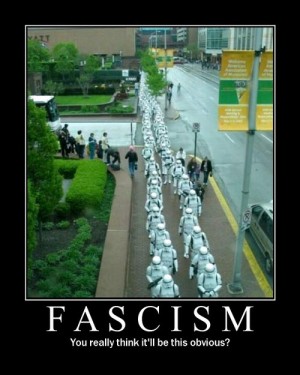
So, there’s this poster that’s been circulating around anarchist, civil libertarian, and lefty blogs for a few months now. It’s become popular because it’s funny (in a nerdy way), and also because it makes an important point:

It has a photo of a column of people dressed as Imperial Storm Troopers from Star Wars is marching down a city street. Caption: Fascism: You really think it'll be this obvious?

But, well, the awful truth is that, as with so many other things in American politics, the answer to that rhetorical question can’t really be taken for granted, because it really depends on what kind of neighborhood you live in. The poster makes an important point addressed to, and about the daily lives of, people of a particular socioeconomic class (specifically, the people who most often spend their time reading blogs). For many if not most people in other social classes, the answer really is just, You bet it will. Or, It already is. Has been for decades. Where you been?

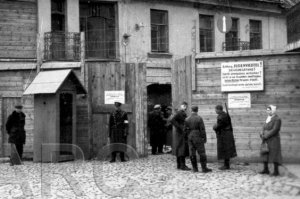
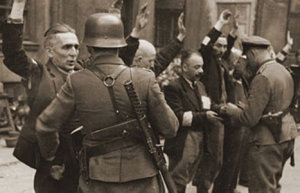
For example, consider the cops plans for improving neighborhood safety in the D.C. Ghetto. No, I’m not using that last word as a careless synonym for slum. I am using it in the most literal sense.


D.C. police will seal off entire neighborhoods, set up checkpoints and kick out strangers under a new program that D.C. officials hope will help them rescue the city from its out-of-control violence.

Under an executive order expected to be announced today, police Chief Cathy L. Lanier will have the authority to designate Neighborhood Safety Zones. At least six officers will man cordons around those zones and demand identification from people coming in and out of them. Anyone who doesn’t live there, work there or have legitimate reason to be there will be sent away or face arrest, documents obtained by The Examiner show.

Michael Neibauer and Bill Myers, The Examiner (2008-06-04): Lanier plans to seal off rough ’hoods in latest effort to stop wave of violence

Guess who decides what counts as a legitimate reason for being in the neighborhood — the people who live and work in that neighborhood, or the government’s goon squad?

Lanier has been struggling to reverse D.C.’s spiraling crime rate but has been forced by public outcry to scale back several initiatives including her All Hands on Deck weekends and plans for warrantless, door-to-door searches for drugs and guns.

Under today’s proposal, the no-go zones will last up to 10 days, according to internal police documents. Front-line officers are already being signed up for training on running the blue curtains.

Peter Nickles, the city’s interim attorney general, said the quarantine would have a narrow focus.

This is a very targeted program that has been used in other cities, Nickles told The Examiner. I’m not worried about the constitutionality of it.

Michael Neibauer and Bill Myers, The Examiner (2008-06-04): Lanier plans to seal off rough ’hoods in latest effort to stop wave of violence

Just so we’re clear, neither am I. I couldn’t possibly care less whether surrounding poor neighborhoods with cops, giving everyone the Ihre Papiere, bitte treatment, and chopping a community up into police-occupied strategic hamlets for the purpose of a government quarantine without any probable cause whatsoever for believing that any of the individual people you will be surrounding, stopping, hassling, and threatening with jail have ever committed any crime against any identifiable victim, is or is not countenanced by the United States Constitution. Who cares? The basic problem with terrorizing and brutalizing entire neighborhoods is that it is evil and incredibly dangerous, whether or not the Constitution allows for it.

Others are. Kristopher Baumann, chairman of the D.C. police union and a former lawyer, called the checkpoint proposal breathtaking.

Shelley Broderick, president of the D.C.-area American Civil Liberties Union and the dean of the University of the District of Columbia’s law school, said the plan was cockamamie.

I think they tried this in Russia and it failed, she said. It’s just our experience in this city that we always end up targeting poor people and people of color, and we treat the kids coming home from choir practice the same as we treat those kids who are selling drugs.

The proposal has the provisional support of D.C. Councilman Harry Tommy Thomas, D-Ward 5, whose ward has become a war zone.

They’re really going to crack down on what we believe to be a systemic problem with open-air drug markets, Thomas told The Examiner.

Thomas said, though, that he worried about D.C. moving towards a police state.

Michael Neibauer and Bill Myers, The Examiner (2008-06-04): Lanier plans to seal off rough ’hoods in latest effort to stop wave of violence

But what the hell did D.C. Councilman Harry Tommy Thomas expect, anyway? You can’t go around pushing your paramilitary crack downs with rhetoric about war zones and then act all surprised when you get a police state. If you plan for an occupation, you can expect that you are going to get lock-downs and de facto martial law.

Radley Balko writes:

Last week, I received the following email:

I live in Eckington, a transitional neighborhood in northeast DC. I got a knock on the door this morning from a guy with ACORN (looks like a lefty community group that I’d never heard of) saying that DC police would be coming around shortly asking to search homes in the neighborhood for guns, and explaining we had the constitutional right to refuse, etc. He added that anything the police find they can use against you because you never know what a friend of a friend might have left in your house Not sure if he told me this because I had just gotten out of bed and had answered the door in my bathrobe looking disoriented, but I digress. He was handing out a packet of info from the ACLU including a nifty doorhanger you can put out that says NO CONSENT TO SEARCH OUR HOME. One of my neighbors told me the guy told them they were only doing this in poor black neighborhoods, and this notice from the ACLU that I found online seems to bear this out.

I know it’s not exactly a wrong-door no-knock raid, but I am concerned because while I certainly don’t want the police (or any other strangers) rummaging through my junk, I’m kind of afraid of what would happen if I refuse the search. I already live on one of those streets with the surveillance cams installed. Does my address get marked for being uncooperative or suspicious? I should mention of course that I don’t own any guns and have never touched anything more powerful than a bb gun.

You are free to refuse the searches. But if a regular reader of this site feels uncomfortable asserting that right, you can imagine how other people subject to these searches might feel.

Radley Balko, The Agitator (2008-06-04): Police State D.C.

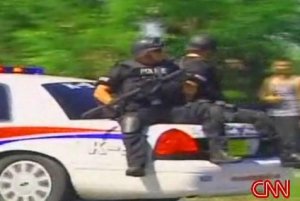
Please also keep in mind that this is the same metro police force which will toting around AR-15 assault rifles as they surround and cordon off and do door-to-door searches and raids in these inner-city neighborhoods.

Do you feel safer now?

See also:

Tribal feud body counts: help me out here (posted 23 April 2008)

Dear LazyWeb,

Jared Diamond makes the following claim in [his recent article on tribal blood feuds in New Guinea:

Without state government, war between local groups is chronic; coöperation between local groups on projects bringing benefits to everyone—such as large-scale irrigation systems, free rights of travel, and long-distance trade—becomes much more difficult; and even the frequency of murder within a local group is higher. It’s true, of course, that twentieth-century state societies, having developed potent technologies of mass killing, have broken all historical records for violent deaths. But this is because they enjoy the advantage of having by far the largest populations of potential victims in human history; the actual percentage of the population that died violently was on the average higher in traditional pre-state societies than it was even in Poland during the Second World War or Cambodia under Pol Pot.

Jared Diamond, The New Yorker (2008-04-21): Vengeance is Ours

I don’t think that anything interesting about anarchism turns on where this factoid comes from or whether it’s true. (It’s not as if I’m suggesting personal vendetta or communal blood feud as the anarchistic replacement for state court systems. Anarchy as I understand it is an achievement for the future, not a recovery of the past.) But it is a very strong claim, which Diamond asserts without providing a citation to the source for these figures or an explanation of how they were calculated. Presumably he has a particular source, but I’m curious as to what it is.

Anyone know a likely anthropological source for this factoid, or for factoids in the general neighborhood? Help me out here.

Taser first, ask questions at the autopsy. (posted 17 November 2007)

Here is what I said a few days ago about the widespread use of tasers by American cops, in response to a recent case in Alabama:

Tasers were originally introduced for police use as an alternative to using lethal force; the hope was that, in many situations where cops might otherwise feel forced to go for their guns, they might be able to use the taser instead, to immobilize a person who posed a threat to them or to others, without killing anybody in the process.

In practice, of course, cops and police culture being what they are, any notion of limiting tasers to those situations very quickly went out the window. Cops armed with tasers now freely use them to end arguments by intimidation or actual violence, to coerce people who pose no real threat to anyone into complying with their bellowed orders, and to hurt uppity civilians who dare to give them lip. They often do so even when the supposed offense that they’re responding to is completely trivial; they often start tasering, or keep on tasering, after their victims have already been rendered helpless by the circumstances or by an earlier use of force. Since any complaints of excessive force are always handled by their fellow cops, the investigations almost always end up concluding that Official Procedures were followed, as if that made everything O.K., and throwing the complaint into the rubbish bin without doing anything at all. So shock-happy Peace Officers can now go around using their tasers as 50,000-volt human prods in just about any situation, with more or less complete impunity.

GT 2007-11-11: Taser first, ask questions later

Meanwhile, in Canada, a gang of four cops in the RCMP has killed a man by electrocution. The victim was Polish immigrant named Robert Dziekanski, who had been detained in a secure area in the Vancouver International Airport. He became agitated and could not communicate with the employees, since he did not speak English. When the cops showed up to try to talk to him, he was is standing with his back to a counter and with his arms lowered by his sides. That didn’t stop them from whipping out their tasers and shooting him within 25 seconds of arriving on the scene. They shot him at least three, and possibly four times, including at least once while he was convulsing on the ground while offiicers were kneeling on him and handcuffing him:

An eyewitness’s video recording of a man dying after being stunned with a Taser by police on Oct. 14 at Vancouver International Airport has been released to the public.

The 10-minute video recording clearly shows four RCMP officers talking to Robert Dziekanski while he is standing with his back to a counter and with his arms lowered by his sides, but his hands are not visible.

About 25 seconds after police enter the secure area where he is, there is a loud crack that sounds like a Taser shot, followed by Dziekanski screaming and convulsing as he stumbles and falls to the floor.

Another loud crack can be heard as an officer appears to fire one more Taser shot into Dziekanski.

As the officers kneel on top of Dziekanski and handcuff him, he continues to scream and convulse on the floor.

One officer is heard to say, Hit him again. Hit him again, and there is another loud cracking sound.

Police have said only two Taser shots were fired, but a witness said she heard up to four Taser shots.

Robert Dziekanski falls to the floor as an RCMP officer looks on.Robert Dziekanski falls to the floor as an RCMP officer looks on.

A minute and half after the first Taser shot was fired Dziekanski stops moaning and convulsing and becomes still and silent.

Shortly after, the officers appear to be checking his condition and one officer is heard to say, code red.

[R]etired superintendent Ron Foyle, a 33-year veteran of the Vancouver police who saw the video tape, said he didn’t know why it ever became a police incident.

It didn’t seem that he made any threatening gestures towards them, Foyle said.

The video was recorded in three segments. The first segment shows Dziekanski before police arrive.

He is clearly agitated, yelling in Polish, and appears to be sweating. He can be seen taking office chairs and putting them in front of the security doors. He then picks up a small table, which he holds, while a woman in the arrivals lounge calmly speaks to him in apparent effort to calm him down.

… In the second segment, Dziekanski picks up a computer and throws it to the ground. Three airport personnel arrive and block the exit from the secure area, but Dziekanski retreats inside and does not threaten them.

Then four RCMP officers arrive in the lounge. Someone can be heard mentioning the word Tasers.

Someone replies, Yes, as the officers approach the security doors.

… People in the lounge can be heard clearly telling the police Dziekanski speaks no English, only Russian. His mother later said he only spoke Polish.

Police enter the secure area with no problems and can be seen with Dziekanski standing calmly talking with officers. They appear to direct him to stand against a wall, which he does.

As he is standing there, one of the officers shoots him with a Taser.

CBC News (2007-11-15): Taser video shows RCMP shocked immigrant within 25 seconds of their arrival

Meanwhile, the cops responded by confiscating the eyewitness’s digital camera, refusing to return it as they’d promised, and then issuing blatant lies about the number of officers on the scene, the number of times they tasered their victim, and whether or not there were bystanders nearby at the time of the attack. The video, which directly contradicts police statements, has only been released to the public since the eyewitness, Paul Pritchard, retained a lawyer and threatened to sue.

Since they have been forced to release the video of the killing, the Mounties have promised that The Matter Will Be Investigated, of course. But the official excuses are already being manufactured as we speak.

RCMP spokesman Cpl. Dale Carr said no one can judge what happened to Dziekanski by just watching the video.

It’s just one piece of evidence, one person’s view. There are many people that we have spoken to, RCMP spokesman Cpl. Dale Carr said at a press conference Wednesday afternoon.

What I urge is that those watching the video, take note of that. Put what they’ve seen aside for the time being. And wait to hear the totality of the evidence at the time of the inquest, Carr said.

CBC News (2007-11-15): Taser video shows RCMP shocked immigrant within 25 seconds of their arrival

What ought to happen after the inquest is that these four Mounties end up in the dock on a charge of murder, in light of their reckless use of violence and their depraved indifference to human life. What will probably happen, instead, is a collective shrug of the shoulders from the Federalis and some sanctimonious official lectures on how important it is to cooperate with airport security.

(Story thanks to Elinor, in comments.)

Over My Shoulder #30: Shana Penn on the women who built the Polish dissident press, from Solidarity’s Secret: The Women Who Defeated Communism in Poland (2005) (posted 18 November 2006)

Here’s the rules:

  1. Pick a quote of one or more paragraphs from something you’ve read, in print, over the course of the past week. (It should be something you’ve actually read, and not something that you’ve read a page of just in order to be able to post your favorite quote.)

  2. Avoid commentary above and beyond a couple sentences, more as context-setting or a sort of caption for the text than as a discussion.

  3. Quoting a passage doesn’t entail endorsement of what’s said in it. You may agree or you may not. Whether you do isn’t really the point of the exercise anyway.

Here’s the quote. This is from the introductory chapter of Shana Penn’s 2005 study, Solidarity’s Secret: The Women Who Defeated Communism in Poland (ISBN 0-472-11385-2). Penn is discussing what she found when she went to Poland to research Solidarity, the worker’s opposition movement that played a decisive role in the collapse of martial law and the Communist regime itself in Poland during the 1980s.

The prisons and internment camps made up another major locus of dissent. After the imposition of martial law, defiantly irrepressible intellectuals such as Adam Michnik and Jacek Kuroń communicated from their jail cells, appealing to the nation to stop living lies and, instead, to live as if we are free. The imprisoned writers penned dazzling essays that were smuggled to the illegal press for publication.

It was the opposition press, which flourished illegally for most of the 1970s and 1980s, that was the third of the major, nonfactory sites of resistance. That enterprising, albeit clandestine, industry, brought people together on the same page, so to speak, to get real news, not state propaganda, and to debate what an open society might look like. The illicit newspapers, magazines, bulletins, and books it published were called bibuła, the Polish term for illegal papers produced during periods of censorship. Analogous to the Russian word samizdat, to self-publish, bibuła had the advantage of being a Polish word.

It was the illegal press that provided 1970s oppositionists with a practical vehicle to activate and coalesce support from the three, very different social groups that were fundamental to making change: the Intelligencja (a nineteenth-century way of saying public intellectuals and a term that continued to be used through 1989); the Workers, with a capital W (a purely communist term that the opposition brilliantly appropriated to argue for free trade unions); and the Polish Catholic clergy, the spiritual leaders most tolerated in the antireligious Soviet Bloc. (The political restraints on their power made the clergy unusually tolerant. They turned their backs on abortion and divorce, and they assisted women activists, even those who were single mothers, such as several of the protagonists of this story.)

Significantly, the illegal press was the chief playing field on which women were able to carve out distinctive, influential roles for themselves in the opposition. They distinguished themselves as editors, publishers, journalists, and communications strategists long before the world beyond Poland’s police-patrolled borders had begun talking about the Information Age. Much of my research leading to this book was to take place in the realm of the opposition press, but I had no inkling of that when I began my journey.

Arriving in Warsaw in the summer of 1990, I was aware that women made up approximately 50 percent of Solidarity’s ten-million strong membership—proportional to women’s presence in the labor force. However, their political representation in the formal solidarity structures was significantly smaller. As one rose in the Solidarity hierarchy, the numers of women diminished. Only 7.8 percent (69) of the 881 delegates to the Solidarity Congress [in September 1981] were women; only one woman sat on the National Executive [Committee], reported U.S. historian Barbara Jancar.

As I began collecting Polish women’s stories, I kept the following questions in mind: If Solidarity’s political leadership was male dominated, in what ways, then, had women participatd? Were there particular issues or activities to which they gravitated? Did they demonstrate special organizing styles? Were there unsung heroines among them or any forgotten events?

The first clues surfaced when several women I interviewed in the summer and winter of 1990 made statements such as the following:

A group of women in Warsaw managed the Solidarity Press Agency after Solidarity was created; then they organized Tygodnik Mazowsze [Regional Weekly] during martial law; and after 1989, they created the first free press, Gazeta Wyborcza [Election Gazette].

When martial law was declared, woemn started the underground in Warsaw.

Men thought they were in charge, but women pulled all the strings.

Listening to first one woman’s memories and then another’s, I heard a subject (a group of women), a place (the Warsaw underground), an occupation (the media), and a date (after the Decemer 13 declaration of martial law) repeatedly linked. Alerted to the possibility that something of consequence might connect the individual stories being told, I formulated a new core interview question: Where were you when martial law was declared, and what did you do? The following picture emerged:

After Solidarity spent sixteen months flexing its newly legal political muscles, the government declared martial law and immediately arrested some ten thousand activists—around nine thousand men and one thousand women. With most of the male leadership either imprisoned or driven into hiding, a core group of women rose up to reconnect Solidarity’s nationwide network of contacts, to protect the leaders in hiding from the secret police, to arrange meetings, and to smuggle money and equipment into the country. By January 1982 a uniquely all-female team based in Warsaw had pulled together unions and volunteers, moved typewriters and printing presses into attics and back rooms, and begun producing Tygodnik Mazowsze, which became the voice of the Solidarity underground.

Working as a team, the women possessed the management skills, confidence, and media savvy to organize a large-scale, illegal publishing operation that served the entire nation, mobilized hundreds of thousands of individuals in support of Solidarity, and enlisted the help of thousands of supporting players—from reporters and printers to distributors and smugglers. The paper thus bolstered the growth of civil society under the repressive conditions of martial law, when it was humanly and technically almost impossible to coordinate nationwide activity.

Like nearly everyone else, the secret police were unaware that the leading newspaper of the 1980s underground was a female-run enterprise and that the thousands of people who helped produce and distribute it took their instructions from an all-woman editorial team. Blinded by sexism, the secret police hunted diligently for the men they assumed to be behind the newspaper—Solidarity men in hiding whose names had appeared in bylines. Keen to arrest and silence the paper’s key personnel, the police completely overlooked its editors and publishers—Helena Luczywo, Joanna Szczęsna, Anna Dodziuk, Anna Bikont, Zofia Bydlińska, and Malgorzata Pawlicka. They also overlooked Ewa Kulik, who coordinated the operations of the Warsaw underground in collaboration with Tygodnik Mazowsze. These seven women called themselves Damska Grupa Operacyjna (Ladies’ Operations Unit), or simply DGO, and they form the core group of this study.

Most of these women could trace their roots as oppositionists back as far as high school; many were involved in the brutally suppressed student protests of 1968; and by the mid- to late 1970s the majority had already anchored their activism in the arena of illegal publishing, which was just becoming a mainstay of the growing democratic opposition. When Solidarity became legal, many of the DGO women ran the Solidarity Press Agency, called AS, communist Poland’s first uncensored news service and digest. During martial law they made Tygodnik Mazowsze a reality. And when it was time to clear the political ground for democratic governance in 1989, they founded the first postcommunist daily, Gazeta Wyborcza.

Beginning with their work at AS, the women shaped illegal publishing into an instrument of civic activism. They made a point of building up their communication channels so they could be used to foster a well-informed society. They planned media strategies on the premise that knowledge is power and communication is the underpinning of action. By December 13, 1981, they were already skilled at publishing and distributing newspapers, organizing protests, and petitioning the government, and when martial law craced down, they reacted immediately. Determined to outmaneuver the military junta, these women were poised to lead the telerevolution.

Martial law was not a time for spectacular actions, for demonstrating, for organizing public events, or making speeches. To throw a bomb against [the authorities] would have been suicide, Polish émigré author Irena Grudzińska-Gross told me in 1991. The road to salvation [was] in thinking and creating. … Without Tygodnik Mazowsze, the underground could not have existed. It was a form in which political opinions and declarations could be made. It was a link among people in finding sympathizers in a dangerous time when people were dispirited.

In a 1999 interview that appeared in Media Studies Journal, Polish-born journalist Anna Husarska confirmed what Irena and several Solidarity women had told me years earlier. The media and especially the print media were Solidarity. All right, Solidarity was a trade union and the workers had demands and the intellectuals supported the workers, but the civil society in Poland was built through the underground press. Almost everybody was involved in either the writing or the printing or the distributing or the transporting or even the producing of the ink. Everyone felt involved. What Husarska did not note or explore, either in this article or in her 1989 piece in the Book Section of the Sunday New York Times, were the identities of the women behind the underground press she described and analyzed.

In 1985 Barbara Jancar published an essay that discussed women’s role in the Polish opposition in the 1970s and 1980s. She concluded that Solidarity’s leadership was male dominated and that its reform agenda did not consider women’s interests outside the family. She also characterized women’s activism at the time as having been spontaneous, symbolic, and endorsed by men. While her essay remains an important introduction to gender dynamics in the Polish opposition, it does not uncover the identities or the roles of women spearheading the opposition press, who were intellectuals, not working-class women. Jancar’s main focus was on women workers because Solidarity was regarded as a working-class phenomenon. There was no indication in her findings that some women had already begun to institutionalize their distinctly female methods of operation at locations outside the realm of workers’ strikes.

The view from inside the movement looked wholly different from what those outsiders had recorded. It came as a great surprise when I listened to Wroclaw activist Barbara Labuda characterize women’s role in the underground during our first interview in 1991. Men didn’t have the skills to manage the underground. Women were the brainpower, she declared. The women chiefs, as she referred to the regional activists, rebuilt the communication channels, organized secret meetings, arranged for the transfers of money, found contacts at Western embassies, spoke to the press, and developed relations with local and foreign clergy. When Solidarity members needed aid, they came to the women. When Western reporters requested interviews, they met with the women. I gave a lot of the interviews but not in my name. I wrote all of the men’s speeches, Barbara admitted. My women friends in other regions share experiences similar to mine—we had to protect our own identities.

In order to protect their identities from discovery by the government or the secret police, the Tygodnik Mazowsze editors insisted on anonymity when speaking to the Western press and perpetuated the myth of working-class men as the superstars of resistance. They worked behind the scenes as invisible organizers in order to publicize the words, deeds, and leadership of their male colleagues. Strategically, they felt that this was the way to gain popular support and to rebuild the splintered movement. And they succeeded.

—Shana Penn (2005): Solidarity’s Secret: The Women Who Defeated Communism in Poland, ISBN 0-472-11385-2. 7–12.

May Day 2006: A Day of Resistance (posted 1 May 2006)

Let us sink such differences as nationality, religion, politics, and set our eyes eternally and forever toward the rising star of the industrial republic of labor; remembering that we have left the old behind and have set our faces toward the future. There is no power on earth that can stop men and women who are determined to be free at all hazards. There is no power on earth so great as the power of intellect. It moves the world and it moves the earth.

Lucy Parsons (1905): Speech to the Industrial Workers of the World

From last year’s commemorative post:

Today is May Day, or International Worker’s Day: a day to celebrate the long, hard struggle of workers for freedom, self-determination, and a better life. The day originated during the heady days of the Eight Hour Day campaign in the late 19th century, a campaign led not by bureaucratic union bosses, much less by Marxist thugs, but by ordinary workers agitating and organizing amongst themselves. Most of them were anarchists, and their struggle was as much against State power as it was against the bosses (part of the reason for May Day commemorations, mind you, is to remember the Haymarket martyrs, anarchists murdered by the state of Illinois).

GT 2005-05-01: May Day, May Day

From Kevin Carson’s commemorative post from last year:

May Day, the international holiday of the socialist and workers’ movements, is popularly viewed in the U.S. as that commie holiday. It’s commonly associated with big parades and displays of military hardware on Red Square, and exchanges of fraternal greetings between leaders of the USSR and its satellites.

In fact, though, it’s a holiday that started in the U.S., and is as American as apple pie. In 1884, the Federation of Organized Trades and Labor Unions, predecessor of the AFL, called for a nationwide general strike in favor of the eight-hour day. It was to be introduced on May 1, 1886. The political strife resulting directly from that movement included the Haymarket bomb and the subsequent police and judicial riot. The celebration of May Day as a worker’s holiday dates back to that movement.

The foreign and communist associations of May Day, in the popular mind, are in large part the outcome of an elite propaganda campaign in the U.S. U.S. ruling circles attempted to identify the assorted workers’ and populist movements, in popular consciousness, with foreign radicalism, “unAmericanism,” and “Red Ruin.” This campaign finally paid off in the War Hysteria and subsequent Red Scare of the Wilson administration, which was used as an opportunity to suppress (via mass arrests, criminal syndicalism laws, etc.) organizations as diverse as the I.W.W., the Non-Partisan League, and the Farmer-Labor Party. Thanks to the war propaganda, the Palmer Raids and the quasi-private vigilantism of groups like the American Legion, socialism largely ceased to exist as a mass-based movement in the U.S. Around the same time, Congress designated May 1 as Loyalty Day.

Kevin Carson, Mutualist Blog (2005-04-29): May Day Thoughts: Individualist Anarchism and the Labor Movement

Which is not to say that the Bolsheviks and the business unionists weren’t more than happy to play along, and lay claim to this day (and labor radicalism as a whole) as if it were their idea, or their rightful heritage. Hell, the pro-government trade union bosses and the nostalgic apparatchiks are still using it to mill about in public, longing for the good old days of tanks and commissars and ballistic missiles hauled down the street:

MOSCOW (AFP) — Tens of thousands of people marched through central Moscow on Monday to celebrate May Day in peaceful demonstrations organized by pro-government trade unions and Communists nostalgic for Soviet times.

About 25,000 trade union members called for a social state, holding balloons and flowers, according to police spokesman, Viktor Biryukov, quoted by ITAR-TASS news agency.

Several thousand Communist Party supporters also marched from the Lenin monument on October Square to a bust of Karl Marx near Red Square, carrying red flags and portraits of Stalin, an AFP reporter at the march said.

USA Today (2006-05-01): Trade unions, Communists march through Moscow on May Day

We know, or if we don’t know we damned well should by now, what the Bolshevik cannibal-empire really meant for trade unions and for ordinary workers. To hell with that, and to hell with any holiday that celebrates it. But we also know, or if we damned well should by now, that this holiday isn’t theirs to ruin. As I said last year:

One of the (many) crimes of the state socialists in the 20th century was their wholesale theft of May Day; what had been and properly remains a day for celebrating the free actions of ordinary workers became, in the bloody talons of the so-called workers’ states, a day for celebrating socialist God-Kings and hideous parades of military power. The folks over at Catallarchy have gone so far as to name May Day a Day of Remembrance for the victims of state Communism. What they are doing is important. The Moloch of Marxist-Leninism consumed more victims than any other power that the world has known in history—through mass executions, through unbelievable mass starvation, through pestilence, through death camps, through war. History is important and memory is political; the stories are harrowing but they need to be told. But I do not think that May Day is the day for the solemn observations. I think that this gives the butchers too much credit. Marxist-Leninism stole May Day from anarchists, from workers, like it stole everything else it ever gained in the 20th century. It did its best to silence its victims, like it did to silence all its other victims, with a bullet to the head and piles of pirated loot to parties and unions that would toe the Bolshevik line. I will not give up May Day to them any more than I will give Juneteenth up to William Tecumseh Sherman or give Easter up to the Holy Inquisition. (If you’re looking for a day of remembrance, I’d suggest the 6th of March, the day that the Kronstadt massacre began.) But today is the International Workers’ Day, not the State’s day—meaning neither the bureaucratic-managerial state so beloved of the conservative AFL-line unions, nor the blood-soaked workers’ states (a contradiction in terms).

GT 2005-05-01: May Day, May Day

May Day is and ought to be a Day of Resistance, of defiance against the arrogance and exploitation of the bosses — whether corporate or political. A day to celebrate workers’ struggles for dignity, and for freedom, through organizing in their own self-interest, through agitating and exhorting for solidarity, and through free acts of worker-led direct action to achieve their goals. So what a real joy it is to see May Day 2006 honored through general strikes across the country, demanding freedom and respect for immigrant workers:

It is being billed as The Great American Boycott 2006. Tomorrow, international labour day in the US, thousands or perhaps millions of people are expected to join in a nationwide boycott to protest against proposals that would toughen existing immigration laws.

Under the slogan No work, no school, no sales, no buying, the boycott will be accompanied by marches and protests across the country. Organisers hope that it will build on the unexpected scale of the anti-immigration reform protest held at the end of March, which saw around half a million people take to the streets of Los Angeles and helped push the immigration debate to the top of the political agenda.

Protesters have been galvanised by the passage of a bill in the House of Representatives in December that focused on tougher restrictions on illegal immigrants without offering any route to legality.

Today’s protests will include events in 72 American cities, 25 of them in California, as well as Mexico, where a boycott of US goods and services is planned. Subcomandante Marcos and his Zapatista rebel movement have promised to hold a rally outside the US embassy in Mexico City.

The biggest US demonstrations are expected to take place in New York, Chicago — where estimates suggest that around 300,000 people will turn out — and Los Angeles, where two demonstrations are planned, each of which could attract 500,000 people, according to police estimates.

The Guardian (2006-05-01): US protesters stage one-day boycott over immigrant bill

From FOX40 KTXL in Sacramento:

We’re here to make a statement, said Catalina Hernandez, an environmental specialist who brought her niece and nephew to one of the Los Angeles marches. All these people didn’t just appear here overnight. We’ve been here all this time.

Many of the demonstrators were like Juana Teresa Kouyoumdjian, 35, who by 5 p.m. had spent eight hours marching through Los Angeles with her brother, Enrique Orellana, 36, and still faced a long trek back downtown to their car.

Quitting wasn’t an option because I want to fight to the very end, said Kouyoumdjian, who is now legal after illegally coming to the United States from El Salvador 16 years ago.

The boycott’s economic power was evident at the Los Angeles and Long Beach harbors, where despite being the nation’s largest port complex few trucks were rolling. In all, traffic was off 90 percent, said Theresa Adams Lopez, spokeswoman for the Port of Los Angeles.

… In California’s agricultural heartland, immigrant farmworkers took the day off to march and rally in towns throughout the San Joaquin Valley.

Several hundred farmworkers marched in downtown Porterville, 70 miles southeast of Fresno, waving American flags. Outside town, groves still holding some of the winter’s orange crop were empty of workers.

We’ve got to help all the people living here without papers, said Samuel Jimenez, 54, a Mexican farmworker who lives Porterville.

FOX 40 KTXL-TV Sacramento (2006-05-01): Immigration Rallies Draw Thousands

Chicago, May Day 2006

From the Associated Press, via Forbes online:

More than 1 million mostly Hispanic immigrants and their supporters skipped work and took to the streets Monday, flexing their economic muscle in a nationwide boycott that succeeded in slowing or shutting many farms, factories, markets and restaurants.

From Los Angeles to Chicago, Houston to Miami, the Day Without Immigrants attracted widespread participation despite divisions among activists over whether a boycott would send the right message to Washington lawmakers considering sweeping immigration reform.

We are the backbone of what America is, legal or illegal, it doesn’t matter, said Melanie Lugo, who with her husband and their third-grade daughter joined a rally of some 75,000 in Denver. We butter each other’s bread. They need us as much as we need them.

Two major rallies in Los Angeles attracted an estimated 400,000, according to the mayor’s office. Police in Chicago estimated 400,000 people marched through the downtown business district.

Tens of thousands more marched in New York, along with about 15,000 in Houston, 50,000 in San Jose and 30,000 more across Florida. Smaller rallies in cities from Pennsylvania and Connecticut to Arizona and South Dakota attracted hundreds not thousands.

In all, police departments in more than two dozen U.S. cities contacted by The Associated Press gave crowd estimates that totaled about 1.1 million marchers.

The mood was jubilant. Marchers standing shoulder-to-shoulder filmed themselves on home video and families sang and chanted and danced in the streets wearing American flags as capes and bandanas. In most cities, those who rallied wore white to signify peace and solidarity.

In Los Angeles, the city streets were a carpet of undulating white that stretched for several miles, with palm trees and grass-covered medians poking through a sea of humanity. Marchers holding U.S. flags aloft sang the national anthem in English as traditional Mexican dancers wove through the crowd.

In Chicago, illegal immigrants from Ireland and Poland marched alongside Hispanics as office workers on lunch breaks clapped. In Phoenix, protesters formed a human chain in front of Wal-Mart and Home Depot stores. Protesters in Tijuana, Mexico, blocked vehicle traffic heading to San Diego at the world’s busiest border crossing.

Many carried signs in Spanish that translated to We are America and Today we march, tomorrow we vote. Others waved Mexican flags or wore hats and scarves from their native countries. Some chanted USA while others shouted slogans, such as Si se puede! Spanish for Yes, it can be done! Others were more irreverent, wearing T-shirts that read I’m illegal. So what?

Gillian Flaccus, Forbes.com (2006-05-01): Update 26: 1M Immigrants Skip Work for Demonstration

Immigration creeps have mostly been muted today, but this is driving them up the wall, because they knowexactly what it means:

Make no mistake. This day is about confrontation, intimidation, and extortion. No American, no person who hopes to be an American, should embrace an action that has criminals demanding that their law breaking be overlooked and even celebrated.

—Kleinheider, Volunteer Voter weblog, quoted by david, the view from below (2006-05-01): Immigrant Action Reaction

Of course, there’s no actual extortion involved in refusing to work for a day; workers are not your servants, not even immigrant workers, and declining to freely give their work for a day is not forcing you to give up anything that was yours to begin with. But you’re damned right that this is about confrontation, and you’re damned right that it’s about defying the law.

You express a great deal of anxiety over our willingness to break laws. This is certainly a legitimate concern. … One may well ask: How can you advocate breaking some laws and obeying others? The answer is found in the fact that there are two types of laws: There are just and there are unjust laws. I would be the first to advocate obeying just laws. One has not only a legal but a moral responsibility to obey just laws. Conversely, one has a moral responsibility to disobey unjust laws. I would agree with Saint Augustine that An unjust law is no law at all.

Martin Luther King Jr. (1963-04-16): Letter from Birmingham Jail

And it is an unjust law: neither you nor the government has any right to commandeer the lives and livelihoods of innocent workers to satisfy your Law-and-Order hang-ups, or your theo-national power trip.

But this is ultimately beside the point anyway. Even if failing to learn English was a dreadful threat to the prospects of liberty; even if not celebrating Veterans’ Day or Flag Day or Arbor Day were an ominous step towards totalitarianism, it would provide absolutely no justification whatever for using force to stop people from traveling to property where they are welcomed by the owner (either out of hospitality, or because they pay rent, or because they are prepared to buy it for themselves). Certain kinds of bad thoughts may very well be corrosive to liberty, but there’s no libertarian justification in restraining, beating, shooting, detaining, jailing, or exiling somebody just for having bad thoughts. Neither you nor the government has any right to force people off of property onto which they have been invited, even if you think that their presence is a looming danger to the future of liberty in America, unless they have actually done or threatened real violence to somebody else. Vices are not crimes, and only crimes can justly be resisted by force.

GT 2006-03-31: Libertarians Against Property Rights: You Will Be Assimilated Edition

What we are witnessing today, and have been witnessing for the past few weeks, is nothing less than an explosively growing freedom movement. A freedom movement bringing millions into the streets, bringing together labor militancy and internationalism. And it is being done in defiance of the violence of La Migra, the bullying bigotry of the nativist creeps, and the condescending hand-wringing of the sympathetic politicos. It is exactly what May Day was made for. And exactly what the kind of creeps behind the Loyalty Days of the world — whether state-communist or state-capitalist — fear the most: ordinary people standing together, celebrating together, free, happy, irreverant, and unafraid.

There will be a time when our silence will be more powerful than the voices you strangle today!

—Last words of August Spies (1887-11-11), immigrant, anarchist, and Haymarket martyr

Happy May Day.

Past commemorations

Further reading: immigration and events today

Further reading: the meaning of May Day

Further reading: from Geekery Today

Sponsorship

Libertarian Ad Network

I speak only for myself in the Rad Geek People's Daily, not necessarily for sponsors. Contrariwise, Google ads are served automatically, without individual review; an ad's appearance doesn't entail my endorsement of the sponsor.