Posts tagged The Nation

Seven and a half things you can do to resist mass incarceration

Here’s a good article from a while back in The Nation (which I’m mentioning now because I just recently saw it, thanks to the November Coalition listserv). In these days, I’m not surprised to see that it was written,[1] but I am (pleasantly) surprised to see that it got published in a prominent place in an organ of the official Left. In any case, it’s right-on, and well worth reading.

Well, in the parts I haven’t crossed out, anyway. The article was originally called Ten Things You Can Do To Reduce Incarceration, but, well, we’ll see what becomes of that.

The United States has 5 percent of the world’s population and 25 percent of the world’s prisoners. Criminologists have found that when too many people are incarcerated the crime rate actually increases. Imagine if we spent some of the $60 billion a year prisons cost on education, job training and healthcare. (0) Paul Butler, a law professor, former federal prosecutor and author of Let’s Get Free: A Hip-Hop Theory of Justice suggests ways to undo the damage caused by overincarceration. If you have state specific resources send them to nationtenthings@gmail.com.

1 Do your jury duty. If you are a juror in a non-violent drug case, vote not guilty. Jury nullification—an acquittal based on principle—is perfectly legal. The framers intended jurors to be a check on unjust prosecutions and bad laws. Click here for more information. (1)

2 Pay a kid to graduate. A report by the RAND Corporation found that paying students to finish high school prevented more crime than the toughest sentencing laws. Dropping out of school creates a high risk of ending up in jail. Work with your community group or place of worship to create a program to pay at-risk students to graduate from high school.

3 Come out of the closet about your drug use. War on drugs propaganda says users are bad people. Let your fellow citizens know the real face of the American drug user. Don’t be scared. Barack Obama admitted he used marijuana and cocaine during his youth, and he got elected president!

4 Hire a formerly incarcerated person. Every year about 600,000 people get out of jail. The odds are against their landing a job, which is a huge factor in why more than half will be re-arrested within a year. Go to Hired Network. Go here if you are formerly incarcerated or visit Reentry Policy.

5 Vote for politicians who are smart on crime. (5) Tougher sentences aren’t the answer. In the US criminal sentences are twice as long as those in England, three times those in Canada and five to ten times those in France. And yet crime rates in US cities are higher than in those nations.

6 Just say no to the police. When cops request your consent to pat you down, peek inside your backpack or purse or search your car, you have the right to decline. When they have a warrant or other legal cause to search, like at an airport, they don’t have to ask. Too many Americans—especially in communities of color—are scared to death of the police. Go to ACLU “Know Your Rights” or the Malcolm X Grassroots Movement to learn your rights if stopped by the police.

7 Don’t be a professional snitch. If you have information about a violent or property crime, call the police. Witnessing is fine. But snitches get paid either in cash or a break in their own prosecution for tattling. They make untrustworthy witnesses. Snitches are responsible for almost half the wrongful convictions of people who were later found to be innocent.

8 Talk up the trades. Retail drug selling pays about as much as working at McDonald’s. As the book Freakonomics pointed out, that’s why most drug dealers live with their moms. Many dealers would prefer a more lucrative—and safer—line of work. People who don’t see themselves as “college material” and might otherwise end up on the street should be encouraged to get training for a blue collar trade. Click here for more information.

9 Let accused people discover the evidence against them. There are very few discovery requirements in criminal law. Many defendants in criminal cases don’t learn who the witnesses are—or even get copies of police reports—until the day of the trial. “Open discovery” laws like one Ohio recently introduced will enable criminal defendants to see the state’s evidence against them before trial. (9)

10 Listen to hip-hop. No other aspect of pop culture has considered as carefully, and as personally, the costs and benefits of the American punishment regime. Members of the hip-hop nation often come fr om the most dangerous communities and have a vested interest in safety . They help us understand that treating people who have messed up with love and dignity is, for law-abiding citizens, an act of self-interest and community safety. Visit AllHipHop.com or Hip Hop Caucus to learn the political side of hip-hop.

Here’s the quibbles from along the way.

(0) Well. If we were free to spend some of that $60,000,000 robbed out of our pockets on education, job training, healthcare, or any of the other infinite needs of civilized beings, that would indeed be something to imagine. Unfortunately, I expect that the other means the special kind of “we” here (the kind that means they, a political bureaucracy that ordinary people like you and me have no effective control over). If they spend the money on government education, government job training, and government healthcare, I expect that it will work out as well as anything else government does at propping up big corporations, corralling kids against their will, and otherwise maintaining business-as-usual and the social and economic status quo. Oh well.

(1) This really is an awesome idea, as far as it goes: if you have the opportunity to free an innocent drug-user or drug-dealer through jury nullification, of course I think you ought to take the opportunity. But how often are you likely to get the chance? Given how narrow the context is, this is really important for the individual life you can save, but it’s only going to be something that reduces incarceration in aggregate if it becomes part of a large-scale culture of non-cooperation with the state. In which case (1) really just depends on the kind of cultural change discussed in the other points. Anyway, call it half a thing you can do.

(5) Oh, come on. Really? Of course, I agree that the government’s crime policies are foolish and destructive. But that’s only a reason to go around voting for smarter politicians if voting for smarter politicians changed anything about crime policies or the War on Drugs. Call me back when that starts working for you.

(9) There’s nothing wrong with this proposal, as a procedural reform. But it’s not something you can do to reduce incarceration — changing government laws is something government could do. But if you somehow managed to accumulate the political connections to make the government do what you want it to do, you probably aren’t the kind of person who cares about this sort of thing; and for the rest of us, the you here is really just they, filtered through the illusion of democratic control. In which case, this is something that they could do to reduce incarceration. But of course there’s no reason to expect that they will.

Anyway.

That done, with those items crossed out, this is a really solid list, and does a great job of stressing the importance of moving beyond stupid, stupidifying political reform campaigns, and encourages you to make a real difference for your own life and your neighbors’ lives, by practicing solidarity on the ground, engaging positively with criminalized cultures and criminalized communities, refusing to collaborate with government cops and prosecutors, coming out of the closet, standing up for yourself and your neighbors, and generally working to shift the terms of the debate, to change the culture that fosters sado-statist mass incarceration, and the creation of positive alternatives that change the material condition faced by criminalized people, primarily by means of practical solidarity and person-to-person grassroots mutual aid.

Call it a solid seven and a half. That’s pretty awesome.

[1] Conventional libertarians who don’t know anything in particular about the Left or how it works are rarely aware of how radically anti-state many people of color on the Left really are. There’s a huge practical divide within the Left, roughly between the liberal politicos and white Progressives, on the one hand, and black, Latin@, and other people of color on the other, with the latter putting out all kinds of really amazing, often deeply radical critiques of government policing, surveillance, prisons, drug laws, border laws, papers-please police statism, etc. The white professional-class Progressives and the liberal politicos typically react to this stuff with some nominal agreement, an ill-conceived weak-tea reformist scheme for monitoring the racial demographics of traffic stops or something, without actually reducing any police powers, and then try to move the conversation along to something they really care about, like electing more Democrats or forcing everybody to buy corporate health insurance. But for many Leftist people of color, especially those who identify culturally and politically with Hip Hop, opposition to this kind of racist, classist, law-n-orderist state violence is their primary political concern and their main motivating reason for identifying with the Left. Anyway, if you think that there’s just not any prominent faction on the state Left that you can make any real headway with using libertarian arguments, or if you’re surprised to see articles coming from activistas who identify with Hip-Hop culture calling out mass imprisonment, and calling for jury nullifcation and concerted efforts to refuse cooperation with the police as a solution, you probably haven’t been paying as much attention as you should have.

Even better than I thought: victory for the Coalition of Immokalee Workers against the Florida Tomato Growers Exchange, too

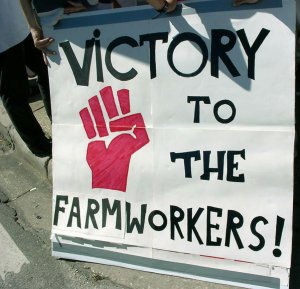
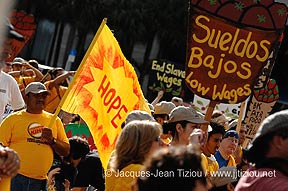
On Friday I mentioned that the Coalition of Immokalee Workers had just announced victory in the Burger King penny-a-pound pass-through campaign. It turns out that the news is even better than I thought. The news reports that have come out since the announcement reveal that not only did Burger King agree to join the penny-a-pound, but the Florida Tomato Growers’ Exchange (the cartel and legislative lobby which represents 90% of Florida tomato farm owners) has also substantially caved in the face of pressure from the CIW and its supporters. Although they are still saying that member farms should not participate, they’ve given up on the hardball tactics they were trying to use to enforce cartel discipline.

Whether workers actually get the increase hinges on tomato growers’ participation.

McDonald’s and Yum! Brands, the world’s biggest fast-food chain and restaurant company, respectively, already have agreed to the raise; Yum!, parent company of Taco Bell, Pizza Hut and more, signed on in 2005; McDonald’s in 2007.

Workers got the extra money for two seasons, then the Florida Tomato Growers Exchange threatened $100,000 fines to any grower member who participated, which stalled the payouts. They’ve since been collecting in escrow. About 90 percent of the state’s tomato growers belong to the exchange.

But the exchange announced Thursday it would no longer threaten members with those fines, said executive vice-president Reggie Brown, in response to inordinate and inappropriate focus on the (fines) by the media.

Amy Bennett Williams, Ft. Myers News-Press (2008-05-24): Tomato pickers celebrate deal with Burger King

Brown is still muttering baseless and murky threats about federal antitrust laws and how participating in the pass-through program could somehow subject growers to lawsuits. (Subjected to lawsuits by whom? Is that supposed to be a prediction or a threat?) So there is still a danger of some very dirty pool and government union-busting here. But the FTGE looks like it’s on the ropes, and their retracting the threat of fines makes it much more likely that individual farm owners will begin participating in the pass-through program again, if nothing else as an incentive for attracting workers away from non-participating farms — an incentive which it costs the farm owners nothing to offer.

In the meantime, the fast-food participants have announced that they will continue to honor the penny-per-pound agreement and pay into the escrow account in case growers change their minds:

McDonald’s and Yum Brands, the world’s biggest fast-food chain and restaurant company, respectively, have agreed to the raise …. Yum, parent company of Taco Bell, Pizza Hut and more, signed on in 2005; McDonald’s in 2007.

Workers received the extra money for two seasons, but then the threatened fines from the exchange stalled payouts. Both companies have been honoring the agreement with the raise amount collecting in escrow.

They say they will continue to honor the agreement.

It’s the right thing to do, and we encourage others to follow our lead, said Taco Bell spokesman Rob Poetsch. While we continue to set aside monies for the affected workers, we’re disappointed that the intended recipients are being penalized.

Now that the threat of fines is gone, members and supporters of the Coalition of Immokalee Workers are wondering what it might mean.

If the (threats of fines) are in fact being lifted, that would be good news, said coalition co-founder Lucas Benitez. We hope our agreements with Yum and McDonald’s will be allowed to again function as they had in the past and workers received a fairer wage.

Amy Bennett Williams, Ft. Myers News-Press (2008-05-23): Tomato growers’ group relents on imposing fine for giving pickers raise

Eric Schlosser, who has been doing some very good work in reporting on the C.I.W.’s struggle, offers an analysis that combines some incredibly muddled history with some admirably clear-sighted analysis of the current position of the C.I.W. within the farmworkers’ struggle:

This may be the most important victory for American farmworkers since passage of California’s Agricultural Labor Relations Act in 1975. That bill heralded a golden age for farm workers. But the state government apparatus it created, the Agricultural Labor Relations Board, got taken over by the growers in the 1980s and watered down the reforms. In Florida, the Coalition has chosen a different path, avoiding government and putting pressure on the corporations at the top of nation’s food chain. The strategy clearly works and can be emulated by other workers in other states. In the absence of a government that cares about the people at the bottom, here’s a way to achieve change.

—Eric Schlosser, quoted by Katrina vanden Heuvel, The Nation (2008-05-23): Sweet Victory: Coalition for Immokalee Workers Wins

The muddle, of course, has to do with the California Agricultural Labor Relations Board and the mythical golden age for farmworkers. Actually the ALRB is exactly what strangled the dynamism of the once-vibrant United Farm Workers, by pulling California farmworkers’ unions into the smothering embrace of bureaucratic patronage, which had strangled the dynamism of the rest of the labor movement for decades under the Wagner/Taft-Hartley system — thus capturing a once revolutionary movement and converting it into just another arm of the State-domesticated labor establishment. It should be no surprise that within a decade the ALRB had been completely captured by the farm bosses; government boards are always captured by the most powerful and best-connected players. Any look at history or at the basics of political economy should quickly demonstrate that Schlosser’s in the absence of is really a statement of universal truth, not a remark on the sad state of affairs today: there will never be a government that cares about the people on the bottom. It’s the State that largely puts them on the bottom in the first place and then keeps them there. Any scraps that it may throw down from the master’s table are intended to keep the rest of us just barely fed enough to keep begging, instead of giving up and taking matters into our own hands.

What Schlosser is right about is that the C.I.W.’s strategy works, and deserves emulation. What I’d want to add, and stress, is that it works not despite the fact that they have avoided entangling themselves in the government labor bureaucracy; it works because they have. The C.I.W. has won all these struggles precisely because they have used creative fight-to-win tactics (especially secondary boycotts) that would be completely illegal if they were subject to the bureaucratic discipline of the NLRB. It’s precisely the freedom that they enjoy as a wildcat union, ineligible for NLRB recognition, which has allowed them to disregard the usual modesty in demands and politeness in means that the Taft-Hartley rules demand.

These victories with the FTGE and Burger King are not the end. The C.I.W. has announced that it will now challenge grocery stores and other fast food restaurants to join Yum Brands, McDonald’s, and Burger King in the pass-through agreement. Every victory in this campaign has made the next victory come quicker: the Taco Bell boycott took four years for victory (from 2001 to 2005); the C.I.W. won an agreement from McDonald’s after two years of active campaigning (from March 2005 to April 2007); and these victories in campaigns against Burger King and the FTGE took just over one year (from April 2007 to May 2008). Lucas Benitez has indicated that the C.I.W. will most likely target Chipotle and Whole Foods next — that is, major tomato buyers who each have a significant stake in maintaining a brand image of corporate social responsibility. There’s good reason to hope that the trend will continue and these campaigns will lead to a speedy victory.

Fellow workers, this past week’s victories for creative extremism and wildcat unionism are both an inspiration and a reminder. We should never forget that the workers have more power standing with our hands in our pockets than all the wealth and weapons of the plutocrats and politicians. Yes, we can do it—ourselves. And we will.

See also:

Republicans do it with class.

Here’s a choice sample from People’s year-end interview with George and Laura Bush, in which George (who, unlike Mrs. Bush, is apparently so elevated in dignity that he must be referred to in print by a definite description rather than by his proper name) talks about his daughter Jenna’s recent engagement.

Q: Tell us about your future son-in-law, Henry Hager. Did he do right and ask for Jenna’s hand?

The President: He kind of sidled up to me and said, Can I come and see you? We were sitting outside the presidential cabin here, and he professed his love for Jenna and said, would I mind if he married her? And I said, Got a deal. [Laughter] And I’m of the school, once you make the sale, move on. But he had some other points he wanted [to make]. He wanted to talk about how he would be financially responsible.

People Magazine (2007-12-31): We’ve grown stronger

(Via Jessica Valenti @ The Nation Blog 2008-01-03: The Daddy State? No Thanks.)

Whited sepulchres

(thanks to feministe: The Gazillion Things Crowding Up My Desktop for the link)

The Boondocks: A Right to be Hostile
photo: Eric Alterman

Eric Alterman, the whitest Leftist on the planet

The Nation is a well-written, insightful magazine that’s well worth reading. Eric Alterman is one of the best popular media critics today. These are people well worth supporting with your time, money, and attention. Nevertheless, I can’t find an ounce of sympathy for them in my heart—or an ounce of pique at Aaron McGruder—on reading The New Yorker’s profile of McGruder and its account of a shouting match between McGruder and white liberals at a recent $500-a-plate dinner for The Nation:

On the day of Saddam Hussein’s capture, last December, the left-leaning political weekly The Nation celebrated its hundred-and-thirty-eighth birthday. It was a Sunday night, and the weather was dreadful—forbiddingly cold and wet, heavy snow giving way to sleet—but three hundred people could not be deterred from dropping five hundred dollars a plate for roast chicken amid the marble-and-velvet splendor of the Metropolitan Club, on Fifth Avenue.

Toward the dessert (chocolate torte) portion of the evening, Uma Thurman rose to introduce a special guest: Aaron McGruder, the creator of the popular and subversive comic strip The Boondocks, who, as it happens, had travelled farther than anyone else to be there, all the way from Los Angeles. McGruder, one of only a few prominent African-American cartoonists, had been making waves in all the right ways, poking conspicuous fun at Trent Lott, the N.R.A., the war effort. … It seemed to be, as a Nation contributor said later, his coronation as our kind of guy.

But what McGruder saw when he looked around at his approving audience was this: a lot of old, white faces. What followed was not quite a coronation. McGruder, who rarely prepares notes or speeches for events like this, began by thanking Thurman, the most ass-kicking woman in America. Then he lowered the boom. He was a twenty-nine-year-old black man, he said, who got invited to such functions all the time, so you could imagine how bored he was. He proceeded to ramble, at considerable length, and in a tone, as one listener put it, of militant cynicism, with a recurring theme: that the folks in the room (courageous? Please) were a sorry lot.

He told the guests that he’d called Condoleezza Rice, the national-security adviser, a mass murderer to her face; what had they ever done? (The Rice exchange occurred in 2002, at the N.A.A.C.P. Image Awards, where McGruder was given the Chairman’s Award; Rice requested that he write her into his strip.) He recounted a lunch meeting with Fidel Castro. (He had been invited to Cuba by the California congresswoman Barbara Lee, who is one of the few politicians McGruder has praised in The Boondocks.) He said that noble failure was not acceptable. But the last straw came when he dropped the N-word, as one amused observer recalled. He said—bragged, even—that he’d voted for Nader in 2000. At that point, according to Hamilton Fish, the host of the party, it got interactive.

Eric Alterman, a columnist for The Nation, was sitting in the back of the room, next to Joe Wilson, the Ambassador. He shouted out, Thanks for Bush! Exactly what happened next is unclear. Alterman recalls that McGruder responded by grabbing his crotch and saying, Try these nuts. Jack Newfield, the longtime Village Voice writer, says that McGruder simply dared Alterman to remove him from the podium. When asked about this incident later, McGruder said, I ain’t no punk. I ain’t gonna let someone shout and not go back at him.

Alterman walked out. I turned to Joe and said, I can’t listen to this crap anymore, he remembers. I went out into the Metropolitan Club lobby—it’s a nice lobby—and I worked on my manuscript.

Newfield joined in the heckling, as did Stephen Cohen, a historian and the husband of Katrina vanden Heuvel. It was like watching LeRoi Jones try to Mau-Mau a guilty white liberal in the sixties, Newfield says. It was out of a time warp. Who is he to insult people who have been putting their careers and lives on the line for equal rights since before he was born?

Can you see his face as he says this? The teeth gritted, the lip curled up, the words Ungrateful nigger— just barely stifled between his tongue and his teeth.

Nevertheless, Newfield is right in one respect: the whole fracas reads like a bad flashback from the 1960s. Not, however, for the reasons that Newfield thinks it does: what feels like it came out of a time warp is a bunch of pretentious, comfortable white radicals (oh, I’m sorry, progressives — a terminological shift that looks like a bad flashback from the 1910s) lecturing everyone else on how to do enlightened politics, patting themselves on the back, angrily shouting down speakers they disagree with, and snivelling about anyone who says things that make them feel guilty.

Here, meanwhile, is what McGruder has to say about the whole thing:

At a certain point, I just got the uncomfortable feeling that this was a bunch of people who were feeling a little too good about themselves, McGruder said afterward. These are the big, rich white leftists who are going to carry the fight to George Bush, and the best they can do is blame Nader?

There’s not much to say on the latter point that I haven’t already said elsewhere in considerably more depth; the main thing to stress here is that, while I have quite a few problems with Green Party strategy since the 2000 election, and a lot of problems with Nader’s campaign for 2004, it’s dreadfully foolish for lefty Democrats to waste their time and effort alienating people who are sympathetic to the independent party movement with slash-and-burn Nader-blaming tactics. The target is Bush: energize your base by taking the fight to him and you will win. Demoralize your base with hectoring and finger-pointing and you will lose, and you will deserve to lose.

It’s the former point that I want to dwell on for a moment: the stifling sense of complacency and self-congratulatory politics that we on the Left are all too often prone to. If there is a characteristic vice of the white, male Left, it is pride: specifically, the phony simulacrum of self-worth that comes from indulgence in a certain sort of Pharisaic purity. The basis of our politics, after all, is the repudiation of some of the very roots of the society we live in — the ugly, daily realities of white supremacy, gay-bashing, war, colonialist occupation, men’s rape and battery against women, and so on. The constant temptation is to act as though we’ve somehow managed to extricate ourselves from the sins of the society that surrounds us, and to purify ourselves through our own virtue.

What happens when that self-image is endangered is all too familiar—all too often we answer criticism with a sort self-righteous, defensive backlash. (This is a lesson that we owe especially to the writings by feminists on the male Left; see, for example, Cocktales, anthologized in Dear Sisters; everything I say here about the white Left just as much to the male Left, the straight Left, the collegiate Left, or whatever form of privileged background you care to look at.) And when this happens, the tactics are all too familiar. We change the subject from what we’re doing to how we’re feeling and what we’ve done—changing the subject from institutional structures and the interpersonal character of our acts, to our own personal good intentions. It shifts from being a question of whether or not I’m doing something fucked up (and if so, what I can do to be accountable for that), to being a question of whether I’m one of Us or one of Them (the bigots, the running-dogs, the misogynists, the Bush Administration—everyone that I, the pure one, have defined myself against). From there it’s not far to taking up criticism as a personal attack rather than as a serious critique; and it becomes very easy just to attack back, to scapegoat the critic and—natch—to reiterate all the virtuous things I’ve done for you (or think I’ve done, anyway), that set me apart from the demoniacal Them—and how dare you not realize it, &c.

But if we want to help build an open and just society, some day or another we are going to have to answer for all the big and little ways that we’ve participated in injustice—and the sooner the better for all concerned. Courage, and pride in accomplishments, is a great thing to have — but without humility and accountability there is no real courage or pride; there is only boldness and egotism. Salvation needs works, but it also needs grace; good intentions alone won’t feed a person who’s hungry or stop an assault or defuse a bomb. I, for one, haven’t always made my good intentions do some good for other people more than once; and I know also that I’m not the only one, either. If pompous white radicals progressives won’t cop to that on our own, then we could use a good Mau-Mauing every now and again—hell, anything to get us to sit down and shut up and think about what other people are saying for two seconds. It’s not about guilt, and it’s not about radical chic. It’s about having the guts to acknowledge that you’ve fucked up from time to time (and if the elite Left hasn’t been fucking up pretty frequently for the past two decades, what the hell has it been doing?!) and having the humility to listen to people (even if you disagree with half of what they are saying) when they take you to task on it.

Aaron McGruder was right; folks like Eric Alterman and Jack Newfield write some good stuff, but they are feeling way too good about themselves. If McGruder’s shock therapy did not work, then I’m not sure what to suggest, except perhaps a long-term prescrption of Daily Abnegations. Every morning, before they sit down to work, maybe they should repeat to themselves: Black people know more about racism than I do. Women know more about sexism than I do. Poor people know more about poverty than I do. Now let’s work together to do some good by the end of the day.

This may seem like a tall order for someone like Eric Alterman, who describes himself as A contributor to virtually every significant national publication in the US and many in Europe, but surely the most honest and incisive media critic writing today can suck it up and manage it.