Rad Geek People's Daily

official state media for a secessionist republic of one

Posts filed under Politics

Freedom Movement Celebrity Birthday Feast (this year with big round numbers)

Today is a feast day, and a jubilee celebration, declared by edict of the Ministry of Culture in this secessionist republic of one, in honor of those who have worked, and with hope for those who are working today, for the liberation of so many held captive by oppressive governments in foreign nations.

Happy 80th birthday, Martin Luther King Jr.!

We know through painful experience that freedom is never voluntarily given by the oppressor; it must be demanded by the oppressed. Frankly, I have never yet engaged in a direct action movement that was well timed, according to the timetable of those who have not suffered unduly from the disease of segregation. For years now I have heard the words Wait! It rings in the ear of every Negro with a piercing familiarity. This Wait has almost always meant Never. We must come to see with the distinguished jurist of yesterday that justice too long delayed is justice denied.

We have waited for more than three hundred and forty years for our constitutional and God-given rights. The nations of Asia and Africa are moving with jet-like speed toward the goal of political independence, and we still creep at horse and buggy pace toward the gaining of a cup of coffee at a lunch counter. I guess it is easy for those who have never felt the stinging darts of segregation to say, Wait. But when you have seen vicious mobs lynch your mothers and fathers at will and drown your sisters and brothers at whim; when you have seen hate filled policemen curse, kick, brutalize and even kill your black brothers and sisters with impunity; when you see the vast majority of your twenty million Negro brothers smothering in an airtight cage of poverty in the midst of an affluent society; when you suddenly find your tongue twisted and your speech stammering as you seek to explain to your six-year-old daughter why she can’t go to the public amusement park that has just been advertised on television, and see tears welling up in her eyes when she is told that Funtown is closed to colored children, and see the depressing clouds of inferiority begin to form in her little mental sky, and see her begin to distort her little personality by unconsciously developing a bitterness toward white people; when you have to concoct an answer for a five-year-old son asking in agonizing pathos: Daddy, why do white people treat colored people so mean?; when you take a cross-country drive and find it necessary to sleep night after night in the uncomfortable corners of your automobile because no motel will accept you; when you are humiliated day in and day out by nagging signs reading white and colored; when your first name becomes nigger, your middle name becomes boy (however old you are) and your last name becomes John, and your wife and mother are never given the respected title Mrs.; when you are harried by day and haunted by night by the fact that you are a Negro, living constantly at tip-toe stance never quite knowing what to expect next, and plagued with inner fears and outer resentments; when you are forever fighting a degenerating sense of nobodiness; then you will understand why we find it difficult to wait. There comes a time when the cup of endurance runs over, and men are no longer willing to be plunged into an abyss of despair. I hope, sirs, you can understand our legitimate and unavoidable impatience.

You express a great deal of anxiety over our willingness to break laws. This is certainly a legitimate concern. Since we so diligently urge people to obey the Supreme Court’s decision of 1954 outlawing segregation in the public schools, it is rather strange and paradoxical to find us consciously breaking laws. One may well ask: How can you advocate breaking some laws and obeying others? The answer is found in the fact that there are two types of laws: There are just and there are unjust laws. I would be the first to advocate obeying just laws. One has not only a legal but a moral responsibility to obey just laws. Conversely, one has a moral responsibility to disobey unjust laws. I would agree with Saint Augustine that An unjust law is no law at all. … So I can urge men to disobey segregation ordinances because they are morally wrong.

Martin Luther King Jr., born 80 years ago today on January 15, 1929. This passage is excerpted from his Letter from Birmingham Jail (1963) .

Happy 200th birthday, Pierre-Joseph Proudhon!

The sovereignty of Reason having been substituted for that of Revolution,

The notion of Contract succeeding that of Government,

Historic evolution leading Humanity inevitably to a new system,

Economic criticism having shown that political institutions must be lost in industrial organization,

We may conclude without fear that the revolutionary formula cannot be Direct Legislation, nor Direct Government, nor Simplified Government, that it is NO GOVERNMENT.

Neither monarchy, nor aristocracy, nor even democracy itself, in so far as it may imply any government at all, even though acting in the name of the people, and calling itself the people. No authority, no government, not even popular, that is the Revolution.

Direct legislation, direct government, simplified government, are ancient lies, which they try in vain to rejuvenate. Direct or indirect, simple or complex, governing the people will always be swindling the people. It is always man giving orders to man, the fiction which makes an end to liberty; brute force which cuts questions short, in the place of justice, which alone can answer them; obstinate ambition, which makes a stepping stone of devotion and credulity.

… I do not see why I myself should submit to this law. Who guarantees to me its justice, its sincerity? Whence comes it? Who made it? Rousseau teaches in unmistakeable terms, that in a government really democratic and free the citizen, in obeying the law, obeys only his own will. But the law has been made without my participation, despite my absolute disapproval, despite the injury which it inflicts upon me. The State does not bargain with me: it gives me nothing in exchange: it simply practises extortion upon me. Where then is the bond of conscience, reason, passion or interest which binds me?

But what do I say? Laws for one who thinks for himself, and who ought to answer only for his own actions; laws for one who wants to be free, and feels himself worthy of liberty? I am ready to bargain, but I want no laws. I recognize none of them: I protest against every order which it may please some power, from pretended necessity, to impose upon my free will. Laws! We know what they are, and what they are worth! Spider webs for the rich and powerful, steel chains for the weak and poor, fishing nets in the hands of the Government.

You say that you will make but few laws; that you will make them simple and good. That is indeed an admission. The Government is indeed culpable, if it avows thus its faults. No doubt the Government will have engraved on the front of the legislative hall, for the instruction of the legislator and the edification of the people, this Latin verse, which a priest of Boulogne had written over the door to his cellar, as a warning to his Bacchic zeal:

Pastor, ne noceant, bibe pauca sed optima vina. [Pastor, for your health, drink but little wine, but of the best.]

Few laws! Excellent laws! It is impossible. Must not the Government regulate all interests, and judge all disputes; and are not interests, by the nature of society, innumerable; are not relations infinitely variable and changeable? How then is it possible to make few laws? How can they be simple? How can the best law be anything but detestable?

You talk of simplification. But if you can simplify in one point, you can simplify in all. Instead of a million laws, a single law will suffice. What shall this law be? Do not to others what you would not they should do to you: do to others as you would they should do to you. That is the law and the prophets.

But it is evident that this is not a law; it is the elementary formula of justice, the rule of all transactions. Legislative simplification then leads us to the idea of contract, and consequently to the denial of authority. In fact, if there is but a single law, if it solves all the contradictions of society, if it is admitted and accepted by everybody, it is sufficient for the social contract. In promulgating it you announce the end of government. What prevents you then from making this simplification at once?

Pierre-Joseph Proudhon, born 200 years ago today, on January 15, 1809. This passage is excerpted from The Principle of Authority, the Fourth Study of The General Idea of the Revolution in the Nineteenth Century (1851).

Here’s to many happy returns!

(Reminders of the occasion thanks to this morning’s e-mail from The Daily Bleed.)

Repudiation now

We have not acquired any debt. The so-called public debt really belongs to the oligarchy. We the peoples have not acquired anything or been benefited, and thus we owe nothing.

–Confederation of Ecuadorian Kichwas (ECUARUNARI), quoted in Daniel Denvir, AlterNet (2008-12-15): Ecuador Calls foreign Debt Illegal, Defaults on Payments

Last month, the government of Ecuador defaulted on a US$ 30,600,000 interest payment on US$ 510,000,000 in bond debt. They will be defaulting on payments on two other series of bonds, amounting to US$ 9,937,000,000, or 19% of the entire country’s GDP.

Kevin Carson, in his first (hooray; congratulations) regular weekly commentary at the Center for a Stateless Society, says It’s about time, and Good on them. He points out that this massive government debt has nothing to do with freed trade or voluntary production. It has everything to do with building political alliances between governments and providing government funding for massive forced-modernization boondoggles and corporate privateering — with the costs, as always, taken out of the hides of Ecuadorian workers and farmers. As Carson writes:

That's entirely correct. In the specific case of Ecuador, according to John Perkins (Confessions of an Economic Hit Man), the loans were designed to foment conditions that make [Ecuador] subservient to the corporatocracy running our biggest corporations, our government, and our banks. Infratructure loans were granted on the condition that engineering and construction companies from our own country must build all these projects. In essence, most of the money never leaves the United States; it is simply transferred from banking offices in Washington to engineering offices in New York, Houston, or San Francisco.

. . .

[The main function of the government agencies set up to receive and manage foreign debt] is to work in collusion with the World Bank to run up debt building the infrastructure foreign capital needs for profitable investment. A majority of World Bank loans since that agency's inception have gone to building the roads and utilities necessary to support foreign-owned industry. The effect is to crowd out decentralized, small-scale, locally-owned industry serving local markets, and to integrate the domestic economy into a neoliberal framework of providing raw materials and labor for foreign industry.

The resulting debt (which the people of the country never approved) can then be used to further cement neoliberal policies, by blackmailing the local government into adopting a structural adjustment program. And the policies adopted under such programs generally include the privatization of the same infrastructure the loans were taken out to build, and selling it to the very people it was built to serve. Not only that, but the privatization is generally arranged on terms virtually dictated by the purchasers, with native governments sometimes spending more taxpayer money to make the assets salable than the sale actually fetches.

— Kevin Carson, Center for a Stateless Society (2009-01-05): Ecuador Repudiates Foreign Debt: It's About Time

Kevin has an excellent discussion of the structural and economic effects of massive government debts in formerly colonized countries like Ecuador. I think he’s entirely right. Of course, I couldn’t care less about the fact that the government of Ecuador has trouble raising funds for its own domestic parasitism and government-funded, government-regimented programs. Like all government programs, these range from useless to foolish and destructive. Would that the government of Ecuador couldn’t raise any money for any purpose. But what is a problem is the fact that the money for the payments on those debts — like all government payments — is always taken out of the pockets of the Ecuadorian people, through taxation, which is to say, by force.

And it’s that that I want to say something about today — not only the structural effects of government debt and government-lubricated neoliberalism (which is to say, government-financed state capitalism), but also the moral case for unilateral and unconditional repudiation. That case is a simple case, and it’s exactly what ECUARUNARI said: people should never be forced to pay debts that they never agreed to take on.

So-called public debt is, of course, never contracted by the public (if that means all the people of a particular country) it is contracted by a tiny, parasitic minority that lives at the expense of the rest of the public, and which has arbitrarily declared itself the rightful rulers and the designated collective-bargaining agents of everybody else in the country — whether or not anybody else ever agreed to that arrangement. When banks or foreign governments loan money to a government, they loan it to that tiny, parasitic minority, and they do so with the expectation that their investment will be repaid by means of taxation, which is to say, by means of the money that the government extracts from the public by force. None of the rest of us are ever asked to take on these debts; none of us are ever given any meaningful choice over whether to take on these debts, or how to disburse the money that has been loaned to us; we are just made to pay them against our will. (And it will not help to say that we somehow consented to let the government act as our financial agent, and so consented to cover the costs of the decisions they make on our behalf; nobody ever consents to the State.)

Now, those individual people — members of the tiny, parasitic minority — who did contract the debt may try to pay it — out of their own pockets — if they like. That’s their business. If they think it’s worthwhile to do so, they can even pass the plate and ask people to voluntarily help pay it back. That’s between them and their donors. But neither they, nor any governments which may show up later to assume the old regime’s usurping claims, have the least duty, or the least right, to inflict their debts on any other living person, or to send the bill to the government tax apparatus (which just means forcing taxpayers to pay for it). But then there are no legitimate government debts at all; at the very most, there are private debts that the tiny, parasitic minority have taken on themselves and then ransomed from the rest of us by force.

Whatever the would-be governmors of Ecuador may owe, the people of Ecuador owe not one damned dime to the World Bank, the IMF, CitiBank, or any other lender. And so the real issue is justice, not charity — except insofar as the most charitable thing that rich governments can do for poor people is to get their boots off, and their fangs out, of those people’s necks. All of which means that the political focus needs to be on inciting indignation and resistance from the people being forced to pay these criminal debts — not on appealing to the better natures of the people collecting them. And that the only just policy with regard to government debt is to burn the bills and stop taking the collectors’ calls — to repudiate all government debts unilaterally, immediately, completely, everywhere, and forever. Whether or not you have taken the time to get permission from the IMF, the United States government, or the humanitarian rock stars of the world.

It may be claimed that, even if repaying the loans by means of taxation is an injustice against Ecuadorian taxpayers, policy-makers (the dignified term that some people use for ranting, violent power-trippers in government offices) must balance that against the injustice of defaulting on the loans — which would be an injustice against investors who made those loans in good faith, expecting to be repaid. But no, it wouldn’t. They made the loans expecting that their return would be stolen from out of the pockets of the Ecuadorian people. (This is why government bonds are traditionally rated as safe investments; the safety consists in the fact that the interest payments are extracted by force rather than depending on market success.) There is no such thing as a good-faith loan to a piratical enterprise; if those who made the loans get nothing for their trouble, then they’ve earned, and deserve, exactly what they get.

It may also be objected that, whatever the justice of the case, insisting on the right to repudiate government-contracted debts will be harmful for the Ecuadorian people — more harmful than the alternative of paying off those illegitimate debts — and so that it would be a good idea to pay them off anyway, as a sort of a ransom. But these objections always depend on one of two lines of argument, both of which are fallacious. First, there are those who argue that repudiating government debts will make Ecuador a pariah, and cut them off from trade, credit, and other resources for economic growth. Thus, for example, Enrique Alvarez, head of research for Latin America Financial Markets for IDEAglobal in New York: They were already sort of headed into isolation. Essentially now they’ve drawn shut the gate. But this line of argument only makes sense if you talk about Ecuador and completely forget the difference between the Ecuadorian government and the Ecuadorian people. Repudiation of government debts will surely make it more difficult for the government to find credit or make financial deals in the future. But so what? If we’re interested in the well-being of the people in Ecuador, and if development means prosperity for ordinary people, rather than a government-driven fetish for great big centrally planned projects, then the important issue has nothing to do with whether or not the government can find credit. It has to do with whether or not people can find trading partners, investors, and money for their own projects. There’s no reason why repudiating government debts would make people in other countries less interested in trading with or extending credit to individual people or private outfits in Ecuador, and so no reason why anyone other than the Ecuadorian government would end up in isolation. And if the Ecuadorian government ends up in isolation, well, who cares, as long as the Ecuadorian people remain free to do their own work and make their own deals?

Others, having recognized that repudiation only immediately harms the financial prospects of the government, not ordinary Ecuadorians, will go on to object that it will still harm the Ecuadorian people, anyway, because that will make it harder for the Ecuadorian government to raise money for its own projects in the future. But while that’s true enough, it’s a plain non sequitur to infer from it that the Ecuadorian people will be harmed by that fact — unless you help yourself to the auxiliary premise that the Ecuadorian people somehow benefit when the Ecuadorian government has easy access to money for its projects. That in turn makes sense only if you suppose that the Ecuadorian government’s projects tend to benefit the Ecuadorian people. But while lots of people make that claim, either tacitly or explicitly, hardly anyone makes any real effort to defend it. And in fact, given both what we know about governments in general, and in particular about the kind of governments that tend to rule countries like Ecuador, it’s a claim that happens to be ridiculously implausible. As a matter of fact, permanently crippling governments’ ability to raise funds for costly government projects is one of the best developments I could hope for on the world scene.

When Progressive outfits like Make Poverty History have noticed the problems that government debts create, their response has been, mainly, to beg rich governments to cancel the existing debts of poor governments, as a sort of charitable hand-out to the poor dears, preferably through a process mediated by some international bureaucracy, probably under the control of the U.N. The whole proposal is absurd; the main consolation is that, like most other grand Progressive proposals, it is more or less completely ineffectual. (Who do you think has more influence over the U.S. government’s trade and international finance bureaucracies? Bono or the IMF and CitiGroup?)

In fact, discussions of government debt should not focus on mediated settlements or relief from creditor governments, but rather on unilateral repudiation of so-called public debt by debtor governments. Not because enforcing the collection of these debts is scroogish or because it ought to be tempered by considerations of charity, but rather because the debts themselves are completely illegitimate and enforcing the collection of these debts is absolutely unjust. Whether that’s the debts of the governments in Ecuador, or in Tanzania, or, for that matter, in the United States of America — where we are all being extorted to pay off US$ 10,000,000,000,000 of debts that we never once agreed to. Debts that were taken out without our permission, then inflicted on us against our will, so that this government could pay for its murderous wars, its tyrannical surveillance and intelligence apparatus, its brain-dead federal programs, its byzantine busybodying regulation, and its multitrillion dollar preservation programs for endangered capitalists and their habitats in the economic status quo.

So here’s to repudiation; and here’s hoping for two, three, many Ecuadors….

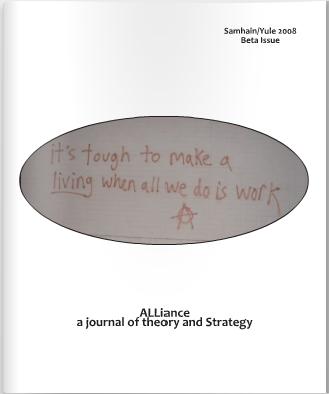
Announcing ALLiance a journal of theory and strategy

From ALLy Chris Lempa (2009-01-11):

ALLiance a journal of theory and strategy [beta] is done. I’m very happy with the content. I used Scribus to do the page layout and that was a mistake. It kept crashing my system and was overall not a very friendly program. Hopefully it will be replaced before the next issue. Please take a look at this issue and provide constructive criticism. My goal is to create a journal that promotes libertarian (broadly defined) theory. Please contact me if you are interested in a hard copy.

It is currently being hosted at www.issuu.com but will soon have it’s own space on the web. Issuu makes two versions available – a downloadable pdf as well as a version that is easier to read online.

Thanks for your interest and please remember that this is a test release! I need your comments. Please send them to chris (at) chrislempa dot info

Read ALLiance [beta] – http://issuu.com/alliancejournal/docs/alliance0

Here’s the introduction from the Beta issue:

A Note from Z’s

Libertarianism is political philosophy with a rich history. A countless number of people have dedicated their lives to the freedom movement. The goal of ALLiance a journal of theory and strategy is not to explain libertarianism — that has been done. The Molinari Institute, the Libertarian Labyrinth, and Anarchy Archives, amongst others, have a great collection of foundational texts. ALLiance aims to disseminate theory and strategy. Both new and recently published articles will be included. So many great articles have been published on blogs and articles. Some of these reach a large audience, unfortunately many do not. Many end up preaching to the so called choir or converted. Hopefully ALLiance will spread the ideas of our loose knit movement.

Future issues will, hopefully, focus largely on strategy. Most people reading this will agree that change is necessary, but how do we realize that change? Let’s move our theory to action. Articles on theory will be accepted and published, but we prefer to move those ideas forward. A lot of other venues focus on theorizing a more free society. An example of such a publication was Z Papers. This magazine continued up where Z Magazine stopped. That is, Z Papers went beyond analyzing what was wrong. In fact, that’s where the journal began. Unfortunately, from what I can gather, it failed due to lack of submissions.

Eventually I would like to turn ALLiance into a Z Papers for the libertarian left. Strategies will be diverse and differ in reach and risk. Anything from encrypting email to tax avoidance will be included. Electoral strategies will also be considered, but we really don’t have much interest in relying on the parasitic class. However since the state is so overarching, there will undoubtedly be people who work within the system. My personal view is that this is okay so long as it’s done as a non-reformist reform (i.e. working towards structural change).

Housekeeping Notes

ALLiance will be published quarterly. Submissions will be accepted up to one month before the next issue is published (February 1, May 1, August 1, and November 1). Please submit articles in publishble form. While I will attempt to edit them, I can’t guarantee that I will catch every error (or that we have the same writing style). Please email submissions to me no later than two weeks prior to the deadline if you are in need of proofreader. That will provide enough time to edit and/or suggest revisions if necessary. There is no specific length requirement. Every submission will be read and considered.

I would love to have a large print run, but that isn’t possible at this time. Until it is possible, I encourage interested parties to print and distribute copies. While it’s not necessary, I ask that you contact me if you plan to do this. The pdf will be distributed freely and hopefully widely.

Also note that this is a Beta Issue. The submissions are top notch, but the format is a work in progress. Graphics posed a problem for this issue. At the end I kept them even though the quality for many were poor. Fault lies with the editor (me) nd not the authors. I used Scribus, an open source desktop publishing program to layout this issue. I will be exploring other options for the next issue. Please contact me if you have any suggestions.

Letters/feedback are encouraged. In fact, response articles are encouraged. Symposium styled issues will be published in the future.

Donations/trades are accepted. There is also limited ad space available. Contact me to work something out.

Thanks for reading.
Chris Lempa
chris@chrislempa.info

Here’s the information about the next issue:

Next Issue

The next issue will take a closer look at action. How can we move towards a stateless society. What are some alternatives to the welfare state. I touched briefly on Mutual Aid Organizations, but what else is there? Have you written (or thought about writing) a Do It Yourself guide or primer tht will help peopl live life a little more freely? If so, please consider submitting it to ALLiance. Submissions deadline is February 14.

Submissions can be sent to chris@chrislempa.info.

Read, as they say, the whole thing.

Update 2009-01-15: If you don’t want to use issuu.com’s online reader or register an account with them, Chris Lempa has also provided a direct link to a PDF of the Beta Issue.

Cops are here to protect you. (#8)

Government cops protect you by dragging a bunch of unarmed young Black men out of a train and lining them up against the wall — in response to an alleged fistfight — and then forcing one of them down to the ground and shooting him in the back. While he is lying prone on the ground, surrounded, and physically restrained both by the shooter and by a gang of other heavily-armed uniformed cops.

Then government cops protect you from being tainted by knowledge of the incident by rounding up everyone in the crowd that they can get their hands on and seizing the cellphones they had been using to take videos. You have only seen these videos because some dastardly criminals hopped back on the train before the cops could grab them, and then set out to taint us all with the truth.

The cop in the video is a Bay Area Rapid Transit cop named Johannes Mehserle. His victim, Oscar Grant, was either shot in the back when he was already handcuffed, or handcuffed by Officer Johannes Mehserle after he had been shot in back, depending on which witness accounts you listen to. I’m not sure which is worse. In any case, no-one has produced any reason whatsoever why Oscar Grant — who was unarmed, who was clearly showing his hands just before he was forced down and shot, who was forced down on his back, who was being searched and held down by two cops, with a third standing by and a gang of other cops standing around only a few feet away — could pose any credible physical threat to anybody at all, let alone the sort of physical threat that would justify standing up and drawing a gun on him.

We are told that (of course, of course) it’s a terrible tragedy what happened, and we should feel in our hearts for all the people who suffered so much because of this incident, but Officer Johannes Mehserle didn’t really mean to shoot Oscar Grant in the back. Maybe he pulled his gun and pointed it directly at a completely helpless victim who was clearly unarmed and under the complete physical control of the police, and then — oops — slipped and fired his gun into an unarmed man’s back by accident. Maybe he meant to pull out his taser so that he could torture a completely helpless man lying prone on the ground who clearly posed no physical threat to anybody with powerful electric shocks, but — oops — he just got so freaked out by The Situation that he couldn’t tell his hay-foot from his straw-foot and he accidentally whipped out his handgun instead, from a holster on the opposite side of his belt, even though it’s a completely different size and shape and weight, and then pulled the trigger and shot an unarmed man with a bullet instead. And, of course, none of this means a goddamned thing.

As I have said, and at the risk of controversy I will repeat: it doesn't matter if Mehserle meant to pull the trigger. He had already assumed the role of sole arbiter over the life or death of Oscar Grant. He had already decided that Grant, by virtue of his skin color and appearance, was worth less than other citizens. And rather than acquitting the officer, all of the psychological analyses and possible explanations of the shooting that have been trotted-out in the press, and all the discussion of the irrelevant elements of Grant's criminal history, have only proven this fundamental point.

If a young black or Latino male pulls a gun and someone winds up dead, intention is never the issue, and first-degree murder charges are on the agenda, as well as likely murder charges for anyone of the wrong color standing nearby. If we reverse the current situation, and the gun is in Oscar Grant's hand, then racist voices would be squealing for the death penalty regardless of intention. And yet when it's a cop pulling the trigger, all the media and public opinion resources are deployed to justify, understand, and empathize with this unconscionable act. One side is automatically condemned; the other automatically excused.

— George Ciccariello-Maher, CounterPunch (2009-01-09): Oakland’s Not For Burning?

Of course, there are two kinds of privileges: sometimes the problem is that a select class of people get consideration that everybody ought to be getting, but other people, not in the privileged class, are unjustly denied. And sometimes the problem is that a select class of people get special consideration that nobody ought to be getting, no matter their social class. Ciccariello-Maher doesn’t make it clear which kind he means, but in this case, the handwringing and We’ll never know chanting and endless excuse-making in the effort to convert manslaughter or murder into nothing more than another Oops, our bad is an example of the second kind. Given the observable facts of the case, there is nothing that could possibly have been going through Officer Johannes Mehserle’s head that could justify this execution-style shooting. If he went drawing his gun on an unarmed and prone and physically helpless man, who posed absolutely no credible threat to him or anyone else in the vicinity, and then, in the course of swinging his gun around, ended up firing it off, somehow, by accident, then he is guilty of criminally negligent homicide. If he planned to shock the hell out of someone who he had no reason to shock and ended up shooting him instead, by accident, then he is guilty of committing felony murder in the course of committing assault and battery. If he shot Oscar Grant intentionally, then, whatever may have been going on in his head about combs in Oscar Grant’s pocket or the folks in the crowd who were booing him from several feet away behind a line of other cops, or the hard, stressful life of a transit cop, then he is guilty of murder in the first.

And then we are told by self-righteous cops and their sado-fascist enablers that (of course, of course) it’s terrible what happened, and maybe Officer Johannes Mehserle overreacted, and zigged when he should have zagged, but really, we shouldn’t rush to judgment, and really, it’s not his fault, because, after all, there was a crowd of unarmed people several feet away, behind a line of other heavily-armed cops, yelling unkind words at him and making allegations as to the character of the police and watching what they were doing; maybe he became so confused and terrified by all this that, consummate professional though he may have been, he just lost all control of his rational faculties, and — oops — it just seemed like a good idea at the time to stand up and draw on an unarmed man being held down face-first on the ground in front of him. So it’s really the crowd’s fault:

We can wait for the official report on the shots fired but the earlier parts of those amatuer [sic] videos are also chilling for the hate-filled crowd reactions to what was, prior to the gunshot, a routine police encounter. We cannot long continue to police in a nation full of antagonists toward law and order. You can find it in videos all over the internet – crowds taunting, jeering, threatening, and obstructing police officers who are engaged in taming disorder.

— profshults (2009-01-07 10:04pm), comment on Tragedy [sic] at Fruitvale Station, at POLICE: The Law Enforcement Magazine

Well, great. Then let government cops quit. Please. As if anybody ever asked them to go around policing like that in this nation. When government cops go around like this, protecting the hell out of us all, then they need to be taunted, jeered, threatened and obstructed until they stop.

It's not entirely clear yet what happened during the incident, and it may never be. [Oscar Grant] was apparently not one of the initial group dragged off the train–one of the videos shows him unrestrained and standing up, trying to intercede with the police. According to witnesses, he was trying to de-escalate the situation between the cops and his friends. This is not an isolated incident, not by a long shot. This kind of thing happens all the time: out-of-control police violence in response to non-violent communication. It happens to people of color, and to queer folks too. It happened to me and Jack a little more than a year ago, along with a group of colleagues and friends, for asking the police why they were making an arrest. An officer decided to pepper spray our group, without any real provocation. We're lucky, and privileged, that it wasn't a gun.

Who knows what's going through these cops' heads? Are they freaking out, paranoid, fearful, are they untrained, do they have no idea what to do? What really matters to me is that they've been given weapons to use, and they're wiling to use them at the slightest provocation, up to and including lethal force. What matters is that any questioning of their authority, whether you're holding a camera or trying to de-escalate a situation, is seen as a challenge that has to be put down, by taking your stuff away, or crowd-controlling you, or killing you. We should all be scared. Especially if you're part of a frequently-profiled community.

. . .

I want to stress one more thing. The news is reporting that the police felt outnumbered. This is exactly the same reason they gave for pepper-spraying the crowd that Jack and I were in. But let's be clear — it doesn't have anything to do with numbers. If it had been a quiet crowd ignoring the police and just sitting on the train, the numbers wouldn't matter. They felt outnumbered because a lot of people watching were demanding to know what was going on, yelling, and refusing to just mind their own business. People who were demanding to know what was happening, because they know that abuses happen far too often and take far too many lives, and that someone has to watch the watchers.

Unfortunately, to police this makes you the enemy, especially if you're making your voice heard, yelling, demanding to know what's going on. The police, whether because of training or inculcated philosophy or temperament, see this as a potential riot, and they escalate the situation.

— Holly @ feministe (2009-01-07): Execution style

The plain fact is that what we have here is one of two things. Either we have a professionalized system of violent control which tacitly permits and encourages cops to handle any confusing or stressful situation with an attempt to dominate everyone in the vicinity by means of threats and overwhelming force, including attempts to retaliate or terrify people into submission by using violence — up to and including lethal violence — against powerless people under their physical control. Or else we have a system of government policing which has clearly demonstrated that it can do nothing effectual to prevent this from happening, over and over again. In either case, it is unfit to exist.

Can anybody ever consent to the State?

Update 2009-01-08: Typos fixed.

These are some remarks on the State and the conceptual possibility of consent, which I originally prepared for my appearance at the Molinari Society’s Authors-Meet-Critics last week in Philadelphia, but which I opted not to read because of time constraints. Fortunately, blogs are not subject to the same constraints of time or topicality, so I have expanded a bit on what I originally prepared, and now I offer them to you, gentle reader.

In their remarks on Crispin Sartwell’s Against the State, both Christopher Morris and Jan Narveson object to Sartwell’s conclusion that existing states are conceptually incompatible with the very possibility of consent (40, emphasis added). Specifically, they object to the strength or the sweep of the incompatibility claim: Morris thinks that this is an exaggeration and an unnecessary one, and Narveson insists that such a strong claim of incompatibility cannot be taken literally. Each attempts to refute the incompatibility claim, at least as originally stated, by means of counterexamples. Presumably, if you can point to at least one case where individual consent to be ruled is actually secured by an existing state, then clearly (modal logic and all that) it must not be logically impossible for existing states to secure it. And each argues that Sartwell could have done just as well, for the purpose of undermining consensualist accounts of legitimacy, with a much weaker claim. Narveson goes so far as to attribute this weaker claim to Sartwell, insisting that Sartwell really must have meant to say, not that existing states operate in a way that logically precludes any of their subjects from consenting to their rule, but rather that they operate so as to preclude the unanimous consent of all their subjects — that is, that there must always be at least one dissenter in any given state, not that there never can be any non-dissenters.

What then are the counterexamples to be considered? Narveson mentions those who voted in a government election for the party currently in power. Morris, for his part, says that at least some people seem voluntarily to perform acts that seem to constitute consent, and they seem to do so with the requisite understandings. I’d be interested to know whether the performances Morris has in mind are performative utterances like the Pledge of Allegiance or citizenship oaths, where the utterer explicitly declares her support for a particular government, or whether he also means to include other kinds of acts, which have some other purpose but from which consent can reasonably be inferred. But whatever sorts of spontaneous or ritualized performances Morris or Narveson may have in mind, what puzzles me is that, while they indicate these cases as counterexamples to Sartwell’s strong claim — as presented on page 40 of Against the State — neither Morris nor Narveson seems to engage with the direct argument for which the strong claim is the conclusion — as presented on page 50 — in which Sartwell explicitly considers and rejects the claim that these sorts of individual performances could count as consenting to the State’s rule. Thus:

… consent is always compromised by force; the mere existence of effective force dedicated to some end constitutes coercion toward that end, whatever you may think or want. If I consent to abide by the law when that law is enforced by a huge body of men with guns and clubs, it is never clear, to say the least, whether my consent is genuine or not. … It will always be prudent for me, under such circumstances, to simulate consent, and there are no clear signs by which a simulation could be distinguished from a genuine consent in such a case. That I am enthusiastic in my acquiescence to your overwhelming capacity for violence—that I pledge my allegiance according to formula, sing patriotic songs and so on—does not entail that I am not merely acquiescing. … [T]he mere existence of an overwhelming force by which the laws will be enforced compromises conceptually the possibility of voluntarily acceding to them. Or put it this way: the power of government, constituted by hypothesis under contract, by which it preserves the liberties and properties of its citizens, is itself conceptually incompatible with the very possibility of their consent. (50-51)

That is, the standing threat of overwhelming force ensures that any individual performance is made under duress, ruling out the preconditions for any genuine consent. I’d be interested to hear what Narveson and Morris make of this argument for rejecting their purported counterexamples to the strong claim. Unless there is some response to it, then it seems like the attempt to use individual performances as evidence for the actual existence of (at least some) individual consent to the State, which is to say, as evidence against Sartwell’s strong incompatibility claim, is simply question-begging.

Now, I think it would be perfectly fair for Narveson and Morris to object that Sartwell’s argument, as stated, does need some tightening, and may also need some elaborating. But I think that once the tightening and the elaborating have been done, the argument does in fact provide a basis for a very strong version of Crispin’s strong incompatibility claim — and the strong version of that strong claim will be of general interest for anyone who intends to connect their notion of political right to respect for individual liberty, and their notion of liberty to respect for individual consent in the use of person or property.

Now, if someone goes through the motions of consenting while under a background threat of force against dissenters, for Narveson or Morris to be able to insist that it is possible for that to express genuine consent only if they deny at least one of the following principles:

  1. Any seeming expression of consent to a condition C, if given under a standing threat of force against refusers, is given under duress.

  2. Any seeming expression of consent to a condition C, if given under duress, cannot be treated as a genuine expression of consent to C.

  3. If you cannot do anything that could be treated as a genuine expression of consent to a condition C, then you do not count as having consented to C.

All three seem initially plausible, to me at least, but if Narveson or Morris accepts all three, then it quickly follows that he cannot count as having consented to any condition C when there is a background threat of force against those who refuse to consent to C. Since that’s how existing states roll, nobody could do anything that would count as having consented to the state — and that would remain the case even for those who say that they consent with all their heart out of an earnest feeling of duty and with a great deal of pride. If all three principles are accepted, then even if you want to give your consent to the State’s rule over you, you can’t do it, because the state’s unilateral imposition of the terms preempts your efforts to consent to the terms.

So, if Narveson or Morris wants to avoid that conclusion, he’ll have to pick one of the principles to reject, and the question is which one to pick.

Principle (1) looks like it’s not very far off of a definition of acting under duress (or performing the specific action of seemingly-expressing-consent under duress). I doubt that much of anyone will be inclined to reject that — or, if they are so inclined, it will probably be because they first rejected a principle very similar to principle (2) — basically, (2) modified so that under a standing threat of force against refusers substitutes for under duress — but are inclined to think that any case of genuine consent should (therefore) not be considered a case of action under duress. In which case you have a counterexample to (1) rather than to (2), as I’ve stated the principles. But if so, then the motivations for rejecting (1) will be similar enough to the motivations for rejecting (2) that my comments below should apply equally to either.

Principle (2) may look much more promising to someone who wants to defend the claim that people may be voluntarily consenting to state authority — even though they would have been forced to acquiesce even if they had tried to refuse. The idea would be something like this: Look, you’ve given us a perfectly good reason to think that there are at least some people who would seem to be consenting but aren’t actually consenting. Fine, but why think their situation affects those who sincerely do want to agree to the terms the State sets down? At most this seems like an epistemological problem — that we may have trouble finding out whether somebody consented or not just on the basis of their outward actions. It doesn’t make it logically impossible for them to have done so.

Some of the ways in which Sartwell tries to state his case might indeed incline you towards a worry like this — as when he argues that It will always be prudent for me, under such circumstances, to simulate consent, and there are no clear signs by which a simulation could be distinguished from a genuine consent in such a case. The mere fact that a second or third party couldn’t distinguish a simulation from genuine consent wouldn’t (just by itself) warrant the conclusion that there can be no such thing as genuine consent. But I think that there are two possible responses to this worry. First, if the worry is purely epistemic, it still poses a serious problem for any consensualist justification of the state — if it is the case, as I think it is, that it is illegitimate not only to use someone’s person or property without her consent, but also to use someone’s person or property when there is no possible way for you to find out whether she has consented or not. (Consider this an argument to the effect that the State cannot be legitimate because it has no reliable procedure for determining whether its rule over any given subject is in fact legitimate or illegitimate. Take that, Robert Nozick.) But, secondly, and more to the point, I think that there is a stronger interpretation of Sartwell’s argument, on which the worry is logical rather than epistemological, because the lack of clear signs of a distinction is not just a lack of diagnostic symptoms, but rather a lack of necessary criteria.

Think of it this way. The claim that a seeming expression of consent does not count, when given under duress, is usually justified by something like the following principle:

Principle of the Alternative: If Norton wants to place Twain’s person or property under a condition C, then Twain’s performing an action A expresses consent to C only if there is some alternative action B, which Twain could have performed, which would have counted as refusing consent to C.

I take this principle to be a necessary condition for a performance to meet the concept of expressing consent. An expression of consent is necessarily a choice among alternatives; if there is nothing that would even count as a refusal, then what we have is just not a matter of consent. Whatever Twain’s personal feelings about A or C may be, what he’s doing when he does A may be an expression of deference, or of obligation, or of some other similar sort of commitment. But whatever it is, it’s just not an expression of consent.

More strongly, and more importantly for the purposes of our argument, it is not enough that there just be something that would count as refusing consent. Consent is a property of transactions between two or more parties, and for you to have it, there must not only be something that would count as a refusal; your partner must also be willing to count that performance, whatever it is, as a refusal which she is bound to respect. An alternative must not only be available; there must be some reasonable expectation that the alternative would be practically effective.

Opt-Out Principle: If Norton wants to place Twain’s person or property under a condition C, then Twain’s performing an action A expresses consent to C only if there is some alternative action B, which Twain could have performed, which would have counted as refusing consent to C, and which Twain can reasonably expect Norton to accept as a decisive reason not to place Twain’s person or property under C.

Again, I take this principle to be a necessary condition for a performance to count as expressing consent; just as the lack of a possible refusal makes the issue one of obligation rather than consent, if Twain performs an expressive act without any expectation that there is some expression of refusal that Norton would consider himself bound to respect, then the issue is no longer one of consent, but rather of unilateral command. And again, it hardly matters what Twain’s personal feelings about the command may be. Maybe he’s into that kind of thing. But whatever he is doing, he is not succeeding at doing anything that would count as expressing consent. You can’t consent if you’re never asked, and if there really is nothing that Norton would count as a binding refusal, then Twain has never even been asked, in any meaningful way.

I think the Principle of the Alternative and the Opt-Out Principle, or something a lot like them, are central to Sartwell’s worry about the difficulty of telling a genuine willingness to accept the state’s terms apart from a willingness simulated only under duress. I also think that these principles, or something a lot like them, provide the only reasonable explanation for why, as a general thing, we should disregard a seeming expression of consent that was only given under duress, and would not have been given but for the threat. (It might seem important that such seeming expressions are not sincere reflections of the utterer’s inner state. But that by itself is not enough. I might freely give an insincere expression of consent — say I consent to let you use my car, but I secretly intend to call the cops on you and report it stolen. But then the expression, even though insincere, is still genuine consent; given my expression of consent to you, it would be false for me to claim that you had stolen my car from me, no matter what I may have whispered to myself in the dark recesses of my soul.) But if both principles, or something a lot like them, express necessary conditions for a performance to genuinely express consent, then it looks like Principle (2) follows without much delay. And it follows in its full logical force — the worry here, remember, has nothing to do with whether or not Norton knows that Twain is genuinely expressing consent; it has to do with whether or not necessary criteria have been met for Twain’s expressions to count as expressions of consent. If the state rigs the situation in such a way that there is nothing it would count as opting out, then it has also rigged the situation in such a way that there is nothing it could really count as opting in; opting just isn’t part of this game. Neither expressing consent nor expressing dissent are even options that are on the table; if the state gives non-negotiable, unilateral commands, merely being cheerfully responsive to those commands is not enough to count as consent in any meaningful sense. And if this is the case, then it ought to be clear that it immediately defeats any claim that, for example, voting, or paying taxes, or reciting the Pledge of Allegiance, or anything of the sort, could count as giving your consent to be ruled by the government that you vote for, or pay taxes to, or pledge your allegiance to. If not voting, not paying your taxes, not reciting the Pledge, or whatever, would exempt you from the terms that the United States imposes on you, then those who chose to do so anyway might well be counted as consenting to be ruled by the United States. But anarchist activism would also be an awful lot easier than it is, and the United States would not, in fact, even amount to a State — at least, not in any sense of the word that anarchists use when they proclaim all States to be illegitimate (because nonconsensual). In the real world, where government taxes and government prohibitions fall on the heads of the voters and the non-voters alike, there is, as Lysander Spooner argues, no way that an performance under such conditions can count as consent to government.

In truth, in the case of individuals, their actual voting is not to be taken as proof of consent, even for the time being. On the contrary, it is to be considered that, without his consent having ever been asked, a man finds himself environed by a government that he cannot resist; a government that forces him to pay money, render service, and forego the exercise of many of his natural rights, under peril of weighty punishments. He sees, too, that other men practise this tyranny over him by the use of the ballot. He sees further that, if he will but use the ballot himself, he has some chance of relieving himself from this tyranny of others, by subjecting them to his own. In short, be finds himself, without his consent, so situated that, if he use the ballot, he may become a master; if he does not use it, he must become a slave. And he has no other alternative than these two. In self-defence, he attempts the former. His case is analogous to that of a man who has been forced into battle, where he must either kill others, or be killed himself. Because, to save his own life in battle, a man attempts to take the lives of his opponents, it is not to be inferred that the battle is one of his own choosing. Neither in contests with the ballot – which is a mere substitute for a bullet – because, as his only chance of self-preservation, a man uses a ballot, is it to be inferred that the contest is one into which he voluntarily entered; that he voluntarily set up all his own natural rights, as a stake against those of others, to be lost or won by the mere power of numbers. On the contrary, it is to be considered that, in an exigency, into which he had been forced by others, and in which no other means of self-defence offered, he, as a matter of necessity, used the only one that was left to him.

Doubtless the most miserable of men, under the most oppressive government in the world, if allowed the ballot, would use it, if they could see any chance of thereby ameliorating their condition. But it would not therefore be a legitimate inference that the government itself, that crushes them, was one which they had voluntarily set up, or ever consented to.

Therefore a man's voting under the Constitution of the United States, is not to be taken as evidence that he ever freely assented to the Constitution, even for the time being. Consequently we have no proof that any very large portion, even of the actual voters of the United States, ever really and voluntarily consented to the Constitution, even for the time being. Nor can we ever have such proof, until every man is left perfectly free to consent, or not, without thereby subjecting himself or his property to injury or trespass from others.

— Lysander Spooner (1867), No Treason no. 2, § II ¶Â¶ 12–14

Spooner, for his own reasons, couches his argument in epistemological terms — or, more specifically, in terms of legally cognizable proof. But, once again, the argument that he frames epistemically can be reframed in terms of the conceptual criteria for a public expression of consent by means of the Principle of the Alternative and the Opt-Out Principle.

I suspect, then, that someone who wants to defend the claim that it is possible to consent to the state’s authority — in spite of the background threat of coercion against anyone who attempts to refuse — will ultimately have to fall back on rejecting Principle (3). That is, in order to defend the claim the claim they are trying to defend, they will need to make some kind of distinction between the property of consenting as such, and the property of expressing consent. In fact I think it’s likely that this is the real core of Morris’s and Narveson’s intuitive sense that of course there must be some people who are consenting to existing states. It may seem like we just know that it’s possible to consent to the state, because we think we see it in people all around us, in their everyday practices and beliefs — whatever attitude the state may have towards them, their personal attitudes involve an acceptance of the state. We might have the same feelings ourselves, or even if we do not, we might imagine that we have them. We might even express this attitude of acceptance with a form of words like I want the State to rule me, or even I consent to the authority of the state. But if the discussion is about consent, and not merely about acceptance or desire, and if consent is supposed to have any kind of weight in ethical deliberation about the transactions between two or more agents, then I doubt that such a notion of private attitudes of consent — attitudes which might not only be unexpressed at the moment, but might not even be expressible in principle, under the prevailing circumstances — is likely to be coherent. That is, I doubt that private acceptance of the state can be understood as consent, at least in any sense that would preserve the connection between consent and political legitimacy, which is after all what inspired us to introduce the question of consent into the discussion of political theory in the first place.

If there is no effective possibility of refusal, then there is no possibility of publicly expressing consent, and if there is no possibility of publicly expressing consent, then there is no possibility of consenting. If existing states make a standing threat to force people to submit to their terms, even if they do not agree to those terms, then governments cut off any effective possibility of refusal, and thus nobody can do anything that would count as consenting to be ruled by an existing state — even if she wants to do so, and even if she sincerely says that she agrees to the terms. Since all existing states do make that standard threat, no existing state rules by consent over any individual subject. And if governments derive their just powers from the consent of the governed, then no government has any just powers at all. Even the most patriotic pledger or the most dutiful voter has not consented to be bound by the terms the state imposes, even if she tried to get herself bound by them; she is not bound in conscience to pay taxes, or to obey government prohibitions, or to obey the government’s requirements in any other way, for even one second longer than she wants to. And no existing state has either the duty or the right to enforce those terms on her.
Anticopyright. All pages written 1996–2026 by Rad Geek. Feel free to reprint if you like it. This machine kills intellectual monopolists.