Rad Geek People's Daily

official state media for a secessionist republic of one

Posts filed under Politics

Herbert Spencer Anti-Defamation League (Part 423 of ???)

Here’s noted evolutionary biologist and village atheist Richard Dawkins, in the course of his review of what seems to be a laughable little documentary that he was tricked into giving an interview for:

My own view, frequently expressed (for example in the The Selfish Gene and especially in the title chapter of A Devil’s Chaplain) is that there are two reasons why we need to take Darwinian natural selection seriously. Firstly, it is the most important element in the explanation for our own existence and that of all life. Secondly, natural selection is a good object lesson in how NOT to organize a society. As I have often said before, as a scientist I am a passionate Darwinian. But as a citizen and a human being, I want to construct a society which is about as un-Darwinian as we can make it. I approve of looking after the poor (very un-Darwinian). I approve of universal medical care (very un-Darwinian). It is one of the classic philosophical fallacies to derive an ought from an is. Stein (or whoever wrote his script for him) is implying that Hitler committed that fallacy with respect to Darwinism. If we look at more recent history, the closest representatives you’ll find to Darwinian politics are uncompassionate conservatives like Margaret Thatcher, George W Bush, or Ben Stein’s own hero, Richard Nixon. Maybe all these people, along with the Social Darwinists from Herbert Spencer to John D Rockefeller, committed the is/ought fallacy and justified their unpleasant social views by invoking garbled Darwinism.

— Richard Dawkins (2008-03-28): Lying for Jesus?

There’s a fair amount to praise here, and a fair amount to pick at. For the moment, though, I’d like to point out that Dawkins’ characterization of Herbert Spencer — the 19th century radical libertarian sociologist and philosopher — is completely wrong on two different counts.
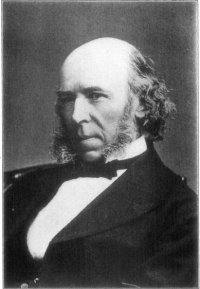
Herbert Spencer, dirty evolutionist hippie

First, Spencer was not a Social Darwinist. He was not, in fact, a Darwinist at all; he published his most famous work on evolution and society, Social Statics, in 1851, eight years before Charles Darwin first published On the Origin of Species. His ideas about evolution, especially as applied to society, were Lamarckian, rather than Darwinian; which is not ultimately that surprising, since he came up with them independently of Darwinian evolutionary theory, and before that even existed in published form.

Second, Dawkins is completely wrong about Spencer’s radical political views, which bear virtually no resemblence to the belligerent Rightism and economic royalism of Thatcher, Bush, Nixon, or Rockefeller. Spencer was in fact a feminist, a labor radical, and a vehement critic of European imperialism (which he described as bearing a very repulsive likeness to the doings of buccaneers). Contrary to the most popular, and most wildly inaccurate, caricature of his social views, Spencer did not believe in cutting off charitable relief to, or mutual aid among, the poor, sick, or other folks whom the powers that be might marginalize and dismiss as unfit, in the name of survival of the fittest. (That is his phrase, but it is being misapplied.) Spencer opposed government welfare programs — because he opposed all forms of government command-and-control — but he believed that voluntary charity and mutual aid were not only a positive moral obligation, but in fact were features of the highest forms of social evolution (Social Statics, pp. 291-2), as the old militant mode of hierarchy and command was supplanted by the new industrial mode of solidarity and voluntary co-operation. Spencer devoted ten chapters of his late work, Principles of Ethics, to the duty of Positive Beneficence. He advocated the organization of voluntary labor unions as a bulwark against exploitation by capitalist bosses, and favored an economy organized primarily in free worker co-operatives as a replacement for the slavery of capitalist wage-labor.. For those — like the cartoon Social Darwinist that Spencer is so often portrayed to be — who advocated indifference or harshness towards the poor and blamed poverty on the ignorance, folly, or vices of the poor people themselves, Spencer himself had nothing but contempt:

It is very easy for you, O respectable citizen, seated in your easy chair, with your feet on the fender, to hold forth on the misconduct of the people – very easy for you to censure their extravagant and vicious habits …. It is no honor to you that you do not spend your savings in sensual gratification; you have pleasures enough without. But what would you do if placed in the position of the laborer? How would these virtues of yours stand the wear and tear of poverty? Where would your prudence and self-denial be if you were deprived of all the hopes that now stimulate you …? Let us see you tied to an irksome employment from dawn till dusk; fed on meager food, and scarcely enough of that …. Suppose your savings had to be made, not, as now, out of surplus income, but out of wages already insufficient for necessaries; and then consider whether to be provident would be as easy as you at present find it. Conceive yourself one of a despised class contemptuously termed the great unwashed; stigmatized as brutish, stolid, vicious … and then say whether the desire to be respectable would be as practically operative on you as now. … How offensive it is to hear some pert, self-approving personage, who thanks God that he is not as other men are, passing harsh sentence on his poor, hard-worked, heavily burdened fellow countrymen …. (Social Statics, pp. 203–5)

Of course, there is plenty in Spencer’s views that Dawkins, as a Social Democrat, would object to. But Dawkins has not yet succeeded in identifying what those disagreements would be. Spencer’s humanitarian, pro-labor, pro-charity radical left libertarianism has just about nothing in common with the authoritarian Right-wing political economy that Dawkins rightly condemns.

Further reading:

Grammatical Investigations: she, he, ze, and they

Last week I wrote about Jamie Kirchick’s latest excursion into truthiness for The New Republic‘s blogs; the comments seem to have lit out on an interesting tangent about language, grammar, and gender-neutral third-person pronouns. It’s all Anon73’s fault:

Continuing the pronoun pondering, I don't really agree with the method of alternating he and she to make language gender-neutral; it provokes too much confusion when one actually does want to specify a person's gender. I think the best method is to switch to new pronouns like ze and use he/she when gender matters to a discussion. But then I favor talking about kibibytes and mebibytes, so what do I know....

— Anon73 @ 24 March 2008 at 11:37 am

I replied:

I don’t actually alternate pronouns very often; with a very few exceptions, I just always use she in preference to he as a gender-indefinite pronoun. But in any case I don’t see either practice as posing much of a stylistic problem when you do want to specify gender: you just do that in the antecedent, rather than in the pronoun. In a language that had no gendered pronouns, that’s what you’d have to do anyway.

Anyone who likes words like ze, hir, ey, xe, thon, etc. should feel free to use them as widely as they can; I’m certainly not going to begrudge them the minimal effort it takes on my part to pick up on new monosyllables. But I generally don’t like them, stylistically speaking, because they usually don’t sound much like English–they don’t fit very well into the phonetic structure of either formal English or dialect. (For example, how is hir even supposed to be pronounced by an English speaker?)

The one big exception to that is the singular they, which comes out of living speech and which flourishes in most dialects because in most of the constructions you might use it in, it sounds pretty natural. But it often gets frowned on and doesn’t have much uptake by self-conscious language reformers, because the kind of people who would actually use a word like ze in writing or speech also tend to be the kind of people who would feel awkward about using an incorrect singular they.

If yo gets some uptake, that would sound fairly natural, too, and would sidestep whatever uneasiness people may feel about the singular they.

— Rad Geek @ 24 March 2008 at 1:21 pm

Laura J., who knows more about language than I could ever hope to, and perhaps more than an entirely sane human being should, adds:

Yo? How curious. I don't think I could easily get used to it – it simultaneously sounds too much like English you and Romance first-person pronouns for my tastes. But then, I don't have a grammatical gap to fill there since I routinely use they as a singular pronoun when there isn't one specific gendered person being referred to.

— Laura J. @ 24 March 2008 2:53pm

Here’s Roderick:

Shakespeare occasionally uses they as a singular pronoun, as I recall.

— Roderick Long @ 27 March 2008 9:30am

Me again, stirring up some controversy:

As do Jane Austen and the King James Version of the Bible. (Cf. 1 for still more examples.) But of course discomfort with the singular they has more or less nothing to do with the norms underlying actually-existing good English, either written or spoken, and everything to do with a fetishized ideal of how a logical language should work, or, more concretely, with participating in a particular culture of correction and officious priggishness, which institutional schooling browbeats most educated professionals into accepting.

— Rad Geek @ 30 March 2008 10:09pm

Anon72 (not to be confused with Anon73, unless they’re actually the same person–I don’t know one way or the other) joins in to reply

Well I think clarity and consistency are always good things to strive for in a language; I just don't see the singular they as satisfying either.

— Anon72 @ 31 March 2008 11:32am

This is pretty much always the first line of defense when challenging an incorrect bit of dialectical grammar. But I don’t buy it; clarity and consistency are certainly things to be desired, but this seems like special pleading. I reply:

I agree with the principle, but not with the application of it.

Can you think of any actual cases in your life where somebody used the singular they and you couldn’t understand what they were saying because of it?

If so, what was the case? If not, then it seems like your worry about clarity is misplaced.

As for consistency, is it a violation of consistency for English to have a single word, you, for the second-person singular and the second-person plural? If not, how is that different from having a singular they? If so, does it rub you the wrong way when someone uses you in the plural (or singular) just as much as when they use they in the singular? If it does, do you fix the problem by introducing dialectical constructions like y’all or youse or yuns in formal contexts? If it doesn’t, what do you suppose accounts for the difference in your reaction?

— Rad Geek @ 31 March 2008 12:16pm

Anon72 answers one of my questions:

As for consistency, is it a violation of consistency for English to have a single word, you, for the second-person singular and the second-person plural?

Yes. I don't like y'all, but it would be nice if the language had separate words for the singular and plural forms. If you want to know my philosophy on language, I think Heinlein was right when he said words should mirror the way we think about reality. Addressing a single person is very different from addressing a crowd, so it's logical to have different words for each. I'd say similar considerations apply to neutral pronouns; sometimes people want to refer to someone of certain but unknown gender, and he/she/it doesn't cut it. However, I don't necessarily agree with Hofstadter that sexism is partly due to gendered pronouns.

Incidentally I was reading an old grammar guide (circa 1961) and when listing the different genders it said something to the effect of he, she, and it are for male living things, female living things, and non-living things (neuter) respectively. It's interesting how the original english speakers decided a fourth category of living-but-necessarily-gendered was unimportant.

— Anon72 @ 1 April 2008 7:34pm

But I’m not especially convinced.

I agree that a proper language needs separate words for addressing a single person and addressing a group of people. But I think that privileged English already has two different words for those two different purposes, even without dialectical constructs like the ones I mentioned. Those two words are you and you.

Those are, to be sure, two words that can’t be distinguished by sound or spelling, but rather are distinguished by the context of their significant use (as expressed in word order, sentence structure, etc.). There are lots of pairs of words like that, sometimes with very different or even opposite meanings — sanction meaning punishment and sanction meaning approval or endorsement, for example — but in real, everyday language, context is often quite enough to distinguish those words from one another. To take another case, suppose that everyone suddenly stopped spelling their, there, and they’re differently in writing, and just used a single spelling for all three words, their. (Lots of people already do this unless a teacher raps them on the knuckles for it.) Would that impair your ability to distinguish the words from each other? Really? Does the fact that they all sound exactly alike impair your ability to distinguish them in speech?

Now, if someone’s depending on context rather than phonetic or graphical features to differentiate different words, then, to be sure, they have to consider how clearly context distinguishes and how often it leaves things ambiguous. In the case of you and you, it turns out there are enough cases with a significant risk of confusion that dialects have repeatedly, spontaneously with alternative second-person plural pronouns to solve the problem. But in the case of they, the situation is quite the reverse: the spontaneous and repeated trend, even among masterful and careful writers of good English — Shakespeare, Chaucer, Austen, the King James Version translators, et al. — has been to spontaneously use the singular they in order to get an epicene pronoun, where the privileged version of the language doesn’t provide it. I think that the dialectical situation is different here because, as a matter of actual fact, the rules for using singular they (which, grammatically, isn’t actually a perfect substitute for he or she; it only works in a subset of cases where he or she works) are such that there’s hardly ever any chance of confusion, given the context of the sentence.

Which brings me back to a couple of my earlier question, which I really would be interested to hear Anon72’s answers to:

Can you think of any actual cases in your life where somebody used the singular “they” and you couldn't understand what they were saying because of it?

And also:

If so, does it rub you the wrong way when someone uses you in the plural (or singular) just as much as when they use they in the singular? … If it doesn’t, what do you suppose accounts for the difference in your reaction?

Incidentally, I should add that I think that y’all is lovely English and I would have no problem introducing it (or you all or whatever) into the context of formal writing, which would (among other things) have the benefit of avoiding certain kinds of ambiguity. There are lots of cases where I prefer an academic she to a singular they, too, but honestly I think any charges of either unclarity or inconsistency against they are surely trumped up, and probably a reflection of just that fetishized ideal of how logical languages are supposed to look (as if the logic were in the signs themselves rather than in their significant use) that I complained about earlier.

Tu quoque #2

Here’s Paul Krugman, self-proclaimed Conscientious Liberal and the New York Times’s professional Keynesian opinionist:

Reading some of today's news, it suddenly struck me: we're living in the age of the anti-Cassandra.

Cassandra had the gift of prophecy — she saw, correctly, what was coming — but was under a curse: nobody would believe her.

Today, our public discourse is dominated by people who have been wrong about everything — but are still, mysteriously, treated as men of wisdom, whose judgments should be believed. Those who were actually right about the major issues of the day can't get a word in edgewise.

— Paul Krugman, The Conscience of a Liberal, New York Times Blogs (2008-03-25): The age of the anti-Cassandra

What he no doubt intended is for that last sentence to be completed with the unspoken phrase: those like me, Paul Krugman. But in fact this is the sort of passage that puts one in grave peril of committing certain kinds of logical fallacies. But in fact an argument can be assessed on its own merits, apart from the vice or folly of the arguer, and I’ll certainly concede Krugman’s general point. In fact, it’s as apt a description as you could hope of the cultural position of the entire staff of professional blowhards on the New York Times Op-Ed page.

Further reading:

And now they bring up you.

Here’s the opening of a MoveOn fundraising letter that I got just before going out of town last week. I’ve cut it off at the point where I stopped reading:

From: Nita Chaudhary, MoveOn.org Political Action <moveon-help@list.moveon.org>
Subject: 60 votes to win
Date: 3/19/2008 6:46 AM

Dear MoveOn member,

It’s happened again and again this year, on every issue we care about. Iraq. Health care. The climate crisis. Strong bills have sailed through the US House, only to stall in the face of Republican obstruction in the Senate. Republicans are on pace to double the Congressional record for the most filibusters.

Here’s the good news: Republicans are defending 23 Senate seats next year, compared to just 12 for the Democrats. Democrats could gain as many as 60 seats in the Senate, enough to break Republican filibusters and usher in a new era of progressive reform.

We’ve got a plan to take advantage of every seat that’s in play, make even more races competitive, and create a progressive majority that will last for a generation. But it’s going to take sustained support from you to pull it off and there’s no time to waste. Can you contribute $15 per month (you can cancel at any time) from now through Election Day?

Last year, the Senate Republicans obstructed numerous bills including stalling health insurance for the children who need it most and blocking a time-line to bring the troops home from Iraq.

Now look at some of the proposals from the Democratic presidential candidates that will almost certainly take 60 votes in the Senate to pass:

  • No more blank checks in Iraq

. . .

I stopped reading here because this is a lie.

It does not take 60 votes in the Senate to pass No more blank checks in Iraq. It does not take a filibuster-proof supermajority in the Senate — any more than it takes a veto-proof majority in the House — to halt blank-check funding for the Iraq War.

It doesn’t take positive legislation of any kind at all to halt funding for the Iraq War; all that it takes is a lack of any more laws to keep on funding it, whether in the form of regular budget line items or in the form of the repeated off-the-ledger infusions of cash which go to fund the Occupation’s perpetual state of emergency. Republican Senators can’t filibuster a non-bill and neither can President George W. Bush — or any President who might succeed him — veto it. It doesn’t take 60 Senators or 290 Representatives to stop bills from passing. All you need is a simple majority, which the Democrats already have, and have had for the last year and a half, and with which they have done worse than nothing over and over again.

The reason that those blank checks keep getting written, with Democrat Harry Reid and Democrat Nacy Pelosi’s signatures right by the X, is because the Democratic leadership, so-called, doesn’t give enough of a damn about ending the war to take on the political costs of blocking funding for it. The only reason that they could possibly think that doing what they want depends on having a larger majority than they already have is if what they want to do is something other than halting war funding.

The Democratic leadership clearly wants a larger majority in Congress, and they are going to keep on giving George Bush every dollar he asks for unless and until they get that larger majority. They don’t need the larger majority to stop sending him the money, so one of two things must be true. Either the Democratic leadership is waiting until they consolidate more political power so that they can pass a plan which will prolong the war rather than ending it, or else they are waiting until they consolidate more political power because they don’t want to end the war until after they’ve fully exploited it as a campaign issue in the upcoming Congressional and Presidential elections. In either case, the strategy is despicable. And in either case, it’s shameful to see a putatively antiwar group repeating their opportunistic lies.

No union with war-mongers, spiritually or politically.

Further reading:

Damn the facts–full speed ahead!

As far as I can tell, Jamie Kirchick, assistant editor for The New Republic,[*] has devoted most of his young professional life to becoming exactly the sort of bright boy at the The New Republic whom Randolph Bourne had in mind when he wrote The War and the Intellectuals, and who, decades later, would make the best and the brightest into a bitter national joke. In any case, here’s something from his latest, a TNR blog post on Barack Obama’s relationship with Rev. Jeremiah Wright, and his recent speech on race:

Finally, what concerns me most about the Wright controversy isn’t the Pastor’s racist statements or even his unhinged views of Israel. I don’t think Obama agrees with any of that nonsense. What concerns me is the sort of comment that Wright made about Harry Truman’s ending World War II, that We bombed Hiroshima, we bombed Nagasaki and we nuked far more than the thousands in New York and the Pentagon, and we never batted an eye. This smacks of the Howard Zinn/Noam Chomsky/Nation magazine wing of the American left that Democrats serious about this country’s security (and winning in November) should not want within 100 miles of the next administration.

— James Kirchick, The Plank (2008-03-21): Thoughts on a Speech

Let’s set aside, for the moment, Rev. Wright’s confusion about personal pronouns. I didn’t bomb Hiroshima or Nagasaki, and I don’t think that he did, either. But that’s apparently not what Kirchick has a problem with. What he has a problem with is what such statements about the U.S. government smack of.

But, Mr. Kirchick, no matter what it may smack of to mention it, isn’t it true that the United States Army bombed Hiroshima?

No matter what it may smack of to mention it, isn’t it true that the United States Army bombed Nagasaki?

No matter what it may smack of to mention it, isn’t it true that the atomic bombings of Hiroshima and Nagasaki killed somewhere around 210,000 civilian men, women and children — about 70 times the number of civilians killed in the attacks on the World Trade Center and the Pentagon?

As far as I can tell, nothing that has provoked Jamie Kirchick’s outrage here is actually, you know, false. Perhaps he thinks that these are facts which it is rude to mention in public. But if being taken for serious about this country’s security (which is TNR-speak for this government’s wars) requires not mentioning them–that is, if being taken for serious requires silence or dissembling about the deaths of hundreds of thousands of people for the sake of a shared vision of American power, then it is well worth asking just who the hell these assholes are who we’re supposed to prove our seriousness to. And what their notion of seriousness really amounts to. And why anyone should think she has to prove a damned thing to them.

(Via David Gordon, via Lew Rockwell 2008-03-23.)

* You may remember Kirchick from an earlier piece he published in TNR during the late unpleasantness. !!!@@e2;2020;a9;

Further reading:

Anticopyright. All pages written 1996–2026 by Rad Geek. Feel free to reprint if you like it. This machine kills intellectual monopolists.