Rad Geek People's Daily

official state media for a secessionist republic of one

Posts filed under Smash the State

Mississippi Corrections

(Via Jessica @ feministing 2008-02-20.)

There is some welcome news from Mississippi, where one of the worst child prisons in the United States is going to be shuttered by order of the governor and the state Department of Human Services. (The prison, named Columbia Training School in honor of George Orwell, would be better described as a paramilitary torture camp for children ages 10-18.) The decision comes in the wake of a federal investigation that uncovered prison guards, drill instructors, recreation officers, and counselors using hog-tying, pole-shackling, pepper-spraying, cruel and bizarre punitive exercises, punching, slapping, choking, and isolation cells in which children were stripped naked and left alone in the dark for hours or even days on end. At least four separate federal lawsuits have been filed against Mississippi child prisons in the past four years over the treatment of the children imprisoned there, including the severe beating of a 14 year old boy and the repeated rape of a 14 year old girl by prison guards. Here is some of what went on at Columbia:

The majority of youth committed to Oakley and Columbia are nonviolent offenders. For example, 75 percent of the girls at Columbia are committed for status offenses, probation violations, or contempt of court. The majority of boys at Oakley are committed for property offenses, lower level drug possession charges, or auto theft charges.

… Approximately 10 to 15 boys and girls consistently described [hog-tying of children at Columbia], where youth are placed face down on the floor with their hands and feet shackled and drawn together. That is, youths' hands are handcuffed behind their backs. Their feet are shackled together and then belts or metal chains are wrapped around the two sets of restraints, pulling them together. A 13-year-old boy, in the SIU [Special Intervention Unit] on suicide watch, told us that he had been hog-tied twice while in the SIU. Another boy told us that he was hog-tied for refusing to follow orders. Several girls in Hammond Cottage told us that either they had been hog-tied or they had witnessed other girls being hog-tied. They reported that girls are typically tied for three hour periods in the corners of the cottage and stated that girls were also hog-tied in the SIU. Girls also reported being hogtied in a SIU cell called the dark room.

Contrary to Columbia's policy that requires the documenting of all uses of restraints, the practice is not documented in incident reports or unit logbooks. When our expert consultant discussed the apparent discrepancy between youth reports and lack of incident report documentation, Columbia SIU staff either denied that these incidents took place or reluctantly admitted they may have occurred — but not during their shifts. A senior manager claimed it had been a long time since hog-tying had occurred because the practice was inhumane. However, one relatively new SIU staff person stated that hog-tying had occurred in the boys' SIU a few months prior to our visit.

… Youth reported that they had either observed or experienced having their arms and legs shackled to poles in public places. For instance, one young girl reported that her arms and legs were handcuffed and shackled around a utility pole because she was non-compliant during military exercises. The rest of the unit was forced to perform military drills around her. The youth was shackled for at least three hours, released for lunch, and briefly shackled again. … Another girl reported that two weeks prior to our visit, she was shackled to a pole for talking in the cafeteria. Still another girl reported that she was shackled to a pole for approximately four hours because she did not say, Yes, sir, on command. Again, this practice is not documented in incident reports or unit logbooks in violation of Columbia's restraint policy. …

Girls in the SIU at Columbia are punished for acting out or for being suicidal by being placed in a cell called the dark room. The dark room is a locked, windowless isolation cell with lighting controlled by staff. When the lights are turned out, as the girls reported they are when the room is in use, the room is completely dark. The room is stripped of everything but a drain in the floor which serves as a toilet. Most girls are stripped naked when placed in the dark room. According to Columbia staff, the reason girls must remove their clothing before being placed in the darkroom, is that there is metal grating on the ceiling and the cell door which could be used for hanging attempts by suicidal girls. Such suicidal hazards should be remedied rather than requiring suicidal children to strip naked.

One girl told us that the weekend prior to our visit, she was placed naked in the dark room from Friday until Monday morning. She stated that she was allowed out of the cell once a day to take a shower, but received all her meals inside of the cell. Another girl told us that in July 2002, she was placed in the dark room with the lights off for three days with little access to water as her requests for water were largely ignored.

… During our visit to the girls' SIU at Columbia, there were 14 girls present. Nine of the girls had been locked in bare cells for more than a week; one girl had been locked in a bare cell for 114 days. The conditions we observed in the SIU are particularly inhumane. The cells are extremely hot with inadequate ventilation. Some girls are naked in a dark room where they must urinate and defecate in a hole that they cannot flush. Restraint chairs are use for punishment in violation of Columbia's own policy and procedures manual. OC [pepper] spray is sometimes used in response to a youth's minor misbehavior. As discussed earlier, sometimes, girls are hog-tied. Girls are often not given access to basic necessities, such as water, personal hygiene items, and bathroom facilities, and girls are not given sufficient mental health services. …

[Y]outh report sitting in a chair, in which youth are required to assume a sitting position while holding their backs up against the wall with knees bent for as long as 20 to 30 minutes. Youth also are forced to perform guard duty. Youth are awakened in the middle of the night, required to get dressed, and walk inside the cottage for hours with their hands to their heads (similar to a military salute) from bed to bed. … Boys housed in the cottages are sent by drill instructors to the SIU during the day for punishment for failing to perform exercises. SIU staff confirmed that boys' punishment may last for hours and consists of running around tables in the SIU day room with mattresses on their backs. Girls are punished in the military field by being forced to run with automobile tires around their bodies or carrying logs. Girls reported being forced to eat their own vomit if they throw-up while exercising in the hot sun.

In the girls' SIU at Columbia, staff reportedly have hit, choked, and slapped girls. For instance, girls reported that a ten-year-old girl was slapped by a male security guard. A young boy in the boys' SIU reported that before being taken to the SIU, security slapped him twice in the face and placed his neck in a sleeper hold.

… According to the facilities' policy, OC [pepper] spray may be used in only three situations: to quell a riot; or to prevent further injury when students are fighting and all other efforts to resolve the fight have failed; or if a youth possesses a device clearly intended to be used as a weapon and refuses to disarm. … At Columbia, boys in the SIU reported that staff sprayed under their locked cell doors and that staff sprayed boys in the face while they were hog-tied. Boys also told us that staff sprayed into the air while boys were doing exercises for punishment in the SIU. Incident reports make clear that suicidal youth are sprayed for their suicidal gestures and behaviors and that youth locked in isolation rooms who bang on the door of their cell are sprayed. A log entry for the SIU in May 2002 indicates that a suicidal girl was sprayed because she refused to remove her clothes before being placed in the dark room.

Youth at Columbia reported that staff routinely sprayed youth for failing to perform military exercises. … For example, a 13-year-old boy was sprayed because he did not perform exercises. Reportedly, he was punished further by being forced to do 100 squat thrusts, 100 push ups, and 100 jumping jacks. One girl, prior to being sent to the SIU, had difficulty keeping up with the group during exercise in the parade field. She yelled to a staff person that it was hot and to shut up talking to me. Security was called and she was sprayed in the face. Youth also talked extensively about running the ridge, a form of intensive running on the campus grounds. Youth who refuse to run the ridge are reportedly sprayed by staff.

… Moreover, during our tour of Columbia, children made various abuse allegations concerning specific staff. Several girls alleged that a recreation staff person forced girls to run and perform military exercises wearing tires. Many youth reported that the acting head nurse routinely denied medical care and access to appropriate health services. The girls in the advanced cottage alleged that a security guard engaged in inappropriate sexual behavior by standing in front of the uncovered windows of the girls' cottage and observing them while they were undressing before going to bed.

… Activity, positive relationships between staff and youth, individual attention, school, exercise, reading, and counseling are necessary aspects of an adequate adolescent suicide prevention program. Instead, at Columbia, suicidal youth are isolated in SIUs in stripped cells, sometimes naked, are not allowed outdoor exercise, and receive very little schooling or counseling. As previously discussed, some suicidal girls at Columbia are placed in the dark room. Furthermore, in the isolation units or SIUs at both facilities, children's mattresses are taken away during the day, leaving them with the option of lying or sitting on concrete or standing. … In the evenings, youth are required to sit in silence for large blocks of time while they sort their clothes, clean their boots, or for girls, braid each other's hair. … [Y]outh are forced to perform physical exercise and threatened with SIU if they are caught talking to each other. In fact, youth expressed frustration at the wasted time and lack of rehabilitation services being offered in the evenings. Lack of activity, social interaction, and counseling assistance put youth at risk for depression.

… The disciplinary practices [in paramilitary programs] are particularly harmful to the younger boys at Columbia who are physically, emotionally, or psychologically unable to participate fully in the training program. Young boys at Columbia are not developmentally suited to benefit from the military approach. Many staff perceived that this particular population was noncompliant and anti-authority, when in reality, many of the boys are merely active third, fourth and fifth graders with short attention spans. The result is that the younger boys stay at Columbia longer because they are considered behavior problems. …

Columbia's paramilitary program also is unsuitable for some of the troubled girls it serves. … Harsh disciplinary practices are characterized as training. A June 2002 log book entry shows that a facility manager punished a girl by requiring her to sleep one hour and walk one hour for two successive nights. This same girl also had to eat every meal standing for one week thereafter. These punishments are largely unregulated and in some cases endorsed by supervisory personnel because they are considered military training. …

A paramilitary program also is inappropriate for youth with learning or developmental disabilities. … For example, staff made fun of a girl who had both physical and cognitive impairments. This girl was just learning to read and was unable to earn a grade higher than 70 on the military test the youth must pass in order to move from the basic to the advanced phase of the program. Her peers were concerned that she would never be able to pass the test. …

… Even asthmatic youth do not receive follow-up care to ensure that their cases are being managed. For example, a girl was admitted to Columbia with a history of asthma. She was not asked about her medical history during her initial exam. She subsequently told the nurse about her inhaler and that it prevented asthma attacks if used prior to exercise. The youth never received an inhaler. While performing exercises, she began to have an asthma attack. She was not allowed to see the nurse and was told to continue to exercise or be punished for disobedience.

… At Columbia, youth are required to attend religious services at the church every Sunday. Some girls reported they would be subject to discipline if they did not sing during services. The facility administrator stated that youth had the option of not attending the Sunday worship services if they chose not to, but both boys and girls indicated that attending Sunday worship services was a requirement or they would be disciplined. Youth also must participate in a religious service in their cottages every Tuesday evening or face discipline. The only reading material the children in the SIUs and some of the housing units are allowed to possess is the Bible. We witnessed a mandatory group counseling session in the boys' SIU in which youth were required to read Bible verses and sing religious songs.

In each of these cases, youth were required to engage in specific religious activities and were subject to disciplinary action if they did not participate.

It is tempting to call this kind of treatment barbaric. But that would be a slander against the good name of barbarians. The most brutal Hun or Vandal would never imagine inflicting this kind of relentless, sustained, coordinated, institutionalized sadism on anyone. They might kill you, but they wouldn’t pay professionals to break you. What would be the point? No, it takes a civilized society for people to imagine a use for a torture camp like Columbia–whether that’s institutionalizing their own revenge fantasies, or, what’s worse, claiming that it’s all for their victims’ own good.

Shuttering Columbia is a welcome move in the right direction. I hope that it will be followed by more, because more are certainly needed. Unfortunately, the governor is spinning this partly as a matter of inadequate staffing and efficiency in government spending. (As if what Columbia needed were even more hired thugs to run it efficiently. They were the ones who created that hellhole in the first place.) The children imprisoned at Columbia, most of whom are nonviolent offenders who should never have been locked in government cages to begin with, are largely being shipped over to Oakley Training School, which previously had been the state’s child prison for older boys. Meanwhile, the All of Columbia’s 109 staff members will keep their jobs for now, within the Mississippi state prison system–although apparently they will generally not be transferred over to the Oakley child prison, and this may be a way to defer firings until a later round of downsizing, in order to mollify the prison guards’ union. But the take-away here is that as usual, when the government’s goon squad goes around humiliating, beating, raping, and torturing, even when their victims are ten year old or fourteen year old children, they can do so with almost complete impunity; politicians and their colleagues can be counted on to deny or minimize the problem, change the subject, and, if their hand is ever finally forced by external pressure, simultaneously personalize the problem as Yet Another Isolated Incident caused by A Few More Bad Apples — thus marginalizing any critique that takes the problem seriously enough to call the institutional culture and incentives of prison guards into question — while also stonewalling any efforts holding individual perpetrators personally accountable, either civilly or criminally, and instead pass off public-relations moves and minimal administrative reprimands as close enough for government work. This double strategy of personalizing blame while depersonalizing accountability ends up guaranteeing that the vast majority of people who create and run a torture camp like Columbia are allowed to operate in an environment of almost absolute impunity, and one or two of the most obviously atrocious prisons are very publicly closed, while the very people who made it that way are allowed to metastasize throughout the rest of the prison system.

So let’s celebrate the end of Columbia; but let’s also remember that what is really needed is the end of something much larger. As Bear Atwood of the Mississippi Youth Justice Project says, Most of the girls at Columbia do not belong in prison at all. Most are there for very minor, nonviolent offenses. Ripping them from their families and locking them up only encourages further delinquency. It’s a view that I would second, and expand. Columbia is only one of the most extreme examples (both because of the obvious ghastliness of the violence, and also because its victims were teenaged girls and young boys) of a festering sore with the prison system as we know it. Or, to be less politic and more accurate, the prison system as we know it is the festering sore. Whenever these kind of atrocities happen, mainstream media sources routinely decry and marginalize them in the same breath, by describing the sadism and the violence as abuses within the prison system, rot within the corrections culture, etc. This admits the problem while not really taking it seriously. In fact, intimidation and violence are the currency of control in prisons as we know them, and these practices bear no meaningful relationship whatsoever to any defense against imminent threats: convicts are imprisoned and coerced whether or not their crimes were violent, whether or not their crimes were even particularly serious, and whether or not there is any realistic chance that they will pose an ongoing threat to anybody in the future, because the hangman State–the uniformed and institutionally regulated body of white power and sadistic patriarchy–exercises unchecked power in the name of after-the-fact deterrence of unrelated parties, in the name of rehabilitation, and sometimes in the name of punishment and vengeance. This is not a fundamentally humane institution being perverted, under the influence of corrupt individuals or a corrupt internal culture, into an abuse of power. The thing itself is the abuse. And the solution should be obvious.

Break the walls and bury the chains.
Further reading:

Over My Shoulder #41: Paul Buhle on establishmentarian unionism, the decline of labor organizing, and the rise of Labor PAC. From Taking Care of Business: Samuel Gompers, George Meany, Lane Kirkland, and the Tragedy of American Labor.

Here’s the rules:

  1. Pick a quote of one or more paragraphs from something you’ve read, in print, over the course of the past week. (It should be something you’ve actually read, and not something that you’ve read a page of just in order to be able to post your favorite quote.)

  2. Avoid commentary above and beyond a couple sentences, more as context-setting or a sort of caption for the text than as a discussion.

  3. Quoting a passage doesn’t entail endorsement of what’s said in it. You may agree or you may not. Whether you do isn’t really the point of the exercise anyway.

Here’s the quote. These are a couple of passages from the final chapters of Paul Buhle’s book, Taking Care of Business: Sam Gompers, George Meany, Lane Kirkland, and the Tragedy of American Labor. They have a lot to say on the logical end-point of establishmentarian unionism and how, within the tripartite planning system of Big Government, Big Business, and Big Labor–particularly after the corporate merger and consolidation known as the AFL-CIO–the top union bosses tacked further and further away from industrial organization towards political organization — in effect, ceasing to be workers’ unions, and instead operating as an enormously wealthy but crumbling and increasingly irrelevant sort of Labor PAC.

The departure of Reuther and the UAW from the AFL-CIO in 1964 not only meant no charismatic personality was left combat meaning but also no block of aggressive unionists to offer significant, concerted resistance to rightward-drifting union leadership and social policies. The executive committee functioned as a glorified rubberstamping agency rather than a representative body. Seen in retrospect, centralization of power was the inner logic of the subsequent institutional consolidation. Neither William Green nor Walter Reuther nor even Samuel Gompers, an expert autocratic manipulator in his day, wielded as much personal control is to Meany and his entourage. One traditional labor historian, admiring the advance of the bureaucracy, put it most politely: labor evidently no longer had any great need for services beyond negotiation and enforcement of existing contracts. Everything else could more safely and efficiently be handled better from above. In December 1977 at the last national convention where Meany played an active role, the only names offered in nomination for president and secretary were Meany and Lane Kirkland. Neither was resistance offered to any of the nominees for the thirty-three vice presidencies. A lone dissident of sorts who did manage to get onto the council, the socialistic machinists’ president, William Winpisinger, was widely regarded as window-dressing for the steady rightward drift. Carefully directing his political views toward the public sphere, Winpisinger restrained his personal criticisms of Meany, much as some socialist craft unionists of the 1910s insisted that Gompers was a symptom and not the cause of labor conservatism, better endured than combated. Meany responded by savaging Winpisinger’s favorite views without mentioning Winpisinger himself.

By the 1970s, Meany grew more candid–or perhaps merely more arrogant. He held his ground proudly against his internal enemies and gleefully watched the mass social movements of the 1960s fade away. Admittedly, he also saw power within the Democratic Party slipped further from his potential grasp and the AFL-CIO fall precipitously by any measurement of size and influence. Asked in 1972 why AFL-CIO membership was thinking as a percentage of the workforce, he responded, I don’t know, I don’t care. When a reporter pressed the issue, Would you prefer to have a larger proportion? Meany snapped, not necessarily. We’ve done quite well without it. Why should we worry about organizing groups of people who do not appear to want to be organized? If they prefer to have others speak for them and make the decisions which affect their lives… that is their right. Asked whether he expected labor’s influence to be reduced, he responded, I used to worry about the… size of the membership…. I stopped worrying because to me it doesn’t make any difference… The organized fellow is the fellow that counts. This is just human nature. Unorganized and lower-paid workers were less-than-irrelevant to Meany; they were unwanted.

Never particularly supportive of strikes except those protecting jurisdictions, Meany became steadily more hostile to walkouts as time went on. (He made one key exception urging political strikes by merit time workers against, of all things, we being loaded onto Russian ships.) In 1970, he observed, where you have a well-established industry and a well-established union, you are getting more and more to the point where strike doesn’t make sense. Rather than strikes and organizing, Meany put his eggs into the basket of electoral campaigns, legislative activity, and involvement in a panoply of government-management-labor commissions and agencies in the Nixon, Ford, and Carter administrations. In some circles these activities actually reinforce the myth of the powerful Meany, labor statesmen and public figure. They did demonstrably little for labor. And no amount of them could quite dispel the image of the narrow-minded unabashedly feminist-baiting and gay-baiting labor boss eating at four-star restaurants and puffing a high-priced class of cigars once restricted to capitalists and mobsters.

The AFL-CIO politicked actively for Jimmy Carter in 1976, after its leaders have expressed their real preference for Scoop Jackson. Ironically, the Georgia Democrat’s narrow margin of victory actually made the support of labor, the African-American community, and feminists, among others, the crucial margin between defeat in victory. Once more, given a different approach, it might have been a moment for the labor movement to flex very real muscles and work for legislative assistance and breaking down barriers to organizing the unorganized, just as the women’s movement reached in early apex and as assorted movements among people of color looked to advances within the mainstream. For that kind of enterprise, however, Meany had no stomach whatever.

Once in office, Carter offered symbols instead of substance: a modest assortment of anti-poverty pilot programs amid a generalized retreat from the Great Society promises. Secretary of Labor Ray Marshall would be remembered not for his speeches saluting labor but because he was the last labor secretary who apparently believed the unions were necessary for working people. As so often, labor had rewarded its friends, gaining little in return. Meany soon let it be known that he was giving Carter a C- as president. Did he wish to see anyone else in the race for 1980? Yes, he shot back, Harry Truman. I wish he were here. To be fair, the old strike-breaking Give ‘Em Hell Harry could not likely have accelerated the growth of American weaponry any faster than Carter did after the Russian invasion of Afghanistan in 1979. He might have bombed Iran into oblivion, and he surely would have sounded tougher. That kind of rhetoric, joined perhaps with robust new liberal-led red-scare against peaceniks, feminists, and radicals at large, would surely have had more appeal to the frustrated, aging bully that Meany had become.

The AFL-CIO issued dire warnings before and after the crucial 1980 election. Union activists worked although with less enthusiasm than anxiety for Carter’s re-election. The aftermath of Reagan’s triumph (by a relatively small margin, it should be remembered, and due to the Iran crisis and the economy rather than any great public fondness for the former California Governor) quickly justified the forebodings. As the new president broke the air controllers’ strike and sent a message to the labor movement both Reagan’s rhetoric and policies proved brutal. The Republican administrations appointees to the National Labor Relations Board notoriously slanted against unions, moved quickly to remove restraints upon opposition to unionization and to all but encourage fresh efforts at decertification. Especially for people of color, disproportionately poor and barely-working class, the prospect of factory shutdowns and worsening health care with few resources was aggravated by their being depicted as the ungrateful recipients of various undue privileges and taxpayer largesse. Union membership fell for an assortment of other reasons as well, but heightened employer resistance stood near the head of the pack. And yet, if labor leaders distrusted or even despise Reagan’s allies, many experienced an unanticipated degree of self realization and hating Reagan’s enemies, those feminists, peaceniks, and assorted left-liberals to assistant to become radio host Rush Limbaugh’s favorite targets.

Besides, labor did have an elusive, thoroughly institutional fallback on the national political stage. In 1981, in the wake of Reagan’s victory, a hard-pressed Democratic National Committee granted the AFL-CIO 25 at-large seats and four out of 35 seats on its executive body. Within a diminished party suffering an early bout of Reaganism (and whose congressional delegation would indeed vote for so many of Reagan’s programs), the AFL-CIO became in return the largest single Democratic financial donor, supplying the DNC with more than a third of its annual budget. The defeat of a modest labor reform bill in Congress in 1978 showed that the conservative counteroffensive had begun in earnest with simultaneous Democratic president and Congress for the last time in at least a generation. Wall Street analysts warned that a new era of militant labor leadership might emerge a political defeat.

Instead, defeat bred timidity and an eagerness to shift foreign of rightward to recuperate the Reagan Democrats. As along with an increasingly unrealistic hope for a major change of labor laws, the specter of protectionism–which labor’s top leaders did not themselves particularly desire–offer the only popular fight-back issue imaginable. In the absence of a real internationalist program of protecting working people across borders, the new protectionism mainly added us mean-spiritedness to organized labor’s perennial self-concern. The downward spiral of labor’s claim to special protection within the liberal coalition thereby lead further and further to its isolation.

–Paul Buhle (1999), Taking Care of Business: Sam Gompers, George Meany, Lane Kirkland, and the Tragedy of American Labor, pp. 195–198, 219–220.

Death by Homeland Security

Due to the United States government’s immigration and customs Securitate, a 14-day-old baby boy with a serious heart condition, whose life was supposed to have been saved by emergency medical care, is dead.

PAGO PAGO, American Samoa– American Samoa’s delegate to the U.S. Congress is calling for an investigation into the death of a baby at Honolulu International Airport.

Delegate Eni Faleomavaega has asked the Department of Homeland Security to begin an investigation into death of 14-day-old Michael Tony Futi last Friday.

The baby had been flown to Honolulu for emergency heart surgery. He died while detained inside a customs’ room at the Honolulu airport with his mother and a nurse.

— Associated Press (2008-02-15): Baby detained, dies in Honolulu airport; child had been flown in for emergency heart surgery, official says

The family plans to sue the federal government for compensation. They certainly deserve it. But if their case isn’t thrown out of court on the excuse of sovereign immunity–which is what will probably happen–then the unaccountable thugs who murdered this family’s baby boy still won’t pay a damned cent for what they did. What they’ll do, public servants that they are, is to help themselves to tax money to cover the pay-out, thus sticking the rest of us, who had nothing to do with their asinine security theater or their callous indifference to human life, with the bill.

Further reading:

Working Within The System comix

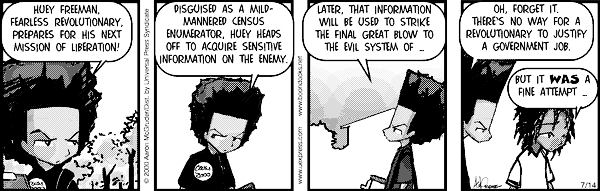
In Friday’s Boondocks re-run, Huey Freeman learns a valuable lesson that certain fearless railroading rEVOLutionaries should have figured out a long time ago.

Huey: Huey Freeman, fearless revolutionary, prepares for his next mission of liberation!

Huey: Disguised as a mild-mannered census enumerator, Huey heads off to acquire sensitive information on the enemy.

Huey: Later, that information will be used to strike the final great blow to the evil system of….

Huey: Oh, forget it. There’s no way for a revolutionary to justify a government job.

Caesar: But it was a fine attempt ….

Happy Dead Prez Day.

Cops are here to protect you.

Cops are here to protect you by looking in on an upset young man who locked himself in a room with a small kitchen knife, then drilling a hole in the wall and spraying pepper spray to force him out from the room when he wouldn’t come out voluntarily, then shooting him to death when the pepper spraying forced him out of the room, because he brought out the small kitchen knife that he had taken in with him.

All for his own good, of course. It became necessary to destroy Scott Rockwell in order to save him.

Cops are here to protect you by using handcuffing and arrest to put an end any argument. Even if you’re a firefighter who’s busy trying to rescue an auto accident victim.

Cops are here to protect you by dumping you out of your wheelchair onto the jailhouse floor, and breaking two of your ribs. Just to make sure you weren’t lying, when you told them you can’t stand up because you’re paralyzed from the shoulders down.

Cops are here to protect you using pain compliance, for example hitting you with 50,000-volt electric shocks at least three different times to make you do what they tell you to do, even when you pose no threat of violence to anyone, when you already have your hands cuffed behind your back, and when you are already surrounded or even pinned down to the ground by three armed professionals.

Cops are here to protect you by pinning a 13 year old boy to the ground and choking him for the crime of skateboarding. Then grabbing a teenaged girl in a chokehold for trying to walk away from the scene. Then wrestling down another teenaged boy who tried to protect her from getting manhandled. Then arresting the lot of them on the grounds that failing to immediately obey a cop’s arbitrary orders is a violation of city ordinances against disorderly conduct.

Cops are here to protect you by threatening a 14 year old boy with juvi for backtalk, threatening to smack your mouth for attitude, wrestling him to the ground to steal his skateboards, screaming in the boy’s face for being addressed as dude, and then turning around to threaten another teenager who happens to be filming their professional conduct.

Cops are here to protect you by trashing your college art project and threatening to beat the hell out of you for using public space in ways that confuse and enrage them.

Please note that if you or I or anyone else without a badge and a gun acted like this, the people around us would more or less universally conclude that we’re belligerent and dangerous lunatics. In fact, if you or I or anyone else without a badge and a gun acted like this, and it was caught on camera, we would soon be in jail for on a charge of assault and battery. When someone with a badge and a gun acts like this, and it’s caught on camera, with a very few exceptions, the worst that ever happens is that they might get fired. The most common response from the powers that be is either to do nothing at all, or else to give the pig a paid vacation and a verbal reprimand. Meanwhile, state legislators propose laws to withhold records of the abuse as classified information for reasons of state security. Fellow cops and freelance sado-fascist blowhards can all be counted on to make up any excuse at all, even in defiance of the clear evidence of their senses, in order to get the pig off the hook, no matter how obviously out-of-control the cop may be and no matter how obviously harmless or helpless his victim.

The mainstream newsmedia writes stories with clauses like this:

The skateboarders, who were violating a city ordinance, are claiming police brutality and some say the pictures back up their claim.

The video shows a 13-year-old being held to the ground by his throat. It also shows a girl being held in what appears to be a chokehold.

— KTHV Little Rock: Video Brings Controversy To Police Department

Other cops say things like this:

Hot Springs Police Department spokesman McCrary Means says, If a subject becomes confrontational, the officer has a right to defend himself. There are certain steps: first of all a verbal command. Like I said, if that subject becomes combative, that officer needs to do all he can do to get that subject under control.

— KTHV Little Rock: Video Brings Controversy To Police Department

Please note that Hot Springs Police Department spokesman McCrary Means believes that police officers have a right to grab you and beat the hell out of you in order to defend themselves against a verbal confrontation.

And freelance police-enabling blowhards write in with letters like this:

In regard to the YouTube video in which the Baltimore police officer seems to go overboard in his actions regarding a teenage skateboarder, I’d point out that teenage boys typically resent authority, often continue to do the wrong thing even after repeated instructions to stop and are, in general, a minor menace to society until they grow out of their teenage years.

When they’re doing something wrong, you can ask them to stop over and over again, and they’ll often simply ignore you until you get loud or otherwise assert your authority.

As the uncle of two teenage boys, I have no doubt that the officer reacted in a normal manner and that he should not be subject to disciplinary action.

Jerry Fletcher
Waldorf

And:

When YouTube recently showed a video of a teenage skateboarder being manhandled by a Baltimore police officer, public reaction was swift and severe.

Mayor Sheila Dixon called him a bad apple and the officer was immediately suspended.

I find this rush to judgment without a complete investigation disturbing, especially as the alleged victim had little more than his feelings hurt.

Police officers put their lives on the line every day, and the lack of public support for these men and women, especially from the mayor’s office, is an embarrassment.

Might it be possible that these kids were just punks harassing a veteran officer? And if these upstanding skater dudes were so in the right, why didn’t they file a complaint against the officer?

Let’s hear the whole story before destroying the career of a dedicated public servant.

E. Mitchell Arion
Goldsboro

If E. Mitchell Arion hasn’t watched the video that he speaks so confidently about, then why keep talking about it when he doesn’t know what he’s talking about? If, on the other hand, he has actually watched the video, he must believe that this hollering uniformed thug is in fact a dedicated public servant whose precious career needs to be handled with kid gloves, even though he watched Officer Salvatore Rivieri going up to one of the people he is supposedly serving, screaming in his face, ordering him around, insulting him, telling him to shut up, threatening him, grabbing him, wrestling him down, shoving him back down to the ground, robbing him of his private property, lecturing him, and getting up in his face about the proper titles to use when the kid addresses his putative servant.

It takes an awfully special kind of dedicated servant to treat you like that.

(Hat tips to Lew, Balko, Anthony Gregory #1, Anthony Gregory #2, Bill Anderson, Anthony Gregory #3, Anthony Gregory #4.)

Further reading:

Anticopyright. All pages written 1996–2026 by Rad Geek. Feel free to reprint if you like it. This machine kills intellectual monopolists.