Rad Geek People's Daily

official state media for a secessionist republic of one

Posts filed under Smash the State

A poem for Nepal

It might not seem like a poetry reading from Rudyard Kipling is the most promising way to commemorate ongoing events in South Asia. But, by jingo, he did turn a good one out in protest of the Boer War; and the Ministry of Culture for this secessionist republic of one would like to offer it in honor of recent events, and in recognition of the danger posed by Geyanendra’s moves toward restoring his political patronage to would-be opposition leaders, in an effort to buy off the opposition. This may also have some application to other deciders I could mention, beyond the Himalayas.

The Old Issue

October 9, 1899

HERE is nothing new nor aught unproven, say the Trumpets,
Many feet have worn it and the road is old indeed.
It is the King–the King we schooled aforetime!
(Trumpets in the marshes–in the eyot at Runnymede!)

Here is neither haste, nor hate, nor anger, peal the Trumpets,
Pardon for his penitence or pity for his fall.
It is the King!–inexorable Trumpets–
(Trumpets round the scaffold at the dawning by Whitehall!)

. . . . .

He hath veiled the Crown and hid the Sceptre, warn the Trumpets,
He hath changed the fashion of the lies that cloak his will.
Hard die the Kings–ah hard–dooms hard! declare the Trumpets,
Trumpets at the gang-plank where the brawling troop-decks fill!

Ancient and Unteachable, abide–abide the Trumpets!
Once again the Trumpets, for the shuddering ground-swell brings
Clamour over ocean of the harsh, pursuing Trumpets–
Trumpets of the Vanguard that have sworn no truce with Kings!

All we have of freedom, all we use or know–
This our fathers bought for us long and long ago.

Ancient Right unnoticed as the breath we draw–
Leave to live by no man's leave, underneath the Law.

Lance and torch and tumult, steel and grey-goose wing
Wrenched it, inch and ell and all, slowly from the King.

Till our fathers 'stablished, after bloody years,
How our King is one with us, first among his peers.

So they bought us freedom–not at little cost
Wherefore must we watch the King, lest our gain be lost,

Over all things certain, this is sure indeed,
Suffer not the old King: for we know the breed.

Give no ear to bondsmen bidding us endure.
Whining He is weak and far; crying Time shall cure.

(Time himself is witness, till the battle joins,
Deeper strikes the rottenness in the people's loins.)

Give no heed to bondsmen masking war with peace.
Suffer not the old King here or overseas.

They that beg us barter–wait his yielding mood–
Pledge the years we hold in trust–pawn our brother's blood–

Howso' great their clamour, whatsoe'er their claim,
Suffer not the old King under any name!

Here is naught unproven–here is naught to learn.
It is written what shall fall if the King return.

He shall mark our goings, question whence we came,
Set his guards about us, as in Freedom's name.

He shall take a tribute, toll of all our ware;
He shall change our gold for arms—arms we may not bear.

He shall break his judges if they cross his word;
He shall rule above the Law calling on the Lord.

He shall peep and mutter; and the night shall bring
Watchers 'neath our window, lest we mock the King–

Hate and all division; hosts of hurrying spies;
Money poured in secret, carrion breeding flies.

Strangers of his counsel, hirelings of his pay,
These shall deal our Justice: sell–deny–delay.

We shall drink dishonour, we shall eat abuse
For the Land we look to–for the Tongue we use.

We shall take our station, dirt beneath his feet,
While his hired captains jeer us in the street.

Cruel in the shadow, crafty in the sun,
Far beyond his borders shall his teachings run.

Sloven, sullen, savage, secret, uncontrolled,
Laying on a new land evil of the old–

Long-forgotten bondage, dwarfing heart and brain–
All our fathers died to loose he shall bind again.

Here is naught at venture, random nor untrue–
Swings the wheel full-circle, brims the cup anew.

Here is naught unproven, here is nothing hid:
Step for step and word for word–so the old Kings did!

Step by step, and word by word: who is ruled may read.
Suffer not the old Kings: for we know the breed–

All the right they promise–all the wrong they bring.
Stewards of the Judgment, suffer not this King!

— Rudyard Kipling (1899-10-09): The Old Issue

Over My Shoulder #20: Damon W. Root (2006), review of David W. Southern’s The Progressive Era and Race

You know the rules; here’s the quote. I’ve mentioned before some of the reasons that I refuse to call myself a Progressive, and why I loathe the current vogue for the term on the Left. I alluded to some of the historical reasons for it but didn’t actually spell the details out at the time. Fortunately, while I was riding to work on the bus a couple days ago I found out that a book review from this month’s issue of Reason said just what I wanted to say, at least as far as the topic of race is concerned. (There are some analogous points to be made about the experiences of women, workers, immigrants, and psychiatric patients during the same dark, violent era. But the book under review deals specifically with the relationship between the Progressive movement and the triumph of Jim Crow in its most brutal incarnation.) So, thanks to Damon W. Root and his review of David W. Southern’s The Progressive Era and Race, here’s a good precis of how I learned to start worrying and loathe Progressivism:

The Progressive movement swept America from roughly the early 1890s through the early 1920s, producing a broad popular consensus that government should be the primary agent of social change. To that end, legions of idealistic young crusaders, operating at the local, state, and federal levels, seized and wielded sweeping new powers and enacted a mountain of new legislation, including minimum wage and maximum hour laws, antitrust statutes, restrictions on the sale and consumption of alcohol, appropriations for hundreds of miles of roads and highways, assistance to new immigrants and the poor, women’s suffrage, and electoral reform, among much else.

Today many on the liberal left would like to revive that movement and its aura of social justice. Journalist Bill Moyers, speaking at a conference sponsored by the left-wing Campaign for America’s Future, described Progressivism as one of the country’s great traditions. Progressives, he told the crowd, exalted and extended the original American Revolution. They spelled out new terms of partnership between the people and their rulers. And they kindled a flame that lit some of the most prosperous decades in modern history.

Yet the Progressive Era was also a time of vicious, state-sponsored racism. In fact, from the standpoint of African-American history, the Progressive Era qualifies as arguably the single worst period since Emancipation. The wholesale disfranchisement of Southern black voters occurred during these years, as did the rise and triumph of Jim Crow. Furthermore, as the Westminster College historian David W. Southern notes in his recent book, The Progressive Era and Race: Reform and Reaction, 1900–1917, the very worst of it–disfranchisement, segregation, race baiting, lynching–went hand-in-hand with the most advanced forms of southern progressivism. Racism was the norm, not the exception, among the very crusaders romanticized by today’s activist left.

At the heart of Southern’s flawed but useful study is a deceptively simple question: How did reformers infused with lofty ideals embrace such abominable bigotry? His answer begins with the race-based pseudoscience that dominated educated opinion at the turn of the 20th century. At college, Southern notes, budding progressives not only read exposés of capitalistic barons and attacks on laissez-faire economics by muckraking journalists, they also read racist tracts that drew on the latest anthropology, biology, psychology, sociology, eugenics, and medical science.

Popular titles included Charles Carroll’s The Negro a Beast (1900) and R.W. Shufeldt’s The Negro, a Menace to American Civilization (1907). One bestseller, Madison Grant’s The Passing of the Great Race (1916), discussed the concept of race suicide, the theory that inferior races were out-breeding their betters. President Theodore Roosevelt was one of many Progressives captivated by this notion: He opposed voting rights for African-American men, which were guaranteed by the 15th amendment, on the grounds that the black race was still in its adolescence.

Such thinking, which emphasized expert opinion and advocated sweeping governmental power, fit perfectly within the Progressive worldview, which favored a large, active government that engaged in technocratic, paternalistic planning. As for reconciling white supremacy with egalitarian democracy, keep in mind that when a racist Progressive championed the working man, the common man, or the people, he typically prefixed the silent adjective white.

For a good illustration, consider Carter Glass of Virginia. Glass was a Progressive state and U.S. senator and, as chairman of the House Committee on Banking and Currency, one of the major architects of the Federal Reserve Act of 1913. He was also an enthusiastic supporter of his state’s massive effort to disfranchise black voters. Discrimination! Why that is exactly what we propose, he declared to one journalist. To remove every negro voter who can be gotten rid of, legally, without materially impairing the numerical strength of the white electorate.

Then there was political scientist John R. Commons, an adviser to the Progressive Wisconsin governor and senator Robert M. LaFollette and a member of Theodore Roosevelt’s Immigration Commission. Commons, the author of Races and Immigrants in America (1907), criticized immigration on both protectionist grounds (he believed immigrants depressed wages and weakened labor unions) and racist ones (he wrote that the so-called tropical races were indolent and fickle).

Woodrow Wilson, whose Progressive presidential legacy includes the Federal Reserve System, a federal loan program for farmers, and an eight-hour workday for railroad employees, segregated the federal bureaucracy in Washington, D.C. I have recently spent several days in Washington, the black leader Booker T. Washington wrote during Wilson’s first term, and I have never seen the colored people so discouraged and bitter as they are at the present time.

Perhaps the most notorious figure of the era was Benjamin Pitchfork Tillman, a leading Southern Progressive and inveterate white supremacist. As senator from South Carolina from 1895 to 1918, Tillman stumped for Free Silver, the economic panacea of the agrarian populist (and future secretary of state) William Jennings Bryan, whom Tillman repeatedly supported for president. Pitchfork Tillman favored such Progressive staples as antitrust laws, railroad regulations, and public education, but felt the latter was fit only for whites. When you educate a negro, he brayed, you educate a candidate for the penitentiary or spoil a good field hand.

— Damon W. Root, Reason (May 2006): When Bigots Become Reformers: The Progressive Era’s shameful record on race, pp. 60–61.

As Southern thoroughly documents, Root notes a bit further down, these examples just begin to scratch the surface. Progressivism was infested with the most repugnant strains of racism. That was no accident. And it wasn’t just some minor blight on a basically good movement. It was part and parcel of Progressivism, its pseudodemocratic anti-radicalism, its sustained assault on autonomous, state-free mutual aid assocations and labor unions, its contemptuous pity for the downtrodden, and its embrace of the government-backed Expert as the natural person to solve their problems for them (whether they liked it or not). It’s long past time for Progressivism to be left in the dustbin of history, for we as a society, and the left as a movement, to progress beyond that kind of adolescent power trip to a theory and practice based on respect, mutuality, solidarity, and freedom. Dump the bosses of your back.

Further reading:

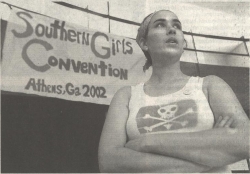
Southern Girls Convention comes to Houston: a feminist shindig deep in the heart of Texas, June 23-25, 2006

The Eighth Annual Southern Girls Convention will be held June 23-25, 2006, in Houston, Texas. Spread the word to anyone you think might be interested!

SGC is an unapologetically feminist, bottom-up, grassroots meeting. Each year for the past seven years, it’s brought out hundreds of rad folks to a different Southern community, with the help of a new set of local organizers, working together with organizers from years past (if you didn’t know, I’m one myself; together with my friends Claire Rumore and Ailecia Ruscin, I helped put on the third annual Southern Girls Convention, which drew about 600 radical activists to Auburn, Alabama). SGC is a space to meet and to talk and to learn from each other–learning skills for activism and everyday life, sharing our experiences organizing deep in the heart of the so-called Red States, and taking it home to raise hell and work together to make our homes freer, safer, more just, and more loving places to be. It’s a place for Southern feminists to find each other, get together, work out our plans and our priorities, and begin to build the communities we want to live in, right in our own hometowns.

photo: Natasha Murphy

SGC’02 organizer Natasha Murphy

The convention’s started in Memphis, Tennessee, and has been held in Louisville, Kentucky; Auburn, Alabama; Athens, Georgia; Asheville, North Carolina; in Memphis, again; and in Baton Rouge, Louisiana. This year the seventh annual Southern Girls Convention will be held on June 23-25, 2006, in Houston, Texas. We’re working to remember, and to join, the radical tradition of the American South–the cradle of the Confederacy and the birthplace of the Klan, yes, but also–lest we forget–the home of the modern Civil Rights movement, the birthplace of SNCC, and the home of women like Sarah and Angelina Grimke, Ida B. Wells, Fannie Lou Hamer, Casey Hayden, Ti-Grace Atkinson, and Rita Mae Brown (just to name a few). In that tradition, we’re working to build an infrastructure for women’s liberation in the South — because the South is our home, it needs to change, and by God we’ll be the ones to do it.

There will be a weekend of workshops and social events for sharing skills, learning from each other about issues and campaigns, and just meeting and talking (or networking, as they say) with each other. There will be music shows, free food, and a free arts and crafts fair to enjoy. There will also be childcare for children over the age of one, incidentally, and children will also be welcome in the convention space. Interested? Consider registering to attend. While you’re at it, if you have a skill you’d like to share or an issue or organization you’d like to talk with radical folks from across the South about, you should consider proposing a workshop! Part of the point of Southern Girls Convention is that we can all learn from each other; we don’t need professional activists coming in from the North to lecture us about how to organize ourselves. (N.B.: this doesn’t mean that professional activists from the North will be unwelcome at SGC; if you are one, we’d love for you to come. Just don’t expect it to be all about you!)

Here’s the announcement from this year’s organizers. Be sure to spread the word.

We are counting on you to spread the word for us! Please forward this message to any friends, family, colleagues, bulletin boards, listservs, or web pages that might be interested in the event!


Eighth Annual Southern Girls Convention

June 23-35, 2006
Houston, Texas

WWW: http://southerngirlsconvention.org/2006/

WHAT IS SOUTHERN GIRLS CONVENTION?

The Southern Girls Convention is an annual grassroots meeting for networking, organizing, educating, agitating, and activism, devoted to empowering women, girls, and transfolks in the South, and to furthering the struggle for social justice. Each year’s convention is hosted by a different Southern community and facilitated by local organizers. Past conventions have brought together hundreds of folks in Memphis, Tennessee; Louisville, Kentucky; Auburn, Alabama; Athens, Georgia; Asheville, North Carolina; and Baton Rouge, Louisiana.

This year, Southern Girls Convention invites activists from across the country to meet in HOUSTON, TEXAS on the weekend of June 23-25, 2006. Hundreds of activists will meet for discussion, action, and entertainment devoted to building a feminist community in the South.

WHAT CAN I DO THERE?

Southern Girls Convention is based around discussions, workshops, and presentations which give participants the opportunity to share skills, share ideas, discuss important issues, organize campaigns, and have fun as a ommunity. All workshops are organized and facilitated by the participants themselves–that means you! (Have a great idea for a workshop? Fill out our online form at http://southerngirlsconvention.org/2006/workshops.)

Other events will include an arts and craft fair, nightly music shows, and tables for participants and organizations to display information, zines, art, and things they have made.

SGC also allows hundreds of activists from across the country to meet, network, strategize, and organize in their efforts on behalf of social justice. Feel free to bring video projects, zines, writing, and anything you are interested in sharing to the convention.

Childcare will be available at the convention space. Housing will be provided for those who register in advance.

Past workshops at SGC have included:

  • Group discussions on fatphobia, abortion rights and access, radical parenting, “100 Years of Revolutionary Wimmin,” the criminalization of women, “Queer and Trans Youth in the South,” gender bias in schools, sexism in the activist community, “Marginalization and Tokenization within the Grrrl Movement,” roles and strategies for boys in the struggle against male supremacy, and “Radical, Southern, and All Fired Up–Where Do We Go From Here?”

  • Skill-sharing on radical cheerleading, community access television, gun safety and self-defense, workplace union organizing, screen printing, sexercises, Internet organizing, and how to start a consciousness-raising group.

  • Organizing meetings for campaigns from Amnesty International, the Coalition of Immokalee Workers, and Planned Parenthood, and state-by-state caucuses for people to meet fellow organizers in their own area.

FOR MORE INFORMATION:

PLEASE FORWARD THIS E-MAIL FAR AND WIDE! Send it to friends and e-mail lists, post it on your website, blog, or bulletin board… we are counting on YOU to help us spread the word. A fresh copy of the e-mail can be sent from our website at: http://southerngirlsconvention.org/2006/spread-the-word

Thank you, and we hope to see you there!

Southern Girls Convention 2006 Organizers
Houston, Texas

I’m doing my part with this note and a banner at the top of the page. If you’d like to support SGC, here’s some things you can do to help out:

Further reading:

Prior restraint

Is there anything as ridiculous and petty, in the end, as the arrogance of power?

But it was a different story when Westword and then the Rocky Mountain News published more extensive excerpts from Harris’s writings. The excerpts showed that Harris had developed detailed plans to attack the school a year in advance, while he was in a juvenile diversion program and supposedly being investigated for building pipe bombs and making death threats (I’m Full of Hate and I Love It, December 6, 2001). Now officials were outraged that their top-secret investigation had sprung yet another leak.

So was the Denver Post. Tired of getting its ass whupped in the leak department, the Post went to court to demand the release of the rest of the materials seized from the killers’ homes. Attorneys for the county and the killers’ parents responded with a flurry of dire warnings about copycat effects, including one from David Shaffer, a psychiatrist and expert on adolescent suicide. In addition to a 27-page resumé, Shaffer submitted a four-page affidavit asserting the toxic nature of the basement tapes, which he hadn’t seen.

Some judges involved in the Columbine litigation have uncritically embraced the copycat argument, saying the disclosure of the materials would have a potential for harm or, in fact, would be immensely harmful to the public. [District Judge Brooke Jackson], who ultimately may have to decide the matter, has been more skeptical. In one hearing on the basement tapes, he pointed out that there were plenty of Columbine imitators before the existence of the tapes was even disclosed. All the more reason, [Assistant County Attorney Lily Oeffler] responded, not to release them.

What evidence do you have today that release of the documents is going to cause some calamity, or are we just speculating? Jackson demanded.

Unless you release the evidence and they actually cause the calamity, Your Honor, the question cannot be responded to, Oeffler shot back.

Does that mean I can’t, and no court can ever release them because maybe some additional copycat is going to be inspired?

I don’t think it is a maybe, Your Honor, Oeffler responded gravely.

— Alan Prendergast, Westword (2006-04-13): Hiding in Plain Sight: Are Columbine’s remaining secrets too dangerous for the public to know — or too embarrassing for officials to reveal?

(Link courtesy of Rox Populi 2006-04-19: Doomed to Repeat It.)

It’s hard not to find the whole thing grimly funny, and not just because the Oeffler sounds exactly like the sort of name Dr. Seuss would invent for some otherwise anonymous, off-screen minion of paternalistic censorship. And then, just to add insult to injury, there’s this:

One proposed solution to the question of the killers’ tapes and writings, advanced by Ken Salazar before he left the post of Colorado attorney general for the U.S. Senate, was to turn over the materials to a qualified professional, who would author a study about the causes of Columbine while keeping the primary materials in strict confidence. The proposal soon fell apart, though, after the killers’ parents refused to cooperate with Salazar’s anointed expert, Del Elliott, director of the University of Colorado’s Center for the Study and Prevention of Violence.

— Alan Prendergast, Westword (2006-04-13): Hiding in Plain Sight: Are Columbine’s remaining secrets too dangerous for the public to know — or too embarrassing for officials to reveal?

Or maybe it’s because they couldn’t find John Ray Jr., Ph.D., to take on the job.

Further reading:

Direct Action

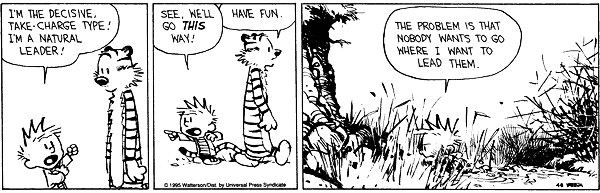
Here’s a recent strip from the Calvin and Hobbes reruns. This one’s going up on my door.

I’m the decisive, take-charge type! I’m a natural leader!

[Calvin points off to the left]

See! We’ll go this way!

[Hobbes turns to the right and walks away]

Have fun.

[Calvin is trudging through a muddy creek alone.]

The problem is that nobody wants to go where I want to lead them.

When we have won, this is what freedom will look like. It won’t take any ballot boxes and it won’t take political parties, let alone guns and barricades. Direct action means being able to walk the other way and just ignore them.

Happy Easter, y’all.

Anticopyright. All pages written 1996–2026 by Rad Geek. Feel free to reprint if you like it. This machine kills intellectual monopolists.