Rad Geek People's Daily

official state media for a secessionist republic of one

Posts filed under Smash the State

Murder in the first

As you probably know by now, mercy was denied, and Stanley Tookie Williams was murdered by the state of California at 12:35 am this morning. In other news, none of his alleged victims came back to life and there are no reports of murders having been deterred in the state of California.

Here are some things I don’t care about today.

I don’t care whether Tookie repented, deep down in his heart, or whether he was trying to put on a good face in order to save his skin.

I don’t care whether Tookie’s trial was fair or not.

I don’t care about whether Tookie was innocent or guilty of the crimes for which he was slaughtered.

I don’t care about whether Tookie was innocent or guilty of a bunch of other crimes that he has or hasn’t copped to.

I don’t give a damn about what kind of message mercy would have sent. Or what kind of message slaughtering him did send.

And if I hear one more goddamned professional blowhard cheerfully pontificating about the calculated electoral pandering that informed Governor Schwarzenegger’s deliberations over a man’s life, as if there were nothing unexpected or wrong with snuffing out a human life in order to make sure that your political base stays behind you, I am going to scream. And cry.

Regardless of the fickle electoral preferences of California Republicans, the messages that the State’s Harrow might inscribe into a man’s body for the edification of unnamed others, his guilt or innocence, the adequacy of his trial, or the inner state of his soul, Tookie would have posed no more credible threat to anyone alive in San Quentin without the possibility of parole than he does now that he has been poisoned to death. I wouldn’t presume to know whether he, or anyone in this vale of tears, deserved to live or deserved to die. What could give me the right to say? More to the point, what ever gave the hangmen and politicians of the state of California the right to say?

I do know that if he did deserve to die, we would have no right to give him what he deserves. Blood vengeance is not ours to dispense. Would you have sanctioned the premeditated murder if one of the other inmates managed to break out and slit Tookie’s throat in the middle of the night, just ’cause he deserved to die? If so, why? If not, what makes the relevant moral difference between the criminal and the State’s hangman?

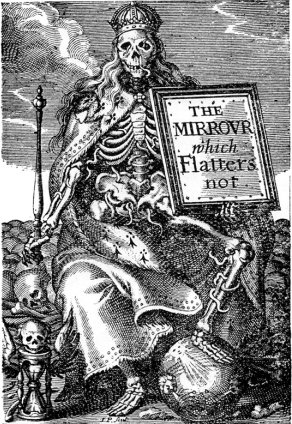
The death penalty is the definitive expression of what the power of the imperium means. It means that the State claims a special right to control you, to beat you, to tie you down, and to kill you, at its own pleasure and discretion, a claim that would be universally met with indignation and horror if it came from anyone else, if it weren’t covered with the robes and the crown. The death penalty — an act of State-sanctioned murder whether the victim is good or evil, innocent or guilty, redeemed or sinful — shows the State in all of its power and all of its glory, in the mirror that flatters not.

engraving: a ghastly skeleton, robed and crowned, holds a sceptre and a polished glass with the words, THE MIRROR THAT FLATTERS NOT

The State is Death. That is its power. That is its justice. That is its law.

At 12:35 a.m., it claimed Tookie Williams. It must be stopped before it claims even one more life.

Further reading:

Over my shoulder #1 (or: Friday Book-Bragging)

Everyone’s got their own Friday afternoon game to play, and this one’s mine. I’m introducing a new recurring feature for the Rad Geek People’s Daily: Over My Shoulder, quotes (mostly without commentary) from something I’ve been reading this week. Irony to one side, this isn’t really intended as bragging about my reading list; the point is that what I’m reading is a way of getting at things I’ve been thinking about, even if I don’t yet have a confident position to stake out yet; and also that there are a lot of people out there who are smarter than I am, and not everything they write is something I can link to in online commentary or read the whole thing weblog posts. So here’s the rules.

  1. The quote should be something that I have read, in print, over the course of the past week. (It has to be something I’ve actually read, and not something that I’ve read a page of just in order to be able to post my favorite quote.)

  2. It should be a matter of one or a few paragraphs.

  3. There’s no commentary above and beyond a couple sentences, more as context-setting or a sort of caption for the text than as a discussion.

  4. Quoting a passage doesn’t entail endorsement of what’s said in it. Sometimes I agree and sometimes I don’t. Whether I do or not isn’t really the point of the exercise anyway.

If you like this idea, feel free to repeat it or adapt it as you see fit on your own page or in the comments. (Just please don’t call it a meme: there’s no such thing. Thanks.)

And we’re off. The inaugural selection is a bit I read yesterday on the bus, from the first chapter of Paul Buhle’s Taking Care of Business: Samuel Gompers, George Meany, Lane Kirkland, and the Tragedy of American Labor (all emphasis is in the original):

Fraina argued that what he called state capitalism, an expansive capitalist state embracing administrative centralization and militarization, had rendered the old socialist expectations irrelevant. Liberalism, as it had taken ideological form (Fraina found fault in the philosophy of pragmatism), now offered the intellectual counterpart to AFL unionism, narrowing the range of radical thought, aiding and assisting the upper classes and upper strata of labor against the threat of the irrational lower classes and of the world’s suffering peoples at large.

Fraina directed the sharpest of his polemics against William English Walling, a renowned socialist intellectual en route to becoming an AFL spokesman. Walling had observed shrewdly that socialists had been blind to the inner strengths of capitalism, the increased power and strength that it will gain through state capitalism and the increased wealth that will come through a beneficent and scientific policy of production. Being regulated, the system would be successively transformed by the mechanics of a complex struggle: a state capitalism under the hegemony of big and petty bourgeoisie would besupplanted by a state socialism under the petty bourgeoisie and the skilled workers. In the process, the allegedly messianic character of socialism would fall away entirely, and the social question would become no more than the struggle by those who have less, against those who have more in matters of income, hours, leisure, places of living, associations, and opportunity. Such a struggle could be properly ordered, guided by reform through existing institutions. The disorder implied by the ideas and very constituency of the IWW was, finally, a danger to the social détente which could make this benign process possible.

Even in AFL circles, confidence in such a benign outcome wavered. As the class conflicts of 1909-1913 took shape, skilled workers once again began to perceive that the emerging system often delivered fewer benefits for them than thinkers like Walling predicted. Solidarity campaigns of mutual support in strikes, like a dramatic one by railroad workers over several years, violated the AFL norm of workers with union contracts crossing picket lines and in effect scabbing on those still striking. The attempt at coordination by railroad brotherhoods, the appearance of metal trades councils, and (by the time of the war) the appeal for solidarity among the skilled and unskilled often bypassed the idea of political or electoral socialism altogether for a more popular American idea: workers’ control of production. Many local AFL members and even leaders unmoved by socialism mulled the idea, while Gompers’s circle rejected it out of hand as impossible and undesirable, an erasure of the line between labor’s prerogative and capital’s rights.

Conservative chiefs of AFL unions ranging from the hatters and pattern-makers to tailors, sheet metal workers, carpenters, and machinists, all lost their offices to socialist-backed candidates during 1911-1912 on grounds of solidarity versus conciliation with employers. A combination of administrative manipulation, political alliances with Democrats inside labor, and forceful support of labor conservatives by the Catholic Church was required to bring anti-socialist functionaries back into union office. The renewed victory of Gompers was sealed by the events of the First World War. As labor surged forward, anti-war ideas were in many parts of the country forbidden in published or spoken form, and those who voiced them faced deportation, arrest, beatings by vigilantes, and even lynching. The IWW, which carefully refrained from any political statements, was nevertheless suppressed in a fashion unknown hitherto in the United States, save perhaps for the attacks on Reconstructionist radicals in the post-Civil War South. This time, the modern version of the Ku Klux Klan had the presidential seal of approval and top labor leaders’ avid cooperation. Gompers demanded political acquiescence to the war, or at least silence, as the price of admission for newcomers to the AFL’s own swelling wartime bureaucracy. Upwardly mobile intellectuals around labor, like Walling, made their contribution by insisting that the U.S. economic empire that had expanded dramatically in wartime was benevolent, and that the leaders of the AFL, in their appeals for loyalty to government and indifference to those suppressed, accurately represented the interests of the working class.

Regulated state capitalism did indeed take shape, even by 1917, though it more resembled Fraina’s nightmares than Walling’s dreams. As newspapers were suppressed, Socialist Party offices destroyed, and local and national anti-war spokespeople, including Eugene Debs, sentenced to long terms in prison, Fraina acutely observed that the newly regulated system included the extension of the functions of the federal government, regulation equally of capital and labor, the Strong Man policy of administrative centralization, and the mobilization of everything by a national administrative control of industry. Having failed to organize an international system to regulate the transfer of profits among ruling groups, capitalism now rended the world, and (as Fraina correctly anticipated the worse horrors to come in the next world war and after) prepared the basis for future global conflicts. In that process, Fraina argued, leaders like Gompers could be depended upon to serve their true masters, while former socialists like Walling would tag along and rationalize the process–as perhaps termporarily dreadful but inevitable, and ultimately beneficial.

— Paul Buhle, Taking Care of Business: Samuel Gompers, George Meany, Lane Kirkland, and the Tragedy of American Labor, pp. 69-71.

Remember. Mourn. Act.

On 6 December 1989, sixteen years ago today, Marc Lepine murdered 14 women at Montreal’s Ecole Polytechnique. He killed them because they were women; he went into an engineering class with a gun, ordered the men to leave, screamed I hate feminists, and then opened fire on the women. He kept shooting, always at women, as he moved through the building, killing 14 women and injuring 8 before he ended the terror by killing himself.

6 December is a day of remembrance for the women who were killed. They were:

  • Geneviève Bergeron, aged 21
  • Hélène Colgan, 23
  • Nathalie Croteau, 23
  • Barbara Daigneault, 22
  • Anne-Marie Edward, 21
  • Maud Haviernick, 29
  • Barbara Maria Klucznik, 31
  • Maryse Leclair, 23
  • Annie St.-Arneault, 23
  • Michèle Richard, 21
  • Maryse Laganière, 25
  • Anne-Marie Lemay, 22
  • Sonia Pelletier, 28; and
  • Annie Turcotte, aged 21

I don’t have much to add today, except to repeat what I said last year:

The Montreal Massacre was horrifying and shocking. But we also have to remember that it’s less unusual than we all think. Yes, it’s a terrible freak event that some madman massacred women he had never even met because of his sociopathic hatred. But every day women are raped, beaten, and killed by men–and it’s usually not by strangers, but by men they know and thought they could trust. They are attacked just because they are women–because the men who assault them believe that they have the right to control women’s lives and their sexual choices, and to hurt them or force them if they don’t agree. By conservative estimates, one out of every four women is raped or beaten by an intimate partner sometime in her life. Take a moment to think about that. How much it is. What it means for the women who are attacked. What it means for all women who live in the shadow of that threat.

On what seems like an unrelated topic, I’ve been asked before, and I’m sure I’ll be asked again, what it is that makes me so sympathetic to, and inspires me in, radical feminism, and Andrea Dworkin’s version of radical feminism specifically. That’s a question that gets tossed at anyone who expresses sympathy for or interest in Dworkin’s work, but I guess it’s supposed to be especially puzzling in my case, as someone who’s (1) male and (2) pretty stridently libertarian in my politics. There are a lot of things to say in response, but the one that means the most is to say that Andrea Dworkin takes violence against women seriously. What it means for violence, and the threat of violence, to be so pervasive, systematic, intense, and socially invisible or culturally excused. The demands that places on all of us. The urgency and seriousness of the struggle that it calls for. The fact that I’m male (and that I’ve had to make the painful realization of how often what I’ve said and what I’ve done hurt women, how much it was shaped by, and participated in, the same system of male supremacy that has hurt some of my dearest friends and family so badly) harldy overrides the fact that, well, what she says is true. (I know it’s true, because it’s happened to my friends.) And the fact that my politics are centrally concerned with a radical and comprehensive commitment to human freedom makes the insights offered by Andrea Dworkin (and Catharine MacKinnon and Susan Brownmiller and Robin Morgan and…) more, not less urgently needed. As I’ve written elsewhere (with my friend Roderick Long):

Brownmiller’s and other feminists’ insights into the pervasiveness of battery, incest, and other forms of male violence against women, present both a crisis and an opportunity for libertarians. Libertarianism professes to be a comprehensive theory of human freedom; what is supposed to be distinctive about the libertarian theory of justice is that we concern ourselves with violent coercion no matter who is practicing it—even if he has a government uniform on. But what feminists have forced into the public eye in the last 30 years is that, in a society where one out of every four women faces rape or battery by an intimate partner,2 and where women are threatened or attacked by men who profess to love them, because the men who attack them believe that being a man means you have the authority to control women, male violence against women is nominally illegal but nevertheless systematic, motivated by the desire for control, culturally excused, and hideously ordinary. For libertarians, this should sound eerily familiar; confronting the full reality of male violence means nothing less than recognizing the existence of a violent political order working alongside, and independently of, the violent political order of statism. As radical feminist Catharine MacKinnon writes, “Unlike the ways in which men systematically enslave, violate, dehumanize, and exterminate other men, expressing political inequalities among men, men’s forms of dominance over women have been accomplished socially as well as economically, prior to the operation of the law, without express state acts, often in intimate contexts, as everyday life” (1989, p. 161). Male supremacy has its own ideological rationalizations, its own propaganda, its own expropriation, and its own violent enforcement; although it is often in league with the male-dominated state, male violence is older, more invasive, closer to home, and harder to escape than most forms of statism. This means that libertarians who are serious about ending all forms of political violence need to fight, at least, a two-front war, against both statism and male supremacy …

Here is the speech that Andrea Dworkin gave at the University of Montreal, a year and a day after the massacre:

Feminists should remember that while we often don’t take ourselves very seriously, the men around us often do. I think that the way we can honor these women who were executed, for crimes that they may or may not have committed–which is to say, for political crimes–is to commit every crime for which they were executed, crimes against male supremacy, crimes against the right to rape, crimes against the male ownership of women, crimes against the male monopoly of public space and public discourse. We have to stop men from hurting women in everyday life, in ordinary life, in the home, in the bed, in the street, and in the engineering school. We have to take public power away from men whether they like it or not and no matter what they do. If we have to fight back with arms, then we have to fight back with arms. One way or another we have to disarm men. We have to be the women who stand between men and the women they want to hurt. We have to end the impunity of men, which is what they have, for hurting women in all the ways they systematically do hurt us.

–Andrea Dworkin (1990): Mass Murder in Montreal, Life and Death, 105-114.

And, as I said last year:

To be serious about creating a free and just society, we have to be serious about ending violence against women. As Andrea Dworkin puts it (speaking about sexual assault), I want to see this men’s movement make a commitment to ending rape because that is the only meaningful commitment to equality. It is astonishing that in all our worlds of feminism and antisexism we never talk seriously about ending rape. Ending it. Stopping it. No more. No more rape. In the back of our minds, are we holding on to its inevitability as the last preserve of the biological? Do we think that it is always going to exist no matter what we do? All of our political actions are lies if we don’t make a commitment to ending the practice of rape. This commitment has to be political. It has to be serious. It has to be systematic. It has to be public. It can’t be self-indulgent. And the same is true of every form of everyday gender terrorism–stalking, battery, rape, murder. How could we face Geneviève Bergeron, Hélène Colgan, Nathalie Croteau, Barbara Daigneault, Anne-Marie Edward, Maud Haviernick, Barbara Maria Klucznik, Maryse Leclair, Annie St.-Arneault, Michèle Richard, Maryse Laganière, Anne-Marie Lemay, Sonia Pelletier, Annie Turcotte, and tell them we did anything less?

Take some time to keep the 14 women who were killed in the Montreal massacre in your thoughts. If you have the money to give, make a contribution to your local battered women’s shelter. As Jennifer Barrigar writes:

Every year I make a point of explaining that I’m pointing the finger at a sexist patriarchal misogynist society rather than individual men. This year I choose not to do that. The time for assigning blame is so far in the past (if indeed there ever was such a time), and that conversation takes us nowhere. This is the time for action, for change. Remember Parliament’s 1991 enactment of the National Day of Remembrance and Action on Violence Against Women — the glorious moment when every single womyn in the House stood together and claimed this Day of Remembrance. Remember what we can and do accomplish — all of us — when we work together. It is time to demand change, and to act on that demand. Let’s break the cycle of violence, and let’s do it now.

Remember. Mourn. Act.

Elsewhere
Well, thank God #2

In the latest news from the world’s greatest deliberative bodies (thanks to Catallarchy 2005-12-02), Texas Republican Joe Barton has continued his diligent work to promote a conservative agenda and protection of individual rights by finding another unregulated industry for the House Energy and Commerce subcommittee’s tender ministrations.

College football is not just an exhilarating sport, but a billion-dollar business that Congress cannot ignore, said committee Chairman Joe Barton, a Texas Republican. Barton’s panel is separate from the House Government Reform panel that tackled steroids in baseball.

So Barton and the committee he chairs will be convening a Congressional hearing next on the compelling State interest of what ranking system collegiate football teams should use to determine the national championship.

The committee announcement called the hearing, scheduled for next Wednesday, a comprehensive review of the BCS and postseason college football.

Too often college football ends in sniping and controversy, rather than winners and losers, Barton said. The current system of determining who’s No. 1 appears deeply flawed.

Well, thank God, says I; it’s about time. If the State doesn’t provide a final arbiter to disputes over who the #1 college football team in the United States is, how will we avoid chaos?

Further reading

Grover Norquist, anarchist?

Did you know …

  1. … that Christian anarchism (think William Lloyd Garrison or Leo Tolstoy) is just like anti-abortion terrorism and Christian Reconstructionism?

  2. … that if you, personally, don’t mind chipping in for public roads, schools and sewer systems, that constitutes a knock-down refutation of the anarcho-capitalist complaint against taxation?

  3. … that anti-capitalist anarchists are in fact Maoists who want a do-over of Bolshevik totalitarianism?

  4. … that dismantling the right of habeas corpus is, in fact, a step towards anarchism?

  5. … that Republican legislators and lobbyists who occasionally express contempt for government are, in fact, paradigm cases of anarchists?

It’s true! I read it on the Internet.. (Thanks, Guerilla Science.)

Here, at least, is something that anarchists of all sects, organizations, and creeds can come together on: Lisa Jones is a know-nothing blowhard. You can let her know what you think at HeyJones@gmail.com. Here’s my contribution:

Ms. Jones,

I recently read your column, The battle between law and anarchy, for the Rocky Mountain News. You wondered if most political debates today aren’t between right and left, but between anarchism and rule of law. I think you’re probably right, but I can’t say that I’m entirely convinced by your brief in favor of the rule of law.

There’s a lot to wonder about; for example, your comparison of the pacifist Christian anarchism of Leo Tolstoy or William Lloyd Garrison (who described complete nonviolence as one of the highest Christian duties) to the statist politics of the Christian Reconstruction movement seems a bit strained, as does your attempt to compare anti-capitalist anarchists such as Emma Goldman or Mikhail Bakunin to the death march of forced collectivism under Mao Zedong. (For the record, you might try reading the extensive and fierce anarchist polemics against Bolshevik tyranny, such as Goldman’s My Disillusionment in Russia.) I was also a bit puzzled by your attempt to portray Republican lobbyist Grover Norquist as an anarchist, when part of the point of the quip that you refer to (about making government so small you can drown it in the bathtub) is that he doesn’t want to abolish the government.

But for the moment I want to focus on a more theoretical point. In the course of criticising anarcho-capitalism, you say:

But anarcho-capitalists also oppose taxation and the very existence of the state. They want to privatize all public institutions, such as schools, and rely on a self-regulating competitive marketplace instead of government. …

Plus, I don’t mind chipping in for public roads, schools and sewer systems. Insofar as tax revenues are used wisely for the common good, I support limited taxation.

Actually, all anarchists oppose taxation and the very existence of the state. That’s what makes them anarchists rather than statists. But I’m a bit puzzled by the justification you give for limited taxation. If you, personally, don’t mind chipping in for public roads, schools, and sewer systems, then no anarchist would suggest that you shouldn’t be allowed to get out your checkbook and make a donation. But that’s not taxation. Taxation is what happens when other people who don’t want to chip in are forced to do so. Do you think that you have the right to sign away other people’s money without their consent? If not, why does your personal willingness to pay for public goods have anything to do with the argument?

Curiously,
Charles Johnson

Let’s hear your response!

Anticopyright. All pages written 1996–2026 by Rad Geek. Feel free to reprint if you like it. This machine kills intellectual monopolists.