Note added 2010-02-02. Since I originally wrote this article in 2005, it has attracted a great deal of attention through Google and become a common reference point for people looking for information on Robert E. Lee’s opinions and practices when it came to slavery. In order to help people who come here for information on Lee, I’ve since added a series of links at the bottom of this article on other things I’ve written and discovered concerning Lee’s views and experience on race and slavery since this article was originally written.
I’ve spent some time ragging on neo-Confederate mythistory here before; today I’d like to take a bit of time to talk about another of the idiot notions popular with the Stars-and-Bars crowd: the idea that Robert E. Lee opposed slavery, or that he didn’t own any slaves. No he didn’t, and yes he did. Robert E. Lee defended the institution of slavery and personally owned slaves.
Lee cheerleaders love to point out that Lee wrote to his wife, in 1856, that In this enlightened age, there are few I believe, but what will acknowledge, that slavery as an institution, is a moral & political evil
He did write that, but the use of the quotation is dishonest. The quote is cherry-picked from a letter that Lee wrote to his wife on December 27, 1856; the passage from which it was taken actually reads:
In this enlightened age, there are few I believe, but what will
acknowledge, that slavery as an institution, is a moral &
political evil in any Country. It is useless to expatiate on its
disadvantages. I think it however a greater evil to the white
man than to the black race, & while my feelings are strongly
enlisted in behalf of the latter, my sympathies are more strong for
the former. The blacks are immeasurably better off here than in
Africa, morally, socially & physically. The painful discipline
they are undergoing, is necessary for their instruction as a race,
& I hope will prepare & lead them to better things. How
long their subjugation may be necessary is known & ordered by a
wise Merciful Providence.
—Robert E. Lee, letter to his wife on slavery
(December 27, 1856)
Lee, in other words, regarded slavery as an evil
–but a necessary evil ordained by God as the white man’s burden
. Far from expressing opposition to the institution of slavery, the purpose of his letter was actually to condemn abolitionists; the letter was an approving note on a speech by then-President Franklin Pierce, which praised Pierce’s opposition to interference with Southern slavery, and declared that the time of slavery’s demise must not be sped by political agitation, but rather left to God, with whom two thousand years are but as a Single day.
After that reassuring note, Lee goes on to offer an impassioned plea for toleration of the Spiritual liberty
to enslave an entire race:
Although the Abolitionist must know this, & must See that he
has neither the right or power of operating except by moral means
& suasion, & if he means well to the slave, he must not
Create angry feelings in the Master; that although he may not
approve the mode which it pleases Providence to accomplish its
purposes, the result will nevertheless be the same; that the
reasons he gives for interference in what he has no Concern, holds
good for every kind of interference with our neighbors when we
disapprove their Conduct; Still I fear he will persevere in his
evil Course. Is it not strange that the descendants of those
pilgrim fathers who Crossed the Atlantic to preserve their own
freedom of opinion, have always proved themselves intolerant of the
Spiritual liberty of others?
And what did the painful discipline … necessary for their instruction
mean? One of the sixty-three slaves that Lee inherited from his father-in-law explains:
My name is Wesley Norris; I was born a slave on the plantation of
George Parke Custis; after the death of Mr. Custis, Gen. Lee, who
had been made executor of the estate, assumed control of the
slaves, in number about seventy; it was the general impression
among the slaves of Mr. Custis that on his death they should be
forever free; in fact this statement had been made to them by Mr.
C. years before; at his death we were informed by Gen. Lee that by
the conditions of the will we must remain slaves for five years; I
remained with Gen. Lee for about seventeen months, when my sister
Mary, a cousin of ours, and I determined to run away, which we did
in the year 1859; we had already reached Westminster, in Maryland,
on our way to the North, when we were apprehended and thrown into
prison, and Gen. Lee notified of our arrest; we remained in prison
fifteen days, when we were sent back to Arlington; we were
immediately taken before Gen. Lee, who demanded the reason why we
ran away; we frankly told him that we considered ourselves free; he
then told us he would teach us a lesson we never would forget; he
then ordered us to the barn, where, in his presence, we were tied
firmly to posts by a Mr. Gwin, our overseer, who was ordered by
Gen. Lee to strip us to the waist and give us fifty lashes each,
excepting my sister, who received but twenty; we were accordingly
stripped to the skin by the overseer, who, however, had sufficient
humanity to decline whipping us; accordingly Dick Williams, a
county constable, was called in, who gave us the number of lashes
ordered; Gen. Lee, in the meantime, stood by, and frequently
enjoined Williams to lay it on well,
an injunction which he
did not fail to heed; not satisfied with simply lacerating our
naked flesh, Gen. Lee then ordered the overseer to thoroughly wash
our backs with brine, which was done. After this my cousin and
myself were sent to Hanover Court-House jail, my sister being sent
to Richmond to an agent to be hired; we remained in jail about a
week, when we were sent to Nelson county, where we were hired out
by Gen. Lee’s agent to work on the Orange and Alexander railroad;
we remained thus employed for about seven months, and were then
sent to Alabama, and put to work on what is known as the
Northeastern railroad; in January, 1863, we were sent to Richmond,
from which place I finally made my escape through the rebel
lines to freedom; I have nothing further to say; what I have stated
is true in every particular, and I can at any time bring at least a
dozen witnesses, both white and black, to substantiate my
statements: I am at present employed by the Government; and am at
work in the National Cemetary on Arlington Heights, where I can be
found by those who desire further particulars; my sister referred
to is at present employed by the French Minister at Washington, and
will confirm my statement.
—Testimony of Wesley Norris (1866); reprinted in John W.
Blassingame (ed.): Slave
Testimony: Two Centuries of Letters, Speeches, and Interviews, and
Autobiographies Baton Rouge: Louisiana State University
Press (ISBN
0-8071-0273-3). 467-468.
Some Lee hagiographers seem to be completely unaware that Lee ever owned slaves, much less treated them like this. Part of that’s just the warping of tidbits they heard elsewhere–it’s true that Lee did not own any slaves during most of the Civil War–and part of it is, frankly, dishonest fudging–Lee’s sixty-three slaves were, in spite of being legally under his control and forced to work on his plantation, not held under his own name, but rather temporarily under his control as an inheritance from his father-in-law, G.W.P. Custis. Other Lee cheerleaders recognize that Lee did own slaves, but give him props for manumitting them. What they leave out of the record is that Custis’s will legally required Lee to emancipate the slaves that passed into his control within five years of Custis’s death. Custis died October 10, 1857 and his will was probated December 7, 1857 (about a year after Lee wrote his letter on slavery); Lee kept the slaves as long as he could, and finally filed the deed of manumission with Court of the City of Richmond on December 29, 1862–five years, two months, and nineteen days after Custis’s death.
Custis actually gave freedom to his slaves without qualification in his will; the matter of the five years was supposed to be time for Custis’s executors to do the legal paperwork for emancipation in such manner as may to [them] seem most expedient and proper
. There’s good reason to read the clause as intending for the five years to serve as an upper bound on settling the legal details, not as five more years for driving the slaves for whatever last bits of forced labor could be gotten. Lee, however, did not see it that way, and set the slaves to for his own profit for as long as he could. We have already seen that some of the slaves disagreed with Lee on this point of legal interpretation, and how he treated those who acted on their legal theory by seceding from his plantation.
Of course, Lee never was very big on secession at all. Those who love to haul out the Confederacy — Lee included — as heros for secessionist self-determination tend to neglect comments such as this one:
Secession is nothing but revolution. The framers of our
constitution never exhausted so much labor, wisdom, and
forbearance in its formation, and surrounded it with so many guards
and securities, if it was intended to be broken by every member of
the Confederacy at will. It was intended for perpetual union
so expressed in the preamble, and for the establishment of a
government, not a compact, which can only be dissolved by
revolution, or the consent of all the people in convention
assembled. It is idle to talk of secession. Anarchy would have been
established, and not a government, by Washington, Hamilton,
Jefferson, Madison, and the other patriots of the Revolution.
–Robert E. Lee, letter, 23 January 1861
Secession allowed; anarchy established, and not a government; one sighs–if only.
Robert E. Lee is no hero. He was a defender of slavery and a harsh critic of abolitionism; he was also a slaver who brutally punished those who sought their rightful freedom. There are many reasons to damn the Federal government’s role in the Civil War, but none of them offer any excuse for celebrating vicious men such as Lee.
See also:
 I mentioned here before that Roderick and I would be presenting an essay for the Molinari Society inaugural symposium on feminism and libertarianism. The symposium was excellent; besides a helpful and provoking discussion on our essay, I also got to hear excellent essays by co-panelists Jennifer McKitrick and Elizabeth Brake. Back home, we found that the discussion had spread ahead of us: some of our comments surrounding the essay have already stirred up an engaging, if sometimes frustrating, discussion/contrversy at Liberty & Power, involving folks who had gotten the chance to hear the essay in Boston and others who are still awaiting a look at the text.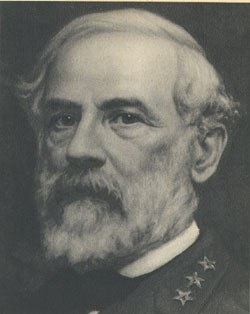
 Here’s a detail from a piece of marketing flotsam that I found recently attached to the advertising section of some magazine or another: an insert hawking the