Just a bit of fun
Seen on the first Sunday after the Revolution, I guess…

You can make your own at Church Sign Generator.com. (Thanks, Roxanne.)
official state media for a secessionist republic of one
Smash the State
Seen on the first Sunday after the Revolution, I guess…
You can make your own at Church Sign Generator.com. (Thanks, Roxanne.)
I’d meant to post a note about this earlier, when it was posted at php.net, but I was distracted by other things. Fortunately, though, Aptenobytes mentioned it yesterday, and so I have been reminded.
Under the influence of the patent system and big industry lobbyists, the European Union is on the verge of making a huge mistake: to pass a law that would legalize software patents.
If that happens, you will pay dearly. Europe’s software industry will fall victim to unscrupulous extortioners. A cartel of large corporations will crush smaller competitors. Consequently, we will all pay more money for less good and less secure software. You personally, your household, your company, your government, all of us.

Companies that push for software patents are more or less universally large corporations that want to extract profits while sitting on their patent portfolio laurels; people who are doing innovative, groundbreaking work now in software and Internet services–such as Red Hat, the developers behind PHP and MySQL, and 1&1, among others–are leading the fight against patents. Software patents don’t foster innovation; they stifle it. And in a society where software and Internet services are the leading technological fields of the forseeable future, that means that software patents are nothing less than a roadblock in the way of civilization. A free culture needs free tools to build it; but to build the tools we need (unfortunately) to resist the on-going intellectual enclosure movement that is being directed against us. You can find out more about what you can do to help from the No Software Patents website.
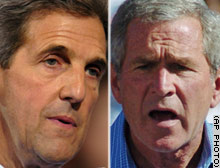
During the late unpleasantness, in spite of a sharply divided electorate and sharply worded debate, there was one point of agreement that you could always count on. To illustrate, here’s George Bush, trying to lay the smack down on Kerry:
When our country is in danger, it is not the job of the president to take an international poll; it’s to defend our country.
And here’s John Kerry doing his best to sidestep the smack down by insisting that he agrees with Bush on the principle:
What I said in the sentence preceding that was,
I will never cede America’s security to any institution or any other country.No one gets a veto over our security. No one.
Of course, Bush and Kerry disagree over something here: they disagree over what Kerry’s position is. But of course that disagreement reveals a fundamental agreement between the two: both of them accept the underlying premise that it would be absolutely damning for a Presidential candidate to tie decision-making about when and where the American military is deployed to another country or an international body. In fact, this is a point of political dogma repeated endlessly by almost everyone who has anything at all to say about the matter. Here’s William Saletan in Slate:
It’s clear from Kerry’s first sentence that the “global test” doesn’t prevent unilateral action to protect ourselves. But notice what else Kerry says. The test includes convincing “your countrymen” that your reasons are clear and sound.

And here’s Dick Cheney, direct as ever:
We heard Senator Kerry say the other night that there ought to be some kind of global test before U.S. troops are deployed preemptively to protect the United States. That’s part of a track record that goes back to the 1970s when he ran for Congress the first time and said troops should not be deployed without U.N. approval.
Now, I think that the Right is obviously wrong on the exegetical question of what Kerry actually said and believes, but I won’t belabor the point here (if you want it belabored, I suggest Roderick’s discussion at Austro-Athenian Empire). Let’s take it for granted that neither Bush nor Kerry would give another country a veto over American security policy, and move on to the critical question: do they have legitimate grounds for refusing to do so?
You’d take it from the way the debate has gone that it’s self-evident that they do: everyone in the droning classes seems to take it for granted that no sane governor could reasonably think that you ought to give other countries a veto over American security policy. Yet both Bush and Kerry were running for President–an office whose legal authority is supposed to derive from the Constitution of the United States. And the Constitution (which you swear to uphold when you become President) says, inter alia, that
This Constitution, and the laws of the United States which shall be made in pursuance thereof; and all treaties made, or which shall be made, under the authority of the United States, shall be the supreme law of the land; and the judges in every state shall be bound thereby, anything in the Constitution or laws of any State to the contrary notwithstanding. (Article VI, emphasis added)
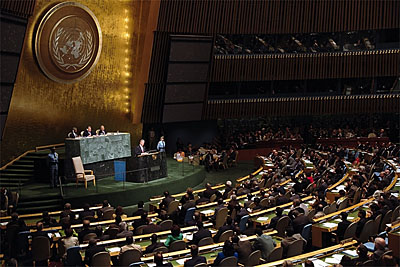
One of those treaties made under the authority of the United States is the Charter of the United Nations, which was ratified by the United States government in 1945. If you accept the Constitution as legally binding, then you have to accept the provisions of the United Nations charter as legally binding; and among those provisions are:
Article 2
…
§ 2. All Members, in order to ensure to all of them the rights and benefits resulting from membership, shall fulfill in good faith the obligations assumed by them in accordance with the present Charter.
§ 3. All Members shall settle their international disputes by peaceful means in such a manner that international peace and security, and justice, are not endangered.
§ 4. All Members shall refrain in their international relations from the threat or use of force against the territorial integrity or political independence of any state, or in any other manner inconsistent with the Purposes of the United Nations.
…
Article 33
§ 1. The parties to any dispute, the continuance of which is likely to endanger the maintenance of international peace and security, shall, first of all, seek a solution by negotiation, enquiry, mediation, conciliation, arbitration, judicial settlement, resort to regional agencies or arrangements, or other peaceful means of their own choice.
§ 2. The Security Council shall, when it deems necessary, call upon the parties to settle their dispute by such means.
…
Article 39
The Security Council shall determine the existence of any threat to the peace, breach of the peace, or act of aggression and shall make recommendations, or decide what measures shall be taken in accordance with Articles 41 and 42, to maintain or restore international peace and security.
Article 40
In order to prevent an aggravation of the situation, the Security Council may, before making the recommendations or deciding upon the measures provided for in Article 39, call upon the parties concerned to comply with such provisional measures as it deems necessary or desirable. … The Security Council shall duly take account of failure to comply with such provisional measures.
Both Bush and Kerry claim to recognize the legal authority of the Constitution and the treaties made under it, including the U.N. Charter. But the plain text of the U.N. Charter gives other countries a veto over U.S. military policy, through the apparatus of the United Nations. Except in cases of actual invasion (which are exempted Article 51), the United States government cannot go to war without U.N. approval without violating the U.N Charter, and thus also the Constitution.
Now, as an anarchist, I don’t have a dog in this fight. I couldn’t care less about the United Nations: I’d argue that trusting a body constituted by the world’s heads of state and their representatives to protect international peace and human rights is about as wise as trusting a League of Foxes to guard the hen-house (and for precisely the same reasons). For that matter, I don’t recognize the legal authority of the Constitution and I don’t think that the pretenders to government office have any legitimate authority to ensnare the rest of us in legally binding treaties. But I do care about bad arguments. If there’s anyone who doesn’t agree with my peculiar views on the nature of legal authority, it’s John F. Kerry and George W. Bush; they claim to recognize the Constitution as legitimate and either one would swear to uphold it after being elected. If they really believe what they claim to believe about the law, then a decent sense of intellectual shame would demand that they either:
… accept other countries’ veto power over the United States’ decisions to go to war,
… move to formally withdraw the United States from the United Nations, or
… stop claiming that the Constitution is the basis for their legal authority
Something’s got to give; you can’t hold all the positions that John Kerry and George Bush loudly insisted that they hold without getting yourself stuck in a rank inconsistency. It may be too much to expect intellectual decency from politicians and political discourse. But if political discourse has lost its sense of shame, then the sooner it learns it again, the better. And someone has got to start the teaching, by example.
As the French might say, écrassez l’inf?@c3;a2;me.
Let’s take an informal review of some case studies in the political economy of medicine and public health.
Aspirin caused about 500 cases of Reye’s Syndrome in 1980, resulting in over 100 children’s deaths within one year.
Women and men use it to relieve headaches and minor pain.
In the 1980s, physicians launched a public education campaign to inform parents that they should never give aspirin to children. Competing drugs such as ibuprofen and acetaminophen were recommended for children’s use and over-the-counter pain-killers made specifically for children were brought onto the market. Because of widespread, responsible adult use, aspirin is still sold over the counter today.
in the first year after its introduction, Viagra caused heart attacks, strokes, and coronary artery disease, and severe hypertension, resulting in 564 deaths worldwide within one year.
Men use it to help them get it up.
A collective shrug of the shoulders. Because of widespread, responsible adult use, Viagra is still prescribed without restriction by ordinary physicians, with a standard side effects warning.
a rewarding and widespread but dangerous process with health risks involving hemorrhage, sepsis, pregnancy-induced hypertension including preeclampsia and eclampsia, obstructed labor caused by cephalopelvic disproportion, iron-deficiency anemia, and gestational diabetes, among others, resulting in an estimated 500,000 women’s deaths, and 416 deaths in the U.S. alone, in 2001.
After men get it up and make a minor contribution, women use it to make babies.
It’s the will of Jesus.
Use of Mifepristone has resulted in somewhere between 1 and 3 deaths in the four years since approval.
Women use it for early term abortions, as an alternative to invasive surgical procedures, when they aren’t interested in making babies.
In spite of widespread, responsible adult use, distribution of Mifepristone is already heavily restricted; it is not available by prescription and stringent requirements are set on doctors who wish to make it available to their patients. The FDA imposed its most stringent level of safety labeling on it in light of the possibly related deaths; prominent Republican legislators are using the moment to push for special legislation to ban it.
Clearly the political agencies responsible for controlling what drugs you can or cannot take are motivated by the purest concern for your own safety, and not by political pressure. This has nothing to do with abortion politics and it has nothing to do with sexuality or gender. Move along citizen, there’s nothing to see here.
Generalísimo Francisco Franco is still dead.
In honor of the 29th anniversary of this joyous day, you may enjoy reading about the memorial anti-fascist demonstrations held across Spain, or by reading about the life and work of Buenaventura Durruti–an anarchist and a hero of the anti-fascist struggle in the Spanish Civil War, who happens to share the anniversary: Franco passed into his well-deserved oblivion 39 years to the day after Durruti was killed on the way to Madrid.
(Thanks, To the Barricades 2004/11/21.)