Rad Geek People's Daily

official state media for a secessionist republic of one

Posts filed under Smash the State

Sciabarra’s Janus-Headed Blog

Wittgenstein once spoke of the Liar Paradox (This sentence is false) as a Janus-headed figure, facing both truth and falsity. So what is up with Libertarian theorists putting out Janus-headed weblogs that refuse to admit that they are weblogs? My first encounter with the phenomenon was Roderick’s weblog, In a Blog’s Stead. But at least Roderick explains why he hesitates to call his blog a blog. A far more egregious performative contradiction comes from another one of my favorite Libertarians – Chris Sciabarra’s NOT A BLOG.

Chris, of course, is a long-time student of Dialectic, so perhaps he finds the collision of thesis and antithesis amusing. Perhaps, by creating a Non-Blog that presupposes the activity of Blogging, he intends a synthesis — a transcendence of the blogging/non-blogging paradigm. In any case, his weblog compiles a lot of his best material from articles and listserv posts, as well as some interesting discussions that follow. In particular, check out his numerous essays on U.S. foreign policy, on Partisanship vs. Objectivity in Ayn Rand Scholarship, and his fascinating series of articles on Objectivism and Homosexuality.

P.S. The rest of this post is false.

It’s Time to Form a Leftist Firing Squad: Everyone Get in a Circle

Right on cue, Salon and other leftist outlets have begun their handwringing and pre-emptive Nader-blaming over a possible Green Party run in 2004. Here’s the line: Nader unreasonably pushed his campaign through the 2000 election, creating an acrimonious rift withiin the American Left, and now the Dems are worried that he’ll do it again, siphoning off votes from the Democratic candidate and putting King George II in office for another four deadly years. Those who think otherwise are blind Green ideologues who can’t see the possibility of achieving their goals through the Democratic Party.

The problem with trying to adjudicate this debate is that both sides of it are acting like morons. The lefty Democrats because they are perpetually unable to honestly acknowledge the severe problems that the Democratic Party has faced since, well, always. Also because they are apparently constitutionally incapable of thinking of any strategy to form a Popular Front campaign against Bush except to whine and vilify Greens. Just think of the arrogance of the rhetoric coming out of their mouths: the assumption that Greens are siphoning off voters who belong, by right, to whatever jackass the Democratic leadership happens to pick; the notion that a messageless and meandering Democratic Party couldn’t possibly be to blame for its pathetic election returns over the last two election cycles; the dismissal of third party activitists as naive and idealistic simply for recognizing that, as a matter of hard-headed pragmatism, the chances of achieving significant leftist goals through the established power structure of the Democratic Party are very close to nil.

On the other hand, the Green Party shares a common disorder with much of the rest of the third party movement: their entire electoral strategy is a cockamaimey plan for wasted resources and eventual implosion. I think that building a strong Green Party is absolutely necessary if we are ever to get out from under the claws of the Republicratic Leviathan. Indeed, as an anarchist, I also think that building a strong Libertarian Party is absolutely necessary too, while we’re at it. But none of this can happen with the current stock set of third party campaign strategies. Based on their past few decades of behavior, one of two things can be concluded about third parties: either they being run as think tanks rather than political parties (issuing policy positions and maximizing fundraising to support office staff, rather than trying to win elections)—or else they are being run by a bunch of drunk baboons. Either they are rationally pursuing some goal other than electoral success, or else, they are irrationally throwing contributor money down the toilet. I don’t know which would be worse for the development of independent parties.

What I mean is this: every four years, the whole independent party movement—Greens, Libertarians, the Constitution Party, the Workers World Party, and everyone else, all get bunched up about the Presidential race. Fundraising appeals go out; money is thrown into advertisements; grassroots activist energy is poured out. The issues are predictable: trying to get a few news interviews, hiring professional petitioners to ensure ballot access, getting indignant over exclusion from the debates, putting out a few press releases that get published by a few papers, and going around the country to talk with local party activists. The goals are almost always unclear: candidates generally acknowledge they have no chance of winning, but they hope to get the message out. Ralph Nader, at least, had a relatively clear purpose in 2000: he wanted to get 5% to get federal funds for party-building. But that, too, failed, and even if it had succeeded, it’s unlikely it would have helped that much—one need only watch the decline and fall of the Reform Party over the past decade to see that funds mean nothing without a strong party structure in place, at the local level.

What I propose is this: independent parties, if they want to get anywhere, are going to have to completely write off the federal government for the next 15-20 years. They should encourage their base to vote strategically on life-or-death issues (abortion, war, civil liberties, etc.). Greens and Libertarians have built up an extensive base for fundraising and activist support; they need to turn that base more or less completely towards local and state-level races. Why? Because we can win local races now—with some basic planning, we can win them in a cakewalk. We can start winning state races within the next few election cycles. It’s only by winning these races that we will make winning the federal races possible.

Imagine if, for example, Ralph Nader could take his eyes off the Presidency for a moment, and run for Governor of California instead. Imagine if he used his celebrity, immense fundraising ability, and good name to recruit an unprecedented slate of Green candidates for state legislature, city council, and mayor. What might be achieved in a state with a strong Leftist contingency, an tradition of independent party activism, and a corrupt Democratic Party that only barely made it through an election cycle that should have been a cakewalk?

I think the results could be stunning. Why?

  1. Local and state level races very often go uncontested—allowing independent party candidates to enter into two-way races, rather than three-way races.
  2. Local and state level races are covered by local media, which offers far more opportunities for free coverage and affordable advertising than the national media.
  3. Winning local and state races builds up a critical mass of name recognition and experienced candidates.
  4. Winning local races allows us to take immediate action on the issues that impact people’s everyday life: getting rid of urban-sprawl-creating zoning regulations, calling the police off of their pursuit of the war on people who use drugs, making sure the police are sensitive and responsive to violence against women, cutting down on cronyism and corporate welfare, and so on.
  5. Winning state races allows us to take immediate and serious action on nearly every issue that matters to us: reforming laws on violence against women, ensuring abortion rights and abortion access, abolishing drug laws, ending the death penalty, ending corporate welfare… need I go on? The vast bulk of these programs are implemented not at the federal level, but rather at the state level. Trying to make serious progress on them by running a Presidential candidate every four years is a fool’s game.
  6. Finally, winning state-level elections is what will make a robust independent party movement possible. Why? Because the state governments are the jackpot for ballot access, Instant Runoff Voting, term limits, initiatives and referenda, and nearly every other sort of political reform that is necessary to pry the democratic process out of the hands of the two-party oligarchy.

Now, in all this, I don’t mean that significant victories won’t be possible before some time decades in the future—when they happen, they tend to happen quickly, seemingly out of nowhere. But if they do end up being possible, they will only become possible as an unforseen consequence of the groundwork we lay between now and then. So I’d like to propose some guidelines for Lefties and Libertarians over the next few election cycles.

  • Forget about the federal: vote strategically. In fact, don’t even bother nominating Presidential or Senatorial candidates at all if there aren’t compelling ballot-access reasons to do so.
  • Focus on the legislature, not the executive: these races are very often unopposed, but ultimately promise a lot more power to bring about democratic reforms than gubernatorial or Presidential victories.
  • Blitz the local media: Get your name and message out through every means possible—letters to the editor, local TV appearances, local press coverage, billboards, guerilla media, and so on.
  • Work with frustrated two-party voters: Find issues where there is a distinctive message that will draw two-party voters–for example, the war on drugs or the death penalty.
  • Build resilient, activist local parties: They’re the only way you can eventually build a strong, democratic national movement.

And now that I have lectured the Greens and Libertarians, allow me to say a bit about what lefty Democrats, in particular, owe us if they expect to get anywhere.

  1. Stop vilifying Greens: many people of good conscience had perfectly good reasons to be disgusted with the Democratic ticket in 2000. Trying to browbeat them back into the party is not an effective way to build a good, hope-based relationship with your party base.
  2. Get back to the issues: voters expect a clear message and a clear distinction between the two candidates. If you make the 2004 race a referendum on abortion, the environment, the economy, civil rights, etc., then the Democrats will win. They represent the majority position on these issues. Bill Clinton came from nowhere in 1992 to win precisely because he knew this, precisely because he had a clear and hopeful message rather than mealy-mouthed meandering, Republican imitation, and fear-mongering (Bill C. had plenty of all of those too, but he won in spite of them, not because of them).
  3. Work together with independent parties, instead of trying to keep them out: trying to prevent spoiler debacles by throwing independent party candidates off the ballot, excluding them from the debates, bullying their supporters, and so on only makes you look sleazy and debases the democratic process. Instead, work with them to open the process up and pass constructive measures that will prevent such conflicts from happening in the future. In particular: Democrats, for the love of God, stop whining about Greens and start supporting Instant Runoff Voting. If your goal is to change things rather than to clutch every scrap of incumbent governmental power that you can, this is the only long-term hope for your success.

The bottom line, I think, is this. It is long past time to stop forming our circular Leftist firing squads. It’s time to start finding constructive and creative ways of working together, and getting smart about how we can actually start achieving our goals.

Let’s begin.
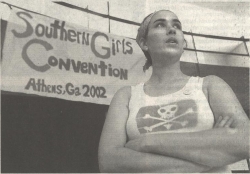
SGC’02 rocks the South from Athens, Georgia

As I mentioned, I spent the past weekend attenting the fourth annual Southern Girls Convention in Athens, Georgia. About 250-300 people showed up from all over the South. I had the opportunity to attend a few really good workshops, had a really good time with friends, heard Elaine Brown and Constance Curry give great talks, saw some excellent shows, and most of all, had the invigorating experience of getting touch with hundreds of people and organizations doing social justice organizing in the South.

photo: Natasha Murphy

SGC’02 organizer Natasha Murphy, super-rad and looking a bit like Che in this photo

Before I go on, let me just say: thank you so much to Natasha, Merritt, Julie, Theo, and everyone else who drove themselves so hard to make sure that everything was set to go in Athens. Thanks also to all the wonderful women and pro-women organizers who made it all happen by organizing workshops and participating in the convention. As y’all may know, I helped organize last year’s Southern Girls Convention in Auburn. It’s been really invigorating to see the convention going on—not to mention having a chance to actually participate rather than just driving myself sleepless and staffing the registration desk!

Why am I getting so effusive? Well, simply the fact that several hundred rad people could come together and put on a pretty unapologetically anarchist / radical feminist political convention in the heart of the Deep South (Alabama and then Georgia) is inspiring and a bit humbling—and the fact that we’ve done it for four years now, going on five, is invigorating. The event has risen to the level of even getting coverage in the New York Times (!). The Times story presents a pretty positive image of the convention, but like most major media presentation, it leaves out a lot of important things about what the convention’s all about politically, and how it runs. But you have to understand all that to understand why SGC is as important and inspiring as it is. The convention is a totally grassroots, bottom-up meeting which is completely organized by local kids and run by the participants rather than any kind of self-appointed professional organizers. Workshops are based around the idea that we don’t need to import experts to tell us how to organize (from the North or from privileged sectors in our own community)—we can share our own knowledge and learn from each other. And the convention’s politics are unapologetically radical feminist, generally socialist and/or anarchist, pro-LGBT, and supportive of many other struggles for social justice. It’s not about being Scarlet O’Hara with an attitude (and let’s not even get started on the racism of that ideal…). Rather, as the Times article gets to at one point, it’s about Southern women and pro-woman activists raising hell and working to make our own communities in the South places that we want to live. And I feel really confident that we are beginning to see that happen.

What does this mean, in concrete terms, on the ground?

It means that we are working on having hard discussions about what we can do to improve our communities and our organizing efforts — such as how we can build activist communities that are more open, loving, and supportive even when we are facing emotional stress and crisis; what sort of processes we need to help prevent and respond to sexual assault in our communities; and how boys can become good allies in the work for women’s liberation. Here we got a lot of good starts but also need a lot more work. For next year, we are talking about new formats for workshops that will give people a lot more space for in-depth and focused strategizing on concrete solution—while still offering time for introductory discussion about the issue and the principles from which we want to approach it.

It also means we are doing on-the-ground organizing to roll back the power of the small Right-wing elite that has rigged the game for so long in the South through measures that directly challenge, or simply sidestep, their power plays. A perfect example is the movement to set up abortion funds to ensure low-income women’s access to reproductive choice in spite of the government’s refusal to cover this vital medical procedure under Medicaid.

It also means chances to share our skills in how-tos, whether on good vegan nutrition, political lobbying, bicycle repair, or taking control of your own body and healthcare.

And it means networking and enjoying a community with people doing work all over the South. When Southern activists are primarily used to feelings of isolation and hopelessness, the value of just seeing how many other people are working for change can’t be overstated.

Organizers have discussed all kinds of plans for how we can improve and expand the work we are doing through SGC. The always-rad Ailecia Ruscin is working on a networking project to keep Southern organizers more closely in touch with one another from day to day (if you’re interested in this project, get in touch with me and I’ll let you know more). We’re talking about organizing smaller state-level meetings to accompany the big annual meeting, allow for more discussions and much more on-the-ground organizing meetings. And new organizers are planning on putting on the next SGC in Asheville, North Carolina. Everyone is really excited about making the fifth SGC even bigger and better than before, and continuing to make SGC a transformative presence in the South for many years to come.

Women’s liberation and the rest of the struggle for social justice are not just alive and kicking in the South; the movement is on the rise and can no longer be ignored.

For further reading:

Hey, hey, DEA! How many patients have you jailed today?

OK, as promised, here’s the report from the past few days of cross-state rabble-rousing. The big event was a protest at the DEA offices in Montgomery, as part of a national day of direct action at about 60 DEA offices across the country, fighting back against the federal government’s nation-wide crackdown against medical marijuana dispensaries.

We drove up to Birmingham on Monday night to petition at the primary election polling places to get Dr. Jimmy Blake on the ballot as an independent candidate for Jefferson County Commission in the November general election. The sun was beating down on us all day, and the breeze couldn’t bother itself to blow for more than about five minutes. Nevertheless, the pay was good, and Vestavia Hills was a hopping place for getting signatures. One poll worker said she’d sign the petition because she supported Jimmy Blake, but she didn’t think we should be outside a primary polling place to petition. Well, OK, I thought, and I don’t think you all should be using state funds to subsidize the internal party business of the two major parties. I’d be glad to stop petitioning out front of primary polling places if Demopublicans actually had to go through the same shit to get on the ballot that independents do. But I held my tongue. A signature is a signature.

On Wednesday morning we drove down to Tuscaloosa and began to plan the big event for Thursday 6/6.

Thursday we met Floyd Shackleford in Wetumpka The Montgomery TV press had arrived thanks to the efforts of the media collective assisting ASA, and we got a chance for some great film of Floyd delivering our Cease & Desist order from 73% of the American people to the DEA. We held a banner (DEA: Stop Arresting Patients) and distributed the fake WANTED posters I put together for the event, while Floyd and I talked to the interviewers.

We had prepared Burma-Shave signs which we hoped to hold by the side of the road for passing motorists to see, but we arrived a bit late and all we had time to do was deliver the Cease & Desist order and talk to the press. We had also run off lots of copies of flyers to hand out to passing pedestrians, but the DEA building was off in a office building ghetto a bit off the main streets, so there was no foot traffic for handing out our flyers. I was a bit disappointed that it turned out to be more of a press conference than an actual demonstration. Nevertheless, the newsmedia coverage was a lot more sympathetic than I thought it would be, and it came together pretty well for something we had thrown together in less than a week of active planning. The day was beautiful, the drive home peaceful, and the remainder of the day restful.

Take action! Thanks to the publicity from participating in the national event, we are quickly gaining contacts around the state for future actions toward taking the high ground in the drug war. If you are in Alabama and would like to join the network we are developing of activists who are fighting to end the federal government’s assaults on states’ rights and compassionate care, get in touch and ask me to add you to the contact list.

Leftists and Libertarians Shocked To Find They Agree

Lakshmi Chaudhry has written a column examining chances for a left-libertarian alliance [AlterNet]. The column focuses on the recent direction of articles from the Cato Institute, which have made bold stands for civil liberties, against corporate welfare, and against the ever-expanding military-security Leviathan of the "War on Terrorism."

This shouldn’t come as that much a surprise. Cato has always held a good line on issues such as foreign policy towards the Mideast (1991) and corporate welfare (1995). The supposed animosity between Cato and the Left is based on fights that emerged from Cato’s role in fueling the economic policies of the 1994 Republican Reaction. But of course, the Republicans never seriously followed Cato; they merely altered the nature of tax-and-manage bureaucratic coercion. They turned welfare into a government-sponsored temp agency for shitty dead-end labor. And they never saw a massive corporate welfare boondoggle they didn’t like. Meanwhile, Cato kept calling for a society based on free association and mutual aid—not State privilege for corporations and a hawkish military.

The move towards a more robust and self-conscious Left-Libertarian alliance is emerging as the natural consequence of the growth of the "War on Terrorism," which like all global warfare, naturally brings the nexus of economic, military, and governmental power into the starkest relief. When the military-industrial Leviathan rises from the sea, it naturally draws together those who are fighting government power and those who are fighting boss power. The last time this happened on a wide scale, the radical libertarian Murray Rothbard allied with the radical left in the Peace and Freedom Party against the Vietnam War and imperialist "anti-Communism" worldwide, and the repression of dissent at home. And the "War on Terrorism" is now playing the same role. Former Libertarian Presidential candidate Harry Browne has written a column condemning United States foreign policy as "terrorism" and urging against a second war on Iraq. Cato itself has published a lengthy report addressing the need to understand the "root causes" of terrorism against the United States and urging an end to military interventionism overseas. Leftist and Libertarians are being brought together as government policy increasingly seems designed with the explicit purpose of proving the dictum, "War is the health of the State."

This is all for the best. I’ve been urging the Left to look to Libertarianism for a while, and I don’t think this should come as much of a surprise. The struggle for social justice is a struggle for equity and against power and privilege. And Libertarianism, properly conceived, is a struggle against the power and privilege of the government over the governed. Now, a lot of members of the Libertarian Party are little more than Young Republican rejects who don’t think that the Republicans go far enough on social welfare or public education. But at their best, the Libertarians have a lot to teach those of us on the Left who have remained too complacent about the bureaucratic State as a solution to societal ills. And the Left has a lot to teach Libertarians about the ways in which the systematic power of "private" hierarchies and exploitations undermine the necessary psychological and cultural conditions for maintaining a free and open society, even if they do not directly involve the use of physical violence. Statism in the polity is deeply linked with authoritarianism in the society, and we need to fight them together.

For further reading:

Anticopyright. All pages written 1996–2026 by Rad Geek. Feel free to reprint if you like it. This machine kills intellectual monopolists.