Rad Geek People's Daily

official state media for a secessionist republic of one

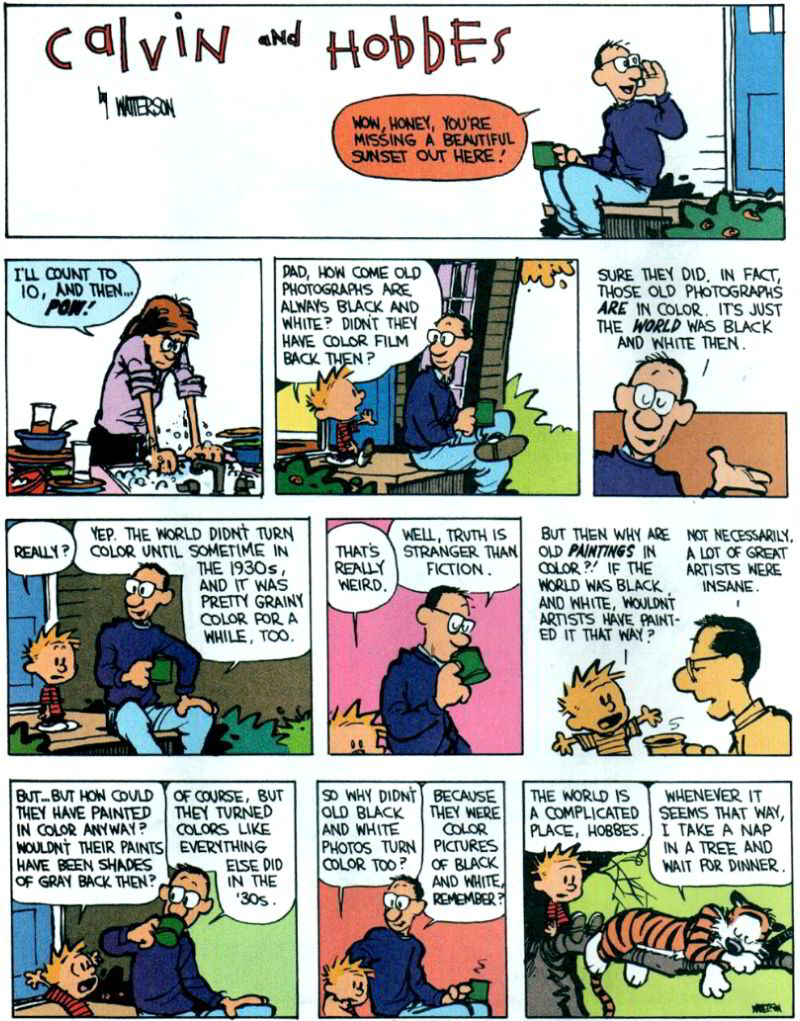
So I guess Calvin’s dad wasn’t telling the truth after all?

So I guess it turns out that the world didn’t really turn color sometime in the 1930s?

This is from 1922, and is one of the earliest recordings ever of natural color on film. You can see it again now because technological civilization is awesome.

This clip is a very early, full-color Kodachrome film made by Kodak in 1922 to test new film stock and color processing. . . . The color and lighting are exquisite—all warm reds with flattering highlights—making it a purely enjoyable thing to watch. In 1922, for all its technical achievements, Kodak hadn’t yet done away with the flicker that gave movies one of their earliest and most enduring nicknames: the flicks. The flicker resulted from variations in film speed produced by the slow, hand-cranked cameras of the time and by variations in the density of the film itself . . . .

— This 1922 Kodachrome Test Footage is Strangely Bewitching, in The Vault at Slate (February 8, 2013)

Reasonable Suspicion

From the West Coast to the East, here’s some news from occupied New York. After a great deal of stonewalling and under intense pressure from New York civil liberties groups, the NYPD has finally released reports on the results of its recent revival of random warrantless stop-and-frisk. Not surprisingly, the results demonstrate that not only is this police power fascist in principle, but also the application of the program is overwhelmingly racist in practice.

The NYPD last night released a report on its controversial stop-and-frisk procedure that breaks down by precinct — and by race — those who've been targeted.

The figures, all from 2011, show the precinct with the most stops by sheer numbers was Brooklyn's 75th, which includes East New York and Cypress Hills.

More than 31,000 people were stopped, 97 percent of them either black or Hispanic.

Brooklyn's 73rd Precinct, covering Brownsville, was the next highest, with 25,167 stops. About 98 percent involved minorities.

The 115th Precinct — which includes East Elmhurst, Corona and Jackson Heights in Queens — ranked third, with 18,156 stops. Nearly 93 percent of those involved minorities, the figures show.

The 40th Precinct in The Bronx, which covers Mott Haven and Melrose, racked up the next highest number — 17,690 — with 98.5 percent involving minorities.

And at No. 5 was the 90th Precinct in Williamsburg, Brooklyn, where there were 17,566 stops, with 88.6 percent involving minorities.

The New York Civil Liberties Union had fought for release of the stats last year.

After getting them, the civil-rights group said they show a pattern of racial profiling — a charge that the NYPD denies.

— Natasha Velez, NYPD releases stop-frisk data, New York Post (Feb 5, 2013)

The NYPD, like most police forces, routinely issues blanket denials of obvious empirical facts, and expects to be believed because the press conference is called in an alternate dimension, where 98+% of all stops just happen to be directed at harassing black or Latin@ victims because of some objective and racially neutral standard of Reasonable Suspicion. In the real world, of course, outside of political power-trip la-la land, Reasonable Suspicion is an entirely meaningless standard, which in practice means nothing more than a police officer’s unreflective and unsubstantiated gut feelings about whether or not someone looks like they are up to no good. And whatever the intentions of NYPD management may have been in designing the policy, or the criteria, the overwhelmingly obvious practical effect of this kind of massive discretionary police power is a campaign of in-effect discriminatory racial harassment by police, which is fueled by the subtle and not-so-subtle sorts of racialized anxiety, tension, and suspicion that set off police officers’ gut reactions. (This is of course why giving police the power to use force, detain, threaten and search people, based on nothing more than their inchoate suspicions is a fundamentally terrible and deeply dangerous idea.)

While it appears at first blush to be a slick, fact-filled response, nothing in the report can dispute the reality that stop and frisk NYPD-style is targeted overwhelmingly at people of color, so innocent of any criminal wrongdoing, that all but 12 percent walk away without so much as a ticket, NYCLU Executive Director Donna Lieberman said in a statement.

. . . A total of 685,724 people — 8.6 percent of the city's population — were detained by cops for reasonable suspicion. [sic] . . . Of that number, 9 percent were white, and 4 percent Asian, the figures showed.

The No. 1 reason for stop-and-frisks that year was possible weapons possession, the report released yesterday said. . . .

— NYPD releases stop-frisk data…

You might be tempted to call racist harassment the occupational disease of police. If not for the fact that it is their occupation.

This is, incidentally, partly a story about how government policing, and police-state tactics like stop-and-frisk, are assaults on civil liberty in principle, and deeply structurally racist in applied practice. Also, though, — pay attention to the punchline at the end — I have to note that this is also a story about how the immediate practical effect of gun control laws in New York has been to provide the Number One legal pretext for a campaign of highly racialized police harassment. Like drug laws, and like any other law that serves to increase the legal power of police to threaten, coerce or arrest people for contraband possessions, gun control laws also are deeply structurally racist in their immediate practical effects.[1]

Also.

  1. [1]See also Anthony Gregory’s important Who Goes to Prison Due to Gun Control?↩

Public Safety (Cont’d)

There was more news released today on the police-on-police manhunt in Los Angeles, and the out-of-control police violence and jumping-the-gun overkill shootings in Torrance, California, which I mentioned previously the other day Now it turns out that they lit up not just one completely innocent pick-up driver, but two. Emphasis added.

David Perdue was on his way to sneak in some surfing before work Thursday morning when police flagged him down. They asked who he was and where he was headed, then sent him on his way.

Seconds later, Perdue’s attorney said, a Torrance police cruiser slammed into his pickup and officers opened fire; none of the bullets struck Perdue.

His pickup, police later explained, matched the description of the one belonging to Christopher Jordan Dorner — the ex-cop who has evaded authorities after allegedly killing three and wounding two more. But the pickups were different makes and colors. And Perdue looks nothing like Dorner: He’s several inches shorter and about a hundred pounds lighter. And Perdue is white; Dorner is black. . . .

The incident involving Perdue was the second time police looking for the fugitive former LAPD officer opened fire on someone else. . . . Torrance police said the officers who slammed into Perdue were responding to shots fired moments earlier in a nearby area in a nearby area where LAPD officers were standing guard outside the home of someone targeted in an online manifesto that authorities have attributed to Dorner.[1]

In the first incident, LAPD officers opened fire on another pickup they feared was being driven by Dorner. The mother and daughter inside the truck were delivering Los Angeles Times newspapers. The older woman was shot twice in the back and the other was wounded by broken glass.

In Perdue’s case, his attorney said he wasn’t struck by bullets or glass but was injured in the car wreck, suffering a concussion and an injury to his shoulder. The LAX baggage handler hasn’t been able to work since, and his car is totaled, Sheahen said. . . . According to the police department, Perdue’s car was headed directly for one of their patrol vehicles and appeared not to be yielding. When the vehicles collided, Perdue’s air bag went off, blocking the view of the driver, and one officer fired three rounds.

— Robert Faturechi and Matt Stevens, Police seeking Dorner opened fire in a second case of mistaken identity, Los Angeles Times (February 9, 2013)

Do you feel safer now?

Mostly, this is just horrible and I hope that my friends in Southern California are staying safe. Connie Rice, a civil rights attorney, was consulted by the authors of the L.A. Times article, but what they chose to print from her statement was not anything having to do with civil rights; it was They [government police] don’t know where he is, and they’re going to be edgy and jumpy . . . Don’t get in their way. They’re in a special state of consciousness right now, and they’re not used to being hunted. I don’t know how much talk about civil rights issues in this homicidal police rampage was edited down to get that pull-quote, so I don’t want to blame Connie Rice for anything if this was taken out of context by the reporters. However, I will say that while it may be sensible practical advice to tell folks to stay away from the cops right now — while they are acting like twitchy, homicidal maniacs, and shooting literally anybody who moves the wrong way — it’s not clear how this advice is supposed to help someone like David Perdue. After all he didn’t get in [the police’s] way; they rammed his truck from behind. And if the attitude you have to take towards government police right now, even when they don’t come right after you for driving down a residential street, is essentially to treat them like mad dogs and do anything you can to keep a safe distance from them, what does that tell you about policing?

Government police are immensely politically and socially privileged, and they constantly demand extraordinary legal immunities and social deference. The reason that police use to justify the special powers and immunities that they get relative to the rest of the population is, in their constant refrain, that they’re putting their own lives on the line, supposedly for our safety. Actually, what constantly happens, and what is happening right now in Southern California, is that police jump on guesses, shoot first and ask questions later, and rely on boss cops and city lawyers to make up excuses for any mistake or any aubse, and so to protect them from any legal consequences whatever for when they attack, hurt or kill unarmed, defenseless or completely innocent people. As a result, when the chips are down, what happens, over and over again, is that police put our lives on the line, in order to protect their own safety, and their political privileges and legal immunities ensure that they will never be held accountable for whatever they do to us in the process.

Government police are one of the greatest menaces to public safety in the United States.

Support your local CopWatch.

Also.

  1. [1]The jumbled grammar here — which, like most writing that was copied more or less directly from cop-speak, is full of passive constructions, lost subjects, rhetorical misdirection fractured causation, and seems more or less entirely calculated to erase the subjects of sentences, in order to ensure maximal obscurity about what police actually chose to do and when they did it — makes it hard to parse out this piece of information. But other reports have made clear that the shots fired moments earlier, which the cops who rammed Perdue’s truck were responding to and which got them afraid, were shots fired by other police officers, specifically the shots fired when LAPD opened up 20-30 rounds on the women in the first pickup truck. So one set of cops is hunting another cop who’s been shooting cops; the first set of cops flies off the handle and lights up the wrong pickup truck; the gunfire from their mistaken-identity overkill shooting frightens another set of cops, and so they flip out, then ram and light up the first pickup truck they see coming.↩

Participatory planning process

Some people, when confronted with a problem for keeping an all-encompassing gift economy running sustainably, think I know, we’ll call a meeting and start using a participatory planning process!

Now they have two problems.[1]

  1. [1]It’s an old joke.↩

Public Safety

From the Los Angeles Times (February 8, 2013), on a recent police shooting in Torrance, California. Emphasis is mine.

It was around 5 a.m. in Torrance on Thursday and police from nearby El Segundo had seen a pickup truck exit a freeway and head in the general direction of the Redbeam Avenue residence of a high-ranking Los Angeles police official, which was being guarded by a group of LAPD officers. Police were on the lookout for Christopher Jordan Dorner, a disgruntled ex-cop suspected of hunting down members of the LAPD . . . . A few minutes later, a truck slowly rolled down the quiet residential street.

As the vehicle approached the house, officers opened fire, unloading a barrage of bullets into the back of the truck. When the shooting stopped, they quickly realized their mistake. The truck was not a Nissan Titan, but a Toyota Tacoma. The color wasn’t gray, but aqua blue. And it wasn’t Dorner inside the truck, but a woman and her mother delivering copies of the Los Angeles Times.

In an interview with The Times on Friday, LAPD Chief Charlie Beck outlined the most detailed account yet of how the shooting unfolded. Margie Carranza, 47, and her mother, Emma Hernandez, 71, were the victims of a tragic misinterpretation . . . They declined to say how many officers were involved, what kind of weapons they used, how many bullets were fired and, perhaps most important, what kind of verbal warnings — if any — were given to the women before the shooting began.

Law enforcement sources told The Times that at least seven officers opened fire. On Friday, the street was pockmarked with bullet holes in cars, trees, garage doors and roofs. Residents said they wanted to know what happened.

. . . Glen T. Jonas, the attorney representing the women, said the police officers gave no comments, no instructions and no opportunity to surrender before opening fire. He described a terrifying encounter in which the pair were in the early part of their delivery route through several South Bay communities. Hernandez was in the back seat handing papers to her daughter, who was driving. Carranza would briefly slow the truck to throw papers on driveways and front walks.

As bullets tore through the cabin, the two women covered their faces and huddled down, Jonas said. They felt like it was going on forever.

Hernandez was shot twice in her back and is expected to recover. Her daughter escaped with only minor wounds from broken glass. . . .

Jonas estimated that the officers fired between 20 and 30 rounds. Photographs of the back of the truck showed at least two dozen bullet holes. Neighbors, however, suggested there were more shots fired. . . .

A day after the shooting, residents in the street surveyed the damage.

Kathy Merkosky, 53, was outside her stucco home pointing out the six bullet holes in the bumper and grill of her silver Acura MD-X. She knew her truck was damaged when she spotted it on television and saw fluid flowing into the street.

Her Ford Focus was hit as well — a bullet shattered the windshield and another flattened a front tire.

. . . [Neighbor Richard] Goo said he could hear the bullets hitting the front door and feared they were coming through the house.

He said he called 911 for the police, but was notified that they were already there.

–Joel Rubin, Angel Jennings and Andrew Blankstein, Details emerge in LAPD’s mistaken shooting of newspaper carriers, Los Angeles Times (February 8, 2013)

Here’s more on the Official Reaction, from the same story:

After the investigation is completed, Beck and an oversight board will decide if officers were justified in the shooting . . . .

— Details emerge …

Fun fact: if you delete the if from this sentence it will still be a completely accurate statement about what is going to happen.

. . . or made mistakes that warrant either punishment or training.

— Details emerge …

LAPD Chief Charlie Beck isn’t sure whether or not a gang of cops lighting up completely the wrong vehicle and shooting an innocent 71-year-old woman twice in the back is making a mistake.

But if it is, it’s a mistake that warrants punishment or training.

Do you feel safer now?

Also.

Anticopyright. All pages written 1996–2026 by Rad Geek. Feel free to reprint if you like it. This machine kills intellectual monopolists.