Rad Geek People's Daily

official state media for a secessionist republic of one

Écrasez l’Wal-Mart

As a nice set piece to my May Day paean to wildcat unionism–that is, workers organizing themselves on the free market, without the suffocating patronage of the government, Ampersand passes along a nice reminder that modern corporate capitalists–the Behemoth from Bentonville chief among them–are not creatures of the free market; they are Frankenstein creations of government privilege for the bosses. Jonathan Tasini at TomPaine.com (2005-04-21) is mired in a host of confusions about free market economics, but he is precisely, and importantly, right to remind us that Truth is, Wal-Mart could not survive in a real free market. Remember that we are talking about a company that routinely robs the land that it needs for its gigantic stores by Mau-Mauing local governments into using eminent domain powers and handing out tax-funded subsidies. Remember that Wal-Mart’s business model for the past decade has been directly dependent on the repression of workers’ wages by the government of Communist China.

Putting aside the morality of forcing people to work in slave-like conditions, the so-called free market does not exist in China when it comes to wages. China artificially suppresses wages by anywhere from 47 to 85 percent below what they should be, according to the AFL-CIO’s complaint about China’s labor policies filed with the United States Trade Representative last year. With Wal-Mart as its willing customer, an authoritarian regime ruthlessly warps the market for wages by enforcing a system that controls where people can work and imprisons and tortures people who attempt to organize real unions or strike. Maybe the rock-bottom labor costs are really behind Wal-Mart’s slogan always low prices, but the company is certainly not an example of how to win in a free market economy.

It’s easy to see why Wal-Mart and its conservative defenders discard ideology: money. By ignoring free market principles, the left-wing Harvard Business School estimates that Wal-Mart reduces its procurement costs by 10-20 percent, primarily by taking advantage of the artificially suppressed labor market in China.

…

Back at home, Wal-Mart’s free market mantra stops at the water’s edge of the public till. By one estimate, Wal-Mart has pulled in $1.5 billion dollars in taxpayer funded subsidies (see www.walmartwatch.com). And that’s at the low end, because subsidies are sometimes hard to track based on the lack of public reporting requirements. Wal-Mart is happy to cash in on government largess like property tax abatements, infrastructure support, free land and just straight-out cold cash–all of which are the antithesis of free market ideology.

Free software advocates sometimes like to point out that there are a couple of meanings of the word free; there’s free as in free speech and free as in free lunch. The thing about Right-wing blowhards is that they routinely support pro-business giveaways, whether in the form of subsidies to Wal-Mart, endless coercive monopolies for pharmaceutical companies, or government-enforced union busting (see: right-to-work laws; see also: Taft-Hartley). When they start pontificating on the virtues of the free market they never mean it–unless by free market means a market that’s free as in free lunch, i.e. a government-guaranteed market for big consolidated businesses that they don’t have to work for or earn.

That’s the real reason to oppose Wal-Mart: not because they supposedly represent the worst of the free market (it isn’t a creature of the free market at all), and certainly not because of some cracked anti-consumerist claptrap. The problem with Wal-Mart is that they steal your money and use it to keep their business running whether you want to shop there or not. But it’s for precisely this reason that I think the best way to take the fight to Wal-Mart is not to dismiss the free market or to try to block Wal-Mart through local zoning controls. Wal-Mart is what it is today because it’s better at manipulating the State than you are, and there is no reason to think that that’s likely to change substantially as long as they remain what they are. (Trying to turn Leviathan against Behemoth has always been a sucker’s bet.) If Wal-Mart couldn’t survive in a free market, then the best way to fix what’s wrong with them is to make them compete on a free market–a real free market, not the corporatist sham market of today–a market where workers organize in freely-constituted unions that aren’t subject to the constraints of government colonization, where competitors can enter the market without having to buy off town and county governments and homeowners aren’t forced to sacrifice their own homes on the altar of Commerce. The system of state patronage is the problem; freedom, as usual, is the solution.
May Day, May Day

Today is May Day, or International Worker’s Day: a day to celebrate the long, hard struggle of workers for freedom, self-determination, and a better life. The day originated during the heady days of the Eight Hour Day campaign in the late 19th century, a campaign led not by bureaucratic union bosses, much less by Marxist thugs, but by ordinary workers agitating and organizing amongst themselves. Most of them were anarchists, and their struggle was as much against State power as it was against the bosses (part of the reason for May Day commemorations, mind you, is to remember the Haymarket martyrs, anarchists murdered by the state of Illinois).

One of the (many) crimes of the state socialists in the 20th century was their wholesale theft of May Day; what had been and properly remains a day for celebrating the free actions of ordinary workers became, in the bloody talons of the so-called workers’ states, a day for celebrating socialist God-Kings and hideous parades of military power. The folks over at Catallarchy have gone so far as to name May Day a Day of Remembrance for the victims of state Communism. What they are doing is important. The Moloch of Marxist-Leninism consumed more victims than any other power that the world has known in history–through mass executions, through unbelievable mass starvation, through pestilence, through death camps, through war. History is important and memory is political; the stories are harrowing but they need to be told. But I do not think that May Day is the day for the solemn observations. I think that this gives the butchers too much credit. Marxist-Leninism stole May Day from anarchists, from workers, like it stole everything else it ever gained in the 20th century. It did its best to silence its victims, like it did to silence all its other victims, with a bullet to the head and piles of pirated loot to parties and unions that would toe the Bolshevik line. I will not give up May Day to them any more than I will give Juneteenth up to William Tecumseh Sherman or give Easter up to the Holy Inquisition. (If you’re looking for a day of remembrance, I’d suggest the 6th of March, the day that the Kronstadt massacre began.) But today is the International Workers’ Day, not the State’s day–meaning neither the bureaucratic-managerial state so beloved of the conservative AFL-line unions, nor the blood-soaked workers’ states (a contradiction in terms). As I said last year:

May Day is a celebration of the original conception of the labor movement, as expressed by anarchist organizers such as Albert Parsons, Lucy Parsons, Benjamin Tucker, and others: a movement for workers to come into their own, by banding together, supporting one another, and taking direct action in the form of boycotts, work stoppages, general strikes, and the creation of workers’ spaces such as local co-operatives and union hiring halls. The spirit was best expressed by John Brill’s famous exhortation to Dump the bosses off your back–by which he did not mean to go to a government mediator and get them to make the boss sit down with you and work out a slightly more beneficial arrangement. Dump the bosses off your back! meant: organize and create local institutions that let you bypass the bosses. Negotiate with them if it’ll do some good; ignore them if it won’t. The signal achievements of the labor movement in the late 19th and early 20th century were achievements in this spirit: the campaigns that won the 8 hour day and the weekend off in many workplaces, for example, emerged from a unilateral work stoppage by rank-and-file workers, declared by the Federation of Organized Trades and Labor Unions, and organized especially by the explicitly anarchist International Working People’s Association, after legislative efforts by the National Labor Union and the Knights of Labor failed. The stagnant, or even backsliding, state of organized labor over the past half century is the direct result of government colonization and the ascendency of government-subsidized unions.

— GT 2004-05-01: Free the Unions (and all political prisoners)!

I don’t really have much to add to what I said before; you can get most of what I would have said by reading what I did say last year. All that I have to add is that the labor news this year has proved it again: when workers free themselves of the State, workers win.

[The Coalition of Immokalee Workers’ victory in the Taco Bell boycott campaign is] also — although you won’t hear this as much — a major victory for government-free, syndicalist labor organizing. The CIW is not a bureaucratic government-recognized union; as a form of organizing it’s far closer to an autonomous workers’ syndicate or a local soviet (in the old sense of a democratic, community-based workers’ council, not in the sense of the hollow state apparatus that the Bolsheviks left after the party committees seized power at bayonet-point). Of course, not having the smothering comfort of the US labor bureaucracy to prop them up has often made things harder on the CIW; but it’s also made them freer, and left them free of the restraints on serious and innovative labor activism that have held the government-authorized union movement back for the past 60 years. (Example: the strategic decision to target Taco Bell in the first place–that is, the whole damned campaign that allowed the Immokalee workers to win such a huge improvement in their standard of living–was a secondary boycott, and so would have been illegal under the terms of the Taft-Hartley Act and the Landrum-Griffin Act. But since the CIW doesn’t need a permission slip from the NLRB to engage in direct action, they won the day–not in spite of, but because of their freedom from government restraints on labor organizing.

— GT 2005/03/23: El pueblo unido jamás será vencido!

(You can read more at GT 2005/03/23: El pueblo unido jamás será vencido! and GT 2005/03/30: Anarquistas por La Causa.)

Dump the bosses off your back. Free the Unions–and all political prisoners!

Saturday Poetry Blogging: Canción del jinete (1923)

April is the poet’s month.

Today is the last day of the Ministry of Culture’s celebration of National Poetry Month. Across the border at D.E.D. Space, Diane has some parting thoughts:

Some final thoughts on poetry…

Why read it? Because a poem can do two things for you. It can cause you to have a moment–and a lifetime–of joy over language. And it can say for you what you yourself have not found adequate words, or maybe any words, to express. Such is the nature of art, that we are enriched by both the medium and the message.

When people say they do not like poetry, they are denying the language, and they are denying their connection with the rest of the world.

— D.E.D. Space 2005-04-30: National poetry month–Day 30

The poem selected for this weekend leans on that connection with the rest of the world; it comes from the gay Andalusian poet, playwright, and political martyr, Federico García Lorca (1898-1936). It was written in 1923 and is sometimes titled Canci?@c3;b3;n de jinete (1860), evoking an era of smuggling through the Sierra Morena (the mountain range dividing Andalusia from northern Spain).

Canci?@c3;b3;n del jinete

C?@c3;b3;rdoba.
Lejana y sola.

Jaca negra, luna grande,
y aceitunas en mi alforja.
Aunque sepa los caminos,
yo nunca llegaré a C?@c3;b3;rdoba.

Por el llano, por el viento,
jaca negra, luna roja.
La muerte me está mirando
desde las torres de C?@c3;b3;rdoba.

¡Ay que camino tan largo!
¡Ay mi jaca valerosa!
¡Ay que la muerte me espera,
antes de llegar a C?@c3;b3;rdoba!

C?@c3;b3;rdoba.
Lejana y sola.

Here’s a translation, mostly fairly literal, but also attempting to preserve something like the music of García Lorca’s Spanish.

The Rider’s Song

Cordoba.
Lonely in the distance.

A black nag, the giant moon
And olives in my saddlebag.
Even if I know the way,
I never will reach Cordoba.

Over the plain, into the wind,
A black nag, the red moon.
The Reaper is watching for me
From up in the towers of Cordoba.

Oh, such a long road!
Oh, my valient nag!
Oh, but the Reaper awaits me
Before I ever reach Cordoba.

Cordoba.
Lonely in the distance.

National Poetry Month 2005 selections

A feminist shindig in the Dirty South: Southern Girls Convention 2005 in Baton Rouge, Louisiana

The Seventh Annual Southern Girls Convention will be held June 17-19, 2005, in Baton Rouge, Louisiana.

Every year for the past 6 years, the Southern Girls Convention has brought out hundreds of rad folks to meet and to talk and to learn from each other–learning skills for activism and everyday life, sharing our experiences organizing deep in the heart of the so-called Red States, and taking it home to raise hell and work together to make our homes freer, safer, more just, and more loving places to be. It’s a place for Southern women and pro-woman activists to find each other, get together, work out our plans and our priorities, and begin to build the communities we want to live in in our own hometowns.

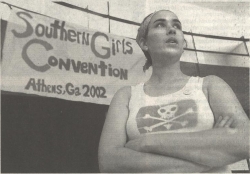
photo: Natasha Murphy

SGC’02 organizer Natasha Murphy

SGC is an unapologetically feminist, bottom-up, grassroots meeting. Each year it’s held in a different Southern community and put together with a new set of local organizers, working together with organizers from years past (if you didn’t know, I’m one myself; together with my friends Claire Rumore and Ailecia Ruscin, I helped put on the third annual Southern Girls Convention, which drew about 600 radical activists to Auburn, Alabama). The convention’s been held in Memphis, Tennessee; Louisville, Kentucky; Auburn, Alabama; Athens, Georgia; and Asheville, North Carolina; last year it returned to its birthplace in Memphis, and this year the seventh annual Southern Girls Convention will be held on June 17-19, 2005, in Baton Rouge, Louisiana. We’re working to reconnect with the radical history of the American South–the cradle of the Confederacy and the birthplace of the Klan, yes, but also–lest we forget–the home of the modern Civil Rights movement, the birthplace of SNCC, and the home of women like Sarah and Angelina Grimke, Ida B. Wells, Rosa Parks, Fannie Lou Hamer, Elaine Brown, Casey Hayden, Rita Mae Brown, and others. We’re working to build an infrastructure for women’s liberation in the South — because the South is our home, it needs to change, and by God we’re the ones to do it.

There will be a weekend of workshops and social events for sharing skills, learning from each other about issues and campaigns, and just meeting and talking and networking (as they say) with each other. There will be music shows, free food, and a talk by bi feminist artist Magdalen Hsu-Li. There will also be childcare for children over the age of one, incidentally, and children will also be welcome in the convention space. Interested? Consider registering to attend. While you’re at it, if you have a skill you’d like to share or an issue or organization you’d like to talk with radical folks from across the South about, you should consider proposing a workshop! Part of the point of Southern Girls Convention is that we can all learn from each other; we don’t need professional activists coming in from the North to lecture us about how to organize ourselves. (N.B.: this doesn’t mean that professional activists from the North will be unwelcome at SGC; if you are one, we’d love for you to come. Just don’t expect it to be all about you!)

Here’s the announcement from this year’s organizers. Be sure to spread the word to anyone you think might be interested!

We are counting on you to spread the word for us! Please forward this message to any friends, family, colleagues, bulletin boards, listservs, or web pages that might be interested in the event!


Seventh Annual Southern Girls Convention

June 17-19, 2005 Baton Rouge, Louisiana

WWW: http://www.southerngirlsconvention.org/2005/

WHAT IS SOUTHERN GIRLS CONVENTION?

The Southern Girls Convention is an annual grassroots meeting for networking, organizing, educating, agitating, and activism, devoted to empowering women and girls in the South and furthering the struggle for social justice. Each year’s convention is hosted by a different Southern community and facilitated by local organizers. Past conventions have brought together hundreds of folks in Memphis, Tennessee; Louisville, Kentucky; Auburn, Alabama; Athens, Georgia; and Asheville, North Carolina.

This year’s convention will be heading as deep South as you can get: Southern Girls Convention invites activists from across the country to meet in BATON ROUGE, LOUISIANA on the weekend of June 17-19, 2005. Hundreds of activists will meet for discussion, action, and entertainment devoted to building pro-woman community in the South.

WHAT CAN I DO THERE?

Southern Girls Convention is based around discussions, workshops, and presentations which give participants the opportunity to share skills, share ideas, discuss important issues, organize campaigns, and have fun as a community. All workshops are organized and facilitated by the participants themselves–that means you! Other events will include a talk by Southern bi feminist musician MAGDALEN HSU-LI, an “un-shop” swap meet, nightly music shows, and tables for participants and organizations to display information, zines, art, and things they have made.

SGC also allows hundreds of activists from across the country to meet, network, strategize, and organize in their efforts on behalf of social justice. Feel free to bring video projects, zines, writing, and anything you are interested in sharing to the convention.

Childcare will be available at the convention space.

Past workshops at SGC have included:

  • Group discussions on fatphobia, abortion rights and access, radical parenting, “100 Years of Revolutionary Wimmin,” the criminalization of women, “Queer and Trans Youth in the South,” gender bias in schools, sexism in the activist community, “Marginalization and Tokenization within the Grrrl Movement,” roles and strategies for boys in the struggle against male supremacy, and “Radical, Southern, and All Fired Up–Where Do We Go From Here?”

  • Skill-sharing on radical cheerleading, community access television, gun safety and self-defense, workplace union organizing, screen printing, sexercises, Internet organizing, and how to start a consciousness-raising group.

  • Organizing meetings for campaigns from Amnesty International, the Coalition of Immokalee Workers, and Planned Parenthood, and state-by-state caucuses for people to meet fellow organizers in their own area.

FOR MORE INFORMATION:

Website: http://www.southerngirlsconvention.org/2005/
E-mail: SGC’05 Organizers organizers@southerngirlsconvention.org

PLEASE FORWARD THIS E-MAIL FAR AND WIDE! Send it to friends and e-mail lists, post it on your website, blog, or bulletin board… we are counting on YOU to help us spread the word. A fresh copy of the e-mail can be sent from our website at: http://www.southerngirlsconvention.org/2005/spread-the-word

Thank you, and we hope to see you there!

Southern Girls Convention 2005 Organizers
Baton Rouge, Louisiana

I’m doing my part with this note and a banner at the top of the page. If you support SGC and can help out by forwarding an e-mail to activist groups you’re a member of, putting up a banner, posting on your website, or whatever you like, don’t hesitate to do so–or to get in touch with me or with the Baton Rouge organizers to see what you can do to help us out.

Further reading:

Patents kill

So, it turns out that today is–by edict of WIPO—World Intellectual Property Day 2005. Among the objectives set out for the day are:

  • To increase understanding of how protecting IP rights helps to foster creativity and innovation;
  • To raise awareness of the importance in daily life of patents, copyright, trademarks and designs.

Well, who could disagree with such educational goals? The Ministries of Culture and Science in this secessionist republic of one applaud the educational purposes of World Intellectual Property day, and offer the following in the effort to raise awareness of the importance in daily life of patents and copyrights, and to make sure that you understand exactly how protecting IP restrictions is fostering creativity and innovation.

Intellectual property restrictions are government-granted monopolies. They have nothing, actually, to do with property rights; what they do is seize ordinary people’s property and hold it hostage to the license-holders’ demands for ransom. They kill innovation because they kill new products; they kill new products because they invade other people’s real property — meaning pens, paper, scanners, computers, DVD players, and so on — in the attempt to lock down ideas — which are, by nature, non-rivalrous resources; this amounts to nothing less than a systematic and ruthless intellectual enclosure movement against what is and ought to be the common property of all humanity.

Now, as a techno-geek, I don’t like how this strangles the amazing innovation that we could be seeing in the intelligent use of audio, video, and text content, in this age of cheap computers and plentiful storage. But the plain fact is that this isn’t, really, about what your latest gizmo can or can’t do with your music library, and it’s not a topic for polite debate and economic wonkery. This is life and death. For example, in India recently:

India, a major source of inexpensive AIDS drugs, passed a new patent law yesterday that groups providing drugs to the world’s poorest patients fear will choke off their supply of new treatments.

The new law, amending India’s 1970 Patent Act, affects everything from electronics to software to medicines, and has been expected for years as a condition for India to join the World Trade Organization.

But because millions of poor people in India and elsewhere — including by some estimates half the AIDS patients in the Third World — rely on India’s generic drug industry, lobbyists for multinational drug companies as well as activists fighting for cheap drugs had descended on New Delhi to try to influence the outcome.

It’s very disappointing, but it could have been worse, said Daniel Berman, a coordinator of the global access campaign for the medical charity Doctors Without Borders. All generics could have been removed from the market.

Instead, all the generic drugs already approved in India can still be sold, though sellers must now pay licensing fees. There are also provisions allowing companies that make generics to copy drugs in the future.

But there are relatively tough criteria for such copying, and activists predicted that prices for newly invented drugs will be much higher, because drug makers will have the same 20-year patent monopolies as they have in the West. As AIDS patients develop resistance to old drugs, new treatments will become less affordable, they said.

In addition, it is unclear whether makers of generic drugs in other countries, like Brazil, China and Thailand, will fill any increasing demand for cheaper medicines.

…

All Western countries grant product patents on new inventions. Since 1970, India has granted process patents, which allow another inventor to patent the same product as long as it was created by a novel process. In pharmaceuticals, that has meant that a tiny tweak in the synthesis of a molecule yields a new patent. Several companies can produce the same drug, creating competition that drives down prices.

Before 1970, India’s patent laws came from its colonial days, and it had some of the world’s highest drug prices. Process patents on drugs, fertilizers and pesticides have extended life expectancy and ended regular famines.

In Africa, exports by Indian companies, especially Cipla and Ranbaxy Laboratories, helped drive the annual price of antiretroviral treatment down from $15,000 per patient a decade ago to about $200 now. They also simplified therapy by putting three AIDS drugs in one pill. Dr. Yusuf Hamied, Cipla’s chairman, called the new law a very sad day for India.

— New York Times 2005-03-24: India Alters Law on Drug Patents

And the same folks want to do the same thing to Latin America, through the adoption of CAFTA:

Found to be HIV-positive shortly before her husband died of AIDS-related complications last fall, an ailing Garcia was convinced of her own death sentence. But generic drugs have kept the virus in check and restored 60 lost pounds to her frame.

I now have hope, said the 52-year-old grandmother and flower vendor, who gets her medicine free from a nonprofit clinic.

Public health experts fear that hope might fade for Garcia and thousands of the region’s chronically ill if the Dominican Republic-Central American Free Trade Agreement, known as CAFTA, is approved this year.

Under the pact American pharmaceutical giants would gain a five-year edge on the development of new drugs by low-cost competitors. Generic versions of name-brand drugs are the main weapon for battling the AIDS pandemic in the developing world.

Healthcare activists say those intellectual property protections would drive up the cost of treating chronic conditions, particularly HIV/AIDS, sufferers of which routinely develop resistance to old medications. About 40 million people worldwide are infected with HIV, the virus that causes AIDS, and more than 275,000 of them live in the six Latin American CAFTA nations, according to United Nations statistics.

— LA Times 2005-04-22: AIDS Patients See Life, Death Issues in Trade Pact

Patents kill people. They mean that the pharmaceutical cartel can call up the armed bully-boys of almost every government in the world in order to enforce artificially high prices for their top money-makers; and that means that State violence is being used to prevent affordable, life-saving drugs from reaching the desparately poor of the world. The multilateral so-called free trade agreements of the past couple decades — NAFTA, the WTO, and upcoming plans such as CAFTA and the FTAA — are slowly cutting back on traditional industrial protectionism while dramatically expanding the scale, scope, and deadly reach of intellectual protectionism.

To hell with that. Intellectual property is not about incentivizing or encouraging or opportunities. It’s about force: invading other people’s property to force them to render long-term rents to you long after you have stopped putting any particular work into what you’re claiming to be yours. A necessary corollary is that it also means invading those who offer innovations based on the work that you have done unless those innovations comply with a very narrow set of guidelines for authorized use. You have no right to do that, and you sure don’t have the right to do it at the expense of innocent people’s lives. A free society needs a free culture. Patents kill and freedom save people’s lives. This is as simple as it gets. Écrassez l’inf?@c3;a2;me: écrassez l’etat.

Further reading

Anticopyright. All pages written 1996–2026 by Rad Geek. Feel free to reprint if you like it. This machine kills intellectual monopolists.