I mentioned here before that Roderick and I would be presenting an essay for the Molinari Society inaugural symposium on feminism and libertarianism. The symposium was excellent; besides a helpful and provoking discussion on our essay, I also got to hear excellent essays by co-panelists Jennifer McKitrick and Elizabeth Brake. Back home, we found that the discussion had spread ahead of us: some of our comments surrounding the essay have already stirred up an engaging, if sometimes frustrating, discussion/contrversy at Liberty & Power, involving folks who had gotten the chance to hear the essay in Boston and others who are still awaiting a look at the text.
What therefore you debate as unknown, this I proclaim to you: I’m glad to announce that a draft-in-progress of our essay, Libertarian Feminism: Can This Marriage Be Saved? This is a draft-in-progress of the essay, which we read in abbreviated form in Boston. Comments, questions, applause, and brickbats are all welcome–nay, encouraged.
The current debate arose from something that was actually fairly peripheral to our essay: the kind words we had for Andrea Dworkin in the course of drawing a comparison between her analysis of the relationship between rape culture and militarism and Herbert Spencer’s. And yes, we partly did that because it was fun and provocative, as a tangent, to draw the comparison between the oft-denounced and seldom-read Spencer, and the oft-denounced and seldom-read Dworkin. But while the remarks were mostly tangential, the issues raised in the controversy are important; both because Andrea Dworkin’s worth defending and because the issues under debate all come back either to central points raised in the essay, or else points that probably should have been addressed there. So if you’ve really been dying to find out whether libertarianism and radical feminism are compatible, why radical feminists should be radical individualists, why existing libertarian feminist projects are so often limiting when they come to really existing contemporary feminist efforts, and how putting the feminism back in libertarian feminism will aid both causes but make for some strange attractors … tolle, lege.
This Mythistory Monday sort of straddles the line between historical and topical: the myth in question is the endlessly repeated chestnut Andrea Dworkin claims that all heterosexual sex is rape. No she doesn’t; she never said this, and has repudiated it when asked directly. The myth is historical, in a sense, since it deals with the upshot of key writings of Second Wave feminism in the 1970s and 1980s. The myth is topical, in a sense, since Andrea Dworkin’s still alive and still writing, and since it seems the idiot notion seems to keep coming up no matter how many times it is addressed (see, for the latest example, Mark Fulwiler’s regrettable comments–which he later, in part, retracted–in the Liberty and Power controversy that Roderick and I have managed to stir up). But whether historical or topical, it’s all bunk.
Dworkin’s slanderers, if they bother to cite anything from her work at all (which they usually don’t), usually skim some out-of-context quote or another from Intercourse; often, for example, something like this:
A human being has a body that is inviolate; and when it is
violated, it is abused. A woman has a body that is penetrated in
intercourse: permeable, its corporeal solidness a lie. The
discourse of male truth–literature, science, philosophy,
pornography–calls that penetration violation. This it does with
some consistency and some confidence. Violation is a synonym for
intercourse. At the same time, the penetration is taken to be a
use, not an abuse; a normal use; it is appropriate to enter her, to
push into (“violate”) the boundaries of her body. She is human, of
course, but by a standard that does not include physical privacy.
She is, in fact, human by a standard that precludes physical
privacy, since to keep a man out altogether and for a lifetime is
deviant in the extreme, a psychopathology, a repudiation of the way
in which she is expected to manifest her humanity.
Male-dominant gender hierarchy, however, seems immune to reform by
reasoned or visionary argument or by changes in sexual styles,
either personal or social. This may be because intercourse itself
is immune to reform. In it, female is bottom, stigmatized.
Intercourse remains a means or the means of physiologically making
a woman inferior: communicating to her cell by cell her own
inferior status, impressing it on her, burning it into her by
shoving it into her, over and over, pushing and thrusting until she
gives up and gives in– which is called surrender in the male
lexicon. In the experience of intercourse, she loses the capacity
for integrity because her body–the basis of privacy and freedom in
the material world for all human beings–is entered and occupied;
the boundaries of her physical body are–neutrally speaking–
violated. What is taken from her in that act is not recoverable,
and she spends her life–wanting, after all, to have
something–pretending that pleasure is in being reduced through
intercourse to insignificance.
But taking the interpretation, from these passages, that Dworkin thinks all heterosexual sex (or all penis-in-vagina intercourse) is rape merely amounts to a misunderstanding–either because the reader has only encountered passages like these, out of context, in a horror file-style catalogue or because he or she is not extending the same effort at interpretive charity towards Dworkin that she or he would for anyone else. Both seem to be unfortunately common conditions; as a result, statements that Dworkin makes about the meaning of intercourse are routinely misinterpreted as statements made in propia voce when in fact they are statements of the meaning attributed to intercourse by male supremacist culture and enforced by the material conditions (economic vulnerability, violence) that women face under patriarchy. These are meanings that Dworkin, among other things, intends to criticize (anyone who has had to write a long exposition of a systematic view with which they disagree could probably be misinterpreted in the same way).
Dworkin’s argument in Intercourse is not that the anatomical features of heterosexual intercourse make it tantamount to coercion. Dworkin has no patience at all for anatomical essentialism–something you should know if you’ve read essays such as Biological Superiority: The World’s Most Dangerous and Deadly Idea. Intercourse is not an anatomy textbook; it’s an examination of intercourse, as a social practice and a lived experience for women, under the cultural and material conditions of a male supremacist society. When she describes intercourse as, for example, occupation, she does not mean that the biological act itself involves occupation; she is talking about intercourse as it is consistently depicted in male supremacist culture, and as it is consistently acted out in a society where rape and male-centric sexuality are extremely defended and culturally excused or even valorized. That doesn’t mean that equality requires the end of either sexual pleasure or, specifically, heterosexual intercourse; it does mean that it requires a radical change to the way it is thought of and approached (she argues that this will involve, inter alia, a sexuality that isn’t monomaniacally focused on intercourse; but that’s a different claim).
In passages like the second one, Dworkin is also specifically responding to sexual liberals and to some feminists (in this case, Victoria Woodhull), who take the legitimacy of intercourse-centric sexuality and intercourse as it is currently practiced more or less for granted–and attempt to draw all the ethical lines on the matter strictly in terms of formal consent, or (in the case of Woodhull) in terms of some more robust sense of women’s sexual autonomy, without challenging the cultural centrality of intercourse or the way in which intercourse is systematically shaped and mandated by the surrounding cultural and material conditions that men impose on women in a patriarchal society. It’s a matter of context; and, in talking about intercourse just as much as in reading the book, context oughtn’t be dropped in the effort to make some kind of point.
If I had to try to summarize what Dworkin is saying while standing on one foot, I’d try this woefully abridged summary of her major theses: (1) that patriarchal culture makes heterosexual intercourse the paradigm activity for all sexuality; other forms of sexuality are typically treated as “not real sex” or as mere precursors to intercourse and always discussed in terms that analogize them to it; (2) that heterosexual intercourse is typically depicted in ways that are systematically male-centric and which portray the activity as iniated by and for the man (as “penetration” of the woman by the man, rather than “engulfing” of the man by the woman, or as the man and woman “joining” together–the last is represented in the term “copulation” but that’s rarely used in ordinary speech about human men and women); (3) that the cultural attitudes are reflective of, and reinforce, material realities such as the prevalence of violence against women and the vulnerability of many women to extreme poverty, that substantially constrain women’s choices with regard to sexuality and with regard to heterosexual intercourse in particular; (4) that (1)-(3) constitute a serious obstacle to women’s control over their own lives and identities that is both very intimate and very difficult to escape; (5) that intercourse as it’s actually practiced occurs in the social context of (1)-(3), and so intercourse as a real social institution and a real experience in individual women’s lives is shaped and constrained by political-cultural forces and not merely by individual choices; (6) that, therefore, drawing the ethical lines in regards to sexuality solely on the basis of individual formal consent rather than considering the cultural and material conditions under which sexuality and formal consent occur makes it hard for liberals and some feminists writing on sexuality to see the truth of (4); that (7) they therefore end up collaborating, either through neglect or endorsement, with the sustanence of (1)-(3), to the detriment of women’s liberation; and (8) feminist politics require challenging both these writings and (1)-(3), that is, challenging intercourse as it is habitually practiced in our society. But, while I hope this helps clarify a bit, you really should just read the whole book for yourself to understand what’s going on.
The myth is one that Andrea has battled for many years now. Here’s what she had to say about the matter in her 1995 interview with Michael Moorcock
After Right-Wing Women and
Ice and Fire you wrote Intercourse. Another book which
helped me clarify confusions about my own sexual relationships. You
argue that attitudes to conventional sexual intercourse enshrine
and perpetuate sexual inequality. Several reviewers accused you of
saying that all intercourse was rape. I haven’t found a hint of
that anywhere in the book. Is that what you are saying?
No, I wasn’t saying that and I
didn’t say that, then or ever. There is a long section in
Right-Wing Women on intercourse in marriage. My point was that
as long as the law allows statutory exemption for a husband from
rape charges, no married woman has legal protection from rape. I
also argued, based on a reading of our laws, that marriage mandated
intercourse–it was compulsory, part of the marriage contract.
Under the circumstances, I said, it was impossible to view sexual
intercourse in marriage as the free act of a free woman. I said
that when we look at sexual liberation and the law, we need to look
not only at which sexual acts are forbidden, but which are
compelled.
The whole issue of intercourse as this culture’s penultimate
expression of male dominance became more and more interesting to
me. In Intercourse I decided to approach the subject as a
social practice, material reality. This may be my history, but I
think the social explanation of the all sex is rape slander
is different and probably simple. Most men and a good number of
women experience sexual pleasure in inequality. Since the paradigm
for sex has been one of conquest, possession, and violation, I
think many men believe they need an unfair advantage, which at its
extreme would be called rape. I don’t think they need it. I think
both intercourse and sexual pleasure can and will survive
equality.
It’s important to say, too, that the pornographers, especially
Playboy, have published the all sex is rape slander
repeatedly over the years, and it’s been taken up by others like
Time who, when challenged, cannot cite a source in my work.
And in a new preface to the tenth-anniversary edition of
Intercourse (1997), Andrea explains why she believes this book
continues to be misread:
[I]f one’s sexual experience has always and without exception been
based on dominance–not only overt acts but also metaphysical and
ontological assumptions–how can one read this book? The end of
male dominance would mean–in the understanding of such a man–the
end of sex. If one has eroticized a differential in power that
allows for force as a natural and inevitable part of intercourse,
how could one understand that this book does not say that all men
are rapists or that all intercourse is rape? Equality in the realm
of sex is an antisexual idea if sex requires domination in order
to register as sensation. As sad as I am to say it, the limits of
the old Adam–and the material power he still has, especially in
publishing and media–have set limits on the public discourse (by
both men and women) about this book [pages ix-x].
I hope that this has helped clear up matters a bit. This one may be a bit lame for a Myth-Busting Monday–it’s already been handled by feministe, not to mention by Andrea Dworkin herself (via Nikki Craft’s web stylings). Nevertheless, it keeps coming up, and so I guess it is worthwhile to keep hammering the point home, and–if nothing else–do some writing for Google on the matter and up the Google juice a bit on other articles that touch on the same point. If I can bust this myth in one person’s head, then I’ll be quite glad; if I can get someone or another to actually read Intercourse before they start screeching for it to be burned, then I’ll be downright giddy.
Update 2005-01-23: Minor revisions, since this is written for Google, to enhance readability and usefulness.
While I look forward to answering your specific questions
concerning my actions and my views, I think it is important to
stress at the outset that I am and will remain deeply committed to
ensuring that the United States government complies with all of its
legal obligations as it fights the war on terror, whether those
obligations arise from domestic or international law.
These obligations include, of course, honoring Geneva Conventions
whenever they apply. Honoring our Geneva obligations provide
critical protection for our fighting men and women and advances
norms for the community of nations to follow in times of conflict.
Contrary to reports, I consider the Geneva Conventions neither
obsolete nor quaint.
Alberto Gonzales reports to George W. Bush on the legal obligations imposed by the Geneva Conventions, 25 January 2002:
The consequences of a decision to adhere to what I understood to be
your earlier determination that the GPW
does not apply to the Taliban include the following:
Positives
Preserves flexibility
As you have said, the war against terrorism is a new kind
of war. It is not the traditional clash between nations
adhering to the laws of war that formed the backdrop for
GPW.
The nature of the new war places a high premium on other
factors, such as the ability to quickly obtain information
from captured terrorists and their sponsors in order to
avoid further atrocities against American civilians, and
the need to try terrorists for war crimes such as wantonly
killing civilians. In my judgment, this new paradigm
renders obsolete Geneva’s strict limitations on questioning
of enemy prisoners and renders quaint some of its
provisions requiring that captured enemy be afforded such
things as commissary privileges, scrip (i.e., advances of
monthly pay), athletic uniforms, and scientific
instruments.
…
Substantially reduces the threat of domestic criminal
prosecution under the the War Crimes Act (18 U.S.C. 2441).
That statute, enacted in 1996 prohibits the commission of a
war crime by or against a U.S. person, including
U.S. officials. War crime for these purposes is
defined to include any grave breach of GPW
or any violation of common Article 3 thereof (such as
outrages against personal dignity). Some of these
provisions apply (if the GPW
applies) regardless of whether the individual being
detained qualifies as a
POW. Punishments for
violations of Section 2441 include the death penalty. A
determination that the GPW
is not applicable to the Taliban would mean that Section
2441 would not apply to actins taken with respect to the
Taliban.
Adhering to your determination that GPW does not apply
would guard effectively against misconstruction or
misapplication of
Section 2441 for several reasons.
First, some of the language of GPW is undefined (it
prohibits, for example, outrages upon personal
dignity and inhuman treatment), and it is
difficult to predict with confidence what actions might
be deemed to constitute violations of the relevant
provisions of GPW.
Second, it is difficult to predict the needs and
circumstances that could arise in the course of the war
on terrorism.
Third, it is difficult to predict the motives of
prosecutors and independent counsels who may in the
future decide to pursue unwarranted charges based on
Section 2441. Your determination would create a
reasonable basis in law that Section 2441 does not
apply, which would provide a solid defense to any
future prosecution.
…
On balance, I believe that the arguments for reconsideration and
reversal are unpersuasive.
I think we’re sent to Washington to solve problems, not to pass
them on to future Congresses. I believe we are called to do the
hard work to make our communities and quality of life a better
place. And it’s hard work for some in Congress to stand up to the
trial lawyers. I understand that. But all we’re asking for is
fairness.
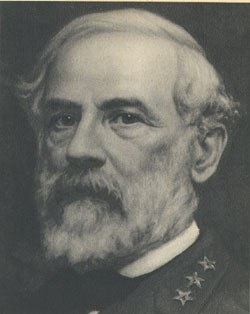
In case you’re wondering what recent development demanded a debunking of the neo-Confederate myth that Robert E. Lee opposed slavery, the answer is: nothing. Lack of inspiration being the mother of invention, I’ve decided to try launching a new feature, Mythistory Mondays, and the Lee article is the first attempt.
The idea is to make myself take at least a little time each week and pull my nose away from the grindstone of today’s affairs, in order to talk about something no less important–that is, yesterday’s affairs, and in particular to take on some of the tall tales about yesterday that you frequently hear today. I hope that the articles will be informative, useful, and well-written for Google–making them available to anyone who needs to pull up the information. That’s the hope, anyway.
Why bother? Well, in part because it’s useful. No matter what it is we face, no matter what we are struggling with today, yesterday is always relevant; history is what we live in, and we can’t help but be affected by the stories that we live amongst, and in. Removing the misunderstandings and distortions of history that are all too pervasive in our daily lives is, therefore, something imminently relevant to what we are doing today. But it’s not just that it’s useful: historical understanding is something worthwhile in its own right. Bogus mythistory is not just an obstacle for us, but also an injustice and an insult to the people who have come before us, and standing up for telling the truth about them is no less worthwhile just because we are younger than they are. There’s no more excuse for parochialism in time than there is for parochialism in neighborhood; and if Mythistory Monday does nothing more than replace one or two lies with one or two truths, that will be enough to have made it worthwhile.
Note added 2010-02-02. Since I originally wrote this article in 2005, it has attracted a great deal of attention through Google and become a common reference point for people looking for information on Robert E. Lee’s opinions and practices when it came to slavery. In order to help people who come here for information on Lee, I’ve since added a series of links at the bottom of this article on other things I’ve written and discovered concerning Lee’s views and experience on race and slavery since this article was originally written.
I’ve spent some time ragging on neo-Confederate mythistory here before; today I’d like to take a bit of time to talk about another of the idiot notions popular with the Stars-and-Bars crowd: the idea that Robert E. Lee opposed slavery, or that he didn’t own any slaves. No he didn’t, and yes he did.Robert E. Lee defended the institution of slavery and personally owned slaves.
Lee cheerleaders love to point out that Lee wrote to his wife, in 1856, that In this enlightened age, there are few I believe, but what will acknowledge, that slavery as an institution, is a moral & political evil He did write that, but the use of the quotation is dishonest. The quote is cherry-picked from a letter that Lee wrote to his wife on December 27, 1856; the passage from which it was taken actually reads:
In this enlightened age, there are few I believe, but what will
acknowledge, that slavery as an institution, is a moral &
political evil in any Country. It is useless to expatiate on its
disadvantages. I think it however a greater evil to the white
man than to the black race, & while my feelings are strongly
enlisted in behalf of the latter, my sympathies are more strong for
the former. The blacks are immeasurably better off here than in
Africa, morally, socially & physically. The painful discipline
they are undergoing, is necessary for their instruction as a race,
& I hope will prepare & lead them to better things. How
long their subjugation may be necessary is known & ordered by a
wise Merciful Providence.
Lee, in other words, regarded slavery as an evil–but a necessary evil ordained by God as the white man’s burden. Far from expressing opposition to the institution of slavery, the purpose of his letter was actually to condemn abolitionists; the letter was an approving note on a speech by then-President Franklin Pierce, which praised Pierce’s opposition to interference with Southern slavery, and declared that the time of slavery’s demise must not be sped by political agitation, but rather left to God, with whom two thousand years are but as a Single day. After that reassuring note, Lee goes on to offer an impassioned plea for toleration of the Spiritual liberty to enslave an entire race:
Although the Abolitionist must know this, & must See that he
has neither the right or power of operating except by moral means
& suasion, & if he means well to the slave, he must not
Create angry feelings in the Master; that although he may not
approve the mode which it pleases Providence to accomplish its
purposes, the result will nevertheless be the same; that the
reasons he gives for interference in what he has no Concern, holds
good for every kind of interference with our neighbors when we
disapprove their Conduct; Still I fear he will persevere in his
evil Course. Is it not strange that the descendants of those
pilgrim fathers who Crossed the Atlantic to preserve their own
freedom of opinion, have always proved themselves intolerant of the
Spiritual liberty of others?
And what did the painful discipline … necessary for their instructionmean? One of the sixty-three slaves that Lee inherited from his father-in-law explains:
My name is Wesley Norris; I was born a slave on the plantation of
George Parke Custis; after the death of Mr. Custis, Gen. Lee, who
had been made executor of the estate, assumed control of the
slaves, in number about seventy; it was the general impression
among the slaves of Mr. Custis that on his death they should be
forever free; in fact this statement had been made to them by Mr.
C. years before; at his death we were informed by Gen. Lee that by
the conditions of the will we must remain slaves for five years; I
remained with Gen. Lee for about seventeen months, when my sister
Mary, a cousin of ours, and I determined to run away, which we did
in the year 1859; we had already reached Westminster, in Maryland,
on our way to the North, when we were apprehended and thrown into
prison, and Gen. Lee notified of our arrest; we remained in prison
fifteen days, when we were sent back to Arlington; we were
immediately taken before Gen. Lee, who demanded the reason why we
ran away; we frankly told him that we considered ourselves free; he
then told us he would teach us a lesson we never would forget; he
then ordered us to the barn, where, in his presence, we were tied
firmly to posts by a Mr. Gwin, our overseer, who was ordered by
Gen. Lee to strip us to the waist and give us fifty lashes each,
excepting my sister, who received but twenty; we were accordingly
stripped to the skin by the overseer, who, however, had sufficient
humanity to decline whipping us; accordingly Dick Williams, a
county constable, was called in, who gave us the number of lashes
ordered; Gen. Lee, in the meantime, stood by, and frequently
enjoined Williams to lay it on well, an injunction which he
did not fail to heed; not satisfied with simply lacerating our
naked flesh, Gen. Lee then ordered the overseer to thoroughly wash
our backs with brine, which was done. After this my cousin and
myself were sent to Hanover Court-House jail, my sister being sent
to Richmond to an agent to be hired; we remained in jail about a
week, when we were sent to Nelson county, where we were hired out
by Gen. Lee’s agent to work on the Orange and Alexander railroad;
we remained thus employed for about seven months, and were then
sent to Alabama, and put to work on what is known as the
Northeastern railroad; in January, 1863, we were sent to Richmond,
from which place I finally made my escape through the rebel
lines to freedom; I have nothing further to say; what I have stated
is true in every particular, and I can at any time bring at least a
dozen witnesses, both white and black, to substantiate my
statements: I am at present employed by the Government; and am at
work in the National Cemetary on Arlington Heights, where I can be
found by those who desire further particulars; my sister referred
to is at present employed by the French Minister at Washington, and
will confirm my statement.
—Testimony of Wesley Norris (1866); reprinted in John W.
Blassingame (ed.): Slave
Testimony: Two Centuries of Letters, Speeches, and Interviews, and
Autobiographies Baton Rouge: Louisiana State University
Press (ISBN
0-8071-0273-3). 467-468.
Some Lee hagiographers seem to be completely unaware that Lee ever owned slaves, much less treated them like this. Part of that’s just the warping of tidbits they heard elsewhere–it’s true that Lee did not own any slaves during most of the Civil War–and part of it is, frankly, dishonest fudging–Lee’s sixty-three slaves were, in spite of being legally under his control and forced to work on his plantation, not held under his own name, but rather temporarily under his control as an inheritance from his father-in-law, G.W.P. Custis. Other Lee cheerleaders recognize that Lee did own slaves, but give him props for manumitting them. What they leave out of the record is that Custis’s will legally required Lee to emancipate the slaves that passed into his control within five years of Custis’s death. Custis died October 10, 1857 and his will was probated December 7, 1857 (about a year after Lee wrote his letter on slavery); Lee kept the slaves as long as he could, and finally filed the deed of manumission with Court of the City of Richmond on December 29, 1862–five years, two months, and nineteen days after Custis’s death.
Custis actually gave freedom to his slaves without qualification in his will; the matter of the five years was supposed to be time for Custis’s executors to do the legal paperwork for emancipation in such manner as may to [them] seem most expedient and proper. There’s good reason to read the clause as intending for the five years to serve as an upper bound on settling the legal details, not as five more years for driving the slaves for whatever last bits of forced labor could be gotten. Lee, however, did not see it that way, and set the slaves to for his own profit for as long as he could. We have already seen that some of the slaves disagreed with Lee on this point of legal interpretation, and how he treated those who acted on their legal theory by seceding from his plantation.
Of course, Lee never was very big on secession at all. Those who love to haul out the Confederacy — Lee included — as heros for secessionist self-determination tend to neglect comments such as this one:
Secession is nothing but revolution. The framers of our
constitution never exhausted so much labor, wisdom, and
forbearance in its formation, and surrounded it with so many guards
and securities, if it was intended to be broken by every member of
the Confederacy at will. It was intended for perpetual union
so expressed in the preamble, and for the establishment of a
government, not a compact, which can only be dissolved by
revolution, or the consent of all the people in convention
assembled. It is idle to talk of secession. Anarchy would have been
established, and not a government, by Washington, Hamilton,
Jefferson, Madison, and the other patriots of the Revolution.
–Robert E. Lee, letter, 23 January 1861
Secession allowed; anarchy established, and not a government; one sighs–if only.
Robert E. Lee is no hero. He was a defender of slavery and a harsh critic of abolitionism; he was also a slaver who brutally punished those who sought their rightful freedom. There are many reasons to damn the Federal government’s role in the Civil War, but none of them offer any excuse for celebrating vicious men such as Lee.
Update 2005-07-03. Since this page is written for Google, I’ve made a couple revisions: (1) The title has been lengthened from Robert E. Lee owned slaves to Robert E. Lee owned slaves and defended slavery, to more accurately reflect the full contents, and the full text and a link to an online transcription of the Testimony of Wesley Norris was added..
 I mentioned here before that Roderick and I would be presenting an essay for the Molinari Society inaugural symposium on feminism and libertarianism. The symposium was excellent; besides a helpful and provoking discussion on our essay, I also got to hear excellent essays by co-panelists Jennifer McKitrick and Elizabeth Brake. Back home, we found that the discussion had spread ahead of us: some of our comments surrounding the essay have already stirred up an engaging, if sometimes frustrating, discussion/contrversy at Liberty & Power, involving folks who had gotten the chance to hear the essay in Boston and others who are still awaiting a look at the text.