Rad Geek People's Daily

official state media for a secessionist republic of one

Posts filed under Politics

In two words or fewer: Stop Snitchin’ edition

Jacob Laskin, Dereliction of Duty, FrontPage (2008-02-15):

There are yet other risks involved. As the White House rightly argues, existing intelligence surveillance may be jeopardized if the PAA is not passed. One of the signal virtues of the PAA is the fact that it provides liability protection to private companies, like telecoms, who cooperate with the government and aid surveillance efforts. Companies like AT&T already face multibillion dollar lawsuits from leftist activist groups like the Electronic Frontier Foundation, who charge that the companies broke the law by assisting government efforts to prevent terrorist attack. With the expiration of the PAA, these companies will lose their legal protections. In the current litigious climate, it is more than likely that they will simply stop aiding the government in its intelligence work.

Well, good.

Conservatives do it with class. (Part 2)

Here’s a Valentine’s Day treat from self-described thinker Glenn Beck, who offers his insights into gender, sex, love, and marriage:

I’m not a sex expert but I’m — you know, I’m thinking, you know, you’re ugly and, you know, that’s a tough one to overcome especially if you’re a woman. If you’re a guy, that’s not hard to overcome. I’m sorry. That’s just the way the world is. Have you — how many ugly guys have hot wives? Take me, for example. I don’t know why she married — I think it was low self-esteem. I do. No, really I think it was low self-esteem. I got in — you know, you buy when the market is low. You know what I mean? While everybody else is selling, you buy. And I think I got in there right at the right time. Low self-esteem, low, wait a minute, could go a little lower, she might come down to my price. Hang on, OK, sold! Now her self-esteem is going up. And if my income wasn’t going up, she would have ditched me long ago. She would have gone, Wait a minute, I think I was depressed when I married you. I’m just — look. I’m not Tania, but I am a thinker. I’m on to you, Tania!

— Glenn Beck, The Glenn Beck Program (2008-02-14)

(Via Echnide of the Snakes 2008-02-15: The Patriarchal Ode To Sexual Love.)

Further reading:

Tyranny means never having to say you’re sorry

Here’s a brief clipping from Wired‘s recent profile on Bill Baker, a structural engineer who specializes in gigantic skyscrapers. He’s currently working on a project for the Emir of Dubai which, when completed, will be the tallest building in the world:

In spring 2003, a pair of developers invited Baker and two of SOM’s managing partners to dinner at a restaurant overlooking the Manhattan skyline. The developers worked for a company in Dubai called Emaar, and they wanted to construct the tallest building in the world. Dubai was eager to make its mark, and because its ruler, Sheikh Mohammed bin Rashid al-Maktoum (known affectionately by locals as Sheikh Mo), supported the project, there would be no litigious neighbors or pesky air traffic controllers to muck things up. There are some places in the world that are like, Let’s do it, get it done, Baker says. Dubai is one of those places. Emaar gave SOM two weeks to submit a proposal for a residential building, to be known as the Burj Dubai. The Dubai Tower.

— Andrew Blum, The Ultrabuilder, in Wired 15.12 (December 2007), p. 224.

In other words, this monumental building project got rammed through, while the people who have to live in its shadow and the airline operators that have to fly around it are legally prevented from doing anything to effectively voice their objections, let alone to get some kind of compensation for the inconveniences, costs and disruptions that such gigantic projects inevitably impose on their private property or their long-established business in common resources and transit lanes. That’s because Bill Baker’s gigantic skyscraper is the pet project of Sheikh Mo, the enormously wealthy, relentlessly self-aggrandizing, and completely unaccountable petty tyrant of Dubai, who can personally manipulate any legal proceeding, override any attempt by ordinary people to get some kind of redress, and shove around any business in the country, if any of them threaten to get in the way of yet another multimillion dollar monument to himself.

It takes a certain kind of mindset to crow about the will and the ability to trample on everybody else’s homes, lives, and livelihoods in order to get a big project rammed through as if it were the positive, can-do sort of attitude that the political-development complex ought to adopt always and everywhere. That mindset is no less tawdry and mean for being so common amongst the most powerful, influential and well-connected people on earth.

Refuge of Oppression #5: Twofer Tuesday edition

Here’s two pieces of correspondence that arrived within three hours of each other, on this past Tuesday. The first comes to us from Stasi [sic!] in reply to GT 2008-01-28: The tall poppies, part 3, my recent article on the spread of opium poppies as a cash crop for impoverished farmers in southern Iraq:

From: stasi
To: Rad Geek
Date: Tue, 12 Feb 2008 1:45 PM
Subject: You Must be High: Tall Poppies, III

How can you even think that raising opium plants is a suitable way of making money to raise your family out of poverty. The only to benefit from drug trade are the high powered, high financed drug cartels.

Additionally, drug use (opium, heroin, etc) has been proven to have detrimental effects on individuals, families, and SOCIETIES. Let’s ALL start raising drug inducing plants to make money.

You MUST be high to think in such terms.

Well, I’m convinced.

Remember, impoverished farmers who grow opium poppies may think that growing a lucrative cash-crop and trading pain-killers to willing customers benefits them more than would starving themselves to grow unprofitable crops that meet the approval of U.S. narcs. But whatever they may think, the Stasi knows that the only people to benefit from the drug trade are high powered, high financed drug cartels. How foolish of Iraqi farmers to think that the ability to provide for your family, rather than starving for the sake of U.S. government narco-diplomacy, would be a benefit worth counting. The Stasi certainly knows what their families want and need better than they do.

Later in the afternoon, I received this from the starr, in reply to one of my posts on the atomic bombing of Hiroshima and Nagasaki, in which over 200,000 Japanese civilians (about a third of the population of Nagasaki, and more than half of the population of Hiroshima) were burned alive, crushed to death, or otherwise killed, in a deliberate use of terror-bombing on heavily-populated city centers intended to force the unconditional surrender of the Japanese government. Apparently my objection to this deliberate act of nuclear terrorism — the first and the only two cases in the history of the world — is the result of historical ignorance.

From: the starr
To: Rad Geek
Date: Tue, 12 Feb 2008, 4:23 PM
Subject: Atomic Bomb

I read your article on the Atomic Bomb, and I must say, you don’t understand World War II at all. The use of the bomb was ABSOLUTELY NECESSARY. The Japanese were a brutal and evil empire and it had to be stopped. They slaughtered countless innocent people, not to mention Pearl Harbor. We urged them to surrender, but they wouldn’t. And they wouldn’t stop killing. The war would have continued for who knows how long and thousands upon thousands of more people would have died. The bomb was our only choice. You said that it killed thousands of innocent people. That’s true. But were the Japanese not doing the same? Did they not slaughter thousands of innocent people by invading other countries, including the completely un-called for attack on Pearl Harbor? There is no morality in warfare. It is foolish to try and equate them. You may want to do a little more research before you criticize the government’s carefully calculated decision.
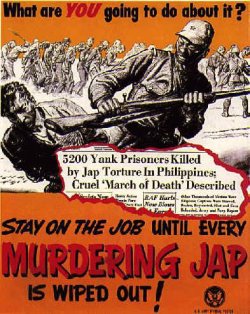
If only I had understood World War II better before I wrote that post. I would have seen that, even though the Japanese military had already long been stopped from any further expansion, and indeed broken, long before August 1945, absolute geopolitical triumph over the Japanese government, and the territorial conquest of Japan, was far more important than the irreplaceable lives of 200,000 or more innocent non-combatants. Indeed, it was important enough to justify or excuse deliberately targeting those 200,000 or more innocent non-combatants in order to force somebody else (the dictatorial clique tyrannizing Japan) to make the necessary political concessions. And little did I know that the Japanese were all invading other countries and killing thousands of innocent people and refusing to surrender. I had foolishly thought that it was a small and unaccountable minority of the population of Japan who were extorting and tyrannizing the rest through the armed power of a military dictatorship. But since more research would have revealed that those 200,000 dead civilians in Hiroshima and Nagasaki (not to mention the hundreds of thousands of dead civilians from the over 100 Japanese cities that the U.S. Army attacked with low-altitude firebombing and conventional high explosives) weren’t actually non-combatants after all, but were all running around with The Japanese as a whole, invading other countries and killing thousands of innocent people, well, I guess that’s that.

Normally, I would also have thought that if you have a true statement of the form There’s no morality in that, that’s as good a reason as you could possibly find to draw the conclusion that you have an unconditional moral obligation to forswear ever engaging in that. This is another sure sign of my folly, ignorance or vice. One man’s reductio and all that; no doubt had I carefully calculated like the Masters of War in the U.S. government, when the antecedent of that is War, it would become clear that what you actually have is a military obligation to sometimes forswear engaging in morality.

My bad.

Further reading:
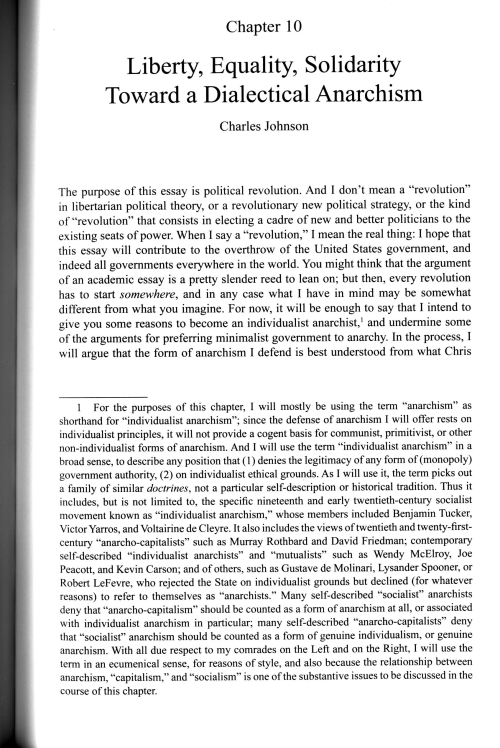
Liberty, Equality, Solidarity: Toward a Dialectical Anarchism

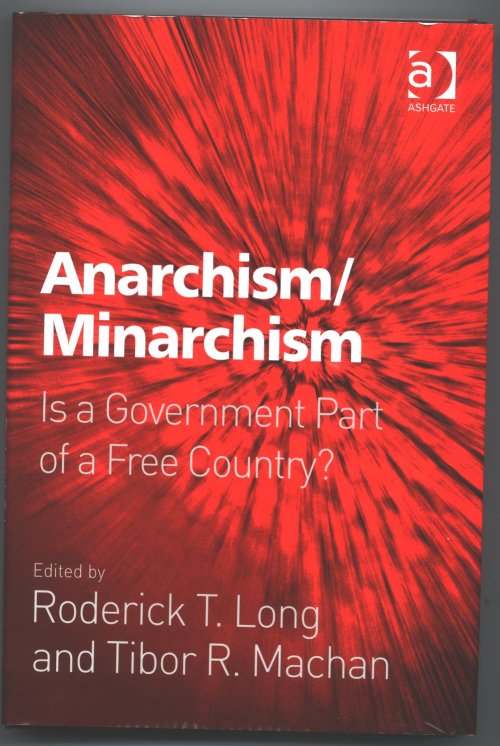
Here’s what I got in the mail Monday afternoon. It took a week longer to reach me than it did to reach Roderick; I don’t know whether that’s one of the perks of being an editor rather than a mere contributor like me, or simply because I’m way out west and he’s in Alabama.

A hardbound copy of Anarchism/Minarchism: Is a Government Part of a Free Country? Edited by Roderick T. Long and Tibor R. Machan. Published by Ashgate Press (pictured here).

Liberty, Equality, Solidarity: Toward a Dialectical Anarchism

The purpose of this essay is political revolution. And I don’t mean a revolution in libertarian political theory, or a revolutionary new political strategy, or the kind of revolution that consists in electing a cadre of new and better politicians to the existing seats of power. When I say a revolution, I mean the real thing: I hope that this essay will contribute to the overthrow of the United States government, and indeed all governments everywhere in the world. You might think that the argument of an academic essay is a pretty slender reed to lean on; but then, every revolution has to start somewhere, and in any case what I have in mind may be somewhat different from what you imagine. For now, it will be enough to say that I intend to give you some reasons to become an individualist anarchist,1 and undermine some of the arguments for preferring minimalist government to anarchy. In the process, I will argue that the form of anarchism I defend is best understood from what Chris Sciabarra has described as a dialectical orientation in social theory,2 as part of a larger effort to understand and to challenge interlocking, mutually reinforcing systems of oppression, of which statism is an integral part—but only one part among others. Not only is libertarianism part of a radical politics of human liberation, it is in fact the natural companion of revolutionary Leftism and radical feminism.

My argument will take a whole theory of justice—libertarian rights theory3—more or less for granted: that is, some version of the non-aggression principle and the conception of negative rights that it entails. Also that a particular method for moral inquiry—ethical individualism—is the correct method, and that common claims of collective obligations or collective entitlements are therefore unfounded. Although I will discuss some of the intuitive grounds for these views, I don’t intend to give a comprehensive justification for them, and those who object to the views may just as easily to object to the grounds I offer for them. If you have a fundamentally different conception of rights, or of ethical relations, this essay will probably not convince you to become an anarchist. On the other hand, it may help explain how principled commitment to a libertarian theory of rights—including a robust defense of private property rights—is compatible with struggles for equality, mutual aid, and social justice. It may also help show that libertarian individualism does not depend on an atomized picture of human social life, does not require indifference to oppression or exploitation other than government coercion, and invites neither nostalgia for big business nor conservatism towards social change. Thus, while my argument may not directly convince those who are not already libertarians of some sort, it may help to remove some of the obstacles that stop well-meaning Leftists from accepting libertarian principles. In any case, it should show non-libertarians that they need another line of argument: libertarianism has no necessary connection with the vulgar political economy or bourgeois liberalism that their criticism targets.

The threefold structure of my argument draws from the three demands made by the original revolutionary Left in France: Liberty, Equality, and Solidarity.4 I will argue that, rightly understood, these demands are more intertwined than many contemporary libertarians realize: each contributes an essential element to a radical challenge to any form of coercive authority. Taken together, they undermine the legitimacy of any form of government authority, including the limited government imagined by minarchists. Minarchism eventually requires abandoning your commitment to liberty; but the dilemma is obscured when minarchists fracture the revolutionary triad, and seek liberty abstracted from equality and solidarity, the intertwined values that give the demand for freedom its life, its meaning, and its radicalism. Liberty, understood in light of equality and solidarity, is a revolutionary doctrine demanding anarchy, with no room for authoritarian mysticism and no excuse for arbitrary dominion, no matter how limited or benign. . . .

1. For the purposes of this essay, I will mostly be using the term anarchism as shorthand for individualist anarchism; since the defense of anarchism I will offer rests on individualist principles, it will not provide a cogent basis for communist, primitivist, or other non-individualist forms of anarchism. And I will use the term individualist anarchism in a broad sense, to describe any position that (1) denies the legitimacy of any form of (monopoly) government authority, (2) on individualist ethical grounds. As I will use it, the term picks out a family of similar *doctrines*, not a particular self-description or historical tradition. Thus it includes, but is not limited to, the specific nineteenth and early twentieth-century socialist movement known as individualist anarchism, whose members included Benjamin Tucker, Victor Yarros, and Voltairine de Cleyre. It also includes the views of twentieth and twenty-first-century anarcho-capitalists such as Murray Rothbard and David Friedman; contemporary self-described individualist anarchists and mutualists such as Wendy McElroy, Joe Peacott, and Kevin Carson; and of others, such as Gustave de Molinari, Lysander Spooner, or Robert LeFevre, who rejected the State on individualist grounds but declined (for whatever reasons) to refer to themselves as anarchists. Many self-described socialist anarchists deny that anarcho-capitalism should be counted as a form of anarchism at all, or associated with individualist anarchism in particular; many self-described anarcho-capitalists deny that socialist anarchism should be counted as a form of genuine individualism, or genuine anarchism. With all due respect to my comrades on the Left and on the Right, I will use the term in an ecumenical sense, for reasons of style, and also because the relationship between anarchism, capitalism, and socialism is one of the substantive issues to be discussed in the course of this essay. !!!@@e2;2020;a9;

2. See Chris Matthew Sciabarra (2000), Total Freedom: Toward a Dialectical Libertarianism. See also Sciabarra 1995a and 1995b. !!!@@e2;2020;a9;

3. Libertarianism as discussed in this essay is a theory of political justice, not as a position on the Nolan Chart. Small government types who speak kindly of economic freedom or civil liberties may or may not qualify as libertarians for the purpose of my discussion. Those who treat liberty as one political good that must be balanced against other goods such as social stability, economic prosperity, democratic rule, or socioeconomic equality, and should sometimes be sacrificed for their sake, are unlikely to count. Since they are not committed to the ideal of liberty as a principled constraint on *all* political power, they are no more likely to be directly convinced by my arguments than progressives, traditionalists, communists, etc. !!!@@e2;2020;a9;

4. Of course, the male Left of the day actually demanded fraternité, brotherhood. I’ll speak of solidarity instead of brotherhood for the obvious anti-sexist reasons, and also for its association with the history of the labor movement. There are few causes in America that most twentieth-century libertarians were less sympathetic to than organized labor, but I have chosen to speak of the value of solidarity, in spite of all that, for the same reasons that Ayn Rand chose to speak of the virtue of selfishness: in order to prove a point. The common criticisms of organized labor from the twentieth-century libertarian movement, and the relationship between liberty and organized labor, are one of the topics I will discuss below.!!!@@e2;2020;a9;

— Liberty, Equality, Solidarity: Toward a Dialectical Anarchism in Roderick T. Long and Tibor Machan (eds.), Anarchism/Minarchism: Is a Government Part of a Free Country. Ashgate Press, ISBN 978-0-7546-6066-8. 155–157.

The good news, for those whose interest is piqued and who would like to read the whole thing, is that the book is now available for pre-ordering and will be shipped somewhere around the end of the month. The bad news is that it’s about $80.00 for the hardcover edition, which is, for the time being, the only edition there is. (If you’re interested in reading the essay but are unlikely to have the bread to buy the book anytime soon, contact me privately.) In any case, for those who do get a chance to read the essay, I’d be glad to hear what you think, or any questions you may have, in the comments section at this post.

I mention this in the essay, but I’d like to repeat it here while I have the chance: the debts I accumulated in the process of writing this essay, and the earlier work on which it drew, are too numerous to give an accounting of them all, but I would especially like to thank my companion Laura and my teacher Roderick. The essay would have been much the poorer, or simply nonexistent, without their patience, inspiration, collaboration, encouragement, and detailed and very helpful comments

Anticopyright. All pages written 1996–2026 by Rad Geek. Feel free to reprint if you like it. This machine kills intellectual monopolists.