Rad Geek People's Daily

official state media for a secessionist republic of one

Posts filed under Politics

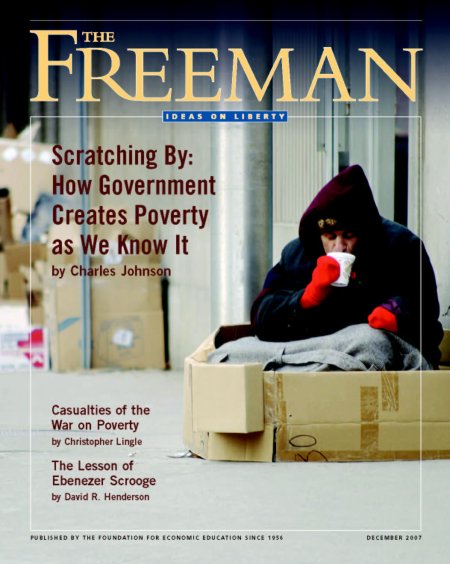
Scratching By: How Government Creates Poverty as We Know It

Here’s something I found in the mail yesterday:

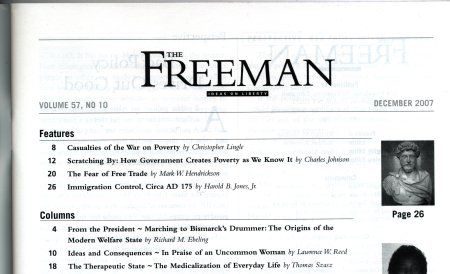
Here's the Table of Contents for the December 2007 Freeman, listing "Scratching By: How Government Creates Poverty As We Know It" on page 12.

Scratching By: How Government Creates Poverty as We Know It

Governments—local, state, and federal—spend a lot of time wringing their hands about the plight of the urban poor. Look around any government agency and you'll never fail to find some know-it-all with a suit and a nameplate on his desk who has just the right government program to eliminate or ameliorate, or at least contain, the worst aspects of grinding poverty in American cities—especially as experienced by black people, immigrants, people with disabilities, and everyone else marked for the special observation and solicitude of the state bureaucracy. Depending on the bureaucrat's frame of mind, his pet programs might focus on doling out conditional charity to deserving poor people, or putting more at-risk poor people under the surveillance of social workers and medical experts, or beating up recalcitrant poor people and locking them in cages for several years.

But the one thing that the government and its managerial aid workers will never do is just get out of the way and let poor people do the things that poor people naturally do, and always have done, to scratch by.

Government anti-poverty programs are a classic case of the therapeutic state setting out to treat disorders created by the state itself. Urban poverty as we know it is, in fact, exclusively a creature of state intervention in consensual economic dealings. This claim may seem bold, even to most libertarians. But a lot turns on the phrase "as we know it." Even if absolute laissez faire reigned beginning tomorrow, there would still be people in big cities who are living paycheck to paycheck, heavily in debt, homeless, jobless, or otherwise at the bottom rungs of the socioeconomic ladder. These conditions may be persistent social problems, and it may be that free people in a free society will still have to come up with voluntary institutions and practices for addressing them. But in the state-regimented market that dominates today, the material predicament that poor people find themselves in—and the arrangements they must make within that predicament—are battered into their familiar shape, as if by an invisible fist, through the diffuse effects of pervasive, interlocking interventions ….

— Scratching By: How Government Creates Poverty as We Know It,
In The Freeman (December 2007), 12–17.

You can read the whole thing at The Freeman‘s website. Enjoy! FEE’s website doesn’t (yet) support online comments, but I’d be glad to hear what you think in the comments section over here.

While I’m on the subject, I’d like especially to thank Sheldon Richman for his encouragement and his help, and my companion L. for her patient reading and helpful comments. The article would have been much the poorer, or more likely nonexistent, without their aid.

Further reading:

Come out, my people, come out…

Here’s something I wrote a little more than a month ago about principled libertarians who have thrown in for the Ron Paul campaign:

As for rising libertarian consciousness, or openness to libertarian ideas, I'd like to believe that it's true, but I'm not especially convinced. If it is true, though, I would suggest that absolutely the most urgent thing to do is to start those conversations and unhitch them as quickly and as thoroughly as possible from the Ron Paul train, because we have a very short window of time — somewhere in the vicinity of 1-3 months, depending on the breaks — before Ron Paul's prospects in the primaries are completely decided. If nothing significant happens in that direction between now and then, then I think that a lot of money and a lot of organizational energy will disappear right into the same dark, lonely station where the Clark train, the Buchanan train, the Perot train, the Nader train, and the Dean train are sitting idle after all these election cycles. That'd be a shame, because, as much as I dislike some of what they're producing, they are certainly showing a lot of genuine organizational intelligence.

I’d say that recent news — Ron Paul’s next-to-last performances in early primaries, and the rippling effects of the recent brouhaha over the newsletters published under his imprimatur — is as good a reason as you could hope for for believing that time is up. Either the Paulistas unhitch themselves now or they will be carried far away from their intended destination.

Yes, yes, the New Republic article is a sloppy hatchet piece, which mixes genuinely fucked-up shit (such as the vile racism and authoritarianism of the law-n-order pieces that appeared in the early 1990s) together with bogus smears (such as the attempt to use longstanding criticism of U.S. military support for the Israeli government as evidence for a charge of anti-Semitism). And yes, yes, Ron Paul’s relationship to the newsletters was weird and there is some complicated and ongoing movement history that makes the full story much less straightforward than Kirchick’s narrative would imply. But that genuinely fucked-up shit is genuinely fucked-up shit. If you’re interested in an overview of the authorship question and of some of the salient movement history, you can see the article and comments at Kn@ppster (2007-01-08), and also Wirkman Netizen (2007-01-09). As I see it the full story, once told tends to make Ron Paul a little less guilty than Kirchick claims, but much more guilty than his kneejerk defenders claim.

That’s a conversation well worth having, and perhaps I’ll join in in the future. But for the time being, the point that I’d like to stress is this: whatever the full, nuanced, correct understanding of the matter may be, there is no realistic chance whatsoever that the necessary nuance will fit into either person-to-person electoral outreach or political media commentary within the amount of time that remains. News media and politicking in the critical months of primary season just don’t provide a medium for that kind of nuanced discussion to happen. It just doesn’t have the bandwidth to get through anything much more complex than Google Ron Paul, Ron Paul’s a crazy racist, Is not, Is so, Your moms! etc.

So Ron Paul’s chances in the Republican primaries, if he ever had any to begin with, are on death’s doorstep, and all that remains on this point are a number of damning associations with his name that radical libertarians will not be able to dispel or to dissociate within the electoral forum. Those radical libertarians who have tried to use Ron Paul’s personality and campaign, warts and all, as an indirect means for educating people about and persuading them of anti-war and radical libertarian views had best give it up. Those radical libertarians who have tried to use mix with Ron Paul’s other supporters as a source for new recruits had best give up on trying to work together with the Paulistas within the context of Ron Paul’s campaign, and start working on poaching them from the campaign into other projects. Any further effort at bolstering the campaign is, as far as I can see, going to be wasted effort. The campaign is just about dead in the water, and ongoing libertarian efforts to talk it up are, as far as I can tell, very unlikely to educate anyone about the real nature of libertarianism. What they are far more likely to do is undermine any efforts to educate people about what genuine radical libertarianism entails. If these efforts are not simply ignored, then what they will accomplish is not mainly to push more anti-libertarians and not-yet-libertarians towards libertarianism, but rather to push them towards associating radical libertarianism with the reactionary bigotry of the hard Right. What would be far more productive is a concerted effort to break that association, by publicly dissociating from and criticizing the Ron Paul campaign, on the grounds of clear, public, and unapologetic statements of radical libertarian principles.

Now, I believe firmly in honesty, and in open radicalism, and I think that if an extreme position is correct, then public indignation at it, or smears of it, are ever a good reason to abandon, or moderate, or dissemble about your position. You just keep at it, against wind and tide, until your intransigence and the rightness of your position have succeeded in shifting the debate. But when we move away from the moral question of fidelity to principle, and to the strategic question of supporting a particular candidate warts and all, the issue is no longer one of honesty but rather one of whether your chosen means are actually well-suited to your ends. If the hope is to convince non-libertarians through education and persuasion, then you’re not likely to promote that goal through boosterism for Ron Paul’s good name and electoral prospects, after his electoral campaign has become moribund and his name is no longer especially good. If Ron Paul boosterism ever was an effective way to get things done, it no longer is, and it’s time to find a better way.
Republicans do it with class.

Here’s a choice sample from People‘s year-end interview with George and Laura Bush, in which George (who, unlike Mrs. Bush, is apparently so elevated in dignity that he must be referred to in print by a definite description rather than by his proper name) talks about his daughter Jenna’s recent engagement.

Q: Tell us about your future son-in-law, Henry Hager. Did he do right and ask for Jenna's hand?

The President: He kind of sidled up to me and said, Can I come and see you? We were sitting outside the presidential cabin here, and he professed his love for Jenna and said, would I mind if he married her? And I said, Got a deal. [Laughter] And I'm of the school, once you make the sale, move on. But he had some other points he wanted [to make]. He wanted to talk about how he would be financially responsible.

— People Magazine (2007-12-31): We’ve grown stronger

(Via Jessica Valenti @ The Nation Blog 2008-01-03: The Daddy State? No Thanks.)

Paul Till You Puke

About a month ago, I criticized an article by David Gordon that criticized left libertarians who criticized Ron Paul. David Gordon later criticized my criticism of the criticism of the criticism; I posted a rejoinder; and Gordon posted a reply to the rejoinder. Meanwhile, Keith Halderman and I had a go-around about my views on libertarian feminism. Just in case that’s not enough dialog for you yet, Roderick has two long and very thoughtful posts at Austro-Athenian Empire, To Paul or Not To Paul, Part 2 and To Paul or Not To Paul, Part 3, about the exchange between me and Gordon in particular, and about libertarian electioneering in general. Be sure to read through the comments sections as well, for rejoinders from David Gordon.

I don’t have much to add beyond what Roderick has already said. One quick clarification about the use of terms, though. In comments, Roderick says:

I’m willing to grant that Ron Paul counts as a libertarian. (I think Charles denies this on the grounds that Paul subordinates liberty to constitutionalism, but I’m happy to grant the label.)

I have argued before that the positions expressed by Ron Paul in his campaign are constitutionalist rather than libertarian. Whether I would call Ron Paul a libertarian or not depends on what is meant by the term. There’s a broad, cluster-concept sort of sense in which Ron Paul could be called a libertarian, and, on some issues, a fairly hard-core libertarian at that. That is, he would fall pretty far towards that corner of the Nolan Chart if you mapped out where he stands on various questions of policy. There’s another sense of libertarianism, which has to do with the ideological reasons that underlie those policy positions — that is to say, a radically individualist theory of justice and political legitimacy, which happens to be incompatible with constitutionalism or any theory that subordinates moral claims for liberty and justice to legalistic proceduralism. To the extent that Ron Paul has been willing to sacrifice libertarian policies for the sake of non-libertarian or anti-libertarian goals, such as a fundamentalist reading of the U.S. Constitution or the so-called rule of law, he must be operating on some theory of political justice other than libertarianism, and so is (in the ideological sense) a Constitutionalist, or a decentralist conservative, or whatever, and not a libertarian. So how happy I am to grant the label depends on how the label is being used in a particular case. There are some reasons, both of temperament and of deliberate rhetorical choice, why I tend to talk about libertarianism in the ideological sense more than I tend to talk about it in the Nolan Chart sense, but I’m certainly happy to grant that Ron Paul has at least as good a claim (often a better claim) to the term libertarian as most of the Libertarian Party, or many of the paradigm cases of libertarians in the mainstream public consciousness.

Hope this helps.

Shiva on “abuse” and “misdiagnosis”

Besides availing itself of my favorite quotation from Edmund Burke, this recent post by Shiva at Biodiverse Resistance is also pretty much right on from beginning to end. Thus:

The headline of this recent BBC story is Stroke victim was misdiagnosed as mad. While reading it was pretty scary (especially as temporary aphasia can also occur in autism, and in fact i experienced it (albeit only for a few very brief periods) in my teens), it follows a certain pattern that annoys me: in describing the horrible treatment that Steve Hall experienced when misdiagnosed, it implicitly suggests that the same treatment would be appropriate and acceptable if he actually was mad.

It reminded me of this case of a woman who was put in a men’s prison because she was percieved to be a transsexual woman (and, therefore, in the eyes of the police who arrested her, really a man) – and of similar cases i’ve heard of where gender-ambiguous-looking women have been refused entry to women’s toilets or other single-sex spaces where they were thought to be MTF transsexuals. As nodesignation says:

The police don’t question the practice of regularly placing trans women in situations where they will be raped. They only lament that they accidentally subjected a non-trans woman to the violence that they regularly subject trans women to. I would assume that as this story gains traction the emphasis will be about how horrible that a woman who was not trans received such mistreatment. That much is clear already from the fact that there are so few stories on trans women receiving this mistreatment despite being its being a regular occurance.

It’s not the inherent wrongness of the treatment that is discussed, it is the supposed horrible mistake of subjecting someone to that treatment when that person actually turned out to be not a member of the category of people that it’s considered acceptable to do this sort of thing to. No thought is given to why it’s supposedly acceptable to do it to people who are in that category, despite the fact that, in both cases, the reporting of the incident blatantly begs the question: if it was horrible and inhuman and inacceptable to do this to one person by mistake, what is it to do it to a whole Othered class of people deliberately?

It was, and in some places still is, common for autistic people (particularly those who don’t fit certain aspects of the commoner autism stereotypes) to be misdiagnosed as schizophrenic, leading to institutionalisation, forced drugging, etc. Similarly, many non-verbal autistic people (who are/were nonetheless capable of communication through other means) are or were misdiagnosed as mentally retarded, again leading to institutionalisation and other abuses justified by the fact of their supposed incapacity for rational thought or communication. On autism message boards and other communities, these cases tend to be talked about primarily in terms of the horribleness of the misdiagnosis, often with comments to the effect that I/you/ze should never have been treated like that, because I’m/you’re/ze’s autistic, not schizophrenic/mentally retarded/whatever, or seeing the case similarly to someone who was acquitted of a crime after new evidence proved them not guilty, as if to be found to be autistic rather than some other diagnostic category after all is what makes all the difference. Even if the people making these sort of comments don’t realise it, they’re implying that it would be OK to do all those things to someone who actually is schizophrenic or mentally retarded.

Whether or not we want to adopt an overarching political/philosophical label like anarchist, however, all of us who fight, with actions or words, for any oppressed groups and against oppression need to actively oppose the hypocrisy of outrage at people being mistakenly treated like they are members of a supposedly OK to exclude, abuse or oppress category, when the real outrage should be that such a category even exists. The thing itself is the abuse…

— Shiva @ Biodiverse Resistance (2008-01-03): The Thing Itself Is The Abuse

Read the whole thing.

Anticopyright. All pages written 1996–2026 by Rad Geek. Feel free to reprint if you like it. This machine kills intellectual monopolists.