Rad Geek People's Daily

official state media for a secessionist republic of one

Posts filed under Politics

Gynocide: mass graves and bodies uncovered in Juarez and Basra

Kyrie eleison.

Forensic teams in Ciudad Juarez in Mexico are unearthing more than 4,000 bodies buried in common graves.

A local government official said DNA samples from the bodies would be compared to those of missing persons.

It is thought that some of the bodies could belong to women killed in a wave of unsolved murders that began in the city in 1993.

The official said the corpses were buried in common graves because they had not been claimed after 90 days.

The bodies being exhumed were buried between 1991 and 2005 – all unclaimed bodies buried since 2005 have been identified first.

More than 300 women have been murdered in the town in Chihuahua state since 1993, and an unknown number have gone missing.

There is no generally accepted motive for the killings.

They have been variously attributed to serial killers, drug cartels and domestic violence. Some of the killings are believed to have been sexually motivated.

Many of the victims were poor working mothers employed in factories in the industrial city, which is on the border with Texas.

There have been several arrests, but the killings have continued.

— BBC News 2007-12-05: Bodies in Juarez graves exhumed

In southern Iraq:

BAGHDAD (AP) — Religious vigilantes have killed at least 40 women this year in the southern Iraqi city of Basra because of how they dressed, their mutilated bodies found with notes warning against violating Islamic teachings, the police chief said Sunday.

Maj. Gen. Jalil Khalaf blamed sectarian groups that he said were trying to impose a strict interpretation of Islam. They dispatch patrols of motorbikes or unlicensed cars with tinted windows to accost women not wearing traditional dress and head scarves, he added.

The women of Basra are being horrifically murdered and then dumped in the garbage with notes saying they were killed for un-Islamic behavior, Khalaf told The Associated Press. He said men with Western clothes or haircuts are also attacked in Basra, an oil-rich city some 30 miles from the Iranian border and 340 miles southeast of Baghdad.

Those who are behind these atrocities are organized gangs who work under cover of religion, pretending to spread the instructions of Islam, but they are far from this religion, Khalaf said.

Throughout Iraq, many women wear a headscarf and others wear a full face veil although secular women are often unveiled. Since the overthrow of Saddam Hussein and the rise of a Shiite-dominated government, armed men in some parts of the country have sometimes forced women to cover their heads or face punishment. In some areas of the heavily Shiite south, even Christian women have been forced to wear headscarves.

Before the U.S.-led invasion in 2003, Basra, Iraq’s second-largest city, was known for its mixed population and night life. Now, in some areas, red graffiti threatens any woman who wears makeup and appears with her hair uncovered: Your makeup and your decision to forgo the headscarf will bring you death.

Khalaf said bodies have been found in garbage dumps with bullet holes, decapitated or otherwise mutilated with a sheet of paper nearby saying, she was killed for adultery, or she was killed for violating Islamic teachings. In September, the headless bodies of a woman and her 6-year-old son were among those found, he said. A total of 40 deaths were reported this year.

We believe the number of murdered women is much higher, as cases go unreported by their families who fear reprisal from extremists, he said.

— Sinan Salaheddin, Associated Press (2007-12-10): Vigilantes Kill 40 Women in Iraq’s South

(Via Feminist Law Professors 2007-12-10 and Majikthise 2007-12-10.)

Further reading:

Pro-Life Terrorism

Incompetent pro-life terrorism, to be specific.

ALBUQUERQUE, N.M. — An eyewitness tells fire authorities about two hooded persons who broke a window and threw a gas can into an abortion clicnic that caught fire Thursday night.

Local, state, and federal law enforcement agencies are investigating a fire at the office of Curtis Boyd, M.D., an abortion provider in Albuquerque.

The fire occurred at Dr. Boyd’s clinic at 801 Encino Place near the University of New Mexico hospital around 11:30 p.m. Thursday.

Albuquerque Fire Department said a witness saw two persons in hooded jackets break a window on the west side of the clinic. The witness called out to them. The two hooded persons then moved to another window on the building’s south side and threw a gas can into the building and a small fire started at that point. The two persons drove away in a square black van.

After several hours of investigating, AFD confirmed that the witness saw an arson in progress. AFD is working closely with ATF and FBI on this case.

According to a statement from the National Abortion Federation, there have been seven murders, 17 attempted murders, 41 bombings, 100 butyric acid attacks, 656 anthrax threats, and 175 arsons against abortion providers since 1977, including Thursday’s Albuquerque incident.

The clinic incurred severe fire damage to one room and smoke damage throughout, but crews say the building is not a total loss. No one was inside at the time. Staff at the clinic is still answering the phone and seeing patients at another undisclosed location.

— KOAT Albequerque (2007-12-07): Eyewitness Accounts Confirm Arson In Abortion Clinic Fire

Meanwhile, peaceful pro-lifers who thank God that nobody was injured (why? aren’t they mass murderers?) will not speculate on why the building was damaged by fire, but they will lament that the fire has in no way diminished Boyd’s enthusiasm for the practice.

The abortion rights movement is in a more precarious position than we sometimes realize. We have spent too long defending an ever-shrinking number of clinics against the repeated harassment, blockades and guerrilla violence of antis. What we desperately need is a forward strategy of building more clinics, along the lines of the courageous efforts to open a new abortion clinic in Aurora, Illinois. The only way to win against this kind of opposition is to give them so many targets that it won’t make much of a difference to lose any given one.

(Via Jill @ feminste 2007-12-10: More Anti-Choice Terrorism.)

Dropping the plumb line

In his Open Letter to Libertarians on Ron Paul, featured on anti-state, anti-war, pro-market LewRockwell.com, anarchist David Gordon made the following objection to Steven Horwitz’s pro-choice libertarian objections to Paul’s position on abortion:

No power to regulate abortion is granted to the federal government. Some of course claim that the Fourteenth Amendment changes matters, but it requires very strained interpretation to conjure a right to abortion out of the text of this Amendment. One critic of Ron Paul has admitted that Roe v. Wade is bad law but thinks we should somehow get to the correct pro-abortion view. Is this not to surrender the possibility of constitutional limits on the federal government?

To which I replied:

Yes. So what?

Anarchists don’t believe in constitutional government.

In his recent rejoinder, Gordon responded:

Anarchists oppose a monopoly state, but it hardly follows from this that if there is a government, anarchists shouldn’t be concerned with restraining it.

But I do not claim that anarchists shouldn’t be concerned with restraining actually existing governments. What I claim is that anarchists do not recognize the legitimacy of constitutional governments any more than they recognize the legitimacy unconstitutional governments, since any government, no matter how restrained by a written constitution, must necessarily violate the rights of innocent individual people in order to remain a government. But if constitutional government has no special claim on our allegiance with respect to its legitimacy, then restraining government through the instrument of a written constitution is, at the most, a pragmatic strategy which should be pursued or abandoned in any given case according to its likelihood of success. If it turns out to be a foolish strategy, then abandoning it is no great loss for libertarians.

But if the question is one of practical prospects, then the strategy of trying to restrain the federal government through the instrument of the United States Constitution has already been empirically tested, and it has already failed. As Lysander Spooner wrote, But whether the Constitution really be one thing, or another, this much is certain — that it has either authorized such a government as we have had, or has been powerless to prevent it. In either case, it is unfit to exist. Thus I would argue that anarchists should be intensely concerned with the problem of restraining actually existing governments. What I deny is that there is either any moral or any strategic reason to try to do so through the instrument of paper constitutions.

Concerning Roe, I will pause to say that, unlike Steven Horwitz, I don’t regard the majority decision as bad constitutional law. Since I am an anarchist, I regard the U.S. constitution as having no color of legal authority, so I don’t much think that there is a right way or a wrong way to read the Constitution in legal contexts, and I don’t think that the failure of a ruling to line up with a restrictive reading of the ipsissima verba of the Constitution is any more of a vice in the ruling than its failure to line up with a traditionalist reading of shariah. If such rulings can be evaluated as good or bad law at all, it must be on the basis of other standards — such as how far they serve to restrain or to promote actual state aggression. To the extent abortion laws are invasions against the liberty of pregnant women to dispose of their own bodies as they see fit, a ruling that repeals those laws is a good ruling, even if it doesn’t line up with a literalist reading of the Constitution. To the extent that eminent domain laws are invasions against the liberty of homeowners to keep their own homes, Kelo was a bad ruling, even if it does line up with some literalist readings of the Constitution.

On Ron Paul’s support for a federal police state to enforce international apartheid, Gordon wrote:

Some object to Ron Paul because he does not support an open borders immigration policy. But why should one take this position to be essential to libertarianism? Hans Hoppe has raised strong objections to open borders; and Murray Rothbard, in his last years, abandoned the view. Free immigration combined with a welfare state is a dangerous brew: does it make sense to reject Ron Paul because he cannot accept it?

I replied:

Yes.

Anarchists don’t believe in national borders and they don’t believe in a federal police state to enforce them.

Gordon had this to say:

On immigration, Johnson says that anarchists should ignore national boundaries. Why? Once more, anarchism is a view about the justification of government. It is opposed to states, not nations.

But I did not say that anarchism per se is opposed to nations. I said that anarchists don’t believe in national borders. In anarchy there are no national borders, only the boundaries of individual or common property. Nobody has any just claim to enforce restrictions on any borders other than these. But the continent-spanning territory of the United States of America is not the common property of the American nation, let alone the proprietary domain of the United States government. Thus there is no entity that has any just claim to set collective terms for immigration that can be imposed upon the entire nation. Anarchism rejects all forms of coercion against peaceful people, including the coercion that must necessarily be committed against landlords, employers, and migrant workers in order for the federal government to exile workers from private property onto which they have been invited, or to stop them from doing jobs for willing employers. That includes not only existing federal immigration laws, but also the (more aggressive) federal immigration laws that Ron Paul supports, and the federal immigration laws that Hans-Hermann Hoppe has deluded himself into thinking that an anarchist can consistently support. Anarchists should take no notice whatsoever of government-enforced national boundaries, except to trample them underfoot as an usurpation.

In response to my complaints against a particular pseudo-libertarian argument in favor of immigration laws, Gordon adds:

He points out that some efforts to restrict immigration use violence against people; and he is right that here lies danger. Libertarians who favor immigration restrictions need to specify exactly what measures they think permissible. Ron Paul doesn’t favor beating and jailing people.

I have no idea why Gordon would say this. Of course Ron Paul does favor beating and jailing people in the name of his immigration control policy. He favors the creation and enforcement of federal immigration laws, including a paramilitary lock-down of the land borders, aggressive enforcement of the existing visa system, and the continued criminalization (no amnesty) of currently undocumented immigrants. He also favors the necessary means to these ends: border walls, paramilitary border patrols, government immigration dossiers and employment papers, internal immigration cops, detention centers, and all the other necessary means to interdicting, discovering, arresting, jailing, and deporting people who try to live and work peacefully in the United States without a federal permission slip for their existence. If you don’t believe that this process necessarily involves violent means, then just try to cross the border without government papers and see what happens to you.

For what it’s worth, I don’t claim that anyone who favors immigration laws is (ipso facto) no longer a True Libertarian. But I do claim that libertarians cannot hold the position consistently, and that attempting to hold the position while also holding a libertarian theory of individual rights necessarily involves grave cognitive vices, and probably grave moral vices, too. In any case support for coercive immigration laws is a good reason for libertarians to refuse their support to a candidate for political office.

On the relationship between libertarianism and leftist or feminist cultural projects, Gordon clarifies that he was not referring to the argument that Roderick Long and I advance in our essay on libertarian feminism, but rather to a different argument by a different writer. He has also stressed elsewhere that his argument is only intended to recommend Ron Paul as a candidate, not to claim that libertarians have some kind of moral obligation to support Ron Paul (or any other candidate in government elections). Fair enough. I’ll let those to whom his letter did refer speak for themselves, as far as the charge of subordinating libertarianism to leftist concerns goes. And for what it’s worth, my intention here is not to claim that libertarians have an obligation not to vote for Ron Paul, or even to make any recommendation for or against voting for Ron Paul. It is merely to take issue with the logic of certain arguments that have been used against libertarian critics of Paul’s campaign. In that vein, I don’t buy the argument that follows:

Johnson correctly claims that the concept of libertarianism doesn’t imply political support for libertarians in elections. I think, though, that if someone who defends political action refuses to support Ron Paul just because he is not a left libertarian, then he is subordinating libertarianism to leftist views.

When Gordon speaks of subordinating libertarianism to leftist views, he does not make it clear whether he means subordinating the left-libertarian’s libertarianism of as a political principle, or whether he means subordinating the candidate’s libertarianism as a criterion for supporting a that candidate in government elections. If the former, then Gordon’s conditional is obviously false. There are lots of practical considerations that affect whether or not one should support a particular candidate in government elections, and declining to support a particularly libertarian candidate for reasons other than her own level of libertarianism is not equivalent to subordinating your own libertarian principles to those other concerns. (I wouldn’t support voting for Murray Rothbard for President, either, even though he would be a much more libertarian candidate than Ron Paul. Since he’s dead, and therefore ineligible to run, such a campaign would be foolish. But this decision doesn’t mean that I subordinate libertarian principles to expediency.)

If, on the other hand, he means that such a choice reflects a subordination of criteria based on the candidate’s level of libertarianism to criteria that are based on other considerations, the conditional is still false, although less obviously so. If I reject X for lacking feature A, while X does have feature B, you cannot reliably infer from my choice that I subordinate preferences for B to preferences for A. It may very well be that B and A are valued equally and indepdently of one another, and that lacking either is considered a sufficient condition for rejecting an alternative.

But more to the point, even if Gordon’s conditional were true on this understanding, it is not clear why that would be objectionable. There is no reason for principled libertarians to treat a candidate’s overall level of libertarianism as the sole or the decisive or even the most important criterion in choosing whether to vote for that candidate, or someone else, or nobody at all. Insofar as voting has any worth at all for anarchists, it is only instrumentally, as a means of defense against government invasions of your own or the liberty of other people you are concerned for. But there’s no guarantee that that end will always be best served by adopting the candidate’s overall level of libertarianism as the sole or the decisive criterion for supporting that candidate. They may be or they may not be, depending on the breaks.

In either case, it is, once more, a serious mistake for libertarians of any stripe, and especially anarchists, to treat government elections as the be-all and end-all of libertarianism.

Gordon closes his rejoinder by saying:

Johnson apparently accepts this as a good argument: Johnson believes p; therefore, anarchists believe p. His post is unfortunately a prime example of the libertarian dogmatism I was most concerned with in my Open Letter.

Hardly. All that I claim is that a couple of propositions — in particular, rejecting the legitimacy of constitutional governments, and rejecting the legitimacy of enforcing restrictions on government-defined national borders, are well-established, core doctrines of anarchism as such.

Core, not essential; anarchism is a family resemblance concept, and some anarchists may deviate from some core anarchist beliefs without ceasing to count as anarchists. But certainly a letter which is written by an anarchist for an audience which includes many other anarchists ought to take such core beliefs seriously, and to recognize that arguments that either tacitly or explicitly presume the falsity of those core doctrines will fail to be persuasive to those who follow the plumb-line.

If this be dogmatism, let us make the most of it.

Further reading:
Republicans for Parochialism and Ignorance

This is a new online ad, recently released by the campaign team, to a chorus of praise from the membership of Know-Nothings for Tom Tancredo:

Oh, wait, my bad. Here’s the right one:

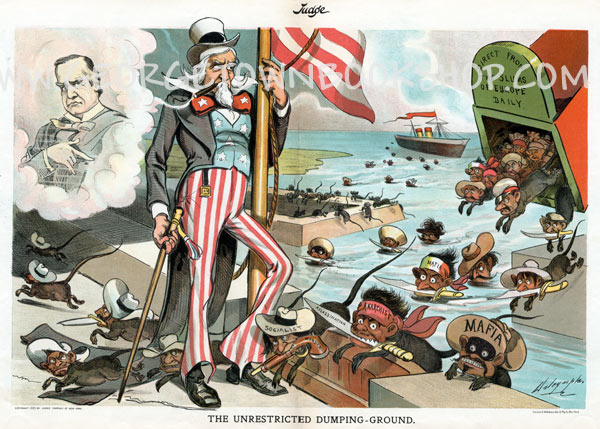
Just remember: they are not against immigrants. They’re just against illegal immigrants.

On a related note, I’d like to wish everyone a very happy Anti-Nationalism Day.

(Link via Migra Matters 2007-12-10.)

Over My Shoulder #38: Yael Tamir, “Siding with the Underdogs” in Is Multiculturalism Bad for Women?

Here’s the rules:

  1. Pick a quote of one or more paragraphs from something you’ve read, in print, over the course of the past week. (It should be something you’ve actually read, and not something that you’ve read a page of just in order to be able to post your favorite quote.)

  2. Avoid commentary above and beyond a couple sentences, more as context-setting or a sort of caption for the text than as a discussion.

  3. Quoting a passage doesn’t entail endorsement of what’s said in it. You may agree or you may not. Whether you do isn’t really the point of the exercise anyway.

Here’s the quote. This is from Yael Tamir’s essay, Siding with the Underdogs, in Is Multiculturalism Bad for Women?, an anthology based on the title essay by Susan Moller Okin.

Why do group rights serve best the interests of those members of society who are powerful and conservative? To begin with, the notion of group rights as it is often used in the current debate presupposes that the group is a unified agent. Rights are bestowed upon the group in order to preserve its tradition and defend its interests. Identifying the tradition and the interests of the group becomes a precondition for realizing these rights. Consequently, internal schisms and disagreements are perceived as a threat to the ability of the group to protect its rights. Group leaders are therefore motivated to foster unanimity, or at least an appearance of unanimity, even at the cost of internal oppression.

Attempts to achieve unanimity are particularly dangerous in those communities which lack formal, democratic decision-making processes. Under such circumstances it is the elderly of the tribe, members of councils of sages, who determine the groups’ norms and interests. Members of such bodies are commonly men, who endorse a rather orthodox point of view. Social norms and institutions place these individuals within a dominant position, and group rights consolidate this position even further. Granting nondemocratic communities group rights thus amounts to siding with the privileged and the powerful against those who are powerless, oppressed, and marginalized, with the traditionalists (often even the reactionary) against the nonconformists, the reformers, and the dissenters.

The conservative nature of group rights is reinforced by the justifications adduced in their defense. The group is granted rights in order to preserve its culture, language, tradition. These are described, by most defenders of group rights, in nostalgic, nonrealistic terms. They are depicted as authentic, unique, even natural. Those who attempt to consolidate the conservative way of doing things are therefore portrayed as loyal defenders of the group, those who strive for social transformation and cultural reformers are perceived as agents of assimilation who betray the group and its tradition. The former are depicted as virtuous individuals who dedicate themselves to the common good; the latter are suspected of being motivated by narrow self-interest–of giving priority to short-term preferences for personal comfort and prosperity over long-term commitments to the welfare of the community.

Agents of social and cultural change are portrayed as feeble-minded individuals who are tempted by the material affluence of the surrounding society, as those who sell their soul to an external devil in exchange for some glittering beads. It therefore seems legitimate to criticize, scorn, even persecute them. This is the fate of Reform Jews who are often portrayed by the Orthodox establishment as irresponsible, weak-minded, pleasure-seeking individuals who wish to escape the burden of Judaism in order to adopt a less demanding lifestyle. Reform Jews, Orthodox argue, are swayed by the external (and superficial) beauty of Christian architecture and ceremonies. The reforms they offer are seen as grounded in mimicry, as an attempt to be like the Gentiles rather than as a call to reevaluate Judaism and offer ways in which it can answer the needs and challenges of modernity. Reform Judaism is therefore portrayed as a threat to the survival of Judaism rather than as an attempt to save it.

The use of the term survival in the context of the debate over group rights is common, yet alarming. It misdescribes what is at stake, intensifying the cost of change and fostering the belief that any violation of social and religious norms, any reform of traditional institutions and the group’s customary ways of life, endangers its existence and must therefore be rejected.

Moreover, it intentionally obscures the distinction between two kinds of communal destruction: the first results from external pressures exhorted by nonmembers; the second, from the desire of members of the community. It is clear why we ought to protect a community and its members in cases of the first kind, but should we protect a community also against the preferences of its own members? Is it just, or desirable, to allow those who aspire to preserve the communal tradition–often members of the dominant and privileged elite–to force others who have grown indifferent or even hostile to this tradition to adhere to that tradition?

Obviously, defenders of group rights who use the term survival to denote cultural continuity tend to give priority to this end over and above individual rights. Charles Taylor’s discussion of the Canadian case demonstrates this order of priorities: It is axiomatic for the Quebec government that the survival and flourishing of French culture in Quebec is a good …. It is not just a matter of having the French language available for those who might choose it …. Policies aimed at survival actively seek to create members of the community, for instance, in their assuring that future generations continue to identify as French speakers.

It should be clear by now that in the Canadian case, as well as in the debate between Orthodox and Reform Judaism, the term survival refers not to the actual survival of the community or its members but to the survival of the traditional way of life. It is used to justify the taking of extreme measures, including disregard for individual rights and forceful suspension of internal criticism, for the sake of preventing change. But is there a reason to prevent a particular way of life from undergoing change? Should one protect a community against cultural revisions or reforms, even radical ones, if these are accepted by its members? The answer to the above question depends on the motivations one may have for protecting cultures or traditions.

An approach that is grounded in the right of individuals to pursue their lives the way they see fit must support individuals who wish to reform their tradition and change their lifestyle as much as it ought to support individuals who wish to retain their traditional way of life. It must be attentive to the kind of life plans individuals adopt and pursue, without prejuding in favor of conservative options. It should therefore defend individuals against pressures to conform and protect their choices to reform their tradition or even exit the community altogether. The opposite is true for an approach that is motivated by the desire to defend endangered cultures. Such an approach must favor conservative forces over reformist ones, even at the price of harming some individual interests. Obviously multiculturalism that is grounded in the former approach is friendly to feminism, while that which is grounded in the latter is not.

–Yael Tamir (1999), Siding with the Underdogs, in Is Multiculturalism Bad for Women?

Anticopyright. All pages written 1996–2026 by Rad Geek. Feel free to reprint if you like it. This machine kills intellectual monopolists.