Rad Geek People's Daily

official state media for a secessionist republic of one

Posts filed under Politics

Happy tax season, Twinky

Just a reminder that you have just under two more weeks to submit the annual accounting of yourself to the State. Do be sure to turn over any of the tribute that you haven’t rendered yet for the privilege of working for a living without being locked in a cage for the next several years of your life. All that protection isn’t free, and the government will be protecting the hell out of you in the upcoming year whether you asked for it or not.

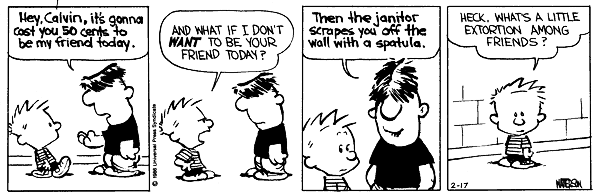
In honor of the event, here’s Monday’s re-run of Calvin and Hobbes, courtesy of GoComics:

Moe: Hey Calvin, it’s gonna cost you 50 cents to be my friend today.

Calvin: (indignantly) And what if I don’t want to be your friend today?

Moe: (smiling) Then the janitor scrapes you off the wall with a spatula.

Calvin: (aside) Heck, what’s a little extortion among friends?

Further reading:

American Stasi

(Via feministe 2007-04-01.)

Michelle Malkin has decided to start a movement. A movement complete with a poorly-written manifesto (actually an open letter of sorts) and a poorly edited mash-up that grafts their sentiments onto a climactic scene from Spartacus (a classic work out of Red Hollywood about a slave revolt in the heart of an ancient republic swiftly degenerating into a decadent empire). Malkin’s movement will take the side of the powerless. They will stand together in solidarity against the lords of the earth and thus throw of the yoke of their oppression. Together, this uprising of sensible moderates and small-government conservatives will smash the mighty power of the Council on American-Islamic Relations by fearlessly rising up and daring to take action. And by taking action, I mean becoming Inoffizielle Mitarbeiter for the surveillance and enforcement arms of United States federal government.

No, seriously.

You do not know me. But I am on the lookout for you. You are my enemy. And I am yours.

I am John Doe.

I am traveling on your plane. I am riding on your train. I am at your bus stop. I am on your street. I am in your subway car. I am on your lift.

I am your neighbor. I am your customer. I am your classmate. I am your boss.

I am John Doe.

I will never forget the example of the passengers of United Airlines Flight 93 who refused to sit back on 9/11 and let themselves be murdered in the name of Islam without a fight.

I will never forget the passengers and crew members who tackled al Qaeda shoe-bomber Richard Reid on American Airlines Flight 63 before he had a chance to blow up the plane over the Atlantic Ocean.

I will never forget the alertness of actor James Woods, who notified a stewardess that several Arab men sitting in his first-class cabin on an August 2001 flight were behaving strangely. The men turned out to be 9/11 hijackers on a test run.

I will act when homeland security officials ask me to report suspicious activity.

I will embrace my local police department's admonition: If you see something, say something.

. . .

I will support law enforcement initiatives to spy on your operatives, cut off your funding, and disrupt your murderous conspiracies.

I will oppose all attempts to undermine our borders and immigration laws.

I will resist the imposition of sharia principles and sharia law in my taxi cab, my restaurant, my community pool, the halls of Congress, our national monuments, the radio and television airwaves, and all public spaces.

I will not be censored in the name of tolerance.

I will not be cowed by your Beltway lobbying groups in moderate clothing. I will not cringe when you shriek about profiling or Islamophobia.

I will put my family's safety above sensitivity. I will put my country above multiculturalism.

I will not submit to your will. I will not be intimidated.

I am John Doe.

— Michelle Malkin (2007-03-28): The John Doe Manifesto

It can’t be denied that the grave and gathering threat of sharia law being imposed on American community pools and government monuments must be resisted. And it’s certain that Red State America will have to be brave to stand up and snitch about the disconcerting behavior of religious minorities and people who seem like foreigners–especially when all they have to protect them is the most powerful government on the face of the earth, or for that matter in the whole of human history. I guess it takes a real rebel to become a collaborator.

Happy belated Fool’s Day.

Unfortunately, this is real.

Meanwhile, here’s the latest from 1919:

The classes which are able to play an active and not merely a passive role in the organization for war get a tremendous liberation of activity and energy. Individuals are jolted out of their old routine, many of them are given new positions of responsibility, new techniques must be learnt. Wearing home times are broken and women who would have remained attached with infantile bonds are liberated for service overseas. A vast sense of rejuvenescence pervades the significant classes, a sense of new importance in the world. Old national ideals are taken out, re-adapted to the purpose and used as the universal touchstones, or molds into which all thought is poured. Every individual citizen who in peacetimes had no living fragment of the State becomes an active amateur agent of the Government in reporting spies and disloyalists, in raising Government funds, or in propagating such measures as are considered necessary by officialdom. Minority opinion, which in times of peace was only irritating and could not be dealt with by law unless it was conjoined with actual crime, becomes with the outbreak of war, a case for outlawry. Criticism of the State, objections to war, lukewarm opinions concerning the necessity or the beauty of conscription, are made subject to ferocious penalties, far exceeding [in] severity those affixed to actual pragmatic crimes. Public opinion, as expressed in the newspapers, and the pulpits and the schools, becomes one solid block. Loyalty, or rather war orthodoxy, becomes the sole test for all professions, techniques, occupations. Particularly is this true in the sphere of the intellectual life. There the smallest taint is held to spread over the whole soul, so that a professor of physics is ipso facto disqualified to teach physics or hold honorable place in a university—the republic of learning—if he is at all unsound on the war. Even mere association with persons thus tainted is considered to disqualify a teacher. Anything pertaining to the enemy becomes taboo. His books are suppressed wherever possible, his language is forbidden. His artistic products are considered to convey in the subtlest spiritual way taints of vast poison to the soul that permits itself to enjoy them. So enemy music is suppressed, and energetic measures of opprobrium taken against those whose artistic consciences are not ready to perform such an act of self-sacrifice. The rage for loyal conformity works impartially, and often in diametric opposition to other orthodoxies and traditional conformities or ideals. The triumphant orthodoxy of the State is shown at its apex perhaps when Christian preachers lose their pulpits for taking in more or less literal terms the Sermon on the Mount, and Christian zealots are sent to prison for twenty years for distributing tracts which argue that war is unscriptural.

War is the health of the State. …

— Randolph Bourne (1919): The State

Regulatory language

Here’s a little something that I noticed the other day while preparing the annual paperwork for the tribute that the State exacts from me. Check out the cover of this year’s Michigan state income tax booklet. I’ve highlighted the portion that caught my eye.

Here's the 2006 Michigan 1040 booklet, reading: Individual Income Tax Forms and Instructions. Make it easy on yourself ...

Now besides tax-collecting, what other line of work would you associate with that particular phrase?

Here are three mobsters standing together, in a scene from the Sopranos.

I’m just sayin’.

The Progressivism of Fools

But I repeat myself.

Last month The Nation had an excellent and infuriating article on the paramilitary assaults and round-ups staged by La Migra at a chain of meat-packing plants across the country.

Working on the meatpacking floor can be a grueling, monotonous, dangerous routine, making thousands of the same cuts or swipes every day, and annual injury and illness rates might run 25 percent or more, but a union job with a wage of $12-$13 an hour, enough to support a family, seems worth the pain and risk.

At least until December 12, the holiday celebrating the appearance of the Virgin of Guadalupe. What materialized in front of the Swift gates that morning was more like a vision of hell. Shortly after 7 am a half-dozen buses rolled up with a small fleet of government vans, which unloaded dozens of heavily armed federal agents backed by riot-clad local police. Immigration and Customs Enforcement (ICE) agents sealed off all entrances and exits and formed a perimeter around the factory. Then others barged inside and started rounding up the whole workforce.

Some of the frightened workers jumped into cattle pens; others hid behind machinery or in closets. Those who tried to run were wrestled to the ground. Sworn statements by some workers allege that the ICE agents used chemical sprays to subdue those who didn’t understand the orders barked at them in English. The plant’s entire workforce was herded into the cafeteria and separated into two groups: those who claimed to be US citizens or legal residents and those who didn’t.

While the Greeley plant was being locked down, more than 1,000 ICE agents simultaneously raided five other Swift factories in Texas, Iowa, Nebraska, Utah and Minnesota. By the end of the day, nearly 1,300 immigrant workers had been taken into custody–about 265 of them from Greeley. Department of Homeland Security Secretary Michael Chertoff boasted that the combined raids amounted to the largest workplace enforcement action in history. ICE Assistant Secretary Julie Myers would later claim that Operation Wagon Train, as the raids were dubbed, dealt a major blow in the war against illegal immigration.

What nobody, including ICE, can answer is why, if the real targets were those people with stolen Social Security numbers, federal officials didn’t go quietly into the Swift factories and, armed with warrants, simply arrest the suspects. Why the brash paramilitary operation? …

… The aggressiveness of the arrests and what followed have startled many. I was amazed by the force used, by the heavy armament, says Democratic State Representative James Riesberg. Amazed that so many didn’t have the bond hearings they were owed, that so many were held without their location disclosed.

When news of the raids broke, Rodriquez entered the plant but ICE officials prohibited him from getting personal information from the workers to pass on to their families. ICE treated the workers like animals, he says. Didn’t let people eat or drink anything. Didn’t let them go to the bathroom. Wouldn’t let workers use phones to make arrangements for kids in school or at home. He adds, This was something you think you might see on TV, but never did I imagine I would actually live through it.

The Greeley Latino community, about 35 percent of the population, was not totally unprepared for the disaster. Political events of the previous year had spurred community organization and generated vibrant new leadership. As word of the raid flashed on local Spanish-language radio, hundreds of worried family members and protesters converged on the factory gates. Local police mobilized to keep the crowd at bay as their loved ones were handcuffed and loaded by ICE into waiting buses. The militarized sweep hit the community like a hurricane, says 33-year-old Sylvia Martinez, one of Greeley’s most prominent new Latino activists. It’s frightening to see the power that the federal government has to blow through here and leave a shambles, she says as we eat lunch at one of the town’s many Mexican restaurants. This has been our Katrina, a man-made Katrina. There’s no information, no accountability.

Marc Cooper, The Nation (2007-02-15): Lockdown in Greeley

And what, you might ask, can we find in the Letters section of the most recent issue (dated April 2, 2007), in response to the obvious injustice of this large-scale assault peaceful and productive workers, followed by shipping them off to holding pens en masse and holding them incommunicado without due process, solely on the basis of their nationality? A protest of the government’s practice of international apartheid, and the assault on immigrant workers by which that practice is enforced? Solidarity with the courageous stands against power taken by the union local and the families of the disappeared?

In a couple of letters, sure. In the numerical majority of letters, no. What we have instead is a gang of comfortable Progressives whose only thought is to escalate efforts to jail immigrant workers and/or those who offer them work. Here’s a sample:

The game until now has been an elaborate choreography among the employers who need the immigrant workers, the immigrants who want these jobs, the communities who need them, the cattlemen who depend on them and the government whose basic motto has been: Don’t ask, don’t tell, says an immigrant advocate. The employers don’t need the immigrant workers. The corporations profit from paying coolie wages [sic!] to the illegals. The communities certainly don’t need them. Many communities are hard-pressed to deal with the exploding immigrant population. The cattlemen depend on the immigrants the same way the corporations do. The cheap labor is a source to be exploited. Product prices would increase if corporations were forced to pay fair wages to US citizens to perform unsavory or labor-intensive jobs. I, for one, would gladly pay more for products made in this country, by citizen labor.

Philip Ratcliffe

Philip Ratcliffe is, of course, perfectly free right now to find sellers who will certify nativist hiring standards and to pay them more for their products. But he has no business trying to force that policy on the rest of the consumers in the country–let alone to force it on immigrant workers who have done nothing worse than do work for willing employers and customers. It’s also interesting to note the explicit effort to pry the nativist rhetoric of coolie wages out of Sam Gompers’ cold, dead hands and dust it off for re-use by early 21st century Progressives. (Also the revival of the rhetorical tactic of labeling entire ethnic groups of workers as coolie labor, even when the workers you’re proposing to exile from the country are in fact unionized and being paid a living wage). But anyway, in case the racism wasn’t explicit enough for you, though, there is always this one:

Re: Lockdown in Greeley, How Immigration Raids Terrorized a Colorado Town by Marc Cooper [Feb. 26]. Why is The Nation so intent on jamming Latino illegal aliens down the throats of their readers and ignoring the other side of the story? I don’t know anyone who is not in favor of sending these people back home and cracking down on corporate America for hiring them. They are costing taxpayers a fortune while enriching corporate America, and they are changing the fabric of American culture. America is importing poverty, something we have plenty of already, since the Republicans and corporations have been running the country. Immigration needs to be controlled, and we need a balance of people coming in from different countries. There are too many Hispanics and Latinos in the country, and they shouldn’t be rewarded for breaking the law.

Jeanne Picard

Well, then.

Immigrant workers are indeed among the most downtrodden and exploited workers in the country. But that’s not because there is anything wrong with moving from one place to another in order to find work. That’s something that working folks have done throughout all known history, and for very good reasons. It’s precisely because the know-nothing blowhard brigade has criminalized their existence and put them constantly at risk of being jailed or shot. Among the worst of the lot, because they are the most insidious, are those who propose walling off labor at national borders in the name of labor solidarity, and attempted to tie nativist policy in with pseudo-populist economics. But of course international apartheid does nothing to benefit workers as a whole; at the most, it only benefits the most privileged working folks–the American-born workers and those who had the resources or the good luck to secure a visa–at the expense of all those other working folks — dehumanized into an anonymous mass of poverty by the nativist rhetoric — stuck on the wrong side of the wall. Those who consider native-born American workers more important or more deserving of an opportunity to work without being shot or jailed, just for having been born here, would do well to shut the hell up about the working class and just admit that they are not Leftists but rather belligerent nationalists. The rest of us would do well to dissociate ourselves, as completely as possible, from the crypto-racism and occasionally overt racism of this unwelcome Progressive-era legacy.

Further reading:

It’s made of people.

Zack Exley’s Preaching Revolution, which recently appeared in In These Times, is fascinating, and frustrating. The article’s about a diffuse set of Evangelical Christian mega-churches, which have begun to preach nonviolence, opposition to war and imperialism, solidarity with and aid to the poor, the need for radical societal change, and opposition to the theocratic power-grabs of the Religious Right. The leaders of these churches consider themselves revolutionaries, and aim to restore the radicalism that they see in Jesus’s mission and primitive Christianity. The churches, like the conservative mega-churches, are large, well-organized, well-heeled, and technologically sophisticated. Exley thinks that they are an emergent movement that could have a dramatic effect on both Evangelical Christianity and American politics; he also suggests that the secular Left has a lot to learn from them.

In his book Irresistible Revolution, 30-year-old author Shane Claiborne, who is currently living in Iraq to stand in the way of war, asks evangelicals why their literal reading of the Bible doesn't lead them to do what Jesus so clearly told wealthy and middle-class people to do in his day: give up everything to help others.

The popular evangelical Christian magazine Relevant, launched in 2003 by Cameron Strang, the son of a Christian publishing magnate, contains a Revolution section complete with a raised red fist for a logo. They've also released The Revolution: A Field Manual for Changing Your World, a compilation by radical, Christian social-justice campaigners from around the world.

Bell and Claiborne are two of the better-known young voices of a broad, explicitly nonviolent, anti-imperialist and anticapitalist theology that is surging at the heart of white, suburban Evangelical Christianity. I first saw this movement at a local, conservative, nondenominational church in North Carolina where the pastor preached a sermon called Two Fists in the Face of Empire. Looking further, I found a movement whose book sales tower over their secular progressive counterparts in Amazon rankings; whose sermon podcasts reach thousands of listeners each week; and whose messages, in one form or another, reach millions of churchgoers. Bell alone preaches to more than 10,000 people every Sunday, with more than 50,000 listening in online.

But this movement is still barely aware of its own existence, and has not chosen a label for itself. George Barna, who studies trends among Christians for clients such as the Billy Graham Evangelical Association and Focus on the Family, calls it simply The Revolution and its adherents Revolutionaries.

The article does contain a couple of gaffes that seem to come from the ignorance that all too many people on the secular Left still have about the varieties of Christianity. For example, Exley claims that Where Revolutionaries most part ways with many mainstream evangelical churches' interpretation of the Bible is in their embrace of women as leaders, elders and preachers. This is actually nothing new in American Protestantism, or even in evangelical mega-churches. Southern Baptists, say, have been and mostly still are hostile to women preaching or leading within the church; but the Pentecostal churches have had women participating in ministry and leadership for over a century now. But there’s a lot here to like. Some of the most interesting things in the article have to do with the participatory culture within some of these revolutionary churches:

If you compare the Mars Hill complex to progressive community centers or union halls, it has no rival. The entire mall has been converted. Most of the stores are now classrooms for the different grades of its enormous Sunday school. One of the large department stores has been converted into an events and youth meeting space with a stage, and ping pong and pool tables. The broad, carpeted concourse is now filled with comfy sofas and chairs for sitting and talking. Though the complex is perfectly clean and attractive, you get the feeling that the church, in renovating the facilities, has spent the minimum possible resources to meet functional needs.

More striking than the size of Mars Hill is the intensity of participation among the membership. The Mars Hill house church program — where small numbers of people come together in a home for Bible study, fellowship, mutual support and as a launching point for outreach into the community — involves more than 2,000 members in hundreds of groups, each with its own leaders. Several hundred volunteer as childcare providers and Sunday school teachers. And hundreds more serve each Sunday as ushers, parking helpers and medics. (With 3,500 people in a room, you never know what can happen.)

Yet Mars Hill is not atypical. According to the Barna Group, nine percent of Americans attend house churches (up from one percent 10 years ago). And tens of thousands of churches are de facto community centers, serving and supporting virtually all aspects of their members' lives, usually with a significant percentage of members acting as volunteers. In this way, churches have left progressives in the dust in terms of serving and engaging people directly. The union hall is the left’s nearest equivalent, but not only is it dying, it rarely attempts to serve anywhere near as many of the needs — spiritual and practical — as churches do.

At the Isn't She Beautiful conference, the non-theological sessions were devoted to one of the secrets of this movement's success: leaders — identifying them, recruiting them, loving them and letting them lead. The pastors at the conference all seemed to view their church memberships as seas of under-utilized leaders, and spent as much time as they could learning from each other and the Mars Hill staff how to be the best fishers of men they believe Jesus called them to be.

This high-density leadership organizing model stands in stark contrast to anything I've ever seen working in unions, progressive organizations and Democratic political campaigns. On the left, recruiting and mobilizing leaders has become devalued work that is typically left to inexperienced recent college graduates. The pastors at this conference, however, saw recruiting and inspiring leaders as one of their central callings. Too often, the left pays lip service to the grassroots, but lacks faith in grassroots leaders. The result is that too many of our organizations are one person deep and stretched impossibly thin. At the conference, I tried to imagine what Kerry campaign field offices (where I spent a lot of time in 2004) would have looked like if we had recruited leaders instead of bodies and expected them to be faithful, committed members of a team (words included in Mars Hill volunteer job descriptions). Some organizations on the left do include leadership development in their organizing models. But churches seem to assume that there are already plenty of developed leaders in their midst and go straight to giving them as much responsibility as they can.

We could use a bit more history here. The union hall is dying, now; but that’s only one of the visible remnants of what used to be a much larger, and much more vibrant, labor culture. Before the New Deal, when political patronage, political control, and professionalized bureaucracy combined to create a long, slow managerial stranglehold on rank-and-file unionism, the labor movement was much more than meetings at the union hall and negotiations in the board room. The radical wing of the labor movement, in particular–and these were, for what it’s worth, mostly anarchists–created and sustained a flourishing counterculture, which included not only the union hall, but also reading groups, schools for children, mutual aid societies, banquets, dances, newspapers, songs, stories, cartoons, posters, murals, and more, all organized by workers who unionized with the slogan We are all leaders here. If the radical labor culture can’t hold a candle to what these radical churches now offer, that is because of what the labor movement has become in the era of state-capitalist unionism, and indeed precisely because of the vacuums created by the collapse of labor radicalism in American culture.

What I want to focus on right now, though, is how Exley has missed out on one of the most important lessons that Mars Hill and other revolutionary churches have incorporated into both their preaching and their works. The failure comes out when he turns to speculate on where the revolutionaries’ strategy for social change might lead in the near future:

Andrew Richards is the local outreach pastor at Mars Hill, charged with driving the Mars Hill house church program to reach people in need in the greater Grand Rapids community. We're not only taking care of the needs of our own community, but we want to respond to the needs that are in the greater community, he said before a recent Sunday service while trying to recruit more leaders. He laid out five areas of focus: urban at-risk youth, refugees, poverty, community development and HIV/AIDS.

Rob Bell and other church leaders seem to be building up to a big challenge. It is unclear exactly what is in the works. (Bell does not give interviews.) But he has been preaching more and more about systemic oppression, poverty, debt and disease — not just locally but globally. And other leaders have indicated to the membership that the current level of sacrifice for others in the community and the world is not in line with Jesus’ teachings.

On Dec. 10, 2006, Bell kicked off a series of sermons, titled Calling all Peacemakers, during which he said:

Never before in history have there been a group of people as resourced as us. … Never before has there been a group of people who could look at the most pressing needs of the world and think: well, we could do it … History is like sitting right there, in the middle of war, and great expenditure, and violence, and the world torn apart in a thousand directions — [waiting for] a whole ground swell of people to say, Well, we could, we could, we could do this. We could do what Jesus said to do.

But, as of now, the Revolutionaries seem to be embracing person-to-person, be the alternative solutions to the exclusion of advocating for social policy that is more in line with their vision of the kingdom. Boyd says, I never see Jesus trying to resolve any of Caesar's problems.

Wallis believes this reluctance comes from the recent experience of being dragged into the mess of partisan politics on the terms of the Republican party.

… But where will their prayers lead them? Will they forever restrict themselves to person-to-person, relational solutions? Or will they choose to influence political leaders on issues they share with the left — poverty, war, environmental destruction — with the same force that the Christian Right exerted around abortion, gay marriage and other areas?

There is something important here that Exley does not seem to grasp, but his subjects do. Social policy, i.e., government making and executing laws, is not something that happens over and above person-to-person, relational solutions like direct action and person-to-person mutual aid. Governments are made of people, no less than churches are. When governments make laws, there’s no magical zap or mystical assumption that elevates the policy beyond the limited, work-a-day efforts with which ordinary people muddle through. There is only one group of mortal human beings writing down general orders, another much larger group choosing whether to follow those orders or ignore them, and a third group that tries to make the second group follow the orders from the first, by force if necessary. The demands might be just or unjust; the enforcement may be appropriate or inappropriate. But whatever they are, they are just human words and human deeds like any others.

So the question isn’t, actually, whether Christian revolutionaries should aim at person-to-person solutions or else advocating for social policy. Person-to-person solutions are the only solutions there are, and government-enforced social policy is just one more form of relational solution amongst many. The right question to ask is: what sort of personal relationships we should cultivate, between whom, with what structures and in what roles? Should our solutions to outstanding social problems come from person-to-person relationships between equals, based on spontaneous human concern and practiced with mutual consent? Or should they come from person-to-person relationships between government authorities and ordinary civilians, based on political lobbying and backed up by legal force? Should the people working to make a social change carry sandwiches and soup, or guns and handcuffs? Caesar has one answer; the revolutionary Christians have another. And I happen to think that Caesar is wrong and they are right. Whatever short-run gains you might be able to extract by getting into governmental politics and enlisting State power on your behalf, it comes at the strategic cost of making your movement dependent on the good graces of a privileged political elite, and at the moral cost of staining a just cause with coercive means.

But that answer will remain incomprehensible until we have first asked the right question, and Exley and Wallis–like all too many people in the so-called Progressive wing of the Left–have failed to understand it, and so failed to understand those (like the Christian revolutionaries that Exley intends to profile) who put it at the center of their concerns. It’s not about timidity or skittishness or the machinations of the Moral Majority; it’s about having a set of ideals about how you should deal with your fellow creatures and build a community with them. Judging from the views they express in the article, there are a lot of things I’d agree with the revolutionary Christians on; and a lot of other things I’d disagree with them on. But this is definitely something that they see correctly, even if only through a glass darkly, and I can only hope that Leftists like Exley will one day learn the same lesson.

Further reading:
Anticopyright. All pages written 1996–2026 by Rad Geek. Feel free to reprint if you like it. This machine kills intellectual monopolists.