Rad Geek People's Daily

official state media for a secessionist republic of one

Posts filed under Politics

Yet another isolated incident: blackface at Stetson University

(I found out about this from Pam Spaulding at Pandagon [2005-11-27].)

Campus life in America
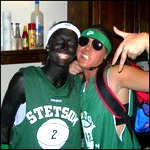
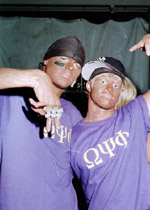
photo: two white members of the women's softball team, in blackface, posing for the camera with gold teeth flashing and hands making gang signs

Stetson University, Halloween 2005

photo: frat brothers, one in blackface, pose a mock lynching.

Oklahoma State, September 2002

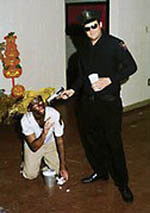
photo: white frat brothers, one in blackface, pose with the student in blackface kneeling on the floor and a student dressed as a cop pointing a prop gun at his head. Ole Miss, Halloween 2001.

Ole Miss, Halloween 2001.

photo: white Beta Theta Pi frat brothers flash gangsta poses in blackface. Auburn, Halloween 2001

Auburn, Halloween 2001.

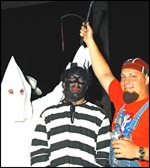
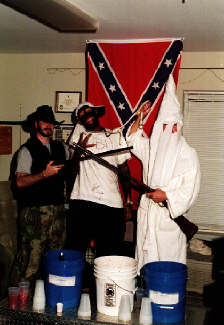
photo: white frat brothers, one dressed in Klan robes and one in blackface, stage a mock lynching. Auburn, Halloween 2001.

Auburn, Halloween 2001.
This Halloween, the (mostly white) women’s softball team at Stetson University in Florida decided to live it up by dressing as the (mostly Black) women’s basketball team for an off-campus Halloween party. Some of the nice little details that they decided to add to their costume included: gold teeth, corn rows, thug poses for photos. Oh, and also blackface makeup.

We’re told by a student from the campus who knows them that I do not think the girls were trying to be racist; I honestly believe that they do not understand what they did. That’s probably true. It’s also very sad. Fortunately, though, careless ignorance of recent American history and blackface fun-and-games at college Halloween parties aren’t at all pervasive or common among affluent white college students. This is, of course, just an isolated incident; it’s not like there is any kind of festering racism in the American campus culture at all. Nothing to see here, citizen; move along.

Completely unrelated links

Historical note, free of facile sarcasm

I don’t just say this because I know people in the Auburn fraternity system who are not the sloped-brow, amoral, reactionary meatheads that the Greeks’ history on Auburn’s campus might lead you to believe they would have to be–although this is definitely true; I have friends in the fraternity system who neither have nor want any part of that mindset. I also say it because I really regret that the meatheads that were directly involved will probably never understand just what they did wrong. They will understand that they did some dumb things that got them caught. And they may look back and grumble at the P.C. Thought Police Bastards who ruined their college career. But will they ever understand that there really was a very deep cut of wilful cruelty in what they did? They didn’t put on those costumes in order to be malicious racists (although I believe that there was certainly some overt malice involved). They put them on to have a roguish bit of fun, that old irreverant frat boy panache. Meaningless images of MTV gangstas and some documentary on the Klan they saw in school or on the History channel–trivial, ultimately, like the whole flux of images across our consciousness. Anything can be funny, right? If you don’t really go out and attack Black people, the images don’t mean anything, do they?

But words, images, costumes, historical scripts do mean something; they mean a hell of a lot. The images and rituals, the signs of white supremacist brutality in this country have a meaning, a meaning they are rooted to by centuries of blood and chains. But we live in an age in which the detached image and the spectacle is omnipresent, and yet the prevailing laid-back liberal ideology tells us that we have no reason to care, indeed, that if we do care it’s a sign of pretentiousness, humorlessness, a general need to lighten the hell up. And it’s slowly, surely killing our conscience, eating away at the possibility of being moral agents. Which has what to do with frat boys in Klan robes? I really fear that this soul-killing laid-back liberalism, the impetus behind the costumes in the first place, will also cripple the boys at Beta and Delta Sig from ever understanding what they did wrong, the cutting cruelty that they were willing to ignore in order to have a laugh. Just as much as their hate party outrages me against them, what it means also saddens me for them.

— GT 2001-11-14: One down, one to go…

The worst part about it all are the smiles. The goofy, clueless, happy-go-lucky grins of white college students who don’t understand a goddamned thing about what they’re doing, and just don’t care.
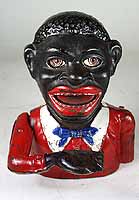
photo: Jolly Nigger Mechanical Bank. A bank shaped like a grotesque caricature of a black man's torso, with huge bright-red lips, bug-eyes, and an outstretched hand

This is a picture of a Jolly Nigger Bank. During the 1880s these were a remarkably popular mechanical bank for children; place a coin on the black man’s hand and he pops it into his mouth as his bug-eyes roll back into his head. the Jolly Nigger Bank was just one of hundreds of popular children’s toys, during the late 19th and early 20th centuries, that used grotesque caricatures of Black people, based on the images and conventions of blackface minstrel shows. It’s hard to believe, today, how pervasive these images were: they were everywhere, not just in children’s toys but also staples of the most popular forms of music and theater, film, cartoons, even advertising brands for everything from pancake mix to washing powder. Blackface caricatures surged in popularity in the decades after Reconstruction, and continued well into the 1940s before the rise of the Civil Rights movement in the 1950s and 1960s did it in. Blackface imagery was a pervasive feature of American pop culture for over a century, a feature intimately connected with casual racism, militant white supremacy, lynch law, race riots, and Jim Crow (you may recall that the system of segregation was itself named after America’s first known minstrel show stock character.

Now, there are two different ways that horrible things can end in the wake of coordinated cultural pressure. The privileged can remember them, and take responsibility for them, as hateful reminders of a shameful past. Or the privileged can do their best to pretend that they never existed, avoid mentioning them for fear of giving offense, drop them down the memory hole in the name of propriety, and drive them into the cultural underground rather than addressing them in the daylight.

Affluent whites in America — that same college-educated professional class that we daily hear praising itself and berating the redneck, reactionary white working class — decided to do the latter, not the former, with blackface when Black people made it clear that they weren’t going to stand for it anymore. Down the memory hole they sent it, and they taught that response — by not teaching that history — to their kids. You are seeing the affects of that decision on white college kids’ consciousness with every passing school year.
Holiday reminder: Buy Something!

Just a reminder: today — Friday November 25th — has been dubbed Buy Nothing Day by the Adbusters crew. I recommend that you Buy Something, for your own pleasure and as a memento of the important difference between serious, materialist Leftism, and misanthropic Romanticism posing as the genuine article. Consumers are not the problem; and you do no-one any good by harassing consumers (that is, you and I and our neighbors). Let alone making your little point by leaving huge piles of trash in the aisle for workers to clean up after.

I dealt with this at considerably more length last year, in GT 2004-11-26: Buy Something!; for this year I add only that today I bought a delicious (and completely unnecessary) orange smoothie, and several books that I didn’t need at the local used bookstore chain. And I note also Ellen Willis was right; as she put it in Women and the Myth of Consumerism (1969):

If white radicals are serious about revolution, they are going to have to discard a lot of bullshit ideology created by and for educated white middle-class males. A good example of what has to go is the popular theory of consumerism.

As expounded by many leftist thinkers, notably Marcuse, this theory maintains that consumers are psychically manipulated by the mass media to crave more and more consumer goods, and thus power an economy that depends on constantly expanding sales. The theory is said to be particularly applicable to women, for women do most of the actual buying, their consumption is often directly related to their oppression (e.g. makeup, soap flakes), and they are a special target of advertisers. According to this view, the society defines women as consumers, and the purpose of the prevailing media image of women as passive sexual objects is to sell products. It follows that the beneficiaries of this depreciation of women are not men but the corporate power structure.

First of all, there is nothing inherently wrong with consumption. Shopping and consuming are enjoyable human activities and the marketplace has been a center of social life for thousands of years.

The locus of the oppression resides in the production function: people have no control over which commodities are produced (or services performed), in what amounts, under what conditions, or how these commodities are distributed. Corporations make these decisions and base them solely on profit potential.

As it is, the profusion of commodities is a genuine and powerful compensation for oppression. It is a bribe, but like all bribes it offers concrete benefits–in the average American’s case, a degree of physical comfort unparalleled in history. Under present conditions, people are preoccupied with consumer goods not because they are brainwashed but because buying is the one pleasurable activity not only permitted buy actively encouraged by our rulers. The pleasure of eating an ice cream cone may be minor compared to the pleasure of meaningful, autonomous work, but the former is easily available and the latter is not. A poor family would undoubtedly rather have a decent apartment than a new TV, but since they are unlikely to get the apartment, what is to be gained by not buying the TV?

The confusion between cause and effect is particularly apparent in the consumerist analysis of women’s oppression. Women are not manipulated by the media into being domestic servants and mindless sexual decorations, the better to sell soap and hair spray. Rather, the image reflects women as they are forced by men in a sexist society to behave. Male supremacy is the oldest and most basic form of class exploitation; it was not invented by a smart ad man. …

For women, buying and wearing clothes and beauty aids is not so much consumption as work. One of a woman’s jobs in this society is to be an attractive sexual object, and clothes and make up are tools of the trade. Similarly, buying food and household furnishings is a domestic task; it is the wife’s chore to pick out the commodities that will be consumed by the whole family. Appliances and cleaning materials are tools that faciliate her domestic function. When a woman spends a lot of money and time decorating her home or herself, or hunting down the latest in vacuum cleaners, it is not idle self-indulgence (let alone the result of psychic manipulation) but a healthy attempt to find outlets for her creative energies within her circumscribed role.

… Consumerism as applied to women is blatantly sexist. The pervasive image of the empty-headed female consumer constantly trying her husband’s patience with her extravagant purchases contributes to the myth of male superiority: we are incapable of spending money rationally: all we need to make us happy is a new hat now and then. (There is an analogous racial stereotype–the black with his Cadillac and magenta shirts.) Furthermore, the consumerism line allows Movement men to avoid recognizing that they exploit women by attributing women’s oppression solely to capitalism. It fits neatly into already existing radical theory and concerns, saving the Movement the trouble of tackling the real problems of women’s liberation. And it retards the struggle against male supremacy by dividing women. Just as in the male movement, the belief in consumerism encourages radical women to patronize and put down other women for trying to survive as best they can, and maintains individualist illusions.

If we are to build a mass movement we must recognize that no individual decision, like rejecting consumption, can liberate us. We must stop arguing about whose life style is better (and secretly believing ours is) and tend to the task of collectively fighting our own oppression and the ways in which we oppress others. When we create a political alternative to sexism, racism, and capitalism, the consumer problem, if it is a problem, will take care of itself.

— Ellen Willis (1969): Women and the Myth of Consumerism

Hope y’all had a happy Thanksgiving, and bought something worth having.

Further reading

Uncle Sam is your ISP

There aren’t many technologies that have come along recently that have as much disruptive potential for democratizing the infrastructure of the Internet as widespread wireless networking. Broadband Internet access is, currently, the more-or-less exclusive domain of behemoth telecommunications and cable companies — the Ma Bells and Comcasts of the world. It’s expensive, the providers are abusive and controlling, and the service sucks. But if we work at developing technologies that are available as we speak, all that can change; free wireless Internet access is becoming more and more available in businesses and public places, so that fewer people even need an ISP to provide a residential line; and with a co-operative provider, some technical know-how, and a small investment in networking equipment, you can easily form wireless community networks between yourself and your neighbors, effectively running a low-cost cooperative ISP out of your garage. It’s exciting, heady stuff, and a lot could change within a few years. And the growing availability of voice services and online content could mean that soon, cooperative neighborhood associations could provide your Internet, phone service, and television all in one low-cost package. (To get a glimmer of the potential, see Robert X. Cringley 2001-08-23: Roll Your Own; for the technical details, read Rob Flickenger’s Building Wireless Community Networks: Implementing the Wireless Web.)

So how are leading lights of the State going to respond to this potential revolution in people-first, grassroots network communications? Of course, it’s to bring it under the control of the regulatory State as quickly as possible. Item 1: earlier this month, the government of Winchester County decided to set a precedent by proposing that the government knows how to set up your wireless network better than you do. Item 2: House Democrats unveil an innovation agenda; one of the chief innovations that they hope for is a centralized, government-directed Nationwide deployment of high-speed, always-on broadband Internet and mobile communications. This will, of course, be attained by means of expanding federal telecom regulations, and providing tax-funded subsidies to large telecom companies.

Because Uncle Sam knows better than you do what kind of Internet service you want. There’s no greater expert on ever-changing network technology than a sclerotic, centralized bureaucracy. And there’s nowhere you can get better service than your local, accountable-to-the-people government-run municipal utility.

Or, as M. Proudhon put it:

To be GOVERNED is to be watched, inspected, spied upon, directed, law-driven, numbered, regulated, enrolled, indoctrinated, preached at, controlled, checked, estimated, valued, censured, commanded, by creatures who have neither the right nor the wisdom nor the virtue to do so. To be GOVERNED is to be at every operation, at every transaction noted, registered, counted, taxed, stamped, measured, numbered, assessed, licensed, authorized, admonished, prevented, forbidden, reformed, corrected, punished. It is, under pretext of public utility, and in the name of the general interest, to be place under contribution, drilled, fleeced, exploited, monopolized, extorted from, squeezed, hoaxed, robbed; then, at the slightest resistance, the first word of complaint, to be repressed, fined, vilified, harassed, hunted down, abused, clubbed, disarmed, bound, choked, imprisoned, judged, condemned, shot, deported, sacrificed, sold, betrayed; and to crown all, mocked, ridiculed, derided, outraged, dishonored. That is government; that is its justice; that is its morality.

P.-J. Proudhon (1851): General Idea of the Revolution in the Nineteenth Century (trans. John Beverly Robinson), Epilogue ¶ 39

Further reading

Submitted for Lileks’ approval, or: the Last Good War

Thanks to Amanda, I recently found James Lileks’ new hobby, Patriotica, a loving collection of genial homefront propaganda from World War II. Lileks’ tone is jokey and sometimes downright satiric. But he makes it clear enough that that’s just his usual campy, self-deprecating schtick, applied at the level of his nation-state; part of the point here is that he’s collecting WWII propaganda because, deep down, he believes in it, and he thinks we have something to learn from it. And it’s clear enough that his audience on the Right is getting the message. (As he comments in the Daily Bleat: New update to Patriotica here, a sad reminder of the days when nearly everyone agreed there was actually a war on, and it had to be won. As a fan at the Independent Women’s Forum puts it, Those were the days when our media supported our troops! Pro-Victory writer Dadmanly wistfully remarks: For all those who think that the current administration is over-hyping the Global War on Terror, a little reminder of how they REALLY knew how to whip up the masses in WW II.)

Let’s everyone get in on the campy collecting fun! Here’s some submissions I’d like to see Lileks put in Patriotica. I’m sure you can soon find these collectibles from the Last Good War on loving display in Lileks’ collection.

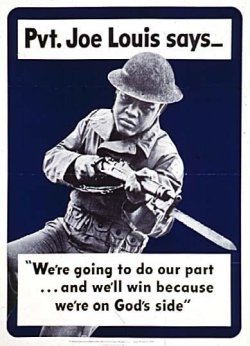
We begin with Private Joe Louis clearing it all up for us. We’re going to win because we are acting as the Sword of God:

poster: Pvt. Joe Louis says: "We're going to do our part ... and we'll win because we're on God's side"

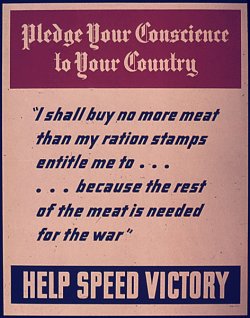
Next, there’s nothing quite so genially amusing — especially for conservatives — as absolute government command over the economy. Obey the price controls, and make sure you get your meat ration, citizen! (We’ll be taking the rest of it.)

poster: "Pledge your conscience to your country: I shall buy no more meat than my ration stamps entitle me to ... because the rest of the meet is needed for the war."

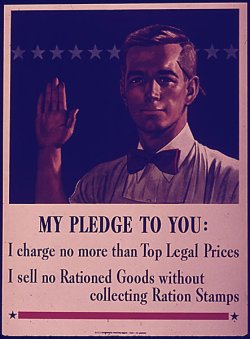
poster: "My pledge to you: I charge no more than Top Legal Prices. I sell no Rationed Goods without collecting Ration Stamps.

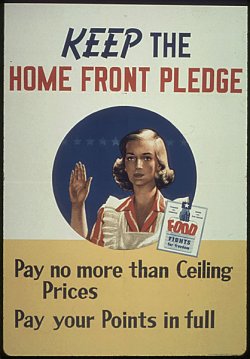
poster: "Keep the Home Front Pledge: Pay no more than Ceiling Prices. Pay your Points in full."

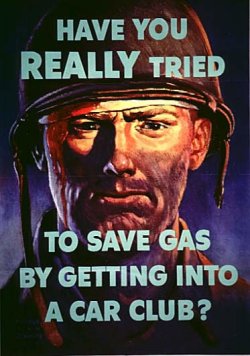
On a similar theme, we have the following adorable bit of naked attempts at intimidation, in order to whip the masses into line:

poster: a scowling soldier's face, with the words “Have you REALLY tried to save gas by getting into a car club?”

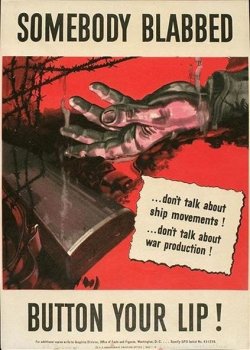
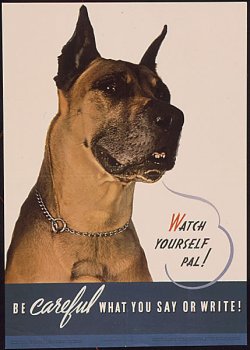
Here’s some more choice bits for Lileks, also on the topic of intimidation. Specifically, a genial reminder from the government to shut the fuck up, citizen.

poster: a dead soldier, with the text "Somebody blabbed. Button your lip!"

poster: "Watch yourself, pal! Be CAREFUL what you say or write!

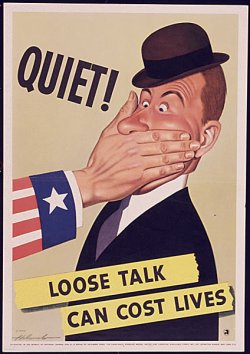
poster: Uncle Sam shoves his hand over a surprised man's mouth. Caption: "Quiet! Loose talk can cost lives!"

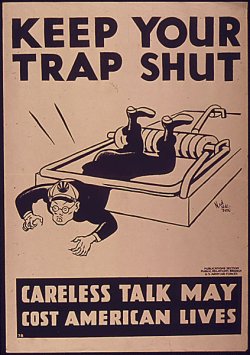
That last image is actually pretty famous. This one isn’t quite so famous, in spite of being a classic combination of two great themes of American World War II propaganda: overbearing commands for silence, and violent racist caricature.

poster: a crudely caricatured Tojo is caught in a mousetrap. Caption: "KEEP YOUR TRAP SHUT. Careless talk may cost American lives."

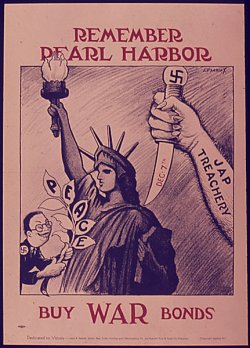
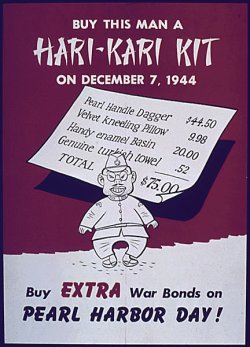
Speaking of which, here’s several more I just can’t wait to see in Lileks’ gallery. Submitted for his approval, without further comment.

poster: slant-eyed caricature of a Japanese diplomat with a lupine grine, offering an olive branch labeled "PEACE" to the Statue of Liberty, while a huge, sharp-nailed arm with the label "JAP TREACHERY" raises a knife behind her back with a swasitka on the hilt and "Dec. 7th" on the blade. Caption: Remember Pearl Harbor. Buy WAR Bonds."

poster: cartoonish caricature of Tojo and a bill of sale for several items; caption: "Buy this man a HARI-KARI KIT on December 7, 1944. Buy EXTRA War Bonds on PEARL HARBOR DAY!"

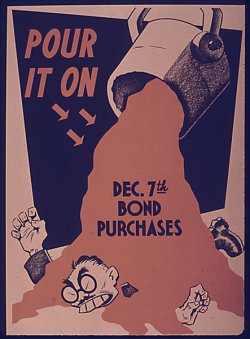
poster: a buck-toothed, slant-eyed caricature of Tojo, wailing underneath some kind of molten substance labeled "Dec. 7th bond purchases." Caption: "Pour it on."

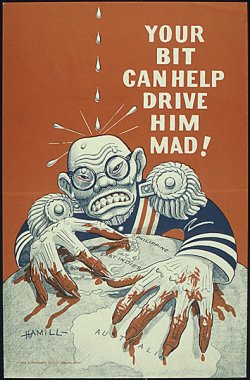
poster: a lurid caricature of Tojo with blood dripping from his fingers, clutching at Australia and the South Pacific on the globe. Drops on his head seem to be enraging him. Caption: "Your bit can help drive him mad!"

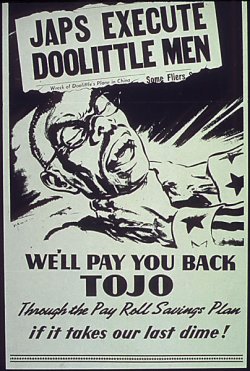
poster: headline reading "JAPS EXECUTE DOOLITTLE MEN." Uncle Sam's arms strangle Tojo in a lurid drawing. Caption: "WE'LL PAY YOU BACK / TOJO / Through the Payroll Savings Plan / if it takes our last dime!

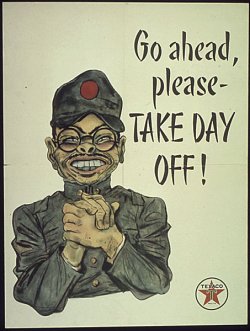
poster: seedy, porcine caricature of a buck-toothed Tojo clasping his hands and saying, "Go ahead, please- TAKE DAY OFF."

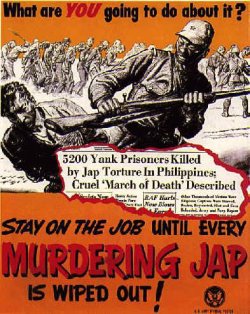
poster: bestial caricature of Japanese soldier slams a kneeling American prisoner in the head with a rifle butt while other soldiers force men to march in the background. Top caption: "What are YOU going to do about it?" Newspaper headline reading: "5200 Yank Prisoners Killed by Jap Torture in Philippines. Cruel 'March of Death' Described." Bottom caption: "STAY ON THE JOB until every MURDERING JAP is wiped out!"

… Yeah.

I really fucking hate World War II propaganda.

Happenings Elsewhere

I have some material coming down the pipe that I’ve been chewing on for a while — a little bit on philosophy, some stuff on copyrights and contracts, and some stuff on the nature of law. Plus some announcements about various things of varying interest. But my aching feet are going to keep me from getting to it today. So, in the meantime, here’s some things that I’ve had going on elsewhere:

Bloviating elsewhere

  • Tonight at No Treason, I dispute Stefan’s claim that tyrants and murderers often have satisfying lives (in any sense of the word satisfying that matters), and argue (with Plato) that being a tyrant is actually the most miserable kind of life. (The point is related, somewhat, to some similar remarks I made against some utilitarian arguments over at Philosophy, et cetera.)

  • Over at Kevin Carson’s Mutualist Blog, Kevin discusses land theft against farmers in modern history, and I follow up in comments by debating with P. M. Lawrence over land ownership, homesteading, and slavery. I defend the radical notion that the Southern plantations should have been expropriated from the slave-drivers’ illegitimate control, and distributed amongst the former slaves, after Emancipation. (It should have been distributed not as reparations for slavery — although the former slaves also deserved those — but rather because freed Blacks were the rightful owners of the land that they had lived and worked on all their lives.) Lawrence objects on several fronts; I defend.

  • At Project for the New Anarchist Century, I object to Jeremy Sapienza making shit up about the civil rights movement and Rosa Parks in particular. We go on to debate the historical significance of the Montgomery Bus Boycott.

  • At Alas, A Blog, I object to several commentators saying, over and over again, that society causes any number of conditions that make rape and other forms of violence against women, as if society were some looming presence outside of us. In fact it just is us. And refusing to recognize this snuffs out any questions we might have about just who, among the men and women that make up society, does most of the things that constitute a rape culture. (Here’s a hint: it is not, for the most part, women.)

Howard Dully and My Lobotomy on NPR

Meanwhile, NPR recently broadcast a riveting and heartbreaking audio documentary, My Lobotomy by Howard Dully. At age 12, diagnosed with nothing worse than being a difficult child, Dully was one of the youngest victims of Walter Freeman’s ice-pick lobotomy. It turns out that the complaints were nothing but a pack of lies, but even if they weren’t, the senseless mutilation of his brain would have still have been an atrocity. In any case, Dully somehow survived with his faculties mostly intact, and is able — unlike so many of Freeman’s other victims — to search for answers about his suffering and to tell his own story. Dully also talked about his experiences some more on Thursday’s Talk of the Nation. It’s not stuff you can enjoy listening too, really, but it is stuff that you should listen to. And listening to it is not a burden; while not pleasant, the tale is compelling, chilling, and, sadly, real.

Further reading

Anticopyright. All pages written 1996–2026 by Rad Geek. Feel free to reprint if you like it. This machine kills intellectual monopolists.