Rad Geek People's Daily

official state media for a secessionist republic of one

Posts filed under Politics

Aid and Comfort

Thanks to our War President, equating political dissent with an act of treason has become something of a national pastime in Republistan. Tom Tomorrow has already commented on this phenomenon in connection with televised sociopath Ann Coulter, but while Coulter is certainly a dangerous lunatic there is at least this one point in her favor: a significant part of her book is devoted to documenting what she takes to be overt acts of war, and material assistance to the enemies of the United States (especially the Soviet Union). Of course, her case is based mainly on distortions, fabrications, and nonsense; but it still puts her a step above the foot-soldiers of tyranny who simply drag out the language of “aid and comfort to the enemy” explicitly and directly on the basis of nothing more than peaceful dissent from the President’s war policy.

Consider, for example, a fellow named Dan Kuykendall, who (during my time in the Auburn Peace Project) decided that it would be best to notify the Opelika-Auburn News that rallies opposing the war on Iraq give aid and comfort to the enemy, and mused that Isn’t the definition of treason giving aid and comfort to the enemy? Since then, the rhetorical tactics haven’t changed much; consider this contribution to Blockheads for Bush, commenting on Ted Kennedy’s recent missives against Mr. Bush’s war:

Let us be clear about this – there are legitimate criticisms to be made about the liberation of Iraq; about whether or not we should have gone in, and about the manner in which we went in, and about how we have performed since we went in; there are, however, no legitimate criticisms to be raised about the reason we went in, nor can there be any legitimate point for an American to make other than that we should be doing more to win this fight. To criticise the reasons we went in and/or to do anything which indicates an unwillingness to see this thing through to final victory is the statement of a fool, or a traitor. No two ways about it.

We’ve given the left a pass long enough – its [sic] time for those who are of leftwing opinion to make their final call: which side of the river are you on? If you’re on America’s side, then you want total and overwhelming US victory – and just to really spell it out; this means that our enemies are dead or begging for mercy. I challenge you – choose, and let you be known for what you are by what you choose – patriot, or traitor.

(Subsequent comments make it clear that most of the Bush League takes the traitor horn of the dilemma. Some offer the charitable suggestion that Ted Kennedy might be both stupid, and a traitor.)

I sent a letter to the editor of the Opelika-Auburn News in reply to Mr. Kuykendall back in April 2003; since the underlying rhetoric hasn’t changed any in the ensuing year, the reply was a useful template for my comment on the BfB article:

Treason is a federal crime, defined in Article III, Section 3 of the Constitution, which says Treason against the United States, shall consist only in levying war against them, or in adhering to their enemies, giving them aid and comfort. No person shall be convicted of treason unless on the testimony of two witnesses to the same overt act, or on confession in open court. Apparently at least some of the commentators on this weblog have read the passage, as they refer to the aid and comfort language. Unfortunately, it seems that they have also failed to read Amendment I, which reads Congress shall make no law … abridging the freedom of speech, or of the press; or the right of the people peaceably to assemble, and to petition the government for a redress of grievances.

The Founders did their best to make very sure that the Constitution prevented the government from using charges of Treason to suppress peaceful dissent. That is why the language of the article clearly states that the law of treason to be invoked only for overt acts with the intent to wage war on the United States, or to provide concrete, material assistance to those who do.

If anyone has evidence that Ted Kennedy has committed such a serious federal crime, they should contact the FBI field office in Boston at (617) 742-5533. Otherwise, baseless insinuations against Mr. Kennedy, for nothing more than disagreeing with George W. Bush’s foreign policy, amounts to little more than a shameful proposal for tyranny. You have every right to agree or disagree with Mr. Kennedy’s policy; you have no right to make such scurrilous attacks against fellow citizens on the basis of mere political disagreement.

Posted by: Rad Geek at April 10, 2004 11:51 AM

The comment has been posted directly on the Blockheads for Bush article; we’ll see how long it remains in their echo chamber as it was posted.

Anniversaries

Ten years ago this week, a campaign of terror began in which over 800,000 Tutsis and moderate Hutus were slaughtered by Hutu extremists, mostly armed with machetes, garden hoes, and spiked clubs. Thousands of women were raped; many of them now live with AIDS. Thousands of children were orphaned. In the terrible slaughter that followed, spurred by hate propaganda broadcast by the French-backed Hutu government, it is estimated that about 8,000 people were killed every single day of the rampage.

Also, some white dude offed himself.

Guess which event is memorialized on the covers of dozens of glossy magazines all over the newsstand? And guess which one is being described as the unique event of suffering that defined a generation of American youth?

If I have to listen to one more self-important 20-something journalist waxing nostalgic about his teenage ennui and how Kurt spoke to it, I am going to go out into the street and start systematically knocking people’s hats off.

Death and Taxes

Posting on Geekery Today may be held up for a while in the next several days, as I grudgingly prepare the paperwork for my annual surrender of tribute to the State.

In honor of the occasion, though, you can follow my argument on Slashdot with Shakrai, who castigates those who would dare to cheat the State of its booty. Since I argue that taxation is nothing more than robbery with more paperwork, I can’t muster much outrage at those who lie to the taxman in order to keep some of their own damn money (thank you very much!).

For what it’s worth, while I don’t see anything morally wrong in cheating on your taxes, that doesn’t mean that I do it; since I make most of my money through self-employment I no doubt look pretty suspicious to the IRS from the get-go, and I have no desire to encourage them to come along and help me get my finances in order by being less than scrupulous in my reporting. It just goes to show that while nothing immoral could count as expedient, lots of things that are morally permissible are still not particularly smart. Such is life in this possible world.

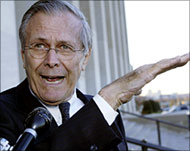
photo: Donald Rumsfeld
photo: Evil Lord Skeletor

In international news, Donald Evil Lord Skeletor Rumsfeld has announced that the situation in Iraq is not out of control. Meanwhile, in Iraq, your tax dollars are hard at work:

FALLUJAH, Iraq (AP) U.S. Marines battled insurgents for control of this Sunni Muslim stronghold Wednesday, calling in airstrikes against a mosque compound where witnesses said dozens were killed in six hours of fighting. An anti-U.S. uprising led by a radical Shiite cleric raged for the fourth day in southern cities.

The Abdel-Aziz al-Samarrai mosque was hit by U.S. aircraft that launched a Hellfire missile at its minaret and dropped a 500-pound bomb on a wall surrounding the compound.

The U.S. military said insurgents were using the mosque for a military fire base. Iraqi witnesses estimated 40 people were killed as they gathered for afternoon prayers. U.S. officials said no civilians died.

An Associated Press reporter who went to the mosque said the minaret was standing, but damaged, apparently by shrapnel. The bomb blew away part of a wall, opening an entry for the Marine assault. The reporter saw at least three cars leaving, each with a number of dead and wounded.

Chaos spreads, people are murdered, and you and I are forced to foot the bill for a war that many of us wanted absolutely no part of. Sooner or later there will be a reckoning for the terrible destruction that is being wrought on Iraq; I can only hope against hope that terrorist logic will not win the day, and that we will not be forced to face the consequences yet again for things that other people decided to do–using stolen money and professing to act on our behalf.

Wit and Wisdom

I’m no great fan of Hillary Rodham Clinton. But she does have her moments. Among them is this:

It’s always sad when anyone dies.

… when asked for her thoughts when J. Strom Thurmond finally shuffled off this mortal coil.

(Thanks to One Good Thing for the pointer.)

The Cars of Tomorrow

I’d like to interrupt the recent stream of political posts for a moment to geek over the prospects of robotic automobiles. Well, not quite; there will be a bit of political grumbling before the end, and there are a few mixed feelings about the technology. But first–the robots!

DETROIT, April 3 — The modern car does not have to guess your weight. It already knows.

It watches how you drive and it can pull a Trump. Skid, and before you can blink, you’re fired — the car is driving for you, if only for a moment. Cars today can decide when to brake, steer and can park themselves. They can even see.

In short, the back-seat driver now lives under the hood. And it does more than just talk.

This is all technology on the road now, if not in a single country or car. But industry engineers and executives view it as the start of a trend that will play out over the next decade, in which automobiles become increasingly in touch with their surroundings and able to act autonomously.

Diminishing returns from air bags and other devices that help people survive crashes have led to a wave of new technology to help avoid accidents. Or, if an on-board microprocessor judges a collision to be inevitable, the car puts itself into a defensive crouch. Mercedes S-Class sedans will even start shutting the sunroof and lifting reclined seats if a collision is deemed likely.

This trend is made possible by the car’s evolution from a mechanical device to an increasingly computerized one, in which electronic impulses replace or augment moving parts. That means microprocessors can take control of the most basic driving functions, like steering and braking.

At the same time, there is a parallel evolution in sensory technology. Most advanced safety systems are equipped with sensors that look inside the car, tracking tire rotation, brake pressure and how rapidly a driver is turning the steering wheel.

Japanese automakers have pushed the boundaries of these technologies farthest in their home market, a society with an affinity for gadgetry. Toyota recently introduced a car that parks itself.

I love gadgets. And while I like having a car available, I hate the routine unpleasantness that goes along with driving most places you need to get. A self-parking car is just so tomorrow–and so nice a solution to one of the more routine frustrations of driving, that it will leave my geeky soul all a-glow for weeks.

I do have to confess, though, that the glow wears off a little when I think about it more. Sure, I’m all for intelligent machines–and robots, no less! And sure, I think that increased road safety is all for the best. But–as Thomas Landauer pointed out back in 1996 in The Trouble With Computers–all too often we end up wasting a lot of productive energy by investing it in sophisticated technological solutions to problems that were created by the inappropriate application of technology in the first place. Landauer discusses this in the context of uncritical transfer of tasks to the computer; but it’s no less true of transportation.

Think of it this way: the reason that people are working on sophisticated robo-cars is because when you have millions of people individually driving cars on crowded streets at high speeds, it makes it all too likely that a lot of people will crash into each other and get killed. One way to do this is to pour a lot of technological effort into making the cars more aware of their surroundings and able to automatically take actions that will reduce the likelihood of a crash, and reduce the damage if one occurs.

Another way to get cars to carry a lot of people without running into each other is to tie a bunch of them together, move them as a unit, and call it a train.

But trains have floundered over the past century while automobiles have flourished. Why? Well, not because stressful, dangerous, polluting, rage-inducing car commutes are really how the average person wants to get from place to place; it has a lot more to do with the fact that the various levels of government in the United States have effectively forced us to adopt automobiles as our method of mass transit through creating a cartelized financial disaster-area in the train industry, and by pouring billions of dollars every year into subsidies for creating and maintaining free highways.

Don’t get me wrong. I wish I had the resources to get myself one of those self-parking cars. I think a future filled with robo-mobiles is one I’d like to live in. But I also appreciate a simple solution to what ought to be a simple problem. So two cheers for robo-cars, and one boo held back for the Interstate Highway System.

We now return you to your regularly-scheduled jeremiads against the Bush Administration.

Anticopyright. All pages written 1996–2026 by Rad Geek. Feel free to reprint if you like it. This machine kills intellectual monopolists.