Rad Geek People's Daily

official state media for a secessionist republic of one

Posts filed under Politics

Happy April Fool’s Day!

A happy slightly-belated April Fools’ Day! (It’s after midnight on April 2, but, on the other hand, I don’t consider the day to have ended until I go to bed. So there.)

The web is full of silly posts today; this website, bold in its conformity, will be no different. Today’s selection is a bit of a re-run; Alina Stefanescu tipped me off to this April Fools’ 1995 article from the Economist:

THE new field of empirical mathematics (EM), a discipline pioneered in the early 1970s by P.G. Somerset and elaborated by V.M. Singh, has already scored some notable successes. Among these are a shortened procedure for the renormalisation of transintegers and refinement of Haberlein’s encryption algorithm. EM, as its name suggests, seeks advances in mathematical theory by means of counting things. As might be expected, the development of computer technology has allowed far more rapid and comprehensive counting of things than previously possible.

It is the belief of the present authors that our work in progress may constitute EM’s most important advance to date. In the course of conducting routine surveys of things counted so far, we discovered that the number of things tended generally to increase more than it decreased. Among the things that proliferated were (in alphabetical order) area of the universe, cable television channels, crime, Economist columns, four-minute milers, lawyers, persons with jobs, persons without jobs, population, potholes, tarts, torts, toxic wastes, video games and weevils. Some things did, of course, decrease. However, our statistical analysis demonstrates to a high degree of confidence that a strong element of hysteresis, or lag-induced upward stickiness, is present in the numbers of things. Put simply, on average everything is proliferating.

This would seem puzzling. Given the conservation laws of natural science, one would expect to see a rough balancing of things that became more numerous with things that became fewer. The persistent upward drift in the average number of things–or burgeoning, as the news media call it–suggests that what is changing is not things themselves but rather numbers. Numbers are losing their value over time; counting any given array of things requires slightly more numbers each year. We refer to this phenomenon as number inflation.

A great many previously puzzling phenomena are now explained–or, more accurately, seen to be illusory. For instance, many have wondered why ever-more athletic records are broken every year. The answer is that adjusted for number inflation, human athletic performance turns out to have been roughly constant over time. Similarly, astronomers devote much attention to the apparent fact that the universe is expanding. Since the universe cannot expand forever (eventually it will run out of space and bump into something), this hypothesis seems less than satisfactory; and, indeed, when proper integer-value adjustments are performed, the expansion of the universe proves to be an artifact of number inflation.

It is, however, in the realm of human affairs and social policy that the implications are richest and most consequential. For example, in America a widely noted phenomenon is the consistent tendency of budget deficits to increase despite all efforts to reduce them. Why should something grow even when cut? Because, of course, what needs to be deflated is not the deficit but the digits.

(The best part about this is that the satire is even better for those of us who are praxeologists. After all, are the findings of number inflation any more ridiculous than the idea that forcing banks to give money away for free is an effective way to encourage productive investments, or that taking billions and billions of dollars worth of human labor and blowing it up in another country is an effective way to increase overall wealth? Yet these are typical results produced by the practitioners of empirical economics…)
OpenOffice.org Milestone

FLOSS advocates — and anyone who likes excellent software for free — rejoice! OpenOffice.org has released its latest milestone release: OpenOffice.org version 1.1.1, a new version of OpenOffice.org 1.1 with scads of new bug fixes, a couple new features, and better performance than ever. OOo is a full-featured, high-quality, open source office suite, including a word processor, a spreadsheet, a vector graphics drawer, and presentation software. All the software can read and write files from Microsoft Office, but it also features an open, XML-based standard file format, and it can even export documents to PDF and presentations to Flash. Download it today! You have nothing to lose but your licensing fees …

A Bigot By Any Other Name…

Ampersand at Alas, A Blog points out an important difficulty in debates about gay liberation:

One area of miscommunication in the marriage equality debate is about words like bigot and homophobe. Marriage equality opponents, quite understandably, don’t like being called
bigots and homophobes. They might genuinely have nothing against lesbians and gays; some of them have good friends who are lesbian or gay, and some of them are lesbian or gay themselves.

The problem here, I think, stems from two different definitions of bigotry. Marriage equality opponents think bigot, in this context, means someone who hates lesbians and gays.

Speaking for myself, that’s only one possible meaning of bigot or homophobe. Another meaning, which is how I tend to use those words in the context of the marriage equality debate, is someone who favors an unequal legal status for lesbians and gays. And by that latter definition, it makes perfect sense to describe those who oppose marriage equality as homophobes and bigots.

This is no different from how I view any other issue involving bigotry. To reuse an example, consider someone in the 1960s who favored laws and rules excluding Jews from fancy country clubs. That person may have had many close Jewish friends; perhaps they only favored the exclusions because they valued the club’s longstanding traditions. But regardless of this person’s personal love for Jews, they nonetheless favored one law for gentiles and a different law for Jews, and that made them an anti-Semite.

Alas, a Blog: How is bigotry defined?

Another way to put it (cribbing from the Marxists) is this: words like homophobic, anti-Semitic, racist, sexist, etc. can be used either in the sense of subjective conditions or in the sense of objective conditions. On the one hand, you might use them to say of some individual person that she or he has a particular set of (negative) attitudes towards other people based on their membership in a particular group; on the other hand you might use them to say of some person or class of people that they are involved in creating, sustaining, and reinforcing material conditions that hurt people who are members of that group.

I think this is an important distinction to make–all too many people today think that racism, sexism, heterosexism, etc. are all about having bad feelings towards people in some group or another; so they seem to think that if they can show that they don’t really have those bad feelings then that’s enough to prove them blameless for the hardships that historically oppressed people face. But it should be obvious that the kind of policies you support and participate in are just as important as your personal overt feelings. (Why should gay people care about the fact that you don’t personally hate them, if you support laws that make them second-class citizens?)

There’s an important caveat to point out here, though, which Ampersand doesn’t draw out. It’s certainly true that objective hostility towards gay people is just as important as a term of analysis and criticism as subjective hostility, and the reflexive urge of many Right-wingers (though certainly not all of them!) to complain about being called bigots or homophobes just misses the point, because it confuses the two ways in which the word is used. But I don’t think that this confusion is entirely the Right-winger’s fault. Part of it is due to unfortunate terminology. Sexism and racism, like imperialism, Communism, republicanism, and so on are terms that obviously can describe either a body of attitudes or beliefs, or an actually-implemented political system. The way we use words ending in -ism is just such that either interpretation might suggest itself, depending on the way in which the word is used. But this is far less obvious in the case of words like bigotry and homophobia. (If a pseudo-psychological term like homophobia isn’t meant to suggest a particular sort of personal attitude towards gay people, then what in the world would be meant to suggest it?)

This isn’t to say that we should ditch the words homophobic or bigot. They’re serviceable words, they work well enough for what they do, and we can make the distinctions we need to make even if it goes against the grain of how the words are constructed. But we should be aware that we are going against the grain, and understand that when discussion is diverted to irrelevant arguments about personal attitudes — the sort of arguments that Ampersand rightly complains of — the language that we’re using to describe people who are anti-gay is partly to blame. (Even if we don’t intend for it to be taken that way: objective conditions are as important as subjective conditions in language, no less than in politics!)

Hardy Har Har

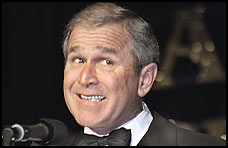
photo: Bush yuks it up

Belly laugh!

Let’s say you told a lie and everyone found out.

In fact, let’s say you started a war over a lie and everyone found out.

Hell, let’s say, just for the sake of argument, that you started a war over a big fat fucking lie and now 8,000-10,000 people who used to be alive, aren’t alive anymore, because of the lie that you told, and slowly, people began to find out about what you’d done.

There are many ways that you might deal with such an awkward situation. Is this one of them?

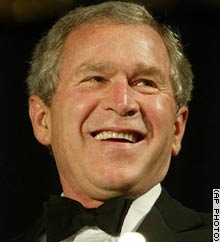
WASHINGTON (AP) — President Bush poked fun at his staff, his Democratic challenger and himself Wednesday night at a black-tie dinner where he hobnobbed with the news media.

Bush put on a slide show, calling it the White House Election-Year Album at the Radio and Television Correspondents’ Association 60th annual dinner, showing himself and his staff in some decidedly unflattering poses.

There was Bush looking under furniture in a fruitless, frustrating search. Those weapons of mass destruction have got to be somewhere, he said.

Bush pokes fun at himself, from CNN.com

Of course, George Trifecta Bush’s sense of humor may be different from yours. I personally would like to see this tape replayed after the election if current trends continue and the American people laugh him out of office. Now that would be good for a belly-laugh! Hardy har har.

(link via Dear God Damn Diary, via feministe)

Supporting Our Troops

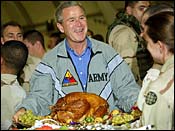
Photo of President Bush's Photo-Op with a fake turkey

This turkey is fake.

Hey, remember that allegedly heartwarming Thanksgiving visit that President Bush gave the soldiers stationed in Baghdad? You know, back when he snuck into Baghdad like a thief in the night so that he could show the men and women in uniform (and, in a complete coincidence that obviously had nothing at all to do with the decision, several newspaper photographers and FOX News television cameras) just how much he Supports Our Troops?

At the time, I mused:

Why are we supposed to feel good about it? Because he made a very public and very scripted show of supporting the troops which consisted of a whopping three hours with 600 (no doubt carefully selected) troops?

But such speculation and nay-saying was no doubt the result of mindless, pathological, Bush-hating cynicism. The passage of time has clearly shown just how much President Bush genuinely cares about the troops and would never ever use them as props for a cynical photo-op:

photo: George W. Bush

What did you think about President Bush’s Thanksgiving visit to Iraq?

I was there when President Bush came to the [Baghdad] airport. The day before, you had to fill out a questionnaire and answer questions, that would determine whether they would allow you in the room with the President.

What was on the questionnaire?

Do you support the president?

Really!

Yes.

Members of the military were asked whether they support the president politically?

Yes. And if the answer was not a gung-ho, A-1, 100 percent yes, then you were not allowed into the cafeteria. You were not allowed to eat the Thanksgiving meal that day. You had an MRE.

About this questionnaire, it raises a serious question about whether military personnel, or civil servants for that matter, should ever be asked questions by their supervisors about their political beliefs. It also raises the whole question of freedom of speech. In particular, the circumstances under which members of the military have freedom of speech.

There is none.

Is a soldier free, for example, to speak to the media if it is in support of the president and his policies, but not free to do so if in opposition or if raising uncomfortable questions?

If you are spouting good things about the president, you are allowed to speak. If you are saying anything negative, you are not allowed to speak.

— Unknown Soldier Speaks Out To Bring Troops Home, from Intervention Magazine.

Bush-Cheney ’04: defending the nation against sagging approval ratings; supporting the troops that support us politicially.

Anticopyright. All pages written 1996–2026 by Rad Geek. Feel free to reprint if you like it. This machine kills intellectual monopolists.