Rad Geek People's Daily

official state media for a secessionist republic of one

Posts filed under Smash the State

Retro-Progressives

As if deliberately setting out to taunt me, Kate Tennier of Toronto wants to coin retro-progressive as a political neologism. Lloyd Alter, also of Toronto, has come up with an accompanying survey, Are You a Retro-Progressive? With all due respect to deliberate primitivism and trend-story thinking person’s terms, I don’t think they’ve quite gotten it. So, I offer my own survey, below.

Are you a retrogressive retro-progressive?

Do you agree or disagree with the following quotations? For each that you agree with, give yourself one point.

We know enough about agriculture so that the agricultural production of the country could be doubled if the knowledge were applied. We know enough about disease so that if the knowledge were utilized, infectious and contagious diseases would be substantially destroyed in the United States within a score of years; we know enough about eugenics so that if the knowledge were applied, the defective classes would disappear within a generation.

(That’s Progressive academic Charles R. Van Hise, quoted in Paul (1995), p. 78.)

… the way of Nature has always been to slay the hindmost, and there is still no other way, unless we can prevent those who would become the hindmost being born.

(That’s notable Fabian H.G. Wells, in 1905, quoted in Paul (1995), p. 75.)

A rigid system of selection through the elimination of those who are weak or unfit — in other words social failures — would solve the whole question in one hundred years, as well as enable us to get rid of the undesirables who crowd our jails, hospitals, and insane asylums. The individual himself can be nourished, educated and protected by the community during his lifetime, but the state through sterilization must see to it that his line stops with him, or else future generations will be cursed with an ever increasing load of misguided sentimentalism. This is a practical, merciful, and inevitable solution of the whole problem, and can be applied to an ever widening circle of social discards, beginning always with the criminal, the diseased, and the insane, and extending gradually to types which may be called weaklings rather than defectives, and perhaps ultimately to worthless race types.

(That’s the noted environmentalist lawyer and author Madison Grant in his eugenicist magnum opus, The Passing of the Great Race (1916), pp. 50–51.)

Bonus question. When you see the following picture…

from a 1950s advertisement, featuring a housewife attentively mixing ingredients for baking

… do you think (a) Quaint, anti-consumerist, and ecologically responsible, or (b) an ad-man’s glossy idealization of an underlying reality of unpaid labor, soul-killing drudgery, and patriarchal control? If (a), give yourself one point. If (b), your second-wave feminism isn’t trendily retro enough for a movement that rhetorically identifies itself with the leading white male technocrats of the 1900s-1930s.

If you scored three or more, congratulations. Your beliefs are closely in line with those of the retro Progressive movement. Now that’s some of that old time religion!

Further reading:

Stasi fatigue

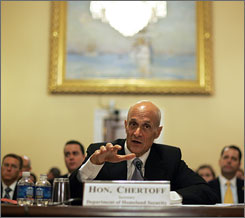
Here is a photo of Michael Chertoff reaching his hand forward while explaining something at a Congressional hearing.

It vill not be difficult, mein F?@c3;bc;hrer…

Michael Chertoff, the top creep at the Comittee of Public Safety, thinks that you and I are not sacrificing enough for our own good. And it’s getting on his very last nerve:

Such opposition [to new border control programs] ranges from Texas ranchers who don’t want border fences built on their property to northern border-state residents who don’t want to get passports to cross back-and-forth between Canada and the USA. Chertoff says he is frustrated by the growing number of people who say, Yes, protect us, but not if it inconveniences me.

But don’t worry. Chertoff will make sure the government protects the hell out of you, anyway. And you’re going to like it, too.

In an interview shortly before the sixth anniversary of the 9/11 terrorist attacks, Chertoff said he considers it one of his biggest obligations in his remaining 16 months in office to eliminate the not-in-my-backyard attitude when it comes to relatively small costs and inconveniences.

And don’t you worry. Michael Chertoff will find that all the costs and inconveniences of national identification papers, a border wall, new passport requirements, deliberate intimidation of employers by La Migra, etc. are relatively small.

Tim Roemer, a member of the 9/11 Commission, said President Bush should help Chertoff better inform the public about new security programs designed to keep terrorists out of the country.

The average citizen needs to know more about what to do to stop these people, Roemer said.

Chertoff says he worries that the public is suffering fatigue after six years of counterterrorism efforts abroad and at home.

— USA Today (2007-09-06): Chertoff: Security requires sacrifice

And there’ll be no security fatigue in Chertoff’s command–that’s an order. You’d better fall in, soldier.

Perhaps if the people who are actually affected by the costs and inconveniences Michael Chertoff’s so-called security policies are not as enthusiastic as Michael Chertoff is about those policies, he should reconsider his efforts to protect them against their will.

(Story thanks to Wolfesblog 2007-09-06: Chertoff says we’re not sacrificing enough.)

Further reading:

Marching orders

So it seems that Ron Paul just had the following exchange with one of the moderators at the Republican Party primary debate, because of Paul’s opposition to the Iraq War and his proposals to withdraw American soldiers from both Iraq and the broader Middle East:

Chris Wallace: So Congressman Paul, … you’re basically saying that we should take our marching orders from Al-Qaeda …?

Ron Paul: No! I’m saying we should take our marching orders from our Constitution!

Max Raskin of the anti-war, anti-state, pro-secession LewRockwell.com Blog calls Paul’s retort Heroic! (exclamation point his). I call it cowardly.

Ron Paul is perfectly capable of making sharp moral arguments against the war. He does during the course of the debate, as in his later exchange with Mike Huckabee. But he doesn’t do it here, and that’s a damn shame. Taking a moral stand against domination and senseless slaughter, in the face of bellowing blowhards such as these takes courage. But instead Ron Paul makes a legal argument, which amounts to ignoring the demands of human decency in order to throw a scrap of paper in their faces and making legalistic excuses. (Would a formal declaration of war, which would certainly have been granted if Presidents were still in the habit of asking for such things, have somehow excused the killing, maiming, and ruining of hundreds of thousands of innocent people by this war?)

For the record, here is what a heroic stance on bloody oppression and the Constitution looks like:

There is much declamation about the sacredness of the compact which was formed between the free and slave states, on the adoption of the Constitution. A sacred compact, forsooth! We pronounce it the most bloody and heaven-daring arrangement ever made by men for the continuance and protection of a system of the most atrocious villany ever exhibited on earth. Yes—we recognize the compact, but with feelings of shame and indignation, and it will be held in everlasting infamy by the friends of justice and humanity throughout the world. It was a compact formed at the sacrifice of the bodies and souls of millions of our race, for the sake of achieving a political object—an unblushing and monstrous coalition to do evil that good might come. Such a compact was, in the nature of things and according to the law of God, null and void from the beginning. No body of men ever had the right to guarantee the holding of human beings in bondage. Who or what were the framers of our government, that they should dare confirm and authorise such high-handed villany—such flagrant robbery of the inalienable rights of man—such a glaring violation of all the precepts and injunctions of the gospel—such a savage war upon a sixth part of our whole population?—They were men, like ourselves—as fallible, as sinful, as weak, as ourselves. By the infamous bargain which they made between themselves, they virtually dethroned the Most High God, and trampled beneath their feet their own solemn and heaven-attested Declaration, that all men are created equal, and endowed by their Creator with certain inalienable rights—among which are life, liberty, and the pursuit of happiness. They had no lawful power to bind themselves, or their posterity, for one hour—for one moment—by such an unholy alliance. It was not valid then—it is not valid now. Still they persisted in maintaining it—and still do their successors, the people of Massachussetts, of New-England, and of the twelve free States, persist in maintaining it. A sacred compact! A sacred compact! What, then, is wicked and ignominious?

… It is said that if you agitate this question, you will divide the Union. Believe it not; but should disunion follow, the fault will not be yours. You must perform your duty, faithfully, fearlessly and promptly, and leave the consequences to God: that duty clearly is, to cease from giving countenance and protection to southern kidnappers. Let them separate, if they can muster courage enough—and the liberation of their slaves is certain. Be assured that slavery will very speedily destroy this Union, if it be left alone; but even if the Union can be preserved by treading upon the necks, spilling the blood, and destroying the souls of millions of your race, we say it is not worth a price like this, and that it is in the highest degree criminal for you to continue the present compact. Let the pillars thereof fall—let the superstructure crumble into dust—if it must be upheld by robbery and oppression.

— William Lloyd Garrison, The Liberator (1832-12-29): On the Constitution and the Union

And also this:

The practical difficulty with our government has been, that most of those who have administered it, have taken it for granted that the Constitution, as it is written, was a thing of no importance; that it neither said what it meant, nor meant what it said; that it was gotten up by swindlers, (as many of its authors doubtless were,) who said a great many good things, which they did not mean, and meant a great many bad things, which they dared not say; that these men, under the false pretence of a government resting on the consent of the whole people, designed to entrap them into a government of a part; who should be powerful and fraudulent enough to cheat the weaker portion out of all the good things that were said, but not meant, and subject them to all the bad things that were meant, but not said. And most of those who have administered the government, have assumed that all these swindling intentions were to be carried into effect, in the place of the written Constitution. Of all these swindles, the treason swindle is the most flagitious. It is the most flagitious, because it is equally flagitious, in principle, with any; and it includes all the others. It is the instrumentality by which all the others are mode effective. A government that can at pleasure accuse, shoot, and hang men, as traitors, for the one general offence of refusing to surrender themselves and their property unreservedly to its arbitrary will, can practice any and all special and particular oppressions it pleases.

The result — and a natural one — has been that we have had governments, State and national, devoted to nearly every grade and species of crime that governments have ever practised upon their victims; and these crimes have culminated in a war that has cost a million of lives; a war carried on, upon one side, for chattel slavery, and on the other for political slavery; upon neither for liberty, justice, or truth. And these crimes have been committed, and this war waged, by men, and the descendants of men, who, less than a hundred years ago, said that all men were equal, and could owe neither service to individuals, nor allegiance to governments, except with their own consent.

… Inasmuch as the Constitution was never signed, nor agreed to, by anybody, as a contract, and therefore never bound anybody, and is now binding upon nobody; and is, moreover, such an one as no people can ever hereafter be expected to consent to, except as they may be forced to do so at the point of the bayonet, it is perhaps of no importance what its true legal meaning, as a contract, is. Nevertheless, the writer thinks it proper to say that, in his opinion, the Constitution is no such instrument as it has generally been assumed to be; but that by false interpretations, and naked usurpations, the government has been made in practice a very widely, and almost wholly, different thing from what the Constitution itself purports to authorize. He has heretofore written much, and could write much more, to prove that such is the truth. But whether the Constitution really be one thing, or another, this much is certain — that it has either authorized such a government as we have had, or has been powerless to prevent it. In either case, it is unfit to exist.

–Lysander Spooner, No Treason No. 2 and No. 6

There’s no heroism in begging the Warfare State to live up to its better nature, or in trying to recommend your position by its connections with power and tradition. Peace, reason, and humanity are good enough to stand on their own, and if the law doesn’t recognize it, then we need to say To hell with the law! not look around for a Super-Duper Law that will supposedly give some marching orders for a principle that never needed them in the first place.

In related news, there are only 12 more ranting days before International Ignore the Constitution Day.

Libido dominandi

An excellent point from Richard Chappell at Philosophy, et cetera (2007-09-02):

One often hears that the ideal government would be a “benevolent dictatorship” – the wise ruler would make the right decision every time, and implement it with a minimum of fuss. But if we are going to engage in such wishful thinking, why stop at one perfect person? Why not have an ideal democracy, where the populace would make the right decision every time, and implement it with a minimum of fuss? How is the perfect autocrat any more ideal than the perfectly united demos? Or how about a perfect anarchy, where everyone simply does what they ought, without need for legal coercion? So long as we’re guaranteed our perfect outcomes in any case, why favour the most repulsive (dictatorial) process? (Is it because the wish is really to be the dictator oneself?)

— Richard Chappell, Philosophy, et cetera (2007-09-02): Ideal Rulers

Happy Labor Relations Day

Today is the first Monday of September, which in the United States and Canada (and only in the United States and Canada) is recognized as Labor Day. In this secessionist republic of one, Labor Relations Day is marked as a day of mourning. It is a bogus holiday, celebrated by the establishmentarian union bosses and originally fabricated by the federal government in 1894. The declaration was signed into law by President Grover Cleveland, as an election-year sop to the working class, six days after he had deployed the Army and the U.S. Marshals to break the Pullman Strike. It is celebrated today at the behest of state and federal governments, and the business unionists at the AF of L and Change to Win (sic), who, after all, have always been happy to suck up to State power in the name of a juicy private-public partnership. The real labor holiday in the United States is, of course, International Worker’s Day, celebrated each year on May Day, a wildcat holiday declared by labor radicals and celebrated not by edicts handed down from on high but by common consent of workers who just refused to show up for work on their holiday.

As much as I enjoy celebrating labor radicalism, today is not the day for it; today belongs to the establishmentarian unionists and the government labor bureaucracy and the bosses who use union patronage as a means of control over workers. They made it and they can have it. In honor of this Gilded Age bait-and-switch, I offer the following thought, reprinted in Benjamin Tucker’s Instead of a Book, and now available online at the Fair Use Repository:

The recent strike at Carmaux, France, was followed by an agitation for compulsory arbitration of disputes between capital and labor. There was a lively fight over it in the French Chamber, which fortunately had the good sense to vote the measure down. Of all the demands made upon government in the interest of labor this is perhaps the most foolish. I wonder if it has ever occurred to the laborers who make it that to grant their desire would be to deny that cherished right to strike upon which they have insisted so strenuously and for so many years. Suppose, for instance, a body of operatives decide to strike in defence of an interest which they deem vital and to maintain which they are prepared and determined to struggle to the end. Immediately comes along the board of arbitration, which compels strikers and employers to present their case and then renders a decision. Suppose the decision is adverse to the strikers. They are bound to accept it, the arbitration being compulsory, or suffer the penalty,—for there is no law without a penalty. What then has become of their right to strike? It has been destroyed. They can ask for what they want; a higher power immediately decides whether they can have it; and from this decision there is no appeal. Labor thus would be prohibited by law from struggling for its rights. And yet labor is so short-sighted that it asks for this very prohibition!

— Benjamin R. Tucker, Liberty, November 19, 1892.

Elsewhere, at Hit and Run, BTS wonders:

I never quite understood why most mainline libertarians despise unions so. Don’t workers have as much a right to free association as the next guy?

In reply, Franklin Harris informs us us that:

In theory, yes, but I really doubt unions in anything like their current form could exist without the legal protections given them by the government — laws that force businesses to recognize and deal with unions once they have organized.

Kevin Carson has an excellent reply, which you should read in its entirety. For myself, I’d just like to say that I also doubt unions in anything like their current form could exist without the legal protections given them by the government. That’s one of the chief reasons labor unionists should want those legal protections abolished. Without that legal patronage, it’s much more likely that unions would exist in something more like the form they existed in for the sixty-odd years that they existed from the beginnings of the American labor movement until the establishment of government-regulated unionism in 1935. Which would be quite a step forward, not backward, for organized labor.

Are you cold, forelorn, and hungry?
Are there lots of things you lack?
Is your life made up of misery?
Then dump the bosses off your back!

–John Brill (1916)

Updated 2007-09-04: Fixed an inaccuracy. Don’t forget Canada!

Anticopyright. All pages written 1996–2026 by Rad Geek. Feel free to reprint if you like it. This machine kills intellectual monopolists.