Rad Geek People's Daily

official state media for a secessionist republic of one

Posts filed under Smash the State

State of the Union suggestions

So it seems that Tom Friedman isn’t happy with the State of the Union speech that he’s likely to get; he decided to play make believe and write his own speech for Bush to read. If I recall correctly, this routine has been part of Friedman’s schtick for a few years; the whole thing seems more than just a bit self-important to me, but then, so does the State of the Union speech. Friedman’s idea, it seems, is that Bush should suddenly change into an alternative energy crank (or perhaps skip halfway steps and just suddenly change into Tom Friedman); and that he should use the bully pulpit to expound his newfound faith and lay down a Kennedyesque challenge to the American energy industry. (If he does not jawbone us about Friedman’s pet cause, apparently, you can stick a fork in the Bush Presidency.) So here’s what he’s informed Mr. Bush he’d like to hear tonight:

My fellow Americans, on May 25, 1961, President Kennedy gave an extraordinary State of the Union address in which he called on the nation to marshal all of its resources to put a man on the Moon. By setting that lofty goal, Kennedy was trying to summon all our industrial and scientific talent, and a willingness to sacrifice financially, to catch up with the Soviet Union, which had overtaken America in the field of large rocket engines.

While we cannot guarantee that we shall one day be first, Kennedy said, we can guarantee that any failure to make this effort will make us last.

I come to you this evening with a similar challenge. President Kennedy was worried about the threat that communism posed to our way of life. I am here to tell you that if we don’t move away from our dependence on oil and shift to renewable fuels, it will change our way of life for the worse — and soon — much, much more than communism ever could have. Making this transition is the calling of our era. …

— Tom Friedman, New York Times (2006-01-27): State of the Union

… and so on, and so forth.

Well, I have my own ideas about what’s important. So I humbly submit my own speech for Mr. Bush to consider giving tonight. I know that this is last minute, but it would be surprisingly easy for him to memorize. And I think it’s important. If Mr. Bush steps up to this challenge, the speech could be a new beginning for our country. If he doesn’t, you can stick a fork in this administration. It will be done — because it will have abdicated leadership on the biggest issue of our day. So here’s the speech I’ll be listening for tonight:
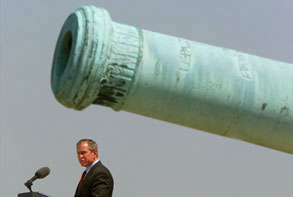
Mr. Speaker, Mr. Cheney, members of Congress, fellow Americans…

I resign.

Anything else is just going to mean more of the same old bullshit.

Postscript

Just remember: when these folks get in front of the camera they just lie. Politicians’ aims are political victory, not truth, and not justice. Hanging on the words and dickering about this or that point and fuming about this or that plain non sequitur will be talking past them entirely. You may as well spend the same amount of time cleaning your house, or sorting old photographs, or sucking on lemons.

Pointing out some piece of plain nonsense may have some value in provoking other people–the so-called rank and file, i.e., you and me–to think for a moment; and it may be worthwhile to use it to call on those other people to discourse that moves a bit beyond the braying of talking-points. But lingering on the endless talk of politicians or the professional political windbags inside the Beltway, as if these folks care what we think, or about what is true, is like trying to beat a street hustler at his three-card monty. It’s a scam. Just walk away.

— GT 2005-02-02: The State of the Union: live-blogged for you!

In Their Own Words, “Totally Out of Line for Even Thinking Such Thoughts” edition

Dick Durbin:

If I read this to you and did not tell you that it was an FBI agent describing what Americans had done to prisoners in their control, you would most certainly believe this must have been done by Nazis, Soviets in their gulags, or some mad regime — Pol Pot or others — that had no concern for human beings. Sadly, that is not the case. This was the action of Americans in the treatment of their prisoners.

— Dick Durbin, on the Senate floor (14 June 2005)

Scott McClellan, White House press flack:

Q Thank you. Scott, Senator Durbin compares the treatment of detainees at Guantanamo with the way Nazis abused prisoners during World War II. How is the President reacting to these accusations?

MR. McCLELLAN: I think the Senator’s remarks are reprehensible. It’s a real disservice to our men and women in uniform who adhere to high standards and uphold our values and our laws. To compare the way our military treats detainees with the Soviet gulags, the Nazi concentration camps, and Pol Pot’s regime is simply reprehensible. … And so I just think those remarks are reprehensible and they are a real disservice to our men and women in uniform. Our men and women in uniform go out of their way to treat detainees humanely, and they go out of their way to hold the values and the laws that we hold so dear in this country. And when you talk about the gulags and the concentration camps in Pol Pot’s regime, millions of people, innocent people, were killed by those regimes.

— Scott McClellan, White House press briefing (16 June 2006)

Commenter PPJ, aka Jim:

His comments are beyond the pale of rational political debate. His false, over the top, comments are demeaning to himself, the Senate, our military and his fellow citizens. He should be censored [sic] by the Senate. He should then apologize to the country and resign.

— PPJ, aka Jim, commenting at TalkLeft (16 June 2005)

Paul at Powerline:

What possessed Durbin to do it? How, after harping constantly on the importance of our image to winning the war on terrorism, could he cast the U.S. in such a false light? It’s not likely that he intentionally set out to injure his country. Until I hear a better explanation, I’ll put it down to a kind of sickness or derangement brought on by hatred — of President Bush, the military, etc. — coupled with a very weak immune system (i.e. intellect).

— Paul @ PowerLine (16 June 2005): Senator Durbin’s trifecta

Michelle Malkin, defender of Japanese internment:

What America needs is for President Bush himself to directly challenge Durbin on his treachery. What President Bush should do is to call on Durbin to retract his remarks (not just apologize) and ask forgiveness from our troops and the American people.

— Michelle Malkin (16 June 2005): THE TREACHEROUS DICK DURBIN

John Furgess, Veterans of Foreign Wars commander-in-chief:

The senator was totally out of line for even thinking such thoughts, and we demand he apologize to every man and woman who has ever worn the uniform of our country, and to their families.

— John Furgess, quoted for Veterans of Foreign Wars press release (16 June 2005)

Lee P. Butler, columnist and GOP apparatchik:

Throughout many sectors of the country Senator Durbin’s name is now synonymous with that of Hanoi Jane Fonda or Baghdad Jim McDermott. He decided he would use outlandish and completely absurd language of equating American soldiers in Guantanamo Bay with Nazis, Stalinist Soviets, and Pol Pot as a way of disagreeing with this administration. It seems as though he may have been emboldened to follow this tact, because of the outrageous allegation spewed by Amnesty International who earlier had labeled Gitmo as the gulag of our time … It’s a pretty big exaggeration for Amnesty International to compare Guantanamo Bay or even Abu Ghraib, for that matter, to a gulag and it’s reprehensible for an American Senator to equate our soldiers to torturous despots, even if they are just trying to malign President Bush.

— Lee P. Butler, OpinionEditorials.com, Senator Durbin’s Gulag Is A Liberal Crescendo Of Rhetorical Absurdity (20 June 2005)

Josh Dwyer, expert columnist from Texas A&M:

Sen. Dick Durbin, R-Ill., desperately needs a history lesson.

— Joshua Dwyer, The Batallion (30 June 2005): Durbin erred grossly in calling Gitmo a gulag

Charles J. Hanley, Associated Press (link thanks to DED Space (2006-01-27) and Hammer of Truth (2006-01-27); more at Echidne of the Snakes (2006-01-28)):

The U.S. Army in Iraq has at least twice seized and jailed the wives of suspected insurgents in hopes of leveraging their husbands into surrender, U.S. military documents show.

In one case, a secretive task force locked up the young mother of a nursing baby, a U.S. intelligence officer reported. In the case of a second detainee, one American colonel suggested to another that they catch her husband by tacking a note to the family’s door telling him to come get his wife.

… The U.S. military on Thursday freed five of what it said were 11 women among the 14,000 detainees currently held in the 2 1/2-year-old insurgency. All were accused of aiding terrorists or planting explosives, but an Iraqi government commission found that evidence was lacking.

Iraqi human rights activist Hind al-Salehi contends that U.S. anti-insurgent units, coming up empty-handed in raids on suspects’ houses, have at times detained wives to pressure men into turning themselves in.

— Charles J. Hanley, Associated Press (28 January 2006): Documents Show Army Seized Wives as Tactic

Aleksandr Isayevich Solzhenitsyn, prisoner of the Soviet gulag and author of The Gulag Archipelago:

9. Playing on one’s affection for those one loved was a game that worked beautifully on the accused as well. It was the most effective of all methods of intimidation. One could break even a totally fearless person through his concern for those he loved. (Oh, how foresighted was the saying: A man’s family are his enemies.) Remember the Tatar who bore his sufferings–his own and those of his wife-but could not endure his daughter’s! In 1930, Rimalis, a woman interrogator, used to threaten: We’ll arrest your daughter and lock her in a cell with syphilitics! And that was a woman!

— Aleksandr Isayevich Solzhenitsyn, The Gulag Archipelago (1973–1978), Chapter 3: The Interrogation

Bureaucratic rationality #3: Indecent Exposure edition

With apologies to Max Weber and H. L. Mencken.

IN NOVEMBER 2004, LUCY WIGHTMAN BEGAN RECEIVING anonymous e-mails that threatened to unravel the life she had crafted as a psychologist in two affluent Boston suburbs. It was, by all accounts, a good life. Her practice, South Shore Psychology Associates, was thriving, with an office first in Hingham, then in Norwell. In addition to her adult clients, children came after school, referred by pediatricians, school counselors, and fellow psychologists. She was liked in part because she was more laid-back than your typical psychologist. She didn’t wear makeup, and dressed in flowing skirts and turtleneck sweaters during her meetings with patients. Often her dog, Perry, was by her side. My daughter, says one Braintree mother, fell in love with her at first sight.

… LUCY WIGHTMAN USED TO BE KNOWN AS PRINCESS CHEYENNE, a stage name she was given, she says, by a strip-club owner. Back in the 1970s and ’80s, she welcomed notoriety, but that kind of attention was not going to be as good for her new career. In early 2005, three months after Wightman received the first threats, Princess Cheyenne was back in the news, her story broadcast on Fox 25 Undercover, as the e-mail writer had promised. Three days later, the state Office of Consumer Affairs and Business Regulation announced that investigators were trying to determine if Wightman, in presenting herself as a psychologist, had broken the law.

Then, on October 6, the state attorney general’s office and a Suffolk County grand jury came down hard. Wightman was indicted on 26 counts of felony larceny, six counts of filing false health-care claims, six counts of insurance fraud, and one count of practicing psychology without a license. Michael Goldberg, the president of the Massachusetts Psychological Association and a psychologist in Norwood, compares it to a surgeon operating without a medical license.

… When Al Deluca, 38, began seeing Wightman in the summer of 2003 to talk about his marital problems, he says Wightman told him not to file an insurance claim because she was not licensed. Many patients, however, believed that she was. The word psychology was in her business name, and that, according to Eric Harris, a lawyer for the Massachusetts Psychological Association, is enough to put an unlicensed practitioner in violation of the law. Her e-mail address is Dr. Wightman. Her billing statements are printed with Lucy Wightman, Ph.D.

While a person can legally practice psychotherapy without a license in Massachusetts, state law requires that psychologists have a degree in psychology from a state-recognized doctoral program and that they be licensed with the state Division of Professional Licensure. Licensed psychologists must also have two years of supervised training. They must take specific courses, pass an exam, and meet continuing-education standards long after they have tacked their degrees to the wall.

… “I HAVE A FULL CASE LOAD RIGHT NOW,” WIGHTMAN E-MAILED IN mid-November. She was talking about her practice, still running and apparently still prospering. The name has changed. It’s now called South Shore Psychotherapy, a notable distinction legally. The people who come to see her don’t care what she calls herself. She made a mistake, I think, in using the word psychology in her business name. But I don’t think what she did warrants all the attention and all the charges that have been levied against her, Al Deluca says. I think Lucy is being used. If this whole thing about her being a stripper had never come out, then this would have died.

— Keith O’Brien, The Boston Globe (2006-01-22): Exposed

(Link thanks to Lori Leibovich @ Broadsheet (2006-01-27).)

If we didn’t have the State to enforce guild rules and save us all from the dire threat of people calling themselves psychologists instead of psychotherapists without a permission slip, who would? If the government won’t stand up to keep people from suffering unauthorized conversations about their problems with a smart, warm, laid-back adviser that they like to talk to, then who will?

Bureaucratic rationality, n.: The haunting fear that someone, somewhere, may have something good in their life without permission.

Over my shoulder #8: Susan Brownmiller’s In Our Time: Memoir of a Revolution

You know the rules. Here’s the quote. This is from Susan Brownmiller’s In Our Time: Memoir of a Revolution, which I’ve been re-reading in parts recently, as a source for WikiPedia contributions on Andrea Dworkin and a new entry on Women Against Pornography. I mention, off to one side, that things are often more complicated than they seem, and that this is relevant to one of the most frequent questions that Roderick and I most frequently get on our qualified defense of Andrea Dworkin and Catharine MacKinnon, and our passing comments about anti-pornography radical feminism, in our paper on libertarian feminism.

Brownmiller has been discussing the fights over municipal anti-pornography civil rights ordinances authored by Dworkin and MacKinnon in 1983-1984.

Andrea mailed me a copy of the ordinance on December 29, the day before it passed by one vote in the city council. I hadn’t even known that she and MacKinnon were in Minneapolis and working on legislation, but on reading the bill I quickly concluded that it was unworkable–full of overblown rhetoric, overly broad and vague intentions, tricky and convoluted legal locutions. Any court in the land, I believed, would find it unconstitutional, an observation I offered in my usual blunt manner when Andrea called a few days later to get my endorsement.

I assured her I would not go public with my negative opinion. I still cared tremendously about the issue, and for all its flaws, I figured the ordinance might be a valuable consciousness-raiser and organizing tool. In a bad lapse of political judgment, I failed to perceive how it would polarize an already divided feminist community by providing an even better organizing tool for the opposition. Not that what I thought mattered at that point. I had ceded leadership in antipornography work to those willing to carry it forward when I’d retreated to finish my book on femininity, just then reaching bookstores after a very long haul.

Few people noticed my absence from the national list of ordinance supporters. Gloria Steinem, Robin Morgan, Phyllis Chesler, and the new leadership of Women Against Pornography had already sent Dworkin and MacKinnon their glowing commendations. I thought it was fucking brilliant, Robin Morgan remembers, just brilliant the way they circumvented the criminal statutes and obscenity codes identified with the right wing, and took a new path through the concept of harm and civil rights discrimination. Robin, coiner of the slogan Pornography is the theory, rape is the practice, did not se any constitutional problem. If I had, she concedes, I doubt that it would have affected my position.

The ordinance was vetoed within days of its passage by Mayor Donald Fraser, who maintained that the city did not have the financial resources to defend the law’s constitutionality in court. Seven months later it came up before the council again, with minor modifications. This time around, pornography was defined only as a contributory factor, not central to the subordination of women. Dorchen Leidholdt flew to Minneapolis to help with a petition drive. Upon her return, she persuaded Women Against Pornography to contribute a few thousand dollars from its dwindling treasury to the effort.

The switch from a plucky, inventive campaign to educate the public about pornography’s dangers to the promotion of new legislation was a huge change in direction for WAP, although given the times, it was probably inevitable. Mehrhof and Alexander, the last of WAP’s original full-time organizers, had already resigned, needing a more reliable weekly paycheck than antipornography work could offer. Increasingly frustrated, the remaining activists had lost their faith in the powers of hand-cranked slide shows and hastily organized protest demonstrations to curb a phenomenal growth industry which was taking advantage of the latest technologies (pre-Internet) to create a multibillion dollar X-rated home video market, Dial-a-Porn, and public-access television channels.

Although WAP backed the ordinance, other antiporn groups were not so sanguine about it. In Washington, political scientist Janet Gornick recalls, the ordinance split her group, Feminists Against Pornography, right down the middle, and ultimately she resigned. We were black and white, lesbian and straight, and almost every one of us had been a victim of sexual violence, says Gornick, whose own activism had started six years earlier, after she was stabbed on the street, dragged twenty feet, and raped a block away from the Harvard campus in a crime that was never solved. FAP was doing very daring direct-action things in addition to the usual slide shows and Take Back the Nights, she relates. We were waging a small war against the Fourteenth Street porn strip north of the White House. But the minute I heard about Minneapolis, I knew it was a strategic catastrophe. It broke my heart. Before then we’d always maintained that we wern’t for new legislation, that we weren’t trying to ban anything. Some of our younger members just couldn’t comprehend that very committed feminists–our elders, our leaders, who were pulling us along by their rhetoric–could make such a big mistake that would lead the movement astray.

… The decision to ally herself with FACT and against the ordinance had come only after some tortured soul-searching by [Adrienne] Rich, whose previous expressions of faith in Andrea Dworkin had attributed to her leadership the greatest depth and grasp. In a special statement for off our backs, optimistically titled We Don’t Have to Come Apart over Pornography, the activist poet wrote, I am less sure than Dworkin and MacKinnon that this is a time when further powers of suppression should be turned over to the State. The lawyer and writer Wendy Kaminer, another early WAP member, went public with her opposition to the ordinance a year or so later.

–Susan Brownmiller, In Our Time: Memoir of a Revolution (1999). 319-322.

We put the “Arch” in “Anarchy”

Quick review.

ANARCHISM … the name given to a principle or theory of life and conduct under which society is conceived without government — harmony in such a society being obtained, not by submission to law, or by obedience to any authority, but by free agreements concluded between the various groups, territorial and professional, freely constituted for the sake of production and consumption, as also for the satisfaction of the infinite variety of needs and aspirations of a civilized being.

— P. A. Kropotkin, Anarchism, for the Encyclopedia Brittanica (1905). Emphasis mine.

From the Left today, Scott at Angry White Kid comes out for fair government elections:

It is already hypocritical enough for Israel and the U.S. to claim to support democracy in Palestine while the U.S. monetarily favors one party and Israel to tries to block voting in East Jerusalem. Assuming they are fair, the world must respect the results of the elections.

— Angry White Kid (2006-01-25): The So-Called Palestinian Elections. Emphasis mine.

Meanwhile on the Right, non-voting LewRockwell.com contributor William L. Anderson is shocked! shocked! to discover that,

… people like Fitzgerald do not give a rat’s behind about Constitutional rights.

And demands to know,

For that matter, how in the world can Sarbanes-Oxley even be Constitutional?

— William L. Anderson, LewRockwell.com Blog (2006-01-18): Sarbanes-Oxley and Patrick Fitzgerald. Emphasis mine.

I am an anarchist. I don’t respect the results of any government elections, and I don’t give a rat’s ass about Constitutional rights, either. That’s part of what being an anarchist means: government elections don’t permit anything, and government Constitutions don’t forbid anything, because they have no legitimate authority over anyone at all. I take it that this is part of what being an anarchist means: if you take seriously an election’s or a Constitutional convention’s claim over the lives of its subjects, then you are accepting the legitimacy of a form of government. Anarchists don’t.

Postscript

This isn’t to offer a brief against voting, or against mentioning the Constitution in some argumentative contexts. It’s perfectly reasonable to look at voting, or appealing to the text of the Constitution, as a low-cost, if often ineffective, tactic of self-defense. It may even be worthwhile to try to use appeals to majoritarian popular sovereignty or to the Constitution as dialectical starting points, to try to get your conversation partner away from galloping Caesarism towards trotting Caesarism, and closer to the point where they will stop caring about The Will of The People and Constitutional Rights, and start caring about the will of people and human rights instead (although I’ll have more to say on dialectical strategies sometime soon…). That’s all fine. But it is one thing to use these arguments in the right contexts, and quite another thing to take them seriously and treat them like we ought to care at the end of the day.

A little more Socratic irony, please.

Anticopyright. All pages written 1996–2026 by Rad Geek. Feel free to reprint if you like it. This machine kills intellectual monopolists.