Rad Geek People's Daily

official state media for a secessionist republic of one

Posts filed under Smash the State

Dr. Anarchy answers your questions: The Great Divorce edition

Conservatives and Libertarians: Can This Marriage Be Saved?

. . . . . .

. . . . . .

. . . . . .

. . . No.

By the way, you stole our title. And it was funnier when we used it.

(Thanks to Alina for the link.)

Which freedom?

I’ve already mentioned here why I think that (Ward Churchill|Hans-Hermann Hoppe) shouldn’t be fired, even though he’s demonstrably an ass. In the course of doing so, I mentioned off to the side a direction I didn’t think the argument should go–but things seem to be getting steadily worse, so it may be wortwhile to touch on it a bit more.

A lot of people seem to think that the reason to join the fight over (Churchill’s|Hoppe’s) remarks, and the threatened repercussions from his University employers, is to defend his First Amendment rights, or to defend free speech from censorship by (Evil Right-Wing Jingoistic Goons|Evil Left-Wing Thought-Police).

No it’s not.

Let’s start with censorship. In the Roman Republic, the censor was a government official who, among other duties, was charged with safeguarding public morals (and had power to, for example, punish unmarried couples living together or land owners who did not keep up their property). Censorship has expanded and shifted in its meanings since antiquity, but the one thing that all censors have had in common is: they are, one and all, government officials who use force backed by law to suppress free expression. Censorship is a government act, and like all government acts, it is ultimately backed by violent enforcement. (Don’t believe me? Try publishing a censored newspaper in, say, Singapore, and see what happens to you.)

Censorship is, properly speaking, government suppression of free speech. No more, no less. Of course, you might talk loosely about censorious people or organizations without referring to any kind of government enforcement, but this is only a loose analogical usage. More to the point, it’s not the way you’re using the term when you say that the First Amendment bans censorship. All the First Amendment prohibits is invasive acts of government:

Congress shall make no law … abridging the freedom of speech, or of the press; or the right of the people peaceably to assemble, and to petition the government for a redress of grievances.

But that’s not what happening to Ward Churchill or Hoppe. There are lone nutcases calling for all sorts of retribution, of course, but nobody politically in a position to make a credible threat is claiming that Churchill or Hoppe should be fined by the government or thrown in prison or burned at the stake, and given that all of these things have been done to real people in the past, it’s a bit insulting to lump the late unpleasantness together with these victims of honest-to-God censorship. The worst that’s been suggested for either is losing his tenure and his job; mostly what’s been floated are administrative reprimands and punitive cuts in pay or position. It’s true that–in spite of the fact that Churchill’s and Hoppe’s remarks were complete claptrap–they shouldn’t have to face that. It would be foolish. It would be petty. It would be narrow-minded. But it wouldn’t be censorship.

So what’s wrong with it, then? Well, the problem in this whole debate is that two related, but importantly distinct issues:

  1. Freedom of speech, in the sense of political freedom from censorship

  2. Academic freedom, the ability to participate in scholarly discussion without repercussions from academic employers, even if your views are unpopular or controversial

People on both the Right and the Left run (1) and (2) together all the time, but the fact is that they’re completely different issues, and if we want to fight for them both (which we should) then we need to recognize that they’re different and why. Free speech in the sense of (1) means freedom from government coercion; it’s a good thing to have because if you don’t have it, what that means is at some point or another some goon is going to pick up a gun or a billyclub and use force or threats in order to keep you saying only what the government thinks you should say–which is tyanny, even if what you say is mistaken, ill-reasoned, foolhardy, or even hateful. That’s damned important to keep in mind and to act on; but there’s no call to act on it in this case, because Churchill and Hoppe aren’t being threatened with force by any government officer.

Academic freedom in the sense of (2), on the other hand, has nothing at all to do with freedom from coercion. If we intend to defend it in any kind of intelligent way, just pointing to the Constitutional and moral arguments for freedom of speech in the sense of (1) are going to be completely misplaced. Freedom of speech doesn’t mean being obligated to provide anyone with a microphone, and getting the government to force other people, against their will, to print or air views that they find repellant or keep employing the person who airs those views, is no less tyrannical than getting the government to force people not to print views or employ teachers that the government finds unsuitable.

That doesn’t mean that firing Churchill or Hoppe for his controversial (and stupid) views would be a good idea; it just means that it wouldn’t be a violation of his rights. Saying that academic freedom is different from free speech doesn’t mean that it isn’t very valuable. It is. But it’s valuable for different reasons. Specifically, it’s valuable because academic freedom in Universities is an essential part of a third value:

(3) Open debate, the encouragement of vigorous, wide-ranging, well-reasoned public debate

It’s hard to have open debate if even those who are paid to inquire and debate for a living are always afraid that they’ll lose their job or face retaliation from their employers for holding controversial views. Enforcing a party line is a damn good way to get bad research and timid debate. If you rule views you find odious out of bounds for discsussion before you even hear the arguments for them, then you’re not going to be able to make any serious effort at getting to the truth.

That’s why Churchill’s and Hoppe’s cases are important. Not because you need to defend to the death their right to say what you disagree with–the issue isn’t their right to say anything (which isn’t at issue) but rather their opportunity to make arguments for it in a civil forum without fear of reprisal from their Universities. Open debate is important to have if you want to make any serious progress for civilization or human freedom, and you can’t have that if you decide that, regardless of the quality of argument, you’re just not going to listen to, or acknowledge, certain people because you disagree with their conclusions.

But notice the difference from free speech here: the issue isn’t your right to say something, but rather your opportunity to get a hearing for your argument for what you say. It’s a very good thing for Universities (and, mutatis mutandis, other outlets for public debate) to consult, and publish, and vigorously discuss many substantively different views on the important issues of our day–but only in the context of reasonable standards of intellectual honesty, scholarly rigor, clarity, etc. Free speech doesn’t have any constraints of that sort–you have a right to say things that are glib, superficial, wildly dishonest, unargued, or belligerently stupid. The moral and Constitutional arguments for free speech are all for unlimited free speech; leaning on them when what you’re really trying to argue for is academic freedom ends up as a call to artificially pump up the diversity of conclusions, without regard to the quality of the argument, in the name of defending the right of opposing views to get a hearing. And that undermines the very goals of rational, informed discourse that academic freedom and open debate are meant to preserve.

The late unpleasantness is only the most dramatic illustration of a troubling long-term trend in the U.S.: major public opinion outlets (in the newsmedia and elsewhere), and increasingly even Universities, seem to have no qualms about neglecting, ignoring, or even blacklisting far too many people for having controversial opinions, without considering their arguments. But that’s not censorship; it’s foolishness, and dishonesty on the part of those who try to shut down discussion.

This isn’t just hypothetical grousing about bad arguments; the confusion has practical consequences that we see every day. Churchill’s defenders on the radical Left and Hoppe’s radical libertarian defenders aren’t the only people who have used these kind of arguments; it’s now a favorite of raving lunatics, Holocaust-denying weasels, and jingoistic politicians who have repeatedly used phony charges of censorship in order to try to Mau Mau timid University bureaucrats into giving them a stage for their views whether or not those views are presented within any reasonable standards of intellectual honesty or scholarly rigor. Hacks like that ought to be ignored, denied a stage, and denied jobs at serious research Universities; there’s no censorship involved in that. Churchill’s and Hoppe’s arguments were idiotic, but unlike (say) the fabrications of a David Irving or the mad-dog rampage of a David Horowitz, there’s no reason to say that they’re outside the standards of academic standards for argument or for teaching. That’s why it’s worth it to stand up for their academic freedom, not because they have some kind of right to carry on however they please without being called to account.

When you equate the virtue of academic freedom with the right of free speech, you end up with calls for enforcement in law; the logical end-point of the the David Horowitz-David Irving gambit is phony free speech legislation like Title VI or Horowitz’s own Academic Bill of Rights–bills which try to use government force to tilt academic discourse in the name of increasing the numerical diversity of conclusions, out of misplaced free speech concerns. That’s a direct assault on the idea of the University, and completely undermines all the reasons we have to say that open debate is worth having in the first place.

The (Churchill|Hoppe) fracas is important, but not because it’s a threat to free speech or the First Amendment. It just ain’t, and if you keep pushing that line you’ll find yourself muddling the issue and travelling in some really unpleasant company. (And jeeze, Churchill and Hoppe are unpleasant enough on their own!)
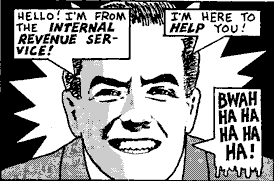
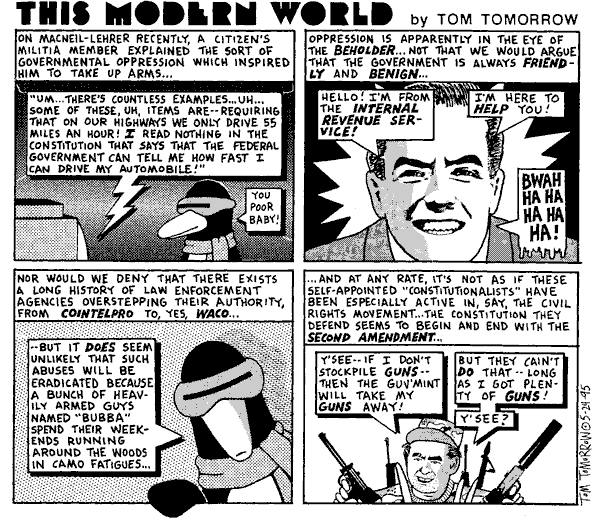
Bureaucratic rationality

Cleaning out some of the older links from my newsreader brought me this old news about a bit of Yuletide scroogery from the IRS, courtesy of Alina at Totalitarianism Today (2004-12-23):

As if payroll taxes weren’t enough– here is an example of the IRS almost literally whisking the Christmas turkery from the table-tops of hard-working Americans. According to Brian Hindo of Business Week, many companies used to hand out turkeys this time of year. Now, however, 41% give out coupons, which can be redeemed at any store for a turkey or a tofu turkey or whatever suits the employee’s fancy.

Sensing a little possibility for happiness, the IRS immediately put its best and brightest bureaucrats on the job. Heaven forbid an employee use that coupon to purchase a tub of Whip Cream rather than a fine-feathered friend. The result? The judgement that gift certificates, unlike actual turkeys, are a cash equivalent– and therefore taxable.

With apologies to H.L. Mencken and Max Weber, I think our theoretical lexicon needs revision. Thus:

Bureaucratic rationality, n.: The haunting fear that someone, somewhere, may be happy without permission.

Hoppe and Churchill: On the Justice of Strange Bedfellows

Ward Churchill and Hans-Hermann Hoppe might not enjoy coffee together very much. I can clearly see the meeting ending in blows. But they do have some things in common, sure: both are radical critics of the State and the social status quo; both are tenured professors at state Universities in the West; and both have recently found themselves in administrative hot water for making controversial public statements.

Churchill’s case, so far, has been more widely reported. Thanks to the heroic efforts of a student journalist using Google, the Know-Nothing blowhard brigade finally discovered that Ward Churchill wrote an essay called Some People Push Back–which has been distributed on the Internet since 2001, and was expanded into a book-length treatment in 2003–in which he described the September 11 attacks as chickens coming home to roost, pointed out that the plane flown into the Pentagon was striking a military target, and that As to those in the World Trade Center … Well, really. Let’s get a grip here, shall we? True enough, they were civilians of a sort. But innocent? Gimme a break. You’re hearing about all this now because Churchill, a professor at the University of Colorado at Boulder, was scheduled to speak on a panel at Hamilton College in New York on The Limits of Dissent (because God is an ironist, I guess), and after a journalist at the student newspaper dug up Churchill’s essay and wrote a story on it, the Right-wing commentariat saw something they’ve been salivating over for a long time: a perfect opportunity to sink their teeth, hard, into the (allegedly Left-dominated) world of academia. So they deployed a predictable combination of media hue-and-cry and outright threats of violence, and managed to mau-mau Hamilton into cancelling the panel. Now, in hopes of a second victory for silence, they are pushing for University of Colorado at Boulder to follow it up by firing Churchill from his (tenured) professorship. The University’s Chancellor has so far agreed to bring a thorough examination of Churchill’s opinions before the Holy Inquisition:

And Colorado’s DiStefano, after an angry grilling from the university’s Board of Regents — an elected body dominated by conservatives — reversed himself and announced a 30-day investigation of all of Churchill’s lectures and publications. This is the first step, the chancellor said, in the legal process required to fire a tenured professor.

Meanwhile, there have been Web site calls for the resignation of Stewart for allowing Churchill to be invited in the first place.

— Washington Post 2005-02-05

Just a few days later, in Las Vegas, because–again–God is an ironist, anarcho-capitalist economics Professor Hans-Hermann Hoppe found himself brought before a disciplinary hearing by the administration at the University of Nevada in Las Vegas. Hoppe had a formal complaint filed against him by a student for his comments in a lecture on the economic concept of time preference, in which he decided to illustrate the concept by examples, and claimed that homosexuals, as a group, tend to have higher time preferences than heterosexuals–that is to say, that homos tend to prefer immediate gratification over deferred rewards more strongly than straights. He went on to insinuate that the emphasis on short-run effects over long-run equilibria in J.M. Keynes’s economic theories might be explained by Lord Keynes’s fondness for gay liasons. In response to the student’s complaint, UNLV is demanding Hoppe accept a letter of reprimand and a dock in pay in response to a formal complaint filed by a student in one of his economics classes; Hoppe is striking back with a letter-writing campaign and legal assistance from the ACLU.

The anarcho-capitalists who are coming out for Hoppe and the lefty anarchists who are coming out for Churchill might not want very much to do with each other. But both camps are right to point out that both of these cases represent dangerous threats to academic freedom. (Note: threats to academic freedom, not freedom of speech. The two are importantly different concepts, although both are valuable.) Unfortunately, both camps have also developed a maddening tendency to smother the point about academic freedom (or open debate more broadly) in a bunch of rally-’round-the-black-flag nonsense.

Hoppe and Churchill should not be punished by academic Inquisitors for the contents of their arguments. Academic freedom is absolutely vital to the functioning of a University (as a place of education rather than an indoctrination camp), and it’s absolutely vital to maintain a climate of vigorous, open debate in our culture. But it’s important to note that the reasons for protecting academic freedom apply to bad arguments as well as to good ones: defending Hoppe’s and Churchill’s freedom to make arguments without fear of professional reprisals doesn’t require defending the arguments they make. And that’s a good thing, because Ward Churchill is a dick, and Hans-Hermann Hoppe is a homophobic bigot. Their arguments shouldn’t be defended, because those arguments are indefensible.

It ought to be transparent why Hoppe’s claims are offensive–and I’m frankly tired of seeing libertarians play innocent on the matter. Hoppe’s latest comments are only the latest in a long record, and I’m frankly baffled that Ilana Mercer or anyone else would take seriously the notion that describing the comments as only a generalization about how homos usually prefer immediate gratification more strongly than breeders is supposed to make it less offensive. Does anyone think that Hoppe’s left-field ad hominem argument–insinuations that poofery might explain errors in Lord Keynes’s economic thought that Hoppe finds particularly grave–is really a vital teaching tool? Or that it doesn’t make his other comments on homosexuality and gratification seem just a little, well, bigoted?

Churchill’s essay, for its part, is a farrago of confusions, logical fallacies, and flat-out lies. Most of the nits aren’t worth picking here; what is worth pointing out is that the central theme of the essay depends entirely on the claim that when America–that is, the American government–goes on a rampage around the world, we are acting like bullies, and so we have no grounds for complaint when we are ruthlessly slaughtered by people [who] push back. The problem here is that the people picked out by the we changes with every use: the people who did the rampaging and bullying are the government and its agents; the people who are complaining are, I guess, ordinary Americans; the people who were ruthlessly slaughtered were a couple of thousand workers, the overwhelming majority of them neither involved with the military nor holding any foreign policy position in the U.S. government, who happened to commit the terrible crime of going to work one Tuesday. But the people are not the government, and they are not owned by the government. They are mostly–we’re anarchists here, remember?–the victims of the government. We didn’t attack Iraq; we rarely if ever have meaningful control over the war-policy machine that has wrought so much misery in the Muslim world. The crimes of the United States government do not license crimes against civilians who happen to be in the United States; any more than the crimes of Osama bin Laden or Saddam Hussein license crimes against civilians who happen to be in Afghanistan, Iraq, or whatever other part of the Muslim world the Leviathan is planning to stomp through next.

Churchill’s critics have repeatedly been accused of misunderstanding his arguments and taking his words out of context. Now, I have read the whole essay through several times, but you never know. So perhaps one of Churchill’s defenders could explain to me exactly what the proper, contextual understanding of this is:

In sum one can discern a certain optimism — it might even be call humanitarianism — imbedded in the thinking of those who presided over the very limited actions conducted on September 11.

Their logic seems to have devolved upon the notion that the American people have condoned what has been/is being done in their name — indeed, are to a significant extent actively complicit in it — mainly because they have no idea what it feels like to be on the receiving end.

Or, while we’re at it, this:

And when they do, when they launch these airstrikes abroad — or may a little later; it will be at a time conforming to the “terrorists”‘ own schedule, and at a place of their choosing — the next more intensive dose of medicine administered here at home.

Of what will it consist this time? Anthrax? Mustard gas? Sarin? A tactical nuclear device?

That, too, is their choice to make.

During the HUAC era, many people in the U.S. were drummed out and blacklisted from teaching because they were genuinely associated with Stalinist parties in the United States. That was wrong; but you shouldn’t have to act like Stalinists were anything other than dupes or bloody-minded opportunists to make the case that the blacklisting and the anti-Communist witch hunts were wrong. The case for their academic freedom shouldn’t have been contingent on their having the right beliefs. And the same is true for both Churchill and Hoppe: the fact that they are wrong does not mean that they should be fired.

I’ll be writing a letter on behalf of both of them; defending both Churchill and Hoppe from the administrative goon squad is important. But we shouldn’t let a siege mentality dull critical thought. The reason Churchill and Hoppe are in hot water is that they made controversial statements which are rationally indefensible and deeply offensive. The problem is the administrative response to the controversy, not the controversy itself; the way to respond to terrible arguments, among rational adults, is with other arguments, not with politically-driven intimidation.

Let’s begin.

Guest-bloggers, like fish, begin to smell after three posts

I’ve said it before, and I’ll say it again: if you aren’t already reading feministe, you should. And if you’re reading this blog already, then you may be interested to know that while Ms. Lauren takes some much-deserved rest from blogging, I am once again filling in as a guest writer at feministe. (I did a couple of posts’ worth of this back in June.) Enjoy:

Anticopyright. All pages written 1996–2026 by Rad Geek. Feel free to reprint if you like it. This machine kills intellectual monopolists.