Rad Geek People's Daily

official state media for a secessionist republic of one

Posts filed under Smash the State

Death and Taxes

Posting on Geekery Today may be held up for a while in the next several days, as I grudgingly prepare the paperwork for my annual surrender of tribute to the State.

In honor of the occasion, though, you can follow my argument on Slashdot with Shakrai, who castigates those who would dare to cheat the State of its booty. Since I argue that taxation is nothing more than robbery with more paperwork, I can’t muster much outrage at those who lie to the taxman in order to keep some of their own damn money (thank you very much!).

For what it’s worth, while I don’t see anything morally wrong in cheating on your taxes, that doesn’t mean that I do it; since I make most of my money through self-employment I no doubt look pretty suspicious to the IRS from the get-go, and I have no desire to encourage them to come along and help me get my finances in order by being less than scrupulous in my reporting. It just goes to show that while nothing immoral could count as expedient, lots of things that are morally permissible are still not particularly smart. Such is life in this possible world.

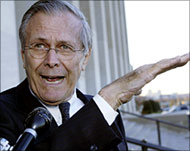
photo: Donald Rumsfeld
photo: Evil Lord Skeletor

In international news, Donald Evil Lord Skeletor Rumsfeld has announced that the situation in Iraq is not out of control. Meanwhile, in Iraq, your tax dollars are hard at work:

FALLUJAH, Iraq (AP) U.S. Marines battled insurgents for control of this Sunni Muslim stronghold Wednesday, calling in airstrikes against a mosque compound where witnesses said dozens were killed in six hours of fighting. An anti-U.S. uprising led by a radical Shiite cleric raged for the fourth day in southern cities.

The Abdel-Aziz al-Samarrai mosque was hit by U.S. aircraft that launched a Hellfire missile at its minaret and dropped a 500-pound bomb on a wall surrounding the compound.

The U.S. military said insurgents were using the mosque for a military fire base. Iraqi witnesses estimated 40 people were killed as they gathered for afternoon prayers. U.S. officials said no civilians died.

An Associated Press reporter who went to the mosque said the minaret was standing, but damaged, apparently by shrapnel. The bomb blew away part of a wall, opening an entry for the Marine assault. The reporter saw at least three cars leaving, each with a number of dead and wounded.

Chaos spreads, people are murdered, and you and I are forced to foot the bill for a war that many of us wanted absolutely no part of. Sooner or later there will be a reckoning for the terrible destruction that is being wrought on Iraq; I can only hope against hope that terrorist logic will not win the day, and that we will not be forced to face the consequences yet again for things that other people decided to do–using stolen money and professing to act on our behalf.

The Cars of Tomorrow

I’d like to interrupt the recent stream of political posts for a moment to geek over the prospects of robotic automobiles. Well, not quite; there will be a bit of political grumbling before the end, and there are a few mixed feelings about the technology. But first–the robots!

DETROIT, April 3 — The modern car does not have to guess your weight. It already knows.

It watches how you drive and it can pull a Trump. Skid, and before you can blink, you’re fired — the car is driving for you, if only for a moment. Cars today can decide when to brake, steer and can park themselves. They can even see.

In short, the back-seat driver now lives under the hood. And it does more than just talk.

This is all technology on the road now, if not in a single country or car. But industry engineers and executives view it as the start of a trend that will play out over the next decade, in which automobiles become increasingly in touch with their surroundings and able to act autonomously.

Diminishing returns from air bags and other devices that help people survive crashes have led to a wave of new technology to help avoid accidents. Or, if an on-board microprocessor judges a collision to be inevitable, the car puts itself into a defensive crouch. Mercedes S-Class sedans will even start shutting the sunroof and lifting reclined seats if a collision is deemed likely.

This trend is made possible by the car’s evolution from a mechanical device to an increasingly computerized one, in which electronic impulses replace or augment moving parts. That means microprocessors can take control of the most basic driving functions, like steering and braking.

At the same time, there is a parallel evolution in sensory technology. Most advanced safety systems are equipped with sensors that look inside the car, tracking tire rotation, brake pressure and how rapidly a driver is turning the steering wheel.

Japanese automakers have pushed the boundaries of these technologies farthest in their home market, a society with an affinity for gadgetry. Toyota recently introduced a car that parks itself.

I love gadgets. And while I like having a car available, I hate the routine unpleasantness that goes along with driving most places you need to get. A self-parking car is just so tomorrow–and so nice a solution to one of the more routine frustrations of driving, that it will leave my geeky soul all a-glow for weeks.

I do have to confess, though, that the glow wears off a little when I think about it more. Sure, I’m all for intelligent machines–and robots, no less! And sure, I think that increased road safety is all for the best. But–as Thomas Landauer pointed out back in 1996 in The Trouble With Computers–all too often we end up wasting a lot of productive energy by investing it in sophisticated technological solutions to problems that were created by the inappropriate application of technology in the first place. Landauer discusses this in the context of uncritical transfer of tasks to the computer; but it’s no less true of transportation.

Think of it this way: the reason that people are working on sophisticated robo-cars is because when you have millions of people individually driving cars on crowded streets at high speeds, it makes it all too likely that a lot of people will crash into each other and get killed. One way to do this is to pour a lot of technological effort into making the cars more aware of their surroundings and able to automatically take actions that will reduce the likelihood of a crash, and reduce the damage if one occurs.

Another way to get cars to carry a lot of people without running into each other is to tie a bunch of them together, move them as a unit, and call it a train.

But trains have floundered over the past century while automobiles have flourished. Why? Well, not because stressful, dangerous, polluting, rage-inducing car commutes are really how the average person wants to get from place to place; it has a lot more to do with the fact that the various levels of government in the United States have effectively forced us to adopt automobiles as our method of mass transit through creating a cartelized financial disaster-area in the train industry, and by pouring billions of dollars every year into subsidies for creating and maintaining free highways.

Don’t get me wrong. I wish I had the resources to get myself one of those self-parking cars. I think a future filled with robo-mobiles is one I’d like to live in. But I also appreciate a simple solution to what ought to be a simple problem. So two cheers for robo-cars, and one boo held back for the Interstate Highway System.

We now return you to your regularly-scheduled jeremiads against the Bush Administration.

Freedom is irrelevant. Assimilation is inevitable.

photo: David Brooks, creepy spendthrift fascist
photo: Locutus of Borg

Resistance is futile. You will be assimilated.

(Typos fixed, revised for clarity.)

About a month ago, neoconservative creepy spendthrift fascist David Brooks wrote an article which he took to be in support of Latino immigrants. In this he took himself to arguing against Samuel Huntington’s anti-immigration essay in Foreign Policy, in which Huntington (famous for his contribution to contemporary fascist sociological thought, the so-called Clash of Civilizations thesis) offers the following bit of post-Enlightenment Volksgeschichte:

Most Americans see the creed as the crucial element of their national identity. The creed, however, was the product of the distinct Anglo-Protestant culture of the founding settlers. Key elements of that culture include the English language; Christianity; religious commitment; English concepts of the rule of law, including the responsibility of rulers and the rights of individuals; and dissenting Protestant values of individualism, the work ethic, and the belief that humans have the ability and the duty to try to create a heaven on earth, a city on a hill. Historically, millions of immigrants were attracted to the United States because of this culture and the economic opportunities and political liberties it made possible.

. . .

In this new era, the single most immediate and most serious challenge to America’s traditional identity comes from the immense and continuing immigration from Latin America, especially from Mexico, and the fertility rates of these immigrants compared to black and white American natives.

Brooks has a bone to pick with Huntington’s analysis. As he writes:

You’ll find that Huntington marshals a body of evidence to support his claims. But the most persuasive evidence is against him. Mexican-American assimilation is a complicated topic because Mexican-Americans are such a diverse group. The educated assimilate readily; those who come from peasant villages take longer. But they are assimilating.

It’s easy to find evidence that suggests this is so. In their book Remaking the American Mainstream, Richard Alba of SUNY-Albany and Victor Nee of Cornell point out that though there are some border neighborhoods where immigrants are slow to learn English, nationwide, Mexicans know they must learn it to get ahead. By the third generation, 60 percent of Mexican-American children speak only English at home.

Nor is it true that Mexican immigrants are scuttling along the bottom of the economic ladder. An analysis of 2000 census data by the USC urban planner Dowell Myers suggests that Latinos are quite adept at climbing out of poverty. Sixty-eight percent of those who have been in this country 30 years own their own homes.

Mexican immigrants are in fact dispersing around the nation. When they have children, they tend to lose touch with their Mexican villages and sink roots here. If you look at consumer data, you find that while they may spend more money on children’s clothes and less on electronics than native-born Americans, there are no significant differences between Mexican-American lifestyles and other American lifestyles. They serve in the military — and die for this nation — at comparable rates.

I have to confess that I simply don’t understand this argument between Huntington and Brooks. Don’t get me wrong — it’s not that they are using unfamiliar words, or that I don’t see the point of contention between Huntington and Brooks, or that I don’t get follow the way in which Brooks and Huntington draw divergent conclusions from the premises and empirical evidence that they cite. All of that seems fairly clear. The part that I don’t understand is this: why in the world does Brooks present himself as posing a serious objection to Huntington? And why in the world does Brooks, in presenting his disagreement, simply leave Huntington’s fundamental premise concerning immigration policy standing there unmentioned, like the proverbial elephant in the room?

This point is particularly imiportant, because Huntington’s (and Brooks’s) fndamental premise concerning immigration policy is completely ridiculous.

By way of illustration, let’s consider a bit of a story.

Say that you’re moving to a new city in order ‘re moving across to a new city to work, and you need a place to stay; fortunately, a friend of yours who lives in the city says you can stay at her house until you find a place of your own. As you turn onto the street where she lives, I ran out in front of your car and demand that you stop. When you roll down the window and ask what’s going on, I demand What’s your business here?

You blink a couple of times and finally say, Well, I’ve got this new job, and my friend Liza invited me to stay with her while I look for a place of my own.

Whoa whoa whoa! I shout, You mean you’re from out of town, and you intend to stay here?

Yes… you say, shifting a bit in your seat.

Sir, I’m afraid you need to fill out this form before I can let you enter the neighborhood, I say, as I hand you a form entitled Top Ten Albums of All Time.

Excuse me? you ask. What in the world is this?

Your top ten LPs of all time. I need you to fill it out before I can let you stay at Liza’s.

Just who are you, anyway? you ask, as you ponder whether you can just speed past to Liza’s house without running me down.

I’m the Neighborhood Patrol! The citizens of this neighborhood rely on me to ensure that only those who adhere to our traditional devotion to 1970s Southern Rock live here. I’m afraid I can’t let you go through to Liza’s house until you give me a list of your top ten albums of all time. We can’t have a bunch of people moving into this neighborhood undermining our neighborly devotion to Freebird!

Look, why don’t you just go knock on Liza’s door and ask her whether I can come through? She invited me here and she’s expecting me.

I get a little anxious and explain, Well, Liza didn’t exactly agree with our decision to implement the Top Ten List…

You stare at me. I’m going to Liza’s house. So what in the world are you blocking my way for?

At this I become visibly irritated. Sir, I’m an official Neighborhood Patrol officer. Liza didn’t agree to the Top Ten List, but more than 1/2 of her neighbors did. I’m going to have to ask you to step out of the car…

Isn’t this story absolutely absurd? And if it is, wouldn’t it be just as absurd for one of the neighbors to run out and argue with me to let you in — because he’s talked with Liza, and he can vouch for your massive collection of Skynyrd?

So how is Huntington’s and Brooks’s argument over whether or not Latino immigrants are assimilating to the surrounding WASP culture different in any salient respect? Why in the world should success or failure at adopting the language, dress, or other cultural trappings of one’s prospective neighbors be a criterion for deciding whether or not a peaceful individual is forced out of the country?

The War on Iraq One Year On: Countdown To Regime Change

The World Still Says No To War: M20 march in NYC

Today is the first anniversary of the Bush administration’s war on Iraq. hundreds of thousands of people are taking to the streets in protest of the war, the occupation, and the lies that were used to murder some 8,000 – 10,000 Iraqi civilians in a bloody game of geopolitical chess, and to create a rudderless, hopeless war between heavy-handed occupying forces and brutal terrorist guerillas. President Bush, meanwhile, keeps repeating the same old crap, perhaps in the hope that it will start to stick through sheer force of repetition. Apparently we are supposed to forget the deception and the manipulation and the bullying of dissenting voices, and the simple fact that the past year has proven that we were right and he was wrong, and pitch in with support for this bloody occupation:

No concession will appease their hatred. No accommodation will satisfy their endless demands, Bush said after deploring last week’s Madrid bombings, which were followed by the election of a new prime minister eager to remove Spanish troops from Iraq. There can be no separate peace with the terrorist enemy. Any sign of weakness or retreat simply validates terrorist violence, and invites more violence for all nations.

As if trying to prove a point, Bush trots out every tired neo-conservative creepy spendthrift fascist trope about the war: the terrorists as the new Hitler, Bush and his cronies as the new Churchill, the new Chamberlain in Decadent Europe and the rest of us who feel just a tad squeamish about a completely unrepetant gang of lying warmongers who profess to be on our side. But the real battle cry here is not from World War II; it is from Vietnam. Apparently we are supposed to persist in a deadly and useless occupation of a Third World nation that the U.S. government annihilated on fabricated grounds because if we pull out now, we will give a sign of weakness. We will send the wrong message.

I don’t know quite what to say to this appalling idea — except to quote from a fine film:

It seems you burned the wrong village.

They always say that. And what does it matter? A village betrays us, a village is burned. The point is made.

Your point, their village.

And also to quote from a fine website, which adds a heart-rendingly fresh update of the theme. in the wake of the 3/11 massacre in Spain and the upsurge of public rage over the Aznar government’s manipulations and lies:

El gobierno miente, manipula, extorsiona, oculta información, asesina, no escucha, insulta, acusa a la oposición, le importa una mierda 200 muertos con tal de sacar votos y no perder, somos objetivo de terroristas islámicos por culpa de la prepotencia, la chulería, el afán de protagonismo, los aires de grandeza de un pequeño gran hijo de la gran puta llamado Aznar.

Vuestra guerra, nuestros muertos [Perdido en Madrid]

The Government lies, manipulates, extorts, hides information, murders, doesn’t listen, insults, accuses the opposition; 200 dead aren’t worth shit so long as they get votes and don’t lose; we’re the target of Islamic terrorists and it’s all the fault of the power-mongering, the insolance, the eagerness for heroism, the airs of greatness of that little son of a bitch called Aznar.

Your war, our dead [Lost in Madrid]

In spite of the warhawk hand-wringing over cowardly Spaniards and their appeasement, the electoral crash-and-burn of the Aznar gang is a courageous step: a popular upsurge against the politics of fear, and emboldened by their much-touted white-hot rage—turned not only on the thugs who inflicted this slaughter on innocents, but also on the lying thugs who launched a dirty war and left 200 innocent madrileños to face the consequences. That the Spaniards can find the courage to throw the bastards out in 2004 gives me some hope that we’ll be able to do it here, too.

This is connected to a broader point about terrorism, war, and the State; it’s a point well worth reflecting on on this anniversary. The essence of the State is irresponsibility: that is, States (as opposed to voluntary associations) always exist in virtue of one group of people inflicting the costs of their decisions on others against their will. The most mundane form of the phenomenon is taxation; the most egregious are War and State terrorism. This is something to remember whenever some politician is droning on about duty, sacrifice, and glory; they mean their glory taken from your duty and sacrifice. George W. Bush will never pay for the destruction that he has wrought. You will pay for it when you surrender your taxes in about a month. Donald Rumsfeld will not be the one who faces death for his agenda in the Middle East. The troops he has deployed will be the ones who have to face the consequences of his decisions. José Maria Aznar and Tony Blair will not be the ones killed in the subway for the war they helped unleash. All too many of us—Spaniards, Britons, and Americans— are the ones who have been put into the crossfire by their reckless war-mongering. Should we be surprised that the health of the State is a disease that we have to live with, and they don’t?

Anarchism: Because it isn’t your fault that George W. Bush is a dickhead.

For further reading:

Happy Tyrannicide Day (observed)!

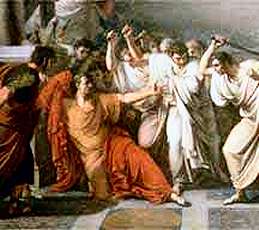
Today, March 15th, 2004 CE, is the 2,047th anniversary (give or take the relevant calendar adjustments) of the assassination of Gaius Julius Caesar–the butcher of Gaul, the annihilator of the Republic, the destroyer of the Great Library of Alexandria, the harbinger of five centuries of absolutist tyranny, and the explicit archetype of every brutal prince, absolute monarch, and fascist dictatorship in the ancient, medieval, and modern history of Eastern and Western Europe. At last, as dictator-for-life Caesar increasingly threatened the elevation of his coup d’etat into an explicit monarchy, a group of Senators led by Marcus Junius Brutus and Gaius Cassius Longinus rose up, taking the title of Liberatores, and stabbed Caesar 23 times in the Forum.

Today is also only two days after (again, give or take the relevant calendar adjustments) the 123rd anniversary of the assassination of Czar Alexander II of Russia, an autocratic self-styled Caesar who, in spite of making a tremendous step forward for freedom by emancipating the serfs, also fostered the ultra-reactionary Three Emperors League with Austria and Prussia, began his reign with the senseless and devastating Crimean War, continued to pursue vigorous warfare against Turkey and conquests in the East, and imprisoned and murdered hundreds of liberal, socialist, and anarchist students. On March 13, 1881 he was killed by a bomb thrown by an anarchist in an act of Propaganda by the Deed.

In honor of the event, I’d like to suggest a new holiday. Let’s celebrate March 15 as Tyrannicide Day (observed)! Two tyrants’ deaths bundled together into one day of celebration; it’ll be just like President’s Day, except cooler.

Anticopyright. All pages written 1996–2026 by Rad Geek. Feel free to reprint if you like it. This machine kills intellectual monopolists.