¿Perestroika Cubana?
O.K., I do not yet have any real idea what to say about this -- in maximally general terms, my starting points are to note that the Cuban Communist regime has been really awful for decades, both a totalitarian nightmare politically and socially, and a study in the most multidimensionally dysfunctional aspects of closed, planned economies, under revolutionary state socialism. U.S. foreign policy towards Cuba from the Cold War to the present has been like most U.S. sanctions regimes — stupid, appallingly belligerent and ineffective when not actively, massively counterproductive. (A policy of isolation cuts off and hurts ordinary Cubans but often strengthens, not weakens, the hands of their hermit-kingdom rulers.)
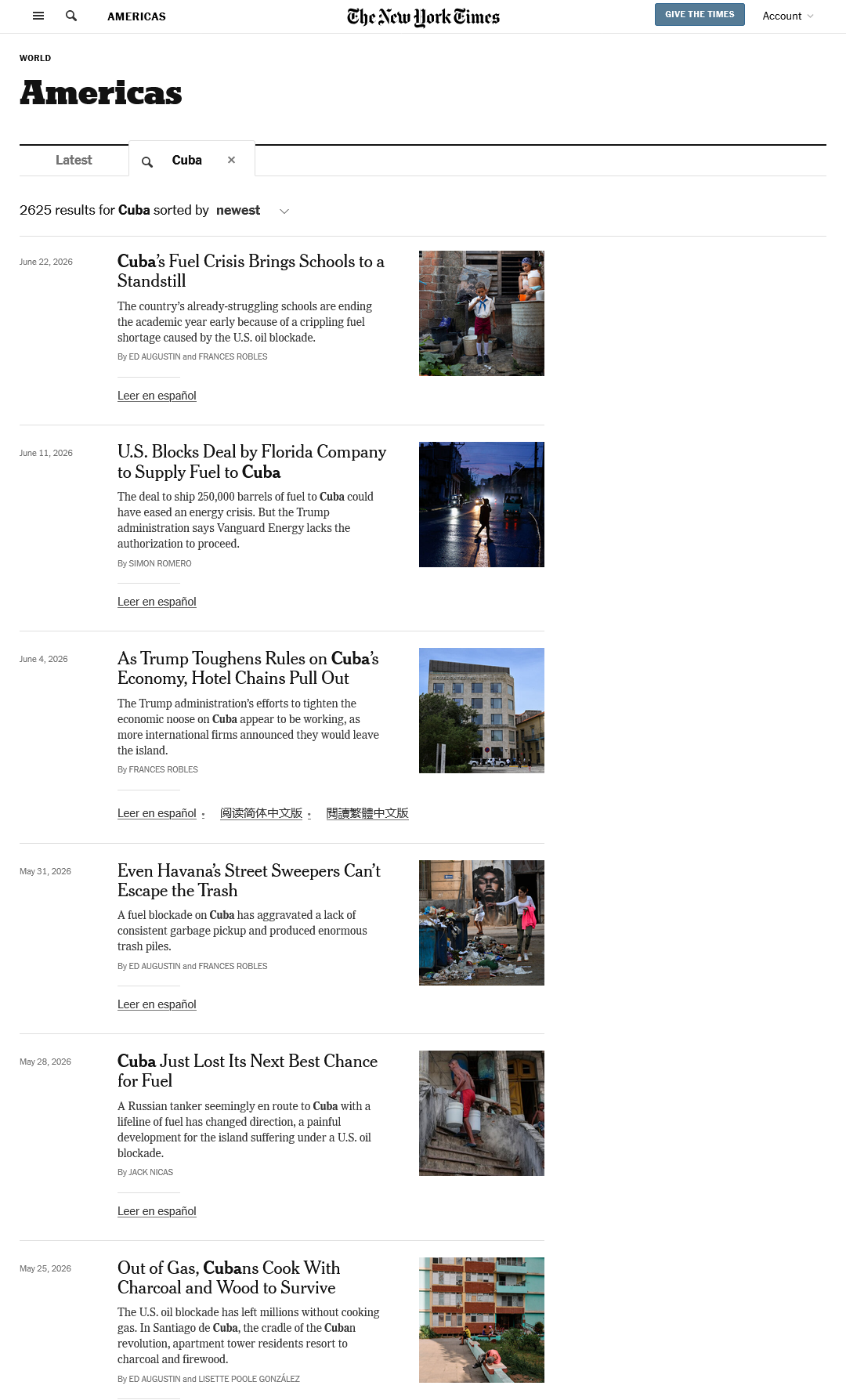
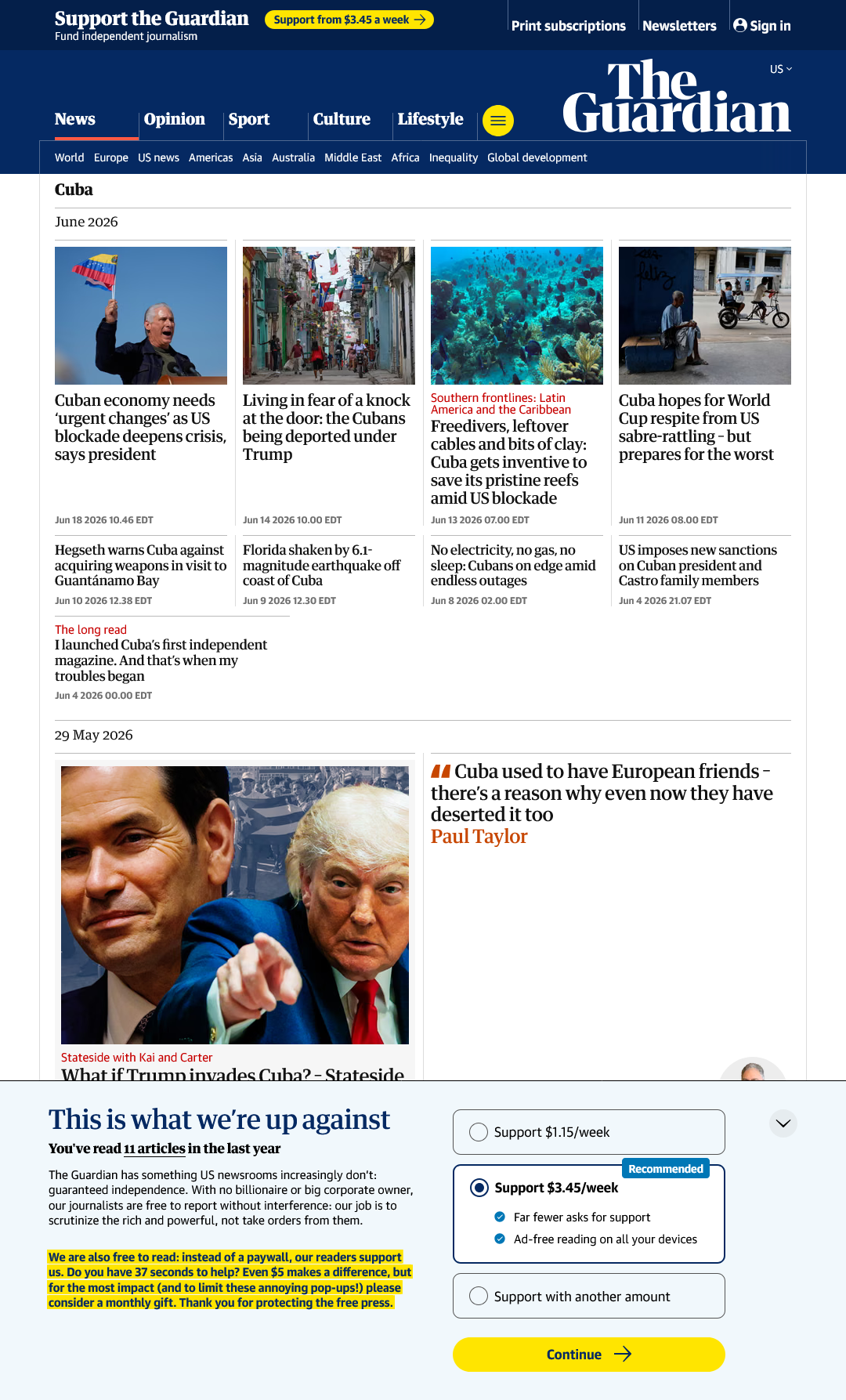
But whether or not the U.S. is acting wrongly and badly (I absolutely think it is), this seems like it could be really significant! If these reforms amount to anything in the end — of course it is far too soon to know whether they will, but these are very big moves — it could be a really hopeful development. I am baffled that as of today (22 June 2026), this has been very publicly developing for at least 10 days, but there currently seem to be not one story yet about these measures in the New York Times Americas section, and only one (1) short article in The Guardian, on president Díaz-Canel's speech to the politburo, without much on the overall framework or significant details on the policies that were actually enacted last week, buried in their usually voluminous Latin America and Caribbean coverage. I've been trying to catch up on this story through Associated Press wire articles since I read about it through a post by Polymarket (!) to X dot com. I don't know what's going to happen for the island or for its catastrophically failed experiment in one-party revolutionary communist rule or for the U.S.'s ludicrous decades of destructive, until-now perennially failing efforts at isolation and regime change, if these reforms do take hold and deepen, if they are acknowledged and diplomatically rewarded, etc. But it seems like folks ought to be reading and talking more about this!
June 12, 2026:
HAVANA (AP) — Cuban President Miguel Díaz-Canel on Friday announced a package of economic reforms aimed at attracting investment, expanding participation by Cubans living abroad in the economy and decentralizing parts of the country's administration.
The president did not provide details about the measures or a timetable for their implementation but said during remarks to state media that it is now
time to changeand that the countrysimply cannot continue on its current course.
Every opportunity in the midst of a crisis must be seized as a moment for takeoff, as a moment for growth,Díaz-Canel said, according to a statement from the presidency that was republished by state-run media.We have established a group of priorities to confront this situation,he added without offering specifics.— Andrea Rodríguez, Díaz-Canel announces economic reforms to attract investment and involve Cubans abroad
Associated Press, 12 June 2026
Shared Article from AP News
Díaz-Canel announces economic reforms to attract investment and…
Cuban President Miguel Díaz-Canel has announced economic reforms to attract investment and involve Cubans abroad in the economy.
apnews.com
June 17, 2026:
HAVANA (AP) — Cuba's powerful Communist Party, or PCC, called an unscheduled session Wednesday, a rare occurrence that comes days after President Miguel Díaz-Canel announced an economic reform package aimed at opening up the struggling island's economy.
Also Wednesday, in a surprise move, the National Assembly was also convened for Thursday to follow up on the party meeting.
Both sessions come at a critical time for Cuba, as it grapples with the effects of a U.S. energy blockade aimed at forcing a change in the island's economic model.
Last week, Díaz-Canel told journalists that the upcoming reforms would expand authorizations for private companies, which were first legalized five years ago. Without providing specific details or deadlines, the president noted that the plan will also allow Cubans living both on the island and abroad to invest in tourism, while granting state-run companies greater freedom to partner with the private sector.
He also forecast changes to the currency exchange market and raised the possibility that private businesses could import and export goods directly, bypassing the state intermediation currently required.
— Andrea Rodríguez, Cuba's Communist Party convenes unscheduled session to debate new economic measures
Associated Press, 17 June 2026
Shared Article from AP News
Cuba’s Communist Party convenes unscheduled session to debate …
Cuba’s Communist Party has called an unscheduled session, days after President Miguel Díaz-Canel announced an economic reform package.
apnews.com
June 18, 2026:
HAVANA (AP) — Cuba's Communist Party has approved an emergency economic package featuring unprecedented free-market measures aimed at opening up the struggling island's economy following heightened pressure from the United States.
While the full document has not been released, here are some of the proposals, based on statements by Cuban President Miguel Díaz-Canel and other officials.
Decentralize state-run economy . . .
Nonspecific changes to foreign exchange market . . .
Government downsizing . . . to reduce the number of ministries from 27 to 21 . . . .
Municipal independence . . . [to] give municipalities greater authority to approve businesses operating within their jurisdictions and to manage relations with economic actors, including state-owned enterprises, cooperatives and private companies. . . .
Autonomy for state-owned companies . . . Companies would be allowed to design their own pay systems, use and distribute profits with fewer restrictions, import and export goods, and enter into partnerships with private businesses and cooperatives. . . .
Elimination of state intermediaries . . . businesses, including small and medium-sized enterprises, would be allowed to import and export goods directly rather than through state-run entities . . . .
Subsidies to phase out . . . moving food and other goods to market pricing.
Rebuilding abandoned infrastructure . . .
— Andrea Rodríguez, What to know about Cuba's economic measures aimed at opening up the island's economy
Associated Press, 18 June 2026
Shared Article from AP News
What to know about Cuba's economic measures aimed at opening up …
Cuba’s Communist Party has approved an emergency economic package featuring unprecedented free-market measures to open up the struggling island’s …
apnews.com
June 19, 2026:
Cuba pushes through sweeping free-market reforms in biggest economic shift since the revolution
HAVANA (AP) — Observers on Friday called Cuba's new free-market reforms the most sweeping economic overhaul of the island's communist economy since the Cuban revolution, as the grandson of former President Ra´l Castro said in an interview that Cuba must seek to move its economy forward.
The 176 measures aim to further decentralize Cuba's state-run economy, which has been left gasping by a tightened embargo under President Donald Trump. Under the island's current economic model, the government largely determines what is produced, who produces it, the prices at which goods are sold and how the country’s resources are allocated.
The plan includes more space for private businesses, imports and exports without state intermediation, free hiring of personnel, authorization for private banks and investment by Cubans abroad. It even permits fast-food chains to establish themselves on the island.
Elements that for decades were listed as pillars of the revolutionary economy, such as the state monopoly on foreign trade and the centralization of productive forces, have been dismantled,said Luis Carlos Battista, a Cuban-American political scientist and lawyer who is a doctoral candidate at the University of Salamanca.Cuban leaders like former President Ra´l Castro -- who still wields significant power on the island -- have sought to push forward more limited reforms of Cuba's economy in the past, but efforts have run into bureaucratic hurdles. In passing the reform, Cuban authorities cautioned that implementation could be slow, and noted measures will not be viable if the U.S. does not lift the energy and financial embargo on the island.
. . .
In an interview published Friday, in the United Arab Emirates-based The National, Raul Guillermo Rodriguez Castro, grandson of the revolutionary leader, reiterated that Cuba
doesn’t even slightly represent a threatto the U.S.. . .
Cuban President Miguel Díaz-Canel said that the proposed measures were based on an analysis of the Vietnamese and Chinese models, communist countries with market economies.
. . .
What is likely to pose a significant barrier are U.S. sanctions on Cuba, said Lee Schlenker, a research associate at the Quincy Institute in Washington. . . . Without sanctions being lifted, Schlenker and other analysts said many of the presented measures will be inapplicable, especially due to the limitations and prohibitions imposed on potential investors, who are penalized in the U.S. financial system if they do business with Cuba.
Beyond that, there are a number of other obstacles that could stymie significant reforms, ranging from mistrust from potential investors to what Battista, the Cuban-American analyst called
slow and inefficientbureaucracy.Despite these obstacles, the Cuban government faces a short window for obtaining results, said Paolo Spadoni, associate professor in the Department of Social Sciences at Augusta University in Georgia.
If Cuban leaders hope to survive this unprecedented crisis and the pressure from the United States, they must move quickly with the implementation of reform and the achievement of tangible results,Spadoni said.— Andrea Rodríguez, Cuba pushes through sweeping free-market reforms in biggest economic shift since the revolution
Associated Press, 19 June 2026
Shared Article from AP News
Cuba pushes through sweeping free-market reforms in biggest econ…
Observers are calling Cuba’s new free-market reforms the most sweeping economic overhaul on the island’s communist economy since the Cuban revolut…
apnews.com
Reply to ¿Perestroika Cubana? Follow replies to this article · TrackBack URI