The Lost Landscapes Beneath the Waves
What I'm Reading: Toby Lester, The Lost World of Aquaterra in The Atlantic (Nov. 10, 2026), on lost landscapes of the Stone Age and underwater archaeology.
Shared Article from The Atlantic
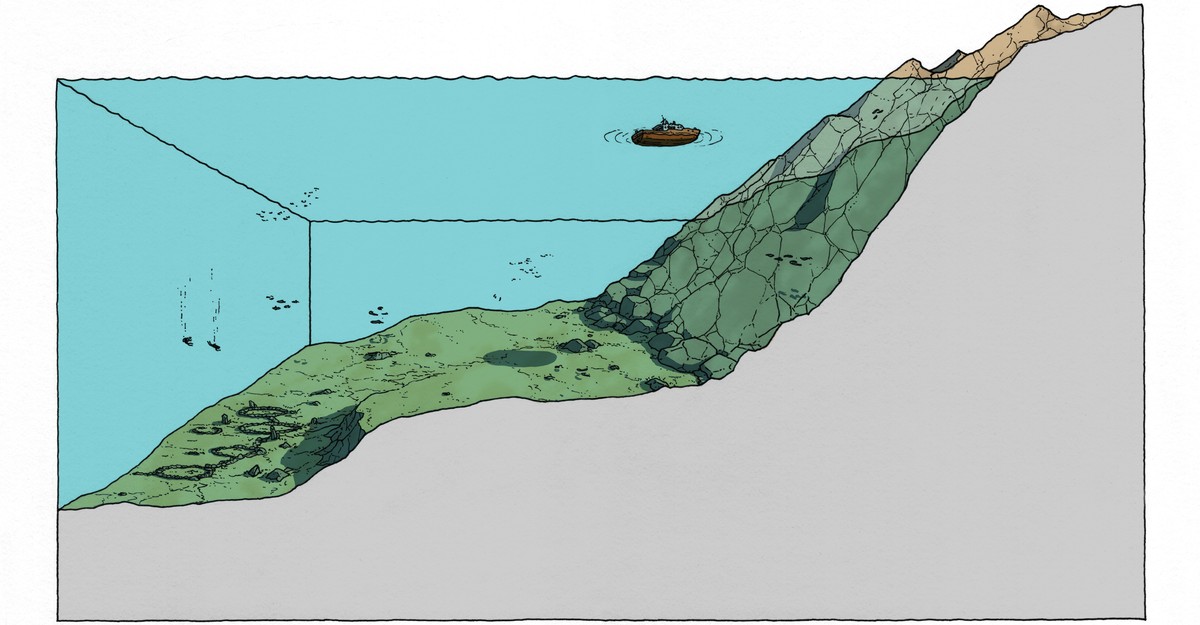
Most of human history is waiting to be found. And it's underwater.
Toby Lester @ theatlantic.com
I first learned about Aquaterra more than a decade ago, when I received an email from the person who came up with the name--Jerome E. Dobson, a professor emeritus of geography at the University of Kansas and president emeritus of the American Geographical Society. . . . Dobson told me another giant
newlandmass was coming into view that deserved to be put on the map. If I wanted to learn more, he said, I should readAquaterra Incognita,a 2014 paper he'd published in the journal Geographical Review.It's a fascinating monograph. To understand where--and what--Aquaterra is, Dobson writes, you have to think about how sea levels fall and rise during an ice age. . . . If you were able to speed up the glacial cycle and watch it from space, you'd observe the ebb and flow of a planetary tide--one that over the course of millennia alternately exposes and submerges immense expanses of land along the continental shelves. The result, as Dobson writes, is
a vast earth feature,bounded by the highest and lowest sea levels of the glacial cycle, thattransforms back and forth among upland, wetland, and seafloor.This Earth feature is what he calls Aquaterra.For much of the most recent glacial cycle, Aquaterra was mainly terra, but today it's mostly aqua. If you've swum or boated near almost any coastline, you’ve been there. Aquaterra isn't just the land now underwater; it's the whole zone that the glacial cycles have alternately drowned and exposed. That includes many of today's beaches and coastal lowlands, which were underwater during warmer periods in the past and, as we're now learning the hard way, are flooding again as global temperatures rise. The present-day seafloor of Aquaterra, Dobson argues, is the
least-known zone on earth-- less mapped than the floor of the deep ocean (or even the surfaces of Mars, Venus, and the moon).When modern human beings began to move out of Africa in serious numbers, starting at least 70,000 years ago, the planet had already been cooling for some 45,000 years, and sea levels were already more than 200 feet below where they are now. During the following 50,000 years, sea levels continued to drop, which meant that as people spread across the globe, they were often moving through and settling in coastal regions of Aquaterra that are now as much as 400 feet underwater. And for much of that time, they were doing far more than just hunting and gathering. Many of the developments that have defined modern human society, Dobson argues, may have had their origins in those now-submerged lands.
Compare the most recent curve of sea level rise against the timeline of cultural innovations,he writes,and you will find that much human progress occurred while seacoasts were still quite low.Aquaterra therefore demands recognition--and exploration.. . . Call the feature what you will, but it exists: During the past 20,000 years, huge stretches of formerly inhabited land along the world's coastal shelves have disappeared underwater, taking with them tens of thousands of years of human history.
Until recently, that is. During the past few decades, artifacts and sites dating back millennia have been found off the coasts of every inhabited continent. A growing number of researchers--geographers, archaeologists, anthropologists, amateur enthusiasts--are turning their attention to what lies offshore.
Everywhere we've systematically looked, we've found some areas where the former landscape has survived,Jessi Halligan, an anthropologist at Texas A&M, told me.And in a lot of those places, those former landscapes have had sites on them.— Toby Lester, The Lost World of Aquaterra
The Atlantic (Nov. 10, 2026).
Reply to The Lost Landscapes Beneath the Waves Follow replies to this article · TrackBack URI