Rad Geek People's Daily

official state media for a secessionist republic of one

Shameless Self-promotion Sunday

It’s a rainy Sunday here in Auburn, but neither rain, nor snow, nor gloom of night should stay you from the swift completion of your appointed Shamelessness.

For me, to-day is mostly going to be a day for preparing, catching up, and staying more or less resolutely offline — catching up on some movies, then helping prepare for a yard sale in the afternoon, and then prepping some exciting stuff for the Distro — the latest issues of Market Anarchy and the Anarchist Classics Series, plus a long-needed catch-up on the many titles that have come out since last I updated here about it, plus prepping the Distro’s largest single order to date, destined for Fort Worth, Texas. And you? What have you been up to this week? Write anything? Leave a link and a short description for your post in the comments. Or fire away about anything else you might want to talk about.

If it moves, regulate it.

This is from the OA News from a few days ago.

. . . On another issue, AU is requiring all students, staff and faculty bringing a bicycle to campus to register it with AU's Parking Services, Smith said.

Although people have previously been asked to register, the requirement will be more strictly enforced now, something Smith said is necessary as the campus has become more pedestrian.

We're seeing many, many more bikes on campus and because of that we've got to get a handle on how many we have …

— Donathan Prater, Opelika-Auburn News, August 15, 2012

(No, you don’t.)

. . . and registering them is a good way to do that, Smith said.

— Donathan Prater, Opelika-Auburn News, August 15, 2012

(No, it isn’t.)

You register your car on campus and the same is true for bicycles.

— Donathan Prater, Opelika-Auburn News, August 15, 2012

(This is a completely specious comparison.)

Registration is free.

— Donathan Prater, Opelika-Auburn News, August 15, 2012

(Don’t count on that lasting forever.)

Smith said the number of bicycles registered with the university will help ensure that an adequate number of bicycle racks are available on campus.

— Donathan Prater, Opelika-Auburn News, August 15, 2012

The reason the University requires you to register cars is specifically to limit and control access: parking space near campus is extremely limited, it’s expensive to build more, and the parking tags regulate who can park in which zones. None of these rationales apply to bicycles on campus, no matter how many there may be. The idea that you just have to know the exact number of bicycles might be brought in at any given time is inane. If you’re seeing many, many more bikes on campus, then evidently you have some idea of the order of magnitude you’re dealing with, and if you want to tell whether you need to install more bike racks, you can do this pretty easily by looking at the bike racks and seeing whether or not they’re full up all the time, or by watching for bikes chained up to lightpoles when the racks are all full. If you see these problems, you need more bike racks. If you don’t, you don’t. The cynic in me would point out that one reason to enforce this policy is that it’s a way of making up for the declining revenues from on-campus cars, by extracting a little more revenue from the bicycles they are going to seize and impound. But really this, and a lot of other policies controlling bicycling that are justified by the same kind of specious comparisons to motor-cars, seems to be driven, more than anything, by a reflexive belief if there’s ever a lot of any damn thing at all, it’s a Problem that has to be counted out and controlled; that any and every important part of civic life, or campus life, must be registered with, and legible to, the controlling authorities. There is no reason at all to enforce this policy, other than an irrational compulsion to control anything that moves in your field of vision. In practice, the effect of the policy will be to waste students’ time, to cost students money, to punish bicyclists, to impound bikes, and to make campus less accessible to the rest of the community. (A lot of us have bikes. But we’re not eligible to register them.)

Also.

U.S. Commission on Civil Rights holds hearings on Arizona and Alabama apartheid bills

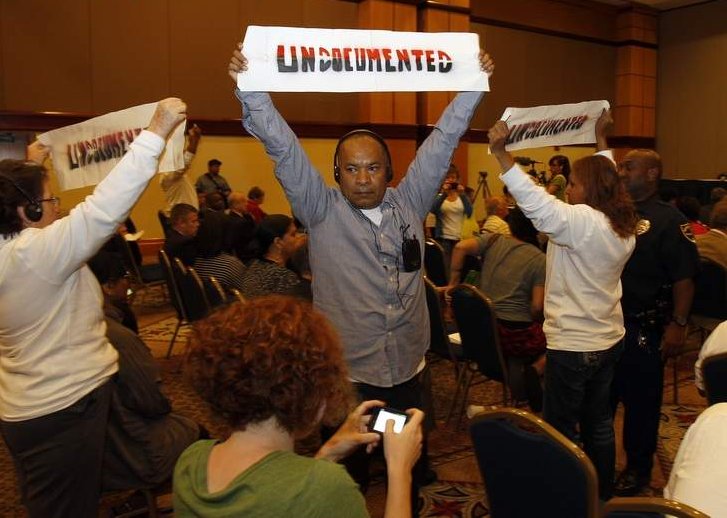
This was on the front page of to-day’s OA News (front page, continued on p. 8A). The online copy is a bit longer than what appeared in print (there are a couple paragraphs at the end that the OA News cut from the printed edition). The U.S. Civil Rights Commission recently held a meeting in Birmingham to discuss SB 1070 and HB 56, the international apartheid police-state bills in Arizona and Alabama. Demonstrators showed up to inject some reality into the proceedings.

From the Associated Press.

Quarrelsome commission

Civil rights panel has first meeting to discuss laws

BIRMINGHAM — A quarrelsome U.S. Commission on Civil Rights held its first hearing on state laws that target illegal immigration, with Republican backers arguing Friday that the measures are vital to protecting American jobs and fighting crime.

Kansas Secretary of State Kris Kobach, who helped write similar immigration laws in Arizona and Alabama, said unemployment in Alabama has dropped three times faster than the national average since parts of the state's law took effect last fall — a change he credited at least in part to the act.

Attempting to head off claims that the laws lead to racial profiling by police, Kobach said the immigration enforcement specifically bars officers from making stops or arrests based on appearance.

As he spoke, four Hispanic women and a girl stood in the audience with their backs toward Kobach. Demonstrators, some speaking Spanish, stood up holding signs that said Undocumented and shouted at Kobach.

These laws are based on hate, said one man.

The meeting room quieted after officers escorted protesters away, but the commissioners still bickered among themselves. . . . Congressional appointee Todd Gaziano, legal director of the conservative Heritage Foundation, accused the demonstrators of hateful speech . . . . Gaziano and chairman Martin R. Castro, appointed by President Barack Obama, exchanged sharp words throughout the opening session. Members even disagreed over who should be allowed to testify, with organizations accusing each other of being hate groups.

The commission will issue a report within months on the findings of the hearing, which focused on whether the state laws foster discrimination and run counter to civil rights laws. But the panel doesn't have any enforcement power, and it can't make states alter their laws.

The U.S. Supreme Court struck down three parts of Arizona's law in June, but it upheld a section that requires police to check the status of people who might appear to be in the country illegally. The ruling was closely watched because Alabama, Georgia, South Carolina, Indiana and Utah have approved similar laws.

Courts have blocked all or parts of the laws in each state, and legal challenges are now moving forward since the justices ruled on the Arizona statute . . . .

Law opponent Tammy Besherse, an attorney with South Carolina Appleseed Legal Justice Center, accused law officers of destroying immigrants' legal documents and of playing computer games in which participants kill Mexican immigrants.

GOP state Sen. Scott Beason, a key sponsor of Alabama's law, said opponents of the laws and the media place more value on the rights of illegal immigrants than the plight of legal U.S. citizens who can't find work because of people living in the country unlawfully.

We cannot solve the world's problems, but we can make sure we don't import some problems, Beason said. Responding to a question about a U.S. Chamber of Commerce that cast immigration in a positive light, Beason said the business organization is pretty slanted because some of its members employ illegal immigrants.[1]

Castro said the Alabama hearing was the commission's first outside Washington, D.C., in years. The panel's first-ever was held in Birmingham in 1958, when state and local laws mandated racial segregation.

— Jay Reeves, Associated Press, Quarrelsome commission: Civil rights panel has first meeting to discuss laws. Opelika-Auburn News, 18 August 2012.

* * *

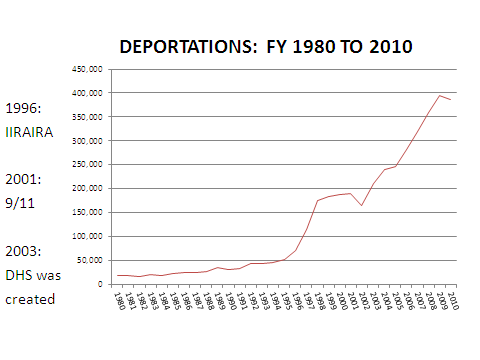
The article goes to some effort to make it out that the fights amongst the panel members were signs of a clear divide between Republicans and Democrats, conservatives and liberals. Of course the notion that the Democratic Party appointees maintain any divide, or have any quarrel, other than a purely rhetorical one, from the Republicans, is absurd. In 2008, presidential candidate Obama promised comprehensive immigration reform, paths out of the shadows for undocumented immigrants, and promised that immigration reform would be a top priority in my first year as President. In 2012, four years later, Liberal Democratic President Barack Obama has accomplished nothing at all towards comprehensive reform or towards paths to citizenship. The claim that it would be a top priority in his first year in office was a lie; he abandoned it as soon as he sat down in the Oval Office, concentrated on pushing stimulus bills and fighting wars and bailing out failed capitalists — and then he radically escalated the militarization of the border, and he presided over the largest mass deportations of peaceful immigrants in the history of the United States. Even his weakest, latest-coming promises have been lies, broken as soon as they were made. But there is a real divide here. It’s not a divide on the panel; it’s the divide between the panel, and the protesters who courageously stood up to challenge them. I am glad to see people calling out Kobach, and challenging this kind of political palavering over the lives and livelihoods of immigrant families. More power to them.
Also.

  1. [1][I-word and xenophobia sic. –RG.]

Whiteness Studies 106: Neutrality

(Via @ami_angelwings, via Roderick.)

This is from a recent report from CBC News:

The Bank of Canada purged the image of an Asian-looking woman from its new $100 banknotes after focus groups raised questions about her ethnicity.

The original image intended for the reverse of the plastic polymer banknotes, which began circulating last November, showed an Asian-looking woman scientist peering into a microscope.

The image, alongside a bottle of insulin, was meant to celebrate Canada’s medical innovations.

But eight focus groups consulted about the proposed images for the new $5, $10, $20, $50 and $100 banknote series were especially critical of the choice of an Asian for the largest denomination.

Some have concerns that the researcher appears to be Asian, says a 2009 report commissioned by the bank from The Strategic Counsel, obtained by The Canadian Press under the Access to Information Act.

. . . The bank immediately ordered the image redrawn, imposing what a spokesman called a “neutral ethnicity” for the woman scientist who, now stripped of her Asian features, appears on the circulating note. Her light features appear to be Caucasian.

The original image was not designed or intended to be a person of a particular ethnic origin, bank spokesman Jeremy Harrison said in an interview, citing policy that eschews depictions of ethnic groups on banknotes.

But obviously when we got into focus groups, there was some thought the image appeared to represent a particular ethnic group, so modifications were made.

Harrison declined to provide a copy of the original image, produced by a design team led by Jorge Peral of the Canadian Bank Note Co., which was a test design only and never made it into circulation.

Nor would he indicate what specific changes were made to the woman researcher’s image to give her a so-called neutral ethnicity. . . .

Because, you see, the way to give someone a neutral ethnicity is to make them look White. You might think that that’s not so neutral after all; you might even think that putting a white person on the bill does seem a bit like depicting a member of a particular ethnic group. But you’ve got to remember that an ethnicity is a social marker, and white people aren’t socially marked out from the background. Because as far as the Bank of Canada and its focus groups are concerned, white people are the social background. An East Asian scientist is part of a particular ethnic group, but a white scientist is not, because white Canadians don’t have ethnicities. Only colorful people do.

Also.

Shameless Self-promotion Sunday

To everything there is a season, and a time to every purpose under heaven. A time to be born; a time to die. A time to laugh; a time to weep. A time to be Shameless, and a time to refrain from Shamelessness.

This is Sunday, so there will be no refraineration in this blogerie. You know what to do. What have you been up to this week? Write anything? Leave a link and a short description for your post in the comments. Or fire away about anything else you might want to talk about.

Anticopyright. All pages written 1996–2025 by Rad Geek. Feel free to reprint if you like it. This machine kills intellectual monopolists.