Rad Geek People's Daily

official state media for a secessionist republic of one

December 17th is the International Day to End Violence Against Sex Workers

We identify with all women. We define our best interest as that of the poorest, most brutally exploited women. —Redstockings Manifesto (1969)

GT 2005-12-17: December 17th is the International Day to End Violence Against Sex Workers

December 17th is the International Day to End Violence Against Sex Workers. The commemoration began from the Sex Workers' Outreach Project's memorial and vigil for the victims of the Gary Ridgway, the Green River Killer. Since then its purpose has expanded to a memorial for, and protest against, all forms of violence against women in prostitution and elsewhere in the sex industry.

I'm opposed to prostitution as an industry, on radical feminist grounds. I frankly have very deep and sharp differences with the organizers of the event, and I'm iffy at best towards the rhetorical framework of sex work as a whole, for reasons that are way beyond the point of this post). But so what? The day is an important one no matter what differences I may have with the organizers. Real steps towards ending the ongoing daily violence against women in prostitution and elsewhere in the sex industry are more important than that; here as much as anywhere — probably more than anywhere else — women's lives are at stake.

You can read the rest at the original post. Any serious commitment to freedom for, and an end to violence against, women, means a serious commitment to ending violence against women who work in the sex industry. All of it. Immediately. Now and forever.

And that means any kind of violence, whether rape, or assault, or robbery, or abduction, or confinement against her will, or murder. No matter who does it. Even if it is done by a john who imagines that paying for sex means he owns a woman’s body. Even it is done by a cop or a prosecutor who calls the violence of an assault, restraint, and involuntary confinement an arrest or a sentence under the color of The Law. The Law has no more right to hurt or shove around a woman than anyone else does.

In honor of the event, in memory of the 48 women murdered by Ridgway, and in solidarity with the living, I have contributed $120.00 tonight to Helping Individual Prostitutes Survive, a harm reduction group that provides counseling, safety resources, clothing, and food to prostitutes on the streets of the Washington, D.C. area, and $120.00 to Alternatives for Girls, whose Street Outreach Project provides similar services out of a van along the Cass Corridor in downtown Detroit. For other groups that provide similar resources and mutual aid, you can check out the links at the end of my original post.

Elsewhere:

International apartheid in Roswell

According to the ruling elite and the rank-and-file of bellowing Know-Nothing busybodies, all the people of the world must be segregated according to their nationality. If they won’t stay in their place voluntarily, then the government had better make them stay there through paramilitary lockdowns at national borders and rigid enforcement of a state-imposed passbook (visa, passport) system to control where people can live and work, which is to say a system of government permission slips for existing, which provides a mechanism for the state to track and control those who go through official channels, and a mechanism for detecting, arresting, jailing, and exiling peaceful residents from the communities that they now call home when they cannot meet some presumptuous government official’s demand for Ihre Papiere, bitte. Those who stand up for this despicable system of coercion and control — some of whom embrace it whole-heartedly out of unapologetic race hatred or inquisitorial theo-nationalism, and some of whom do the same damage by making half-hearted Sensible Liberal excuses based on an illusory need for control or the chauvinistic ideal of assimilation — are all promoting a government-imposed system of discrimination and rigid segregation in housing, employment, education, and civic life, supported by government surveillance, enforced through government violence, all in the name of an illusory national unity or integrity that depends, at the bottom, on having the government presumptively treat outsiders (even those outsiders who have been living and working inside for years) as more dangerous, more likely to be criminal, more unsanitary, less deserving of security in their persons and effects, less worthy of a happy life, and less deserving of simply being left in peace than the native-born, solely on the basis of their nationality. That is to say, treating them as if their lives and homes and livelihoods were worth less than nothing–just so much foul-smelling garbage to be removed at the first opportunity.

It’s precisely this sort of immorality — the elevation of state control or belligerent nationalism over common decency towards peaceful people — that has been put on display recently in Roswell, New Mexico, with the arrest, jailing, expulsion and exile of Karina Acosta, a pregnant high schooler who was ready to graduate in the spring, because the immigration law, which is nothing but Jim Crow imposed at the level of nationality, forbids her from attending an Estadounidense school, and Student Resource Officer Charlie Corn, the pig-in-residence at Roswell High School, decided to take the opportunity of a minor traffic violation pull her out of class, arrest her, and then snitch on her to La Migra, so that they could jail her and force her out of her home, away from her family, and back into her place.

U.S. immigration officials deported a pregnant Roswell High School senior after she was pulled from class Wednesday by a local police officer regarding a traffic ticket issued days before.

According to Roswell Police Chief John Balderston, Karina Acosta, 18, was given several days to provide proper identification after being cited for a parking violation and driving without a license on Nov. 29 but failed to do so.

RHS Student Resource Officer Charlie Corn, a 10-year RPD veteran, removed Acosta from class Dec. 5 regarding the traffic violation and detained her at the school before notifying U.S. immigration officials of her illegal status, according to Balderston.

Acosta, who is five months pregnant, was transported to the Chaves County Detention Center, put on hold by the INS and later deported to Mexico, according to Balderston.

In the course of an investigation, if we determine that someone is not here legally, we will contact INS and tell them what their status is, he said.

Worried about the deportation of the girl and the future security of other illegal immigrant students at RHS, Acosta’s mother and nearly 50 members of the Hispanic community gathered at the RHS Little Theater, and later the Roswell Police Department, to voice their concerns.

The kids are scared now because this thing happened, so we need your help, said Maria Rodriguez to Balderston during a meeting in an RPD conference room Friday afternoon.

At the meeting, Balderston listened to complaints about Corn, including allegations he targets Hispanics. Balderston agreed to meet further with representatives from the Hispanic community and Corn in an effort to ease relations and eliminate any problems or misconceptions that might exist.

If you don’t trust us then we need to do some more work here, said Balderston, who will retire Jan. 4.

Roswell Independent School District Assistant Superintendent Mike Kakuska said the RISD has officially protested Acosta’s arrest with the INS and the Mexican Consulate.

We are very, very concerned as a public school as to what happened the other day, said Kakuska, addressing a group of about 50 parents who gathered at RHS Friday morning. The police officer, without our knowledge, had this young lady brought into his office here at school and the detain orders were issued through him, not the Roswell schools.

— Richard Jacques, Roswell Daily Record (2007-12-08): RHS senior deported; parents concerned

The good news is that Charlie Corn and all the other pigs-in-residence have been removed from Roswell city schools. The bad news is that Karina Acosta is still stuck in Mexico, away from her family, her home, and her school. And the Roswell cops will do it again, by God, just as soon as they get the chance:

In the lengthy open meeting that lasted more than one hour, Kakuska and other school officials, including RHS Principal Brian Shea, answered questions and notified those in attendance that Corn has been removed as an SRO.

The Roswell Independent School system did not support the decision of this officer to have this young lady arrested, said Kakuska.

In a joint decision by the RPD and RISD, all SROs have been removed from RISD schools. Both Balderston and Kakuska maintain that despite the incident, no contention exists between the RISD and the RPD.

We’re going to work through this and I wish I can say that it’s not going to happen again, but I can’t. The officers are going to enforce the law, said Balderston.

School officials said Acosta was on course to graduate in the spring.

— Richard Jacques, Roswell Daily Record (2007-12-08): RHS senior deported; parents concerned

Just remember: it doesn’t matter to these people how good a student you are, or how hard you’ve worked, or what a decent and productive member of your community you are, let alone — ha, ha — the mere fact that you are an individual, irreplaceable human being who has the right to expect a certain level of dignity, decent treatment, and basic humanity from your neighbors and from your brothers and sisters in other communities. What matters is The Law, and the coerced integrity of a segregated nation, and the power of the world’s governments to each keep their own herd properly corralled and branded. To hell with that idiot notion. Smash international apartheid, now and forever.

(Story thanks to brownfemipower 2007-12-11.)

Reformist overtures

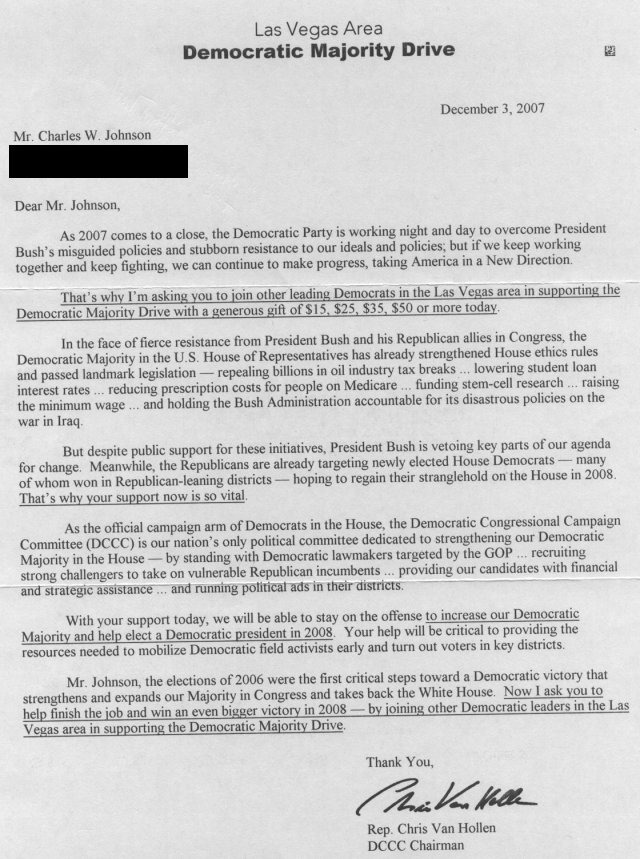
Saturday I got a letter from the Las Vegas Area Democratic Majority Drive, an attempt by the Democratic Congressional leadership–which already has a majority but has been doing nothing or worse with it–to drum up money for an even bigger do-nothing majority through the Democratic Congressional Campaign Committee. Here’s the letter I got:

From the Las Vegas Area Democratic Majority Drive

Dear Mr. Johnson,

As 2007 comes to a close, the Democratic Party is working night and day to overcome President Bush’s misguided policies and stubborn resistance to our ideals and policies, but if we keep working together and keep fighting, we can continue to make progress, taking America in a New Direction.

That’s why I’m asking you to join other leading Democrats in the Las Vegas area in supporting the Democratic Majority Drive with a generous gift of $15, $25, $35, $50 or more today.

In the face of fierce resistance from President Bush and his Republican allies in Congress, the Democratic Majority in the U.S. House of Representatives has already strengthened House ethics rules and passed landmark legislation–repealing billions in oil industry tax breaks … lowering student loan interest rates … reducing prescription costs for people on Medicare … funding stem-cell research … raising the minimum wage … and holding the Bush Administration accountable for its disastrous policies on the war in Iraq.

But despite public support for these initiatives, President Bush is vetoing key parts of our agenda for change. Meanwhile, the Republicans are already targeting newly elected House Democrats — many of whom won in Republican-leaning districts — hoping to regain their stranglehold on the House in 2008. That’s why your support now is so vital.

As the official campaign arm of Democrats in the House, the Democratic Congressional Campaign Committee (DCCC) is our nation’s only political committee dedicated to strengthening our Democratic Majority in the House–by standing with Democratic lawmakers targeted by the GOP … recruiting strong challengers to take on vulnerable Republican incumbents … providing our candidates with financial and strategic assistance … and running political ads in their districts.

With your support today, we will be able to stay on the offense to increase our Democratic Majority and help elect a Democratic president in 2008. Your help will be critical to providing the resources needed to mobilize Democratic field activists early and turn out voters in key districts.

Mr. Johnson, the elections of 2006 were the first critical steps toward a Democratic victory that strengthens and expands our Majority in Congress and takes back the White House. Now I ask you to help finish the job and win an even bigger victory in 2008–by joining other Democratic leaders in the Las Vegas area in supporting the Democratic Majority Drive.

Thank You,

Rep Chris Van Hollen
DCCC Chairman

I marked the enclosed contribution form $0.00 and referred them to this enclosed letter, which I mailed them today, postage courteously paid by the D.C.C.C.

Rep. Chris Van Hollen
Chair, Democratic Congressional Campaign Committee
P.O. Box 96039
Washington, DC 20077-7243

Dear Rep. Van Hollen:

Yesterday I received a direct mail solicitation from you as part of the Las Vegas Area Democratic Majority Drive, asking me to donate money to the D.C.C.C. I am writing to inform you that, under the present conditions, I cannot donate in good conscience, and I have joined a Democratic Donor Strike against both the D.C.C.C. and the D.S.C.C. (http://www.democrats.com/donor-strike-2007).

While I have contributed both votes and campaign donations to Democratic candidates in the past, I have been deeply disappointed by the refusal of Democratic leadership and the Democratic-controlled Congress to live up to the promises that brought them into the majority in the 2006 elections. In your fund-raising letter, you write that the Democratic Party is working night and day to overcome President Bush’s misguided policies, and claim that the Congressional Democrats have already been holding the Bush Administration accountable for its disastrous policies on the war in Iraq. But under the control of Democrat Nancy Pelosi in the House of Representatives and Democrat Harry Reid in the Senate, the Democratic Congressional leadership has repeatedly shown, by its actions, that either it agrees with the Bush administration’s misguided policies, or else will do nothing to check them. For example, every penny of funding for the catastrophic war on Iraq must be approved by the Democratic Congress, and if you refuse to continue funding the war, President Bush has no power to continue it. Yet the catastrophic war in Iraq rages on because Congressional Democrats have supported Bush’s demands for unconditional and unlimited emergency funding to continue this appalling war over and over again. They have faced no fierce resistance from President Bush and his Republican allies in Congress, because they continue to capitulate to every demand of Bush and the Republican war hawks. That is not even a failure; it is complicity.

In light of the Democratic leadership’s actions, I will not support, or donate money to, either the D.C.C.C. or the D.S.C.C., under any conditions, unless and until the Democratic-controlled Congress stands up to the Bush administration and accomplishes these four goals:

  1. Restricting any new Iraq funds to a safe and immediate withdrawal of U.S. troops—not another penny for occupation or the Bush-Maliki enduring security guarantees;

  2. Passing legislation explicitly prohibiting any use of funds to plan or execute a pre-emptive attack on Iran, and repealing the post-9/11 Authorization of Use of Military Force that Bush and Cheney believe authorizes them to attack Iran or any other country they please, as well as to wiretap all our calls and emails without warrants;

  3. Fully restoring key civil liberties by strictly outlawing warrantless wiretapping and torture, closing Guantanamo, and restoring habeas corpus;

  4. Completing the investigation of White House crimes by using inherent contempt to compel testimony by current and former White House officials

If my help will be critical, as you claim in your letter, then I urge you and your fellow Democrats in Congress to make that help possible by demonstrating your commitment to these four goals. And I mean demonstrating your commitment by deeds, not by words. You can begin immediately by refusing to allow Congressional Republicans to attach tens billions of dollars in unconditional funding for the war on Iraq to the 2008 defense budget. I urge you to do so.

Sincerely, etc.

No union with war-mongers, spiritually or politically.

And I heard another voice from heaven, saying, Come out of [Babylon], my people, that ye not be partakers of her sins, and that ye receive not of her plagues.

— Revelation (KJV), 18:4

Our boys in uniform

Perhaps it makes me an anti-American scumbag to point this out, but I don’t especially support these efforts by lying creeps and transphobic adolescent Internet trolls in uniform to protect my freedom:

US military personnel at Guantanamo Bay called Fidel Castro a transsexual and defended the prison for terrorism suspects in anonymous web postings, an internet group that publishes government documents said today.

The group, Wikileaks, tracked web activity by service members with Guantanamo email addresses and also found they deleted prisoner identification numbers from three detainee profiles on Wikipedia, the popular online encyclopedia that allows anyone to change articles.

Julian Assange, who led the research effort, said the postings amount to propaganda and deception.

This is the American government speaking to the American people and to the world through Wikipedia, not identifying itself and often speaking about itself in the third person, Assange said in a telephone interview from Paris.

Army Lt Col Ed Bush, a Guantanamo spokesman, said there is no official attempt to alter information posted elsewhere but said the military seeks to correct what it believes is incorrect or outdated information about the prison.

Bush declined to answer questions about the Castro posting.

Assange said that in January 2006, someone at Guantanamo wrote in a Wikipedia profile of the Cuban president: Fidel Castro is an admitted transexual, the unknown writer said, misspelling the word transsexual.

The US has no formal relations with Cuba and has maintained its base in the south-east of the island over the objections of the Castro government.

Comments on news stories were posted by people using apparently fictitious names to news sites–and were prepared by the Guantanamo public affairs office, according to Wikileaks.

A comment on a Wired magazine story about a leaked Guantanamo operations manual that was recently posted on the Wikileaks website urged readers to learn about Guantanamo by going to the public affairs website, adding that the base is a very professional place full of true American patriots.

— The Age (2007-12-16): Gitmo troops vandalise Wikipedia

(Via Dan Clore (2007-12-13) on LeftLibertarian2.)

Alexander Hamilton and the birth of American state capitalism

The most recent issue of the Boston Review has an interesting article from William Hogeland on Alexander Hamilton and his recently-acquired fan club among the court intellectuals of the Beltway Consensus — with Hamilton’s recent biographers and neo-conservativecreepy spendthrift fascist David Brooks at the fore. The article is almost entirely right-on; here’s one of the most important parts, on the political economy that was brought forth in the early Constitutional period, through the ministrations of the newly empowered central government:

David Brooks, for his part, embraces the thrust of Hamilton's finance plan, writing that Congress's decision to fund the federal debt at Hamilton's urging formed the basis of the fluid capital markets that are today the engine of world capitalism. The quick-and-dirty textbook version is that Hamilton gave the country sound credit. What that means is rarely made explicit: the first treasury secretary found ways to support, at all costs, the federal bondholders whom he and Morris had been frustrated in supporting in the 1780s. In 1791 Hamilton finally got the U.S. Congress to commit to paying reliable interest on its debt instruments, halting both their face-value depreciation and the free-for-all speculation in them, making them articles of rational trade in high-finance marketplaces. (Following British models, Hamilton also used proceeds of the U.S. Post Office to create a sinking fund; such funds were dedicated to paying down each issuance of a public debt, making bonds reliable.) Hamilton's idea, bold and creative, was to let the government get its hands on easy money by letting bondholders and traders grow American fortunes lending that money.

Brooks also associates Hamilton's authorship of modern capitalism with what historians call assumption: Hamilton persuaded Congress to assume the states' war debts in the federal one, thus swelling the federal obligation to massive proportions. But that idea wasn't original with Hamilton, and by overlooking its history Brooks and other Hamiltonians obscure its purposes. Robert Morris too had wanted the Confederation Congress to assume state debts, placing all public debt in federal hands and making it so big that federal taxes would have to be levied to pay interest on it. That dream came true when the U.S. Congress, having agreed to assume state debts, ran up a deficit, as Hamilton was happy to report in December of 1790.

A new tax, Hamilton told Congress, was the only way to solvency. He proposed not only expanding duties on imports (the old, embattled impost had finally been passed in the first session) but far more significantly, he urged Congress to impose the first federal tax on an American product. Just as Morris had hoped, assumption of state debts had become the wedge for opening the purses of the people, enforcing domestic federal taxation to support federal bondholders. In fact, passing a federal domestic tax (on distilled liquor, a fact that has helped obscure its real purpose) was so important that in the first funding proposal he submitted to Congress Hamilton appended a fully drafted bill. It was characteristically Hamiltonian (and reminiscent of health-care-reform-era Hillary Clinton), replete with distilling and tax-policy minutiae and overwhelmingly, even patronizingly, thorough, with every loophole closed, every question pre-answered, every problem sure to be caused by Congress's financial ineptitude solved. The bill was controversial, and Hamilton's patience must have been tried when Congress, seeming to bumble, passed funding and assumption yet ignored the whiskey tax—the brilliant law that would pay for them. But he was becoming a politico. In reporting the deficit, he calmly referred Congress back to the tax law he'd already written for them almost a year earlier. They were politicos too. They passed it—now that they had to—almost unmodified.

The structure of that tax sharply qualifies assertions made by Brooks and others that Hamilton wanted government power to enhance opportunity, mobility, and democracy. The reasons Hamilton gave Congress for going beyond a foreign impost and imposing domestic taxation are telling, both for what he said and for what he left unsaid. In the same 1790 report Hamilton reminded Congress that merchants, naturally, paid import duties, and that since merchants had always been the class most committed to American nationhood, taxing them further would be onerous and disaffecting; hence the need for a new tax not on imports but on a domestic product. What he did not explicitly point out was that the merchant class was also the bondholding class: they'd long been nationalists because federal power—the very kind Hamilton was wielding now—had long seemed to be where their interest lay. Today we might expect investors to be content with steady, tax-free income (there was, of course, no income tax). For Hamilton, shoring up and concentrating bondholders' wealth meant paying that income with funds drawn not from the small bondholding class but from a tax collected from the large class of people who would never own a bond. And he structured the tax around aspects of the distilling process itself, so that big-time distillers (industrialists, members of the bondholding class) would be charged a lower tax while small-time producers (people engaged in a wide variety of work as farmers and artisans, with whiskeymaking often their sole source of cash and credit) would be charged a substantially higher tax, in many cases a crushing one. It was no accident. The bill was modeled on a series of whiskey taxes passed by British governments. Driving small and occasional producers out of business served imperial economic aims of efficiency and consolidation. In the same year that Congress passed Hamilton's whiskey tax, the Irish Parliament stopped merely dis-incentivizing small distilling, and made it illegal to operate a still of less than 500-gallon capacity.

Hamilton wanted to turn the country into an efficient global competitor. As he would argue before Congress in his famous 1791 Report on Manufactures (which was far less successful than his funding plan but just as eager to stun all comers with its depth of research on hemp, nails, hats—wool hats, fur hats, and also fur-and-wool hats—and so on), labor power should not be dissipated in small, generalist farms and one-man artisan shops but efficiently marshaled, stabilized, and deployed on commercial farms and in factory towns like the one he founded in Paterson, New Jersey. And of course he wanted to use federal power to achieve that national vision.

The effect of the whiskey tax was precisely to render American distilling efficient through consolidation bordering on cartelization: even as the tax threatened to ruin small producers, Hamilton busily restructured army buying practices to make it impossible for small distillers to sell to army commissaries. In western Pennsylvania, where small distillers had managed to gain an economic toehold, Hamilton went even further: he made the region's richest, largest-scale distiller the federal tax collector. Paid both a federal salary and a commission on what he took from his less successful neighbors, and charged with enforcing the federal tax that directly benefited his business, this distiller/collector had close relatives—again, federally commissioned, correspondents of both Hamilton and Washington—in the commissary office of the local army post. Business was sewn up.

Brooks routinely characterizes Hamilton's use of federal power as intended to spur competition and furnish opportunity. But the control of business near the Ohio headwaters by a government-connected family and its pals was a direct consequence of Hamilton's policy, and it was anything but unintended. Government is really bad at rigging or softening competition, Brooks has written by way of praising Hamilton's economic policies. Yet the rigging inherent in Hamilton's tax aggravated ordinary people's existing problems. Farmers and artisans who were losing their weak grip on economic well-being and falling into foreclosure, as federally connected commercial farmers, Eastern real-estate speculators, and entrepreneurs in brick, glass, iron, and other rising industries—the sort Hamilton always said he wanted to promote—bought up more and more of the best Western land. Descendants of the pioneers who had cleared the land found themselves working as day laborers in the factories of their creditors, which was anything but a bleak outcome by Hamilton's reckoning.

Thus did the first federal domestic tax—linchpin to Hamilton's finance plan, culmination of nationalists' decade-long efforts to unite the country, first step in making the American economy a global competitor—operate regressively, comprehensively, and deliberately. Its avowed purpose of wealth concentration and industry consolidation was intended to restructure the country along the modern American lines now hymned by so many neo-Hamiltonians. Such extreme and systemic results can't be what Jason Bordoff and others at the Hamilton Project mean to support by invoking Hamilton's legacy. But it is what Morris meant by opening the people's purses, and it's what Congress made law, at Hamilton's behest, in 1791.

In his June 8 column, Brooks pits his Hamiltonians against modern populists who want, he says, to fundamentally rewrite the rules and obstruct policies they see as benefiting only the rich. He would brand as populists the many former foot soldiers of the Revolution who rose up against the whiskey tax—the so-called whiskey rebels. To them, American independence now seemed to have been gained for the exclusive benefit of a military-industrial cartel run by and for the privileged and staffed by the well-connected. Western Pennsylvania populists wanted a fair shot at modern America too. They wanted access to cash and credit. They wanted to grow their businesses. They were not anti-tax. They were against taxes that straitjacket markets, restrict opportunity, reduce competition, punish small operators, cripple local economies, and offer government cronies bonanzas at the direct expense of other citizens. Most important, they were against what they called taxes that don't operate in proportion to property.

At least that's what they said they were against, in published resolutions, letters, and petitions. Brookhiser and Chernow caricature them as drunk hillbillies (Brookhiser) whom scholars study merely because they are colorful (Chernow). But the essential fact remains that, during the nation's formative years, the explicit idea that an essential promise of republican democracy lies in fostering opportunities for economic advancement and upward mobility is found not in Hamilton's funding plan, but in the resolutions of the ordinary people who became whiskey rebels.

So how have neo-Hamiltonians managed to remake Hamilton in their own image, diminishing his outrageous charisma and ruthless political intelligence in the process?

One way today's Hamiltonians connect their hero's economics to the American Dream is through the needle's eye of his disadvantaged background and remarkable success. Hamilton came from nothing, Brooks wrote in his New York Times Magazine piece, and spent his political career trying to create a world in which as many people as possible could replicate his amazing success." Or, as one of the PBS talking heads informs viewers, Hamilton believed that "if you worked hard, you should get ahead.

It's more likely that Hamilton believed exceptional, bright boys like him should erupt like meteors across the night sky. Blending creative genius with an almost mad degree of thoroughness and tenacity, he strove to dominate everyone he encountered, a quality that brought enormous success but also marred his life and may have shortened it. The idea that Hamilton spent his career trying to create conditions for replicating such a rise seems fantastic. One searches his letters and public statements in vain for thoughtful reflection on ordinary families' economic struggles or respect for their goals and hopes for their children's betterment. He is unconcerned about using government power to encourage the rise of laborer's descendants and would not have related upward mobility to democracy—a dirty word to Hamilton.

Brooks cites remarks from Report on Manufactures as evidence of Hamilton's hope that people would advance socially by moving from agrarian scatteredness to industrial centralization. When all the different kinds of industry obtain in a community, Hamilton argued, each individual can find his proper element. He also defined as a goal of industrial policy to cherish and stimulate the activity of the human mind, by multiplying the objects of enterprise. Where many founders were farmers and planters, Hamilton (like Franklin and Samuel Adams) was an urbanite, and he made an appealing case for the creative synergy to be found in cities. He certainly wanted people mobile enough to get off the farm, out of the artisan shop, and into the mill, and he had a forward-looking fondness, at once emotional and practical, of encouraging meritocracy over aristocracy in responsible government positions.

But it is a feat of intellectual acrobatics to ascribe to Hamilton, on the basis of these remarks, a broad policy of encouraging, much less sustaining, widespread upward social mobility through hard work among succeeding American generations. For Hamilton, the hard work/get ahead equation, which revivalists want to call a democratic legacy, applied only to the sort of people he deemed it wise to encourage. He had cogent national and financial reasons for carefully dismantling the few ways—which already involved manufacturing and selling—that people had of getting ahead. They involved consolidating land, money, opportunity, and power in the West, while obstructing both mobility and democracy. He was explicit about this.

Chernow, straining to detect Hamilton's sympathy for the impossible difficulties faced by the debtor class, misreads a minor Federalist essay, number six. He suggests that Hamilton felt sorry for Daniel Shays, leader of a 1787 debtor uprising in Massachusetts, arguing that federal assumption of state debts was intended to relieve small-farming debtors. While it's true that Hamilton objected to vacillations from leniency to aggressiveness in Massachusetts finance policy, his essay as a whole makes clear his disdain for the vaunting ambition and criminal tendencies of all such as Shays, on whom he lays personal blame for the anti-creditor movement sweeping the western part of the country, the real basis and wide scope of which Hamilton always impatiently declined to acknowledge.

To the extent that he thought about it at all, Hamilton wanted people to stop talking nonsense about their own economic aspirations and get ahead his way and his way alone, by becoming efficiently organized laborers and farm workers for the financiers and industrialists. If people wouldn't do that, he'd make them.

— William Hogeland (2007), Inventing Alexander Hamilton, in Boston Review (November/December 2007)
Anticopyright. All pages written 1996–2026 by Rad Geek. Feel free to reprint if you like it. This machine kills intellectual monopolists.