Few groups of people in America today produce as much mythistorical bunk as the Religious Right, and few people are victimized by their distortions than the so-called Founding Fathers
. In order to manufacture the unitary conservative Christian heritage for America that they pin their nationalist mythistory on, Christian fundamentalists routinely repeat cherry-picked quotes or outright fabrications in order to distort the religious views of the Founders. Another favorite target is the notion of separation between Church and State
: the Religious Right has spent the past few decades trying to manufacture a historical-legal account on which (1) when the Founders wrote the First Amendment, they did not intend for it to enact anything like what we now call separation between Church and State
, and (2) that this notion, completely alien to the Constitution, was invented by activist judges
. Here, for example, is a typical presentation of the doctrine, by Stephen Erwin in The Rule of Law (2004-01-12):
Judge Moore held in his Eleventh Circuit Court appeal that the
First Amendment bans any law respecting (regarding) an
establishment of religion.
The judge correctly points out that
because of its no law
language, the First Amendment proscribes
only laws
and his monument was not a law. The Eleventh Circuit
totally failed to provide a reasonable explanation of how or why
his position was wrong. Their only answer was to say that precedent
(state decisis) requires separation of church and state
and to
express horror that if we adopted his position, the Chief Justice
would be free to adorn the walls of the Alabama Supreme Court’s
courtroom with sectarian religious murals and have decidedly
religious quotations painted above the bench. Every government
building could be topped with a cross, or a menorah, or a statue of
Buddha, depending upon the views of the officials with authority
over the premises. A crèche could occupy the place of honor
in the lobby or rotunda of every municipal, county, state, and
federal building.
These judges have completely forgotten that an independent and
impartial judge is bound to interpret the law and let the
legislature correct any problems that may result from a fair
interpretation of that law. Political correctness is simply not
within the official purview of our courts.
The separation of church and state
is a concept that is not found
anywhere in the Constitution. It is just one of many red t-shirts
invented by our courts. And as long as we allow our imperial
judiciary to ban red t-shirts there will be no legitimate rule of
law.
Now, let’s set aside for a moment the non sequitur involved in the argument that the actions of a government employee funded by legislatively-appropriated tax dollars somehow sidestep the First Amendment’s concern with the laws
passed by the legislature. There’s an argument to be had about the specifics of Roy Moore’s case, but that’s an argument I’ve already had elsewhere. What I want to focus on here is the historical-legal story underlying its application to the specific case; and for a Religious Rightist wanting to push some theocratic public display or another, it is a handy little historical-legal story indeed. For one, it allows the Rightist to construct a poignant tale of historical decline from our lofty origins. For two, it lets the myth-makers get into their favorite pose as myth-busters; many people do seem to be under the mistaken impression that the phrase separation between Church and State
appears in the First Amendment, and the Religious Rightist can point out that it doesn’t. Finally, it their Constitutional prooftexting allows them to ascribe the last few decades of First Amendment case law entirely to the malign influence of Activist Judges, the most devious fiends in the Religious Right demonology. The problem is that the story is false on several points and deceptively selective on others.
Now, Erwin and other conservative Christians are right to point out that separation between Church and State
is a phrase that does not appear anywhere in the U.S. Constitution, and never has. This is what the First Amendment actually says:
Amendment I
Congress shall make no law respecting an establishment of religion,
or prohibiting the free exercise thereof; or abridging the freedom
of speech, or of the press; or the right of the people peaceably to
assemble, and to petition the government for a redress of
grievances.
 What exactly
mak[ing] no law respecting an establishment of religion
means might not be entirely clear at first glance. One way to cash it out would be separation between Church and State
. But that’s not necessarily the only possible interpretation of the text, and the Religious Rightist is right to want to know where this principle was introduced from, if judges are going to go around using it in their legal reasoning. But the problem is that, contrary to the claims of Erwin and other conservative Christians, the principle does not originate from some activist judge
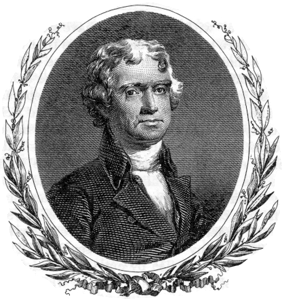
toiling to undo our national piety in the middle of the 20th century. The phrase comes from no less an authority on the founding documents than Thomas Jefferson, who explicitly offered it as his understanding of the First Amendment’s provisions in a letter to Danbury Baptist Church in 1802:
Believing with you that religion is a matter which lies solely
between Man & his God, that he owes account to none other for
his faith or his worship, that the legitimate powers of government
reach actions only, & not opinions, I contemplate with
sovereign reverence that act of the whole American people which
declared that their legislature should make no law respecting an
establishment of religion, or prohibiting the free exercise
thereof,
thus building a wall of separation between Church
& State.
–Thomas Jefferson, Letter to the Danbury Baptists, 1 January 1802
(As a historical side-note, Jefferson’s letter was meant to reassure the Danbury Baptists that the Federal government had no power to regulate religious expression; the Baptists in America during the Founding generation were among the leading crusaders for complete separation of Church and State. Oh how things change in this fallen world!)
Of course, it’s true that Jefferson was not the author of the First Amendment. That’s true; but he did coin the phrase specifically to explain what he understood the First Amendment to mean. And it would be hard to say that Jefferson was not in at least as good, or better, of a position to know what the people who did write the First Amendment (including friends and colleagues such as James Madison) meant by it than Stephen Erwin, ex-Chief Justice Roy Moore, and others who decry the separation doctrine are. Furthermore, Jefferson was the author of the Virginia Statute for Religious Freedom, which the establishment clause and the free-exercise clause of the First Amendment were derived from. Whatever the merits or demerits of judicial activism
may be, the wall of separation
is not an example of it; it is a gloss of the First Amendment first introduced by one of the most prominent of the Founders, who was in a very good position to claim some authority on what the proper meaning of the First Amendment was.
Now there’s a second line of attack that some Religious Rightists have pushed (Alan Keyes, in particular), with a bit more justice: some have pointed out that the First Amendment explicitly restricts only Congress (meaning the Congress of the United States); and that even if the First Amendment did impose a wall of separation between Church and State in the federal government, it was not understood, by Jefferson or anyone else at the time, to have anything to say about how state governments could conduct their affairs. Yet most of the modern applications of the separation doctrine are rulings on state governments–e.g. on state laws requiring prayer in government schools or on the actions of state judges such as ex-Chief Justice Roy Moore. So how does the modern legal doctrine of separation relate at all to what Jefferson meant by the phrase?
Now let’s be straight: the fundamentalists are right that when the First Amendment was written, it was understood to constrain only the federal government. State governments were widely understood to have the right to establish churches and pass laws restricting the free exercise of religion. (Congregationalist Massachussetts, for example, had an established church from the adoption of the Constitution up to 1833.) But so what? For one, the much-lamented activist judges
do not, and very obviously do not, enforce the separation doctrine on the states on the basis of the First Amendment alone. The legal reasoning behind decisions such as Engel v. Vitale was based on the First Amendment together with the Fourteenth Amendment, which says (among other things):
Amendment XIV
Section 1. All persons born or naturalized in the United States,
and subject to the jurisdiction thereof, are citizens of the United
States and of the state wherein they reside. No state shall
make or enforce any law which shall abridge the privileges or
immunities of citizens of the United States; nor shall any
state deprive any person of life, liberty, or property, without due
process of law; nor deny to any person within its jurisdiction the
equal protection of the laws.
One plausible reading of the emphasized portion is that the Fourteenth Amendment extends the protections granted to citizens of the United States in the Bill of Rights to include protection from violations by state as well as the federal government. Maybe that reading of the Fourteenth Amendment is inaccurate; but if the Religious Right wants to make that claim they are going to have to give some substantive argument against it, rather than deceptively pointing to the text of the First Amendment, as if that were the only part of the Constitution in question.
In any case, whether the incorporation doctrine is a good reading of the Fourteenth Amendment or not, there is another point on which the Religious Rightists’ arguments here are deceptive. It’s true that Jefferson and his compatriots only understood the First Amendment to constrain the federal government. But the package-dealed suggestion that they didn’t have any problem with state-level breaches of the wall of separation
is plainly false. Jefferson may have believed that the First Amendment only imposed a wall of separation between the church and the federal government, but that does not mean that he didn’t think that the same separation shouldn’t be effected elsewhere. Jefferson, for example, drafted the state law that disestablished the Anglican Church in Virginia and James Madison ensured that it would be passed by the state legislature. Several other states also disestablished their churches around the time of the Revolution; even the late hold-outs such as Massachussetts eventually concluded that separation was a doctrine whose time had come, and had eliminated the last vestiges of established churches in America by the early 19th century. Jefferson did not think that the wall of separation between Church and State
was a merely legal principle; he and many of his fellow Founders thought it was a moral principle that ought to apply to every level of government whatever, and they actively campaigned to get it so applied. As he eloquently put it in the Virginia Statute:
That to compel a man to furnish contributions of money for the
propagation of opinions which he disbelieves and abhors, is sinful
and tyrannical; that even the forcing him to support this or that
teacher of his own religious persuasion, is depriving him of the
comfortable liberty of giving his contributions to the particular
pastor whose morals he would make his pattern, and whose powers he
feels most persuasive to righteousness; and is withdrawing from the
ministry those temporary rewards, which proceeding from an
approbation of their personal conduct, are an additional incitement
to earnest and unremitting labours for the instruction of mankind;
that our civil rights have no dependence on our religious opinions, any more than our opinions in physics or geometry; …
And though we well know that this assembly elected by the people
for the ordinary purposes of legislation only, have no power to
restrain the acts of succeeding assemblies, constituted with powers
equal to our own, and that therefore to declare this act to be
irrevocable would be of no effect in law; yet we are free to
declare, and do declare, that the rights hereby asserted are of the
natural rights of mankind, and that if any act shall be hereafter
passed to repeal the present, or to narrow its operation, such act
shall be an infringement of natural right.
Amen, brother.
The separation between Church and State
was not a bit of judicial hokum cooked up in the head of some activist judge
somewhere around 1962. The Founders really did intend for there to be a wall of separation between Church and State, and they did what they could to put the masonry up. Jefferson was wrong about many things in his life, but he was right about this.
 To put things mildly, there’s just not a hell of a lot that you can say our