Rad Geek People's Daily

official state media for a secessionist republic of one

"Winning the Peace"

I think it is high time that we took a minute to consider how history will remember the present administration and how it treated the men and women who it sent to fight and die overseas. Many people have publicized the Bush administration's callous assaults on veterans' benefits and pay--and it's very important to keep that in mind. But what about the simple fact that the Bush administration has simply left hundreds of thousands of soldiers to die, one by one in terror attacks, so that he could unleash an illegal, pointless war, and a disastrous, hated occupation?

Conventional wisdom is finally starting to come around; even mainstream media and Democratic Presidential hopefuls are now daring to utter mild criticisms of the senseless bloodbath into which King George has led us. But they still don't quite get it. The standard story that keeps being repeated from the liberal side is now: O.K., so the war was wrong and we never should have blundered into Iraq. But now that we're there, we have to stick it out and continue the occupation until some unspecified date in the future, when we're satisfied with how Iraq looks and can finally cut out.

John Kerry, for example, has this to say:

(from Iraq - Winning the Peace on the John Kerry Campaign Website)

We can and should protect our troops and we can and should meet our obligations in Iraq. But America can and must do better.

. . .

John Kerry's plan will show that we understand real partnership by reaching out to our allies, rebuilding international good will, and asking the UN to do what it has done well from Kosovo to East Timor by putting Iraqi governance and reconstruction under UN authority. It's not necessary for the U.S. to go it alone on rebuilding Iraq's institutions and meeting humanitarian needs - and we shouldn't have to.

And so on, and so forth. The idea is that Iraqis are basically imbeciles who cannot be trusted to establish a prosperous and free society unless the United States miliary and U.N. forces (of all people!) hang around to lecture them about how to do it. The idea is also that we have to leave our soldiers to die and leave the Iraqis under the jackboots of military occupation until we can claim that we've managed to win the peace. That way, we won't ever have to admit that we made a mistake, and that it cost the lives and freedom of many, many innocent Iraqis, as well as the senseless death of hundreds (perhaps thousands, by the time this is over) of U.S. troops.

It's a bunch of damned rubbish, of course, it's a bunch of damned rubbish that we ought to have the wisdom and the historical memory by now to recognize. Here's how the view was skewered by--well--John Kerry, when he was younger and wiser:

(from Modern History Sourcebook: Vietnam Veterans Against the War Statement by John Kerry, 1971)

Now we are told that the men who fought there must watch quietly while American lives are lost so that we can exercise the incredible arrogance of Vietnamizing the Vietnamese.

Each day to facilitate the process by which the United States washes her hands of Vietnam someone has to give up his life so that the United States doesn't have to admit something that the entire world already knows, so that we can't say that we have made a mistake. Someone has to die so that President Nixon won't be, and these are his words, the first President to lose a war.

We are asking Americans to think about that because how do you ask a man to be the last man to die in Vietnam? How do you ask a man to be the last man to die for a mistake?

Happy Veteran's Day.

Copyleft and Copyright: The Prospects for Liberty

Minor updates have been made to the original post for clarity and removal of typographical errors.

  • (CC) Attribution
  • (CC) Share Alike

You may or may not have noticed it already, but there's been a bit of a change around here at Geekery Today. I'm proud to announce that recently I freed the content on these pages through a copyleft. What that means is that you can, except where I note otherwise, copy and distribute any of the works on this website, and you can also make and distribute derivative works based on them. What's the catch? Only that the copies or derivative works you produce have to be honest, and they have to stay free. The copyleft license is the Creative Commons Attribution-ShareAlike 1.0 license, which requires that the original author must be given credit, and that any derivative works or reuse of the original work must also be distributed under the terms of the copyleft. (For more exact details, see the copyleft notice.)

Of course, I'm not anywhere near conceited enough to think that there's any great demand for reproductions or derivative works based on my pedantic ramblings. My motives are much more ideological than that: I've done this because I don't believe that there are any such things as intellectual property rights; I don't think it's possible to enforce copyright law without violating the rights of ordinary people to make peaceful use of good old-fashioned tangible property, such as pens and computers and your own brain. (If you want a good argument about why this is the case, I don't have one on hand. Fortunately enough, Roderick Long does, in brief in Thoughtcrime, and at more length in The Libertarian Case Against Intellectual Property Rights. Thank goodness for the free exchange of information!) In short, intellectual property restrictions are nothing more than State aggression on a massive scale. Worse still, they're a form of State aggression that is getting worse every day, and, increasingly, violently stifling innovation and the progress of civilization.

In light of all this, you might think that I've chosen a rather odd means to my ends--trying to fight back against intellectual monopolists by placing my works under a restrictive licensing scheme that depends upon international copyright law. In fact, it's not nearly as odd as it might initially seem. Saying that copyright laws are illegitimate is not the same as saying that nothing it's currently used for is legitimate. It just means that none of its legitimate uses are legitimate because of a right to control your intellectual property.

For example, say that you write a brilliant philosophical essay, and send me a copy for feedback. I put white-out over your name, write my name in, and send it off to Mind. Have I done something wrong? Well, certainly—what I did was dishonest and mean. More to the point, have I done something criminal? Well, yes. But it's not because I've violated some right to control "intellectual property." Rather, it's because I've committed fraud—I've passed something off as my work when it is in fact yours. There's no need to talk about "intellectual property rights" to deal with this, any more than there is to deal with someone who sells TofurkeyTM as Thanksgiving turkey (or vice versa).

So what about a copyleft? Well, the terms of the license allow for free copying, distribution, performance, and creation of derivative works, without having to ask the permission of the author. So putting up a copyleft is not a restrictive use of intellectual property law; it's a statement of the author's intent not to use intellectual property law in aggression against peaceful reuse or creation of derivative works.

Of course, the license does add two restrictions: first, copies and derivative works have to accurately credit the original author for her work, and second, copies and derivative works also have to be distributed as free content under the terms of the copyleft.

The first restriction, however, is just a restatement of the requirement that we considered above--that the users of the information cannot commit fraud. They can't pass off your work as somebody else's, and they can't pass off somebody else's work as your own.

The second restriction is where the real genius of copylefting lies. If anyone wants to reuse the copylefted content, they also have to free whatever they copy or produce from the restrictions of traditional copyright law. But the restrictions of traditional copyright law are unjust; since enforcing them constitutes a violation of rights, enforcing a copyleft to prevent them from being enforced is like using a gun to keep innocent people from being shot--a defensive, rather than an aggressive use of force. Copylefting reverses copyrighting from within, using the illegitimate power of the State against itself to undermine the arrogated power of intellectual monopolists.

It is worth noting, though, that copylefting didn't originate for use with the written content on webpages. It originated from the world of Free / Libre / Open Source Software. What I'm talking about here is a bit different from what they are talking about. Copylefting as I am deploying it deals with how information can be used once it is published; copylefting as it is deployed in the FLOSS world has to do with that, but it also makes specific requirements about what information should be published. GPL-style licenses allow for free reuse and modification of source code, but they require that any source code for these derived works be distributed under a copyleft. That's copylefting in the sense that I'm using it. But they go a step further: they don't just impose a restriction on how the source code is to be distributed if it is distributed; they also require that it actually be distributed. That's copylefting in a different sense. While enforcement of copyright law is a violation of rights, it's perfectly legitimate to choose to do whatever you please with your own copies of information. In world without copyright, Microsoft would still have every right to withhold their proprietary source code; a closed-source business model is not criminal.

Nevertheless, not being criminal isn't the same thing as not being wrong. Closed-source software doesn't violate anyone's natural rights, but it does suck. The reasons for using FLOSS are reasons of cultural politics: FLOSS is better than closed-source because it fosters innovative use of technology and high-quality, co-operative, participatory projects. It also provides affordable access to high-quality software for underprivileged users. None of these are matters of justice (except in the extended sense of fairness or equity); but justice is not the only virtue.

In short, copylefting, or freeing content can mean one of two things. It can mean freeing information users to make whatever peaceful use they like of the copies they already have. Or it can mean making copies more freely available for information users to make innovative, peaceful uses. I think that only the first goal is enforceable; but both goals are desirable. This connects with a point that I have often made about the relationship between anarcho-capitalism and anarcho-socialism. The first sort of free content has to do with the virtues of a free market: it is a matter of the form of a free society, i.e., that the organization of society must be free rather than coerced. The second sort of free content has to do with the virtues of open, participatory institutions within the free market: it is a matter of the content of a free society, i.e., the specific organizations that people ought to choose to freely form.

Fair and Balanced

Last Friday L. and I met up with some friends to go see Michael Moore, who was giving a talk in Ypsilanti. It was hilarious of course--with a protesting delegation of the Young Americans for Freedom providing spreading some unintentional extra humor outside. One of the best points that Mike made during the night was his briefly mentioning how Al Franken had succeeded where so many other liberal and Leftist commentators had failed: taking down FOX News. It didn't happen through a bunch of whining and accusations of bias; it happened by telling the truth, making it funny, and then using their own public belligerence to reveal what collosal asses they are. Now, FOX News is just a national joke. (Albeit still a very rich and high-rated national joke.)

Of course, that doesn't mean that there's no role for a bit of whining and hectoring from time to time; dour pedantry provides a necessary base of information for uncovering the simple truths that wittier people tell. At least, that's what I tell myself to help justify my own project. In that spirit, I'd like to note the following:

(text from former FOX News employee Charlie Reina, link thanks to Tom Tomorrow)

The fact is, daily life at FNC is all about management politics. I say this having served six years there - as producer of the media criticism show, News Watch, as a writer/producer of specials and (for the last year of my stay) as a newsroom copy editor. Not once in the 20+ years I had worked in broadcast journalism prior to Fox - including lengthy stays at The Associated Press, CBS Radio and ABC/Good Morning America - did I feel any pressure to toe a management line. But at Fox, if my boss wasn't warning me to be careful how I handled the writing of a special about Ronald Reagan (You know how Roger [Fox News Chairman Ailes] feels about him.), he was telling me how the environmental special I was to produce should lean (You can give both sides, but make sure the pro-environmentalists don't get the last word.)

. . .

But the roots of FNC's day-to-day on-air bias are actual and direct. They come in the form of an executive memo distributed electronically each morning, addressing what stories will be covered and, often, suggesting how they should be covered. To the newsroom personnel responsible for the channel's daytime programming, The Memo is the bible. If, on any given day, you notice that the Fox anchors seem to be trying to drive a particular point home, you can bet The Memo is behind it.

The Memo was born with the Bush administration, early in 2001, and, intentionally or not, has ensured that the administration's point of view consistently comes across on FNC. This year, of course, the war in Iraq became a constant subject of The Memo. But along with the obvious - information on who is where and what they'll be covering - there have been subtle hints as to the tone of the anchors' copy. For instance, from the March 20th memo: There is something utterly incomprehensible about Kofi Annan's remarks in which he allows that his thoughts are with the Iraqi people. One could ask where those thoughts were during the 23 years Saddam Hussein was brutalizing those same Iraqis. Food for thought. Can there be any doubt that the memo was offering not only food for thought, but a direction for the FNC writers and anchors to go? Especially after describing the U.N. Secretary General's remarks as utterly incomprehensible?

The sad truth is, such subtlety is often all it takes to send Fox's newsroom personnel into action - or inaction, as the case may be. One day this past spring, just after the U.S. invaded Iraq, The Memo warned us that anti-war protesters would be whining about U.S. bombs killing Iraqi civilians, and suggested they could tell that to the families of American soldiers dying there. Editing copy that morning, I was not surprised when an eager young producer killed a correspondent's report on the day's fighting - simply because it included a brief shot of children in an Iraqi hospital.

These are not isolated incidents at Fox News Channel, where virtually no one of authority in the newsroom makes a move unmeasured against management's politics, actual or perceived. At the Fair and Balanced network, everyone knows management's point of view, and, in case they're not sure how to get it on air, The Memo is there to remind them.

Let me repeat a bit of that again:

They come in the form of an executive memo distributed electronically each morning, addressing what stories will be covered and, often, suggesting how they should be covered. To the newsroom personnel responsible for the channel's daytime programming, The Memo is the bible.

There is a story that, when Nixon made his historic trip to China in 1972, he and Kissinger watched as Zhou Enlai was presented with a folderful of papers, which he leafed through, and handed back with a nod. When Kissinger asked what had happened, the translator told him that Zhou had just approved the layout of the next day's People's Daily. Nixon, it is said, muttered, I'd like to rearrange a front page now and then.

Need I make the obvious point? Don't let anyone tell you that there's been no political progress in the past 30 years.

Roy Moore’s Lofty Brow

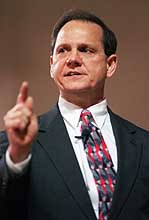
photo: Roy Moore

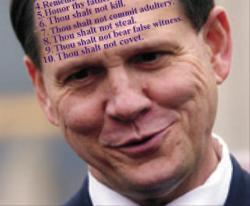
This is Roy Moore. Roy Moore recently got in trouble because he defied a federal court order to move a Ten Commandments monument that he placed in the rotunda of the Alabama Supreme Court building. Roy Moore is suspended from the Alabama Supreme Court, and is facing a trial from the Court of the Judiciary which could permanently remove him from the bench.

Roy Moore also has a huge forehead.

If Chief Justice Moore had only made use of his God-given endowments, he could have avoided this whole mess. He could have sidestepped the court battle by removing the Ten Commandments monument from the rotunda—and then having the Ten Commandments tattooed on his humongous forehead.

Wherever Roy Moore would go, the Ten Commandments would be there, showing forth the divine law from his lofty brow. The removal of the monument would satisfy the federal court order, but Roy Moore and his supporters would have the last laugh. No court could possibly rule that Roy Moore should be banned from sitting on the court because of a First Amendment-protected tattoo. And would even Judge Myron Thompson be so rude as to order that a gentleman cover his forehead with a hat while indoors? I think not.

Thank goodness that Roy Moore didn't recognize this in time. Here's to two months of freedom from theocratic rule in Alabama!

Blues for Dixie

Tomorrow--or, if you reckon it by the time of night when I'm posting this, today--I'm hopping on a Greyhound bound southward to Alabama for a weekend at the beach with L. You might find it a bit odd that I am bussing all the way down to Alabama for a weekend at the cold end of October; it might not seem so odd when I mention that our vacation is going to consist in going to the annual Alabama Philosophical Society conference in Orange Beach, Alabama.

For what it's worth, I'll be presenting a paper at the APS conference. It's an essay on the Liar Paradox and other related paradoxes of self-reference. I argue against traditional attempts to rule out the formulation of paradoxical sentences through the employment of syntactical rules; using Tarski's semantic conception of truth as a case study, I argue that the dream of a logical syntax leads either to overt ad hockery, or else systematic theories that go systematically wrong. In place of the syntactic method, I argue for a dialectical method of elucidations--rather than looking for prior syntactic rules, the right method is to explore the putative sentences and show how, even if they follow all the syntactic rules, they never succeed in doing propositional work. (To get a rough idea of the distinction, think of two different ways of talking about what goes wrong in a chess game. On the one hand, think of how you would react if someone tried to win by moving her bishop sideways: you would get out the rule book and point out the rule that specifies only diagonal moves as well-formed bishop moves. The syntactic method takes something like this picture as the model for deflating self-referential paradoxes: if you adhere rigorously to the syntactic rules of the formalism, there is no way for the paradoxical sentences to ever be formulated. The dialectical method, on the other hand, takes the matter to be more like moving your pieces into stalemate than like making an illegal move: all of the moves leading up to it are legal, and there's no single non-trival rule to tell you why you can't win from a stalemate. Rather, you realize that you are stalemated by trying out moves until you see that there's just no more chess to play.)

In any case, I'm really looking forward to the upcoming weekend: what could be better than a restful weekend at the beach, a vacation alone with L., and a quality philosophy conference all in one? (Disneyworld, eat your heart out.) Also, I'll get to head back to the South and spend a little time in Auburn again.

In related news, I won't be taking much time out of my vacation to post updates to the weblog. (You might protest that I don't take much time out of my work week or weekends to post updates, either. I haven't gotten back into the groove of regular posting yet, no. But mostly because I've been busy with a lot of updates to various parts of the website that aren't immediately visible in the form of weblog posts. I have a couple of posts in the queue that I'll polish up and post on my return, and hopefully I'll carry on from there.)

I hope you all have a wonderful weekend. Ciao!

Anticopyright. All pages written 1996–2026 by Rad Geek. Feel free to reprint if you like it. This machine kills intellectual monopolists.