
Rad Geek People's Daily

official state media for a secessionist republic of one

Fair and Balanced

Last Friday L. and I met up with some friends to go see Michael Moore, who was giving a talk in Ypsilanti. It was hilarious of course–with a protesting delegation of the Young Americans for Freedom providing spreading some unintentional extra humor outside. One of the best points that Mike made during the night was his briefly mentioning how Al Franken had succeeded where so many other liberal and Leftist commentators had failed: taking down FOX News. It didn’t happen through a bunch of whining and accusations of bias; it happened by telling the truth, making it funny, and then using their own public belligerence to reveal what collosal asses they are. Now, FOX News is just a national joke. (Albeit still a very rich and high-rated national joke.)

Of course, that doesn’t mean that there’s no role for a bit of whining and hectoring from time to time; dour pedantry provides a necessary base of information for uncovering the simple truths that wittier people tell. At least, that’s what I tell myself to help justify my own project. In that spirit, I’d like to note the following:

(text from former FOX News employee Charlie Reina, link thanks to Tom Tomorrow)

The fact is, daily life at FNC is all about management politics. I say this having served six years there – as producer of the media criticism show, News Watch, as a writer/producer of specials and (for the last year of my stay) as a newsroom copy editor. Not once in the 20+ years I had worked in broadcast journalism prior to Fox – including lengthy stays at The Associated Press, CBS Radio and ABC/Good Morning America – did I feel any pressure to toe a management line. But at Fox, if my boss wasn’t warning me to be careful how I handled the writing of a special about Ronald Reagan (You know how Roger [Fox News Chairman Ailes] feels about him.), he was telling me how the environmental special I was to produce should lean (You can give both sides, but make sure the pro-environmentalists don’t get the last word.)

. . .

But the roots of FNC’s day-to-day on-air bias are actual and direct. They come in the form of an executive memo distributed electronically each morning, addressing what stories will be covered and, often, suggesting how they should be covered. To the newsroom personnel responsible for the channel’s daytime programming, The Memo is the bible. If, on any given day, you notice that the Fox anchors seem to be trying to drive a particular point home, you can bet The Memo is behind it.

The Memo was born with the Bush administration, early in 2001, and, intentionally or not, has ensured that the administration’s point of view consistently comes across on FNC. This year, of course, the war in Iraq became a constant subject of The Memo. But along with the obvious – information on who is where and what they’ll be covering – there have been subtle hints as to the tone of the anchors’ copy. For instance, from the March 20th memo: There is something utterly incomprehensible about Kofi Annan’s remarks in which he allows that his thoughts are with the Iraqi people. One could ask where those thoughts were during the 23 years Saddam Hussein was brutalizing those same Iraqis. Food for thought. Can there be any doubt that the memo was offering not only food for thought, but a direction for the FNC writers and anchors to go? Especially after describing the U.N. Secretary General’s remarks as utterly incomprehensible?

The sad truth is, such subtlety is often all it takes to send Fox’s newsroom personnel into action – or inaction, as the case may be. One day this past spring, just after the U.S. invaded Iraq, The Memo warned us that anti-war protesters would be whining about U.S. bombs killing Iraqi civilians, and suggested they could tell that to the families of American soldiers dying there. Editing copy that morning, I was not surprised when an eager young producer killed a correspondent’s report on the day’s fighting – simply because it included a brief shot of children in an Iraqi hospital.

These are not isolated incidents at Fox News Channel, where virtually no one of authority in the newsroom makes a move unmeasured against management’s politics, actual or perceived. At the Fair and Balanced network, everyone knows management’s point of view, and, in case they’re not sure how to get it on air, The Memo is there to remind them.

Let me repeat a bit of that again:

They come in the form of an executive memo distributed electronically each morning, addressing what stories will be covered and, often, suggesting how they should be covered. To the newsroom personnel responsible for the channel’s daytime programming, The Memo is the bible.

There is a story that, when Nixon made his historic trip to China in 1972, he and Kissinger watched as Zhou Enlai was presented with a folderful of papers, which he leafed through, and handed back with a nod. When Kissinger asked what had happened, the translator told him that Zhou had just approved the layout of the next day’s People’s Daily. Nixon, it is said, muttered, I’d like to rearrange a front page now and then.

Need I make the obvious point? Don’t let anyone tell you that there’s been no political progress in the past 30 years.

Roy Moore’s Lofty Brow

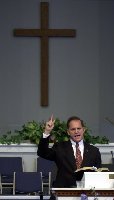
photo: Roy Moore

This is Roy Moore. Roy Moore recently got in trouble because he defied a federal court order to move a Ten Commandments monument that he placed in the rotunda of the Alabama Supreme Court building. Roy Moore is suspended from the Alabama Supreme Court, and is facing a trial from the Court of the Judiciary which could permanently remove him from the bench.

Roy Moore also has a huge forehead.

If Chief Justice Moore had only made use of his God-given endowments, he could have avoided this whole mess. He could have sidestepped the court battle by removing the Ten Commandments monument from the rotunda—and then having the Ten Commandments tattooed on his humongous forehead.

Wherever Roy Moore would go, the Ten Commandments would be there, showing forth the divine law from his lofty brow. The removal of the monument would satisfy the federal court order, but Roy Moore and his supporters would have the last laugh. No court could possibly rule that Roy Moore should be banned from sitting on the court because of a First Amendment-protected tattoo. And would even Judge Myron Thompson be so rude as to order that a gentleman cover his forehead with a hat while indoors? I think not.

Thank goodness that Roy Moore didn’t recognize this in time. Here’s to two months of freedom from theocratic rule in Alabama!

Blues for Dixie

Tomorrow–or, if you reckon it by the time of night when I’m posting this, today–I’m hopping on a Greyhound bound southward to Alabama for a weekend at the beach with L. You might find it a bit odd that I am bussing all the way down to Alabama for a weekend at the cold end of October; it might not seem so odd when I mention that our vacation is going to consist in going to the annual Alabama Philosophical Society conference in Orange Beach, Alabama.

For what it’s worth, I’ll be presenting a paper at the APS conference. It’s an essay on the Liar Paradox and other related paradoxes of self-reference. I argue against traditional attempts to rule out the formulation of paradoxical sentences through the employment of syntactical rules; using Tarski’s semantic conception of truth as a case study, I argue that the dream of a logical syntax leads either to overt ad hockery, or else systematic theories that go systematically wrong. In place of the syntactic method, I argue for a dialectical method of elucidations–rather than looking for prior syntactic rules, the right method is to explore the putative sentences and show how, even if they follow all the syntactic rules, they never succeed in doing propositional work. (To get a rough idea of the distinction, think of two different ways of talking about what goes wrong in a chess game. On the one hand, think of how you would react if someone tried to win by moving her bishop sideways: you would get out the rule book and point out the rule that specifies only diagonal moves as well-formed bishop moves. The syntactic method takes something like this picture as the model for deflating self-referential paradoxes: if you adhere rigorously to the syntactic rules of the formalism, there is no way for the paradoxical sentences to ever be formulated. The dialectical method, on the other hand, takes the matter to be more like moving your pieces into stalemate than like making an illegal move: all of the moves leading up to it are legal, and there’s no single non-trival rule to tell you why you can’t win from a stalemate. Rather, you realize that you are stalemated by trying out moves until you see that there’s just no more chess to play.)

In any case, I’m really looking forward to the upcoming weekend: what could be better than a restful weekend at the beach, a vacation alone with L., and a quality philosophy conference all in one? (Disneyworld, eat your heart out.) Also, I’ll get to head back to the South and spend a little time in Auburn again.

In related news, I won’t be taking much time out of my vacation to post updates to the weblog. (You might protest that I don’t take much time out of my work week or weekends to post updates, either. I haven’t gotten back into the groove of regular posting yet, no. But mostly because I’ve been busy with a lot of updates to various parts of the website that aren’t immediately visible in the form of weblog posts. I have a couple of posts in the queue that I’ll polish up and post on my return, and hopefully I’ll carry on from there.)

I hope you all have a wonderful weekend. Ciao!

Who Has the Better Argument? We Report, You Decide.

One of the favorite satirical devices of Karl Kraus, an acerbic critic writing in the last days of the Austro-Hungarian Empire, was to simply print verbatim quotes from prominent Viennese figures, without any additional commentary. Sadly, the tactic has only become more necessary since the end of the Great War–particularly within the discursive world of televised debate.

(link thanks to Tom Tomorrow)

Hannity & Colmes: Debate on Impeaching Bush

While inspectors in Iraq continue searching for weapons of mass destruction, some Americans are outraged at the president that so far no weapons of mass destruction have been found. Our next guest thinks that’s grounds for impeachment.

We’re joined by the publisher of Harper’s magazine, John MacArthur, who’s with us. And the author of the best selling book, Treason, Ann Coulter is with us.

It’s not even really intellectually worth discussing. After reading your article, my first reaction is to bubble and fizz and get mad. My second reaction is this is beyond silly, you know, but you really believe this?

Why do you invite me to go on the show if you think it’s beyond discussion?

Because Alan wanted you on. That’s why.

OK. But clearly…

It wasn’t my first choice.

Clearly, if the president of the United States has lied on a grand scale to Congress…

Name me one lie. Name me one lie.

Let me finish.

If you’re going to call him a liar, back it up.

I will, yes. I’ll talk about what he said to Bush…Blair at the press conference on September 7 at Camp David. He said…he cited a non-existent report from the International Atomic Energy Agency, saying that Saddam was six months away from developing a nuclear weapon and infamously said, What more evidence do we need? And from there…

We don’t have time for a speech.

… we moved on to aluminum tubes. We moved on to connections with Al Qaeda.

Did you call…

We talked about an atomic bomb threat that did not exist. Sean, this didn’t exist. This didn’t exist.

This isn’t a speech time.

You need me to give you the facts.

I’ve got to ask you, did you call for the impeachment of Bill Clinton?

I wasn’t interested in the impeachment of Bill Clinton.

You weren’t interested? So you’re only interested in the impeachment of Republicans?

No, no, no, no. I mean, it’s…Listen, I can’t stand Bill Clinton.

Did Bill Clinton lie to the American people?

Yes.

Why do you have one standard for him and another standard for a Republican?

I have the same standard for both of them.

No, you don’t. Because you didn’t write an article asking for his impeachment.

Actually, what I’m trying to tell you is that if you, as Senator Graham put it a few months ago very intelligently, if you apply the same standard to Bush that was applied to Clinton, then it’s impeachable. He should be impeached. Absolutely.

Ann…

Because as Alexander Hamilton said in The Federalist Papers, this has to do with the immediate consequences and harm done to society. What could be greater harm than the deaths of American soldiers…

Excuse me. The immediate consequences…Sir, you have yet to…

… in Iraq, who have been sent to Iraq on a fraudulent pretext, utterly…

My patience is really running thin.

… and they’re dying.

Could you please be quiet, because there are other people on the panel?

OK. Sure.

The idea here, he cannot give a specific example.

I did give a specific example.

He’s full of crap.

I did give an example.

And this is just, hatred of George W. Bush now has become a sport for these guys.

Ann Coulter?

First of all, I agree with you. I hate to treat this seriously by responding, but the particular lie that he cited as his leading, case in chief of the president lying, yes, Bush cited something like the Atomic Energy Commission. He misspoke.

Right.

It was the International Institute for Strategic Studies or something. He misspoke about the name of the institute.

No, he didn’t. He didn’t.

It’s my turn now. You stop that.

OK.

Point two, as you know, I’m something of an authority on the grounds for impeachment. And this is precisely the sort of thing that impeachment is not for. I mean, it’s not for policy disagreements. It’s certainly not for something that is in the president’s prerogative, such as waging war, for example.

To take a decision that I think is appalling, but is not grounds for impeachment. Bill Clinton sending a small Cuban boy back to a Bolshevik monster in Cuba. That is not grounds for impeachment, because that is part of the president’s authority.

Ann…

You don’t impeach for disagreements over policy. It is for misbehavior; that is what misdemeanor means. It’s for bad decorum.

Ann, we didn’t let Rick make a speech. You can’t make a speech, either.

Well, actually, you did.

I know it’s hard, but if you look to your left, I know that’s difficult.

Look, I don’t think he should be impeached. I disagree with Rick about that.

That’s very big of you.

Thank you. I think I’d rather put our time and effort toward 2004, and just like I don’t think Bill Clinton should have been impeached, I don’t.

But I understand Rick’s point. There are many Americans who increasingly seem to feel that we were not leveled with, for whatever reason, whether it was Bush who did it or people in his administration who gave him false information.

He did say the IAEA reported that Iraq was six months away from a nuclear capability, which turned out not to be true. It’s a scare tactic.

He got the name of the institute wrong.

Saying I misspoke, and they said they misspoke about a number of things. Misspoke about uranium. They misspoke about tubes, misspoke about how many things.

Right.

Misspoke lets him off the hook?

No. Liberals don’t want to fight terrorism. You want there to be lots of 9/11’s.

Why There Are No Arguments for Terrorism

A link to Ted Honderich’s essay Terrorism for Humanity [sic] was recently forwarded to members of the Radical Philosophy Association listserv. Several members of the list wrote posts dismissing Honderich’s essay as nauseating–including one post wondering whether it was a hoax in the tradition of the Sokal affair. In response, Edward D’Angelo writes:

Ted Honderich is a respected contemporary British philosopher. He has contributed some important philosophical works in the latter part of the twentieth century. The remark that his paper Terrorism for Humanity, presented at the International Social Philosophy Conference, can be equated with the spoof on postmoderism is discounting the content of the paper. Additionally, saying that one can be nauseous about Honderich’s views is an emotive apppeal. I suggest that we examine the logical content of Honderich’s paper instead of using nonlogical devices to reject his viewpoint.

It seems to me that a flippant dismissal of the paper, or a feeling of nausea, is far from discounting the content of the paper–it is, rather, a very reasonable response to the content of the paper.

Nevertheless, D’Angelo’s suggestion that the logical content of the paper be examined is also a perfectly good one. Therefore, let’s do a bit of analysis, borrowing from the methods advanced by another respected British philosopher, Mr. G.E. Moore:

  1. If everything in Ted Honderich’s essay is correct, then the use of terrorist tactics to commit mass murder against civilians is sometimes acceptable.
  2. But the use of terrorist tactics to commit mass murder against civilians is never acceptable.
  3. Therefore, it is not the case that everything in Ted Honderich’s essay is correct. (M.T. 1, 2)

And thus, something in Ted Honderich’s essay is wrong. Q.E.D.

The form of argument that I have adapted here is, of course, Moore’s famous refutation of external world skepticism; I have, I think, conclusively shown that Honderich’s argument, like the skeptic’s, . . .">deserves nothing more than a certain gesture of the hands.

[This is a somewhat modified version of an e-mail response that I sent over the RPA listserv.]

Notes

  1. I leave the identification of which parts of his essay are wrong as a matter for further discussion.
  2. It may be objected against my argument, as it was against Moore’s here is one hand, that it merely begs the question. But what meaning is being given to the term begging the question here? Question-begging is a term of logical criticism; what is being claimed is that a fallacy has been committed. One common way to gloss the fallacy involved, which would seem clearly to indict my argument, is that your argument begs the question if it depends on one or more premises that your interlocuter does not accept. If that is a logical crime, then, since Honderich readily denies the crucial premise (2), I (and, mutatis mutandis, Moore) am certainly guilty. But then so is Honderich, whose argument proceeds from the denial of (2); the objection cannot rule my argument out-of-court without doing the same to Honderich’s.

    Indeed, it is much worse than that–a charge of begging the question would, on this account, rule out any argument whatsoever if only some sophist is willing to pick a premise to deny, and stick to it relentlessly until the dialectical game is left in a complete stalemate. (Karl Popper pointed out that a resolute partisan could defend any empirical hypothesis, at the last resort, by simply insisting that any putative counterexample you discover must be a hallucination.) Now I don’t want to deny that someone could use just such a strategem to stalemate any attempt at argument–indeed, sophists sometimes do just that. But the point here is that when they do, it is silly: a sophist who does this is not playing by the rules. The point of dialectical discourse is to hash out reasons for what is said; the point of doing that is to fit what we say as closely as possible to the truth. It’s obvious that it is the sophist who is frustrating this aim, not the person who is actually giving arguments. If begging the question is supposed to pick out a fallacy, then that means it is the question-begger’s fault that the argument gets nowhere. But here it is not your fault, even though your argument depends on premises that the sophist denies.

    A better gloss of what begging the question means—one which nicely solves this difficulty–might be: an argument begs the question when it is less plausible to affirm the premises than it is to deny the conclusion (the word plausible here has to indicate something like objective grounding, rather than the mere willingness to assert a proposition–otherwise this picture merely reformulates the one that we just rejected). Our new gloss is much better fitted to what we think charges of question-begging ought to do: you make an argument in the course of dialectic in order to give reasons for a particular conclusions, and inferring Q from P only counts as giving a reason for Q if there are stronger reasons for affirming P than there are for denying Q. Thus, consider Moore and the skeptic: the skeptic claims to have a deductive argument from philosophical intuitions to the conclusion that one cannot know that Here is one hand. But what’s more obvious? Some murky philosophical intuitions about evil deceivers and the immediate objects of perception? Or the hand in front of your face? It is the skeptic, not Moore, who begs the question: any argument against a Moorean proposition must depend upon something far less plausible than the mundane truisms that one is supposed to be attacking.

    What I maintain, then, is that the massacre of civilians is always and everywhere wrong is a Moorean truth. So, too, is there is no excuse for making shrapnel tear into the guts of little children. So, too, are many others. Honderich thinks he has an argument to show that these are not true, based upon his speculations about the nature of moral philosophy and the hegemonic structuring of ethical sentiments among those benighted souls who disagree with the slaughter of helpless civilians. But Honderich is wrong–he offers no reasons in support of terrorism, because there are no such reasons. All that he can offer is a logical demonstration of the urgent need to reject his premises.

Anticopyright. All pages written 1996–2026 by Rad Geek. Feel free to reprint if you like it. This machine kills intellectual monopolists.