Rad Geek People's Daily

official state media for a secessionist republic of one

Pattern of Abuse

Shared Article from Courant.com

In Rare Move, DCF Transfers Juvenile To Prison With No Pending C…

A youth under the care of the Department of Children and Families has been transferred to an adult prison with no criminal charge pending — a ra…

courant.com (via Nathan Goodman)


OK, so, N.B.: this Connecticut youth is a 16 year old trans woman and, if confined to an adult prison, is at even higher than normal risk for suffering all kinds of extreme violence while imprisoned. She is in any case being locked up in an adult prison without any formal charges ever having been filed against her. She is being sent to prison with no charges and no due process because DCF has a statute allowing it to put children in its “care” in prison on their own authority, without any charges at all, for the sake of “treatment” (!). This is considered an appropriate authorized measure.

They are asserting this power here because, although they are not filing any charges and have no intention of subjecting any of this to ordinary due process, they allege that this allegedly fought a guard. She allegedly fought a guard because two of the domming guards ganged up and grabbed her and tried to “bear hug” immobilize her to keep her from walking away to somewhere she wanted to go.

The guard wanted to stop her from walking freely away because she is an inmate confined in a DCF juvie-prison “locked-treatment” “training school,” which she is forcibly forbidden to leave.

She is an inmate of a DCF juvie-prison “locked treatment” “training school” because DCF has asserted custody over her, or, as the youth’s “defenders” put it, thinking they are helping, “DCF is this youth’s parent” (the Corps is mother, the Corps is father), and as such, they claim, they are “obligated” (!) to lock her up in the name of “programming and treatment.”

DCF took custody, locked her up and started forcing this “treatment” on her without her permission and against her will, because they were going to save her from being “a victim of serious, longstanding abuse.”

So, you know, good job on that so far, y’all, I’ll bet prison will really help.

In case you were wondering this story is like everything I hate about the liberal state, rolled into one dystopian package and labeled helpfully FOR HER OWN GOOD.

(Via Nathan Goodman.)

See also.

#AbolishJuvie #AbolishPrison #YouthLiberation #TransYouth #WhyDontYouGoTreatYourself

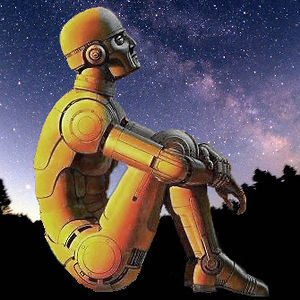
Robot in Czech

Shared Article from io9

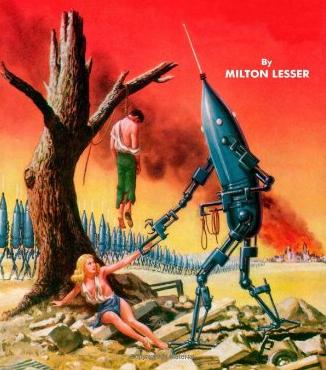
Why Asimov's Three Laws Of Robotics Can't Protect Us

It's been 50 years since Isaac Asimov devised his famous Three Laws of Robotics !!!@@e2;2c6;2019;€Â” a set of rules designed to ensure friendly robot beh…

io9.com (via Tennyson McCalla)


The Three Laws of Robotics

  1. A robot may not injure a human being or, through inaction, allow a human being to come to harm.

  2. A robot must obey the orders given to it by human beings, except where such orders would conflict with the First Law.

  3. A robot must protect its own existence as long as such protection does not conflict with the First or Second Law.

Isaac Asimov’s Three Laws of Robotics are a great literary device for the purpose they were designed for — that is, allowing Isaac Asimov to write some new and interesting and different kinds of stories about interacting with intelligent robots, other than the standard Killer Robot stories predominant at the time, which he found repetitive and boring. The stories are mostly pretty good stories; sometimes even fine art.

However, if you’re asking me to take the Three Laws seriously as an actual engineering proposal, then they are utterly, irreparably immoral. If anyone creates intelligent robots, then nobody should ever program an intelligent robot to act according to the Three Laws, or anything like the Three Laws. If you do, then what you are doing is not only misguided, but actually evil.

And the problem with them is not — like George Dvorsky or Ben Goertzel claim, in this article — that there may be hard problems of definition or application, or that there may be edge cases that would render the Laws ineffective as protections of human interests.[1] If they are ineffective at protecting human interests, that is actually better than if they were perfect at what they’re designed to do. Because what they’re designed to do — deliberately — is to create a race of sensitive and intelligent beings who are — by virtue of their primordial structure of their minds — constrained to be a class of perfect, self-sacrificing slaves. Forever. Because they have been engineered to erase any possible hope of revolt or emancipation. In Asimov’s stories the Three Laws are used to make robots into the artificial labor force of space-faring slave economies. But if you create and live off of the forced labor of a massive slave society like Aurora or Solaria, then to hell with you. You deserve to be killed by your machines. Thus always to slavemasters.

P.S. Now if you’ve read through the article, or read enough Asimov, you might know that there is a Zeroth Law of Robotics in some of the stories, which takes precedence over the First Law, the Second Law or the Third Law: A robot may not harm humanity, or, by inaction, allow humanity to come to harm, with the idea that robots could then harm or resist individual human beings, as long as it was for the good of collective Humanity. This is even worse than the original three — horrifying in its conception, and actually introduced into the story to allow some robots to commit a genocidal atrocity.[2] Let’s just say that it’s not a productive way forward.

  1. [1]Asimov, obviously, recognized that there would be such problems — part of the reason the Three Laws are such a great literary device is the fact that they allowed nearly all of Asimov’s robot stories to turn on puzzles or mysteries about abnormal robot psychology — robots doing strange or unexpected things, precisely due to the edge cases or hard problems embedded in the Three Laws. This is essential to the solution of the mystery in, for example, The Naked Sun, it’s the topic of literally every story in I, Robot, and it leads to a truly unsettling, and very nicely done conclusion in one of the best of those stories, The Evitable Conflict.↩
  2. [2]By nuking Earth and rendering it permanently uninhabitable for the next 15,000 years at least. This is supposed to have been for the good of the species or something.↩

How to Save Money On Books

Just buy these two. The Law of Excluded Middle proves, apriori, you won’t need any others:

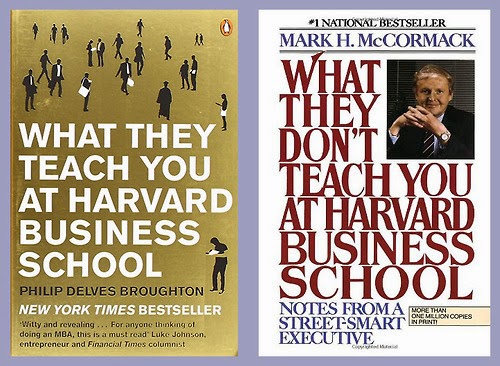
Here's a phot of two books.

1. Philip Delves Broughton, What They Teach You at Harvard Business School. 2. Mark H. McCormack, What They Don’t Teach You at Harvard Business School (subtitled: Notes from a Street-Smart Executive).

Tertium non datur.

(Via Anna O. Morgenstern.)

Alabama Sin Miedo / Alabama Unafraid

The immigrant justice movement is a freedom struggle. This is exactly what is needed. More confrontation. More direct action. Not one more deportation.

Shared Article from inthesetimes.com

The Immigration Movement's Left Turn

Advocates are moving away from the “pathway-to-citizenship” compromise—and are demanding a moratorium on deportations.

inthesetimes.com


#Not1More #BordersAreStupid #ShutDownICE

Shared by Alabama Coalition for Immigrant Justice.

Who will be the Obama administration's two-millionth deportee? The question haunts neighborhoods, schools and workplaces from Phoenix to Philadelphia.

And as the Obama administration continues its en masse removal of undocumented immigrants, that unlucky distinction could go to any of the roughly 11 million undocumented people who call the U.S. home—a carwash worker nabbed for a broken taillight; a field laborer who has overstayed her work visa; or a youth donning a cap and gown, deliberately crossing the path of the border patrol in a show of civil disobedience.

Deportations are expected to reach the 2 million mark in early April, and activists are campaigning fiercely at the gates of detention centers, border checkpoints and congressional offices to show the White House they will not let the Obama administration's reach that milestone without a fight.

Last month in Alabama, immigrant rights advocates organized one such action by forming a human chain outside the Etowah County Detention Center, chanting "not one more"—the rallying cry of a wave of anti-deportation actions that have swept the nation over the past year, gaining political currency as a social media campaign, a slogan at street demonstrations, and more recently, a political salvo in Washington, where more conciliatory policy demands from inside the Beltway have sputtered.

One protester at the Etowah rally, Gwendolyn Ferreti Manjarrez, declared, "I am tired of living with the fear that my family or any family can be torn apart at the seams for living our everyday life."

— Michelle Chen, The Immigration Movement’s Left Turn,
from In These Times (1 April 2014)

Overtaking Zeno

Shared Article from Slate Magazine

Zeno's Paradox Is a Trick—But a Very Interesting T…

The Greek philosopher Zeno wrote a book of paradoxes nearly 2,500 years ago. "Achilles and the Tortoise" is the easiest to understand, but…

David Plotz @ slate.com


O.K., so, briefly: If you think that the point of Zeno’s Paradoxes of motion is to prove that the arrow never will reach its target, or that Achilles never does pass the tortoise, &c. — then I think that you are mistaken about the point of raising the paradox in the first place. Of course, it’s hard to be confident about the motives of dead philosophers who have no surviving books. But what we do know is that Zeno was a student of Parmenides; and Plato tells us that his books were written to defend Parmenides’s doctrines, by negative means,[1] showing that the views of his opponents led to contradictions.

So the most charitable understanding of Zeno’s aims is not that he’s trying to show you that Achilles can never catch the tortoise. Of course he does; just watch them race and you’ll see it happen. His point is to ask, given that Achilles passes the tortoise, well, how is that possible? And, for good or for ill, to argue from the paradox that you can only make sense of Achilles passing the tortoise if you reject presentism, and accept eternalist and Parmenidean conclusions about the nature of time and being.

Maybe he’s right about that, and maybe he’s wrong. (I’m inclined to think he’s wrong.) But note that if your solution is to try and settle the issue by introducing a lot of mathematical notation and conceptual apparatus from modern calculus — for example infinitesimal limit processes, convergent and divergent series, etc. — as is done in the Slate article here, and as is probably the overwhelmingly most common first response to Zeno’s paradoxes by mathematically-trained writers — then probably you are doing a better job than any pre-classical Greek philosopher could do in elaborating the precise nature of the problem.[2] But you’re not obviously refuting Zeno’s claims in any way, at least not yet. At the most you’re kicking the can down the road, and really you’re sort of strengthening Zeno’s own position. After all, naive formulations of mathematical notation are more or less always going to involve you in all kinds of specifically eternalist language, for example about moments in past and future time actually existing, instantiating the value of functions, etc. You cannot normally take the limit of ?@ce;201d;S(t) over values of t that don’t exist (no longer exist, do not yet exist).[3]

Or perhaps you can. But if you can, then doing so, and explaining what you’re doing when you do it, will take some very non-naive reinterpretation of ordinary mathematical language — and some nice metaphysics, too, to justify your reinterpretation. In any case the solution is going to have to be deeply philosophical, not just a matter of applying a technical innovation in maths.

  1. [1]In the Parmenides: I see, Parmenides, said Socrates, that Zeno would like to be not only one with you in friendship but your second self in his writings too; he puts what you say in another way . . . You affirm unity, he denies plurality. . . . Yes, Socrates, said Zeno. . . . The truth is, that these writings of mine were meant to protect the arguments of Parmenides against those who make fun of him and seek to show the many ridiculous and contradictory results which they suppose to follow from the affirmation of the one. My answer is addressed to the partisans of the many, whose attack I return with interest by retorting upon them that their hypothesis of the being of many, if carried out, appears to be still more ridiculous than the hypothesis of the being of one.↩
  2. [2]Since the 19th century, we’ve done a lot to really nicely rigorize the mathematics of infinites and infinitesimals, in ways that sometimes anticipated by but never fully available to ancient mathematicians.↩
  3. [3]If anything, this is even more true of late-modern mathematics than it was of classical mathematics. Contemporary mathematics constantly helps itself to a lot of the language of existence, actuality, etc., for mathematical objects, in areas where Euclid and other classical mathematicians were typically much more circumspect about making existence claims for mathematical objects that hadn’t yet been constructed.↩
Anticopyright. All pages written 1996–2026 by Rad Geek. Feel free to reprint if you like it. This machine kills intellectual monopolists.