Rad Geek People's Daily

official state media for a secessionist republic of one

Prooftexting

Show me an axiomatic approach to ethics, ideology or anything else in the marketplace of ideas, and I’ll show you a recipe designed to produce a specific result. . . . Besides, everyone since G?@c3;b6;del’s proof knows formal systems degenerate into mental masturbation at some point.[1]

Groundbreaking developments in the history of mathematics and logic: In 1931 Kurt G?@c3;b6;del published "?@c3;153;ber formal unentscheidbare S?@c3;a4;tze der Principia Mathematica und verwandter Systeme I"[2] in the journal Monatshefte f?@c3;bc;r Mathematik. The paper is famous among logicians and mathematicians for the two "Incompleteness Theorems" it contains,[3] logically demonstrating that no formal system rich enough to express truths of ordinary arithmetic can be both consistent and deductively complete while having a finite number of axioms.

The paper is famous among almost everyone else for containing a multi-page Rorschach inkblot, allowing a projection test in which the reader-subject can discern an easy dismissive response to whichever deductive argument they happen to like the least; or, if they prefer, to the exercise of deductive logic as a whole.

  1. [1]Lorraine Lee, Re: Julian Assange, the Left-Anarch. Comments at Social Memory Complex (21 April 2013). This is actually not even remotely what either of G?@c3;b6;del’s two major Incompleteness Theorem proofs says. –CJ.↩
  2. [2]A PDF blob of the article in its original German is available online thanks to Wilhelm K. Essler. An English translation of most of the paper is also available online thanks to Martin Hirzel.↩
  3. [3]Theorem VI and Theorem XI in the paper, specifically.↩

Technological civilization is awesome. (Cont’d.)

In which some engineers develop a billboard, ideally suited to environmental conditions in Lima and similar cities in Peru, which can pull clean drinking water out of thin air.

See also.

8:15am

Here is a pocket watch, stopped at 8:15am.

Donated by Kazuo Nikawa
1,600m from the hypocenter
Kan-on Bridge

Kengo Nikawa (then, 59) was exposed to the bomb crossing the Kan-on Bridge by bike going from his home to his assigned building demolition site in the center of the city. He suffered major burns on his right shoulder, back, and head and took refuge in Kochi-mura Saiki-gun. He died on August 22. Kengo was never without this precious watch given him by his son, Kazuo.

— Hiroshima Peace Memorial Museum

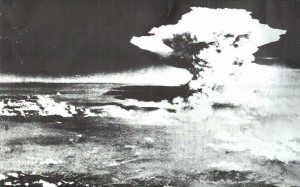
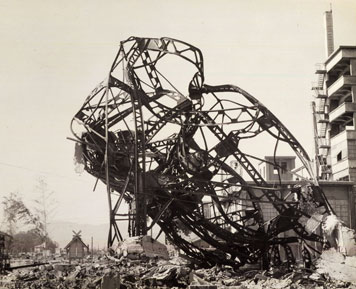
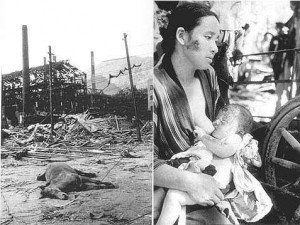
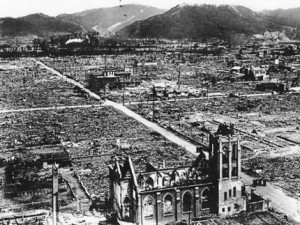
Sixty eight years ago today, on August 6, 1945, at 8:15 in the morning, the American B-29 bomber Enola Gay dropped an atomic bomb over the center of the city of Hiroshima, Japan. Hiroshima was the first target ever attacked with nuclear weapons in the history of the world.

The bomb exploded about 200 yards over the city, creating a 13 kiloton explosion, a fireball, a shock-wave, and a burst of radiation. On the day that the bomb was dropped, there were about 255,000 people living in Hiroshima.

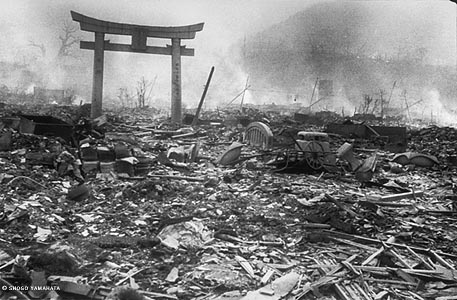
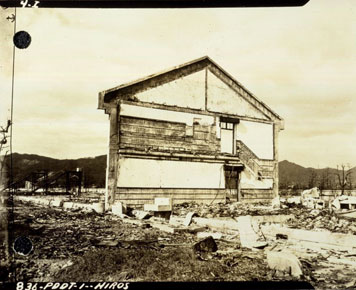
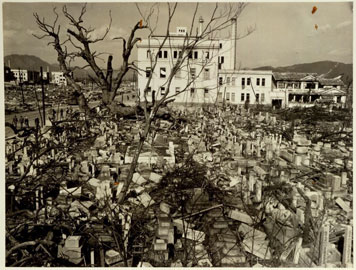
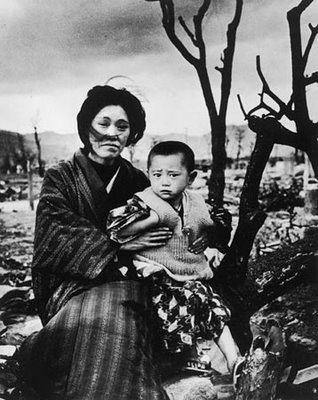
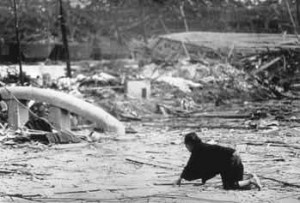
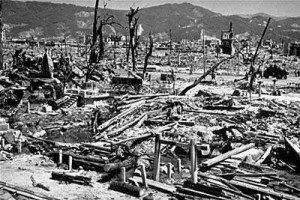
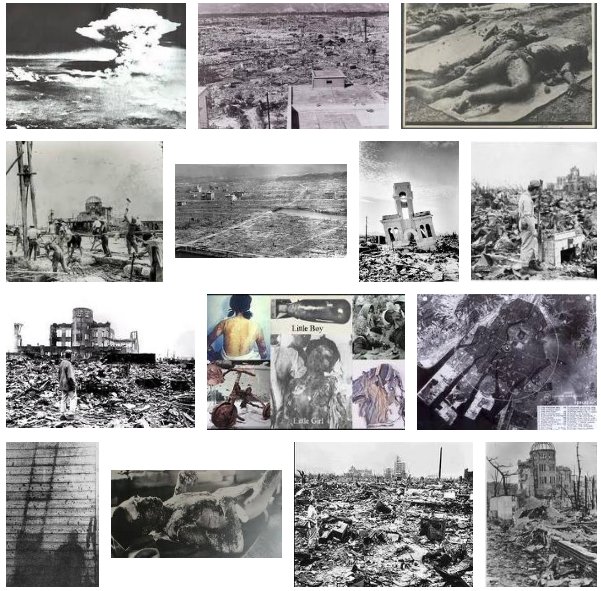
The explosion completely incinerated everything within a one mile radius of the city center. The shock-wave and the fires ignited by the explosion damaged or completely destroyed about nine-tenths of the buildings in the city. Somewhere between 70,000 and 80,000 people–that is, about one third of the entire population of the city–died immediately. The heat of the explosion vaporized or burned alive many of those closest to ground zero. Others were killed by the force of the shock-wave or crushed under collapsing buildings. Many more died from acute radiation poisoning–that is, from the effects of having their internal organs burned away in the intense radiation from the blast.

By December 1945, thousands more had died from their injuries, from radiation poisoning, or from cancers related to the radioactive burst or the fallout. It is estimated that the atomic bombing killed about 140,000 people, and left thousands more with permanent disabilities.

Almost all of the people maimed and killed were civilians. Although there were some minor military bases near Hiroshima, the bomb was dropped on the city center, several miles away from the military bases on the edge of town. Hiroshima was chosen as a target, even though it had little military importance, because It is a good radar target and it is such a size that a large part of the city could be extensively damaged. There are adjacent hills which are likely to produce a focussing effect which would considerably increase the blast damage. 1. Hiroshima was also one of the largest Japanese cities not yet damaged by the American firebombing campaign. Military planners believed it strategically important to demonstrate as much destruction as possible from the blast.

Thomas Ferebee, a bombadier for the United States Army, was the man who dropped the atomic bomb on Hiroshima. His commanding officer was the pilot of the Enola Gay, Paul Tibbets. Tibbets and Ferebee were part of the XXI Bomber Command, directed by Curtis LeMay. LeMay planned and executed the atomic bombings at the behest of Secretary of War Henry L. Stimson and President Harry Truman.

Kengo Nikawa died on August 22nd, 1945 because of the bombing. This is his pocket watch.

We will never know the names of many of the 140,000 other residents of Hiroshima who were killed by the bombing. We have only estimates because the Japanese government was in a shambles by this point in the war, and countless records, of those that were successfully kept, were consumed by the flames, along with the people whose lives they recorded.

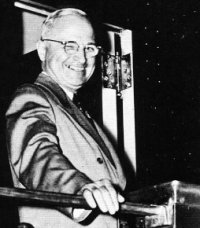
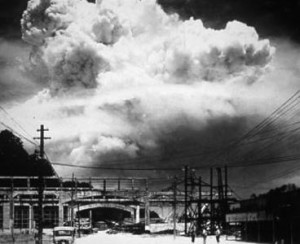
Three days later, on August 9, 1945, CBS broadcast a recorded address by President Harry S. Truman about the atomic bombing. It was broadcast on the same day that the U.S. government sent bombers to incinerate a second city, Nagasaki, with atomic weapons. Here is what Truman said:

Here's Harry S. Truman, looking awfully proud of his damn self.

Harry S. Truman, August 9, 1945.

We won the race of discovery against the Germans….

In his radio address on August 9, Truman described Hiroshima, a port city of some 255,000 people, as a military base, and then said, That was because we wished in this first attack to avoid, insofar as possible, the killing of civilians. The bomb was dropped on the city center, far away from military installations.

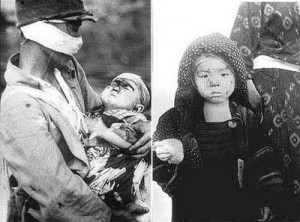
On that bright morning in August, with a sudden flash, brighter than the sun, the downtown of an industrial city was converted into a scene of hell. The sky went dark, buildings were thrown into the ground, and everything began to burn. People staggered through the ruins, with their eyes blinded, with their clothing burned off their bodies, with their own skin and faces burned off in the heat. Everyone was desperate for water, because they were burning, because everything was unbearably hot. They begged soldiers for water from their canteens; they drowned themselves in cisterns. Later, black rain began to fall from the darkened sky. The people thought it was a deliverance. They tried to catch the black rain on their tongues, or they caught it and drank it out of cups. But they didn’t know that the rain was fallout. They didn’t know that it was full of radiation and as they drank it it was burning them away from the inside. There was no refuge, no sanctuary; there was nobody to help. The city was burning, medical workers were almost all downtown, and so over 90% of the doctors, and over 90% of the nurses, were killed or injured in the bombing. Because of the targeting of the city center, about 85% of the people killed in Hiroshima were civilians — about 120,000 of the 140,000 men, women and children killed — vaporized or carbonized by the heat, crushed to death in the shockwave, burned to death, killed quickly or slowly by radiation poisoning and infections and cancers eating their bodies alive.

It is worth remembering that the atomic bombing of the Hiroshima city center — the first ever use of atomic weapons against human targets — a bombing in which the United States government’s forces deliberately targeted a civilian center — a bombing that the United States government carried out with the explicit intention of obliterating an entire city in seconds, in order to break enemy morale — an attack in which that government’s forces turned weapons on civilians that destroyed 90% of an industrial metropolis, and killed over half of all the people living in it — remains the deadliest act of terrorism in the history of the world.

See also:

The audio clip above is from a recording of President Harry S. Truman’s radio report on the Potsdam conference, recorded by CBS on August 9, 1945 in the White House. The song linked to above is a recording of Oppenheimer (1997), by the British composer Jocelyn Pook. The voice that you hear at the beginning is Robert Oppenheimer, in an interview many years after the war, talking about his thoughts at the Trinity test, the first explosion of an atomic bomb in the history of the world, on July 16th, 1945.

Shameless Self-promotion Sunday

Sunday, Sunday, Sunday. Time to get Shameless, Shameless Shameless. So you know what to do. (Or, if you don't, it's not too hard to figure out . . .) So, how're things where you are? Got anything big coming up? Anything you've been working on lately? What have you been up to this week? Write anything? Leave a link and a short description for your post in the comments. Or fire away about anything else you might want to talk about.

Immigration freedom is personal liberty. Borders are statism.

When I read miserable, belligerently statist exercizes in punitive nationalism like this article (content warning: violent xenophobia, ill-informed conservative legalism, ethnic slurs all over comments threads)[1] at a conservatarian website that calls itself the Personal Liberty Digest, I have to wonder what the words personal liberty mean to them, and what it is about ever more statist policies spawned by globalists and liberals [sic] that they actually object to. Apparently not much, since whatever personal liberty might have meant goes right into the garbage as soon as some political official says there oughta be a law, or some border cop says Ihre Papiere, bitte. And whatever it is in statist policies that they object to, it doesn’t, apparently, include the creation and maintenance of a massive police state required to corral millions of people, denying them the most basic freedoms of individual movement, demanding papers and national identification as a permission slip for working, or just for existing within those borders, and then — if any of the people fenced out by political force should try to evade these purely political restrictions, and assert their ability to peacefully live, work, and move onto property whose owners have opened their doors and welcomed them to come onto — sending border cops to hunt them down, break into their homes and workplaces with guns drawn, disappear them into hellhole detention centers, put them through a special due-process free deportation system, and then force them out of their homes and jobs, all for the sake of nothing more than a government-demanded legal status. And when those who try to exercise their personal liberty to move, live and work are attacked and punished by the state, the overwhelming response is to spit in their face and sneer at them for breaking the law.

When I read page after page of conservative commenters, many of whom speak in praise of small government shouting Illegal is illegal! and comparing undocumented immigrants to trespassers[2] and toss out sarcastic quips about how we wouldn’t want them to feel bad about themselves for breaking the law, then I wouldn’t dare speculate about what we would or wouldn’t want, but — speaking only for myself — I can only say that of course I don’t want anybody to feel bad for breaking border laws. Nobody should feel bad about that because there is nothing wrong with immigrants, either documented or undocumented, and there is absolutely nothing wrong with breaking unjust or tyrannical laws. Such laws ought to be broken; they deserve no notice at all, except to ridicule them, and to trample them underfoot. Of course, perhaps you don’t agree that government border laws are unjust or tyrannical; but if not, you ought to give up pretending to care about personal liberty or statism at all, and just take some pride in the bullying, authoritarian big-government nationalism that you evidently enjoy so much.

When I read commenters angrily insisting that They invaded our country [sic] by the millions without a shot fired. . . then I have to wonder what invasion even means to these people. Without a shot fired! Of course, this just means, without force, and hence, without invading. The country is where you are from, homie; it’s not “your” country in the sense of being your personal or exclusive property. Personal liberty means that you get to decide who comes onto your personal property, not that you get to command other people about where else they can go or where else is off limits; immigrants move from one place to another, and in the homes or the apartments they move into, in the places where they work, in the businesses they buy from, the landlord or the boss or the owner has explicitly chosen to open their doors and welcome them onto their property.

When people move from one place to another without using violence, without trespassing on others’ land, and go to places where they’ve been invited to stay by mutual agreement with the property owner, that’s not an invasion in any meaningful sense of the word, any more than I invaded Michigan after I graduated from college, or any more than I invade the Waffle House when I go there to get some hash browns.

And when I read commenters trotting out the last-ditch talking point that undocumented immigrants ought to be punished and stigmatized because they ILLEGALLY entered as opposed to the thousands who are STILL waiting in line to do it LEGALLY!!!!!!!”, I don’t know what to make of the proposal that if thousands of people are jerked around over the course of more than a decade by cruel, capricious, obviously broken and massively unfair immigration requirements, then everybody else should be jerked around by the same cruel, capricious, obviously broken and massively unfair immigration quotas, no matter what, forever. You know, just to be fair. In reality, telling people to wait in the queue is, for the overwhelming majority of people in the world, telling them to wait forever, because it is literally impossible for most people in the world to successfully gain residency status in the USA.

Ben Bullard, the author of the original post, describes himself in his bio by saying that Reconciling the concept of individual sovereignty with conscientious participation in the modern American political process is a continuing preoccupation for him. Apparently the way that the two are reconciled is to toss out the concept of individual sovereignty in favor of a properly politic notion of national sovereignty, writing — as far as I can tell completely without irony — that Immigration — legal or not — is an enormously difficult phenomenon to attempt to control. But if there's national will to address it as a problem that threatens the foundations of a society, then a Nation has every right to do so. I don’t know what creeps me out more — the capitalization of a Nation and the frankly collectivist attempt to speak of a unified subject with rights to command and exclude others; or the unvarnished fascist appeal to solve a systemic political problem by the application of national will.

I do know that neither of these has anything at all to do with respecting the personal liberty of individuals.

You can believe in individual liberty, and freedom from arbitrary political restriction; or you can be a nationalist and a bordercrat. You cannot do both together. Choose.

Also.

  1. [1]It isn’t particularly relevant to what I actually aim to discuss today, but I’d be remiss if I didn’t at least mention that the entire article by Ben Bullard, and the comments that reads have thrown up in response to it, are the worst sorts of belligerently ill-informed ignorance and Right-wing border-baiting. Based on a Telegraph reporter’s bellyaching about a leaflet distributed by a UN refugee commissioner in Malta, asking reporters to avoid the term illegal when describing the specific conditions and activities of north African asylum-seekers and victims of human trafficking in Malta. But Bullard would rather bait his border-policing readers’ sensitivities about being asked to use phrases like undocumented immigrants instead of dehumanizing and politically-charged words like illegals or aliens when they talk about immigration politics — especially the political targeting of working-class immigrants from Mexico and Central America — to the United States; and so he portrays this very specific and limited request from one office concerning reporting on the specific situation in Malta as some kind of diktat handed down by the U.N. telling us how we ought to talk about immigration, and immigrants, in general, and then easily segues into a really pretty appalling bit of commentary on the tide of humanity unleashed by the movements of desperate or displaced people. Of course, virtually every single commenter on the post has something to say about Mexican immigration to the U.S., and virtually none have anything to say about the humanitarian situation in north Africa or in Malta.↩
  2. [2]As if the entire territory of the U.S. were the property of the government that rules it; as if the homes, workplaces, and businesses that undocumented immigrants live in, work in, and patronize didn’t belong to the owners who specifically opened their doors and invited them to come in.↩
Anticopyright. All pages written 1996–2026 by Rad Geek. Feel free to reprint if you like it. This machine kills intellectual monopolists.