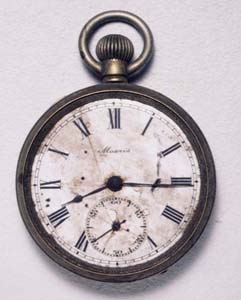
Donated by Kazuo Nikawa
1,600m from the hypocenter
Kan-on Bridge
Kengo Nikawa (then, 59) was exposed to the bomb crossing the Kan-on
Bridge by bike going from his home to his assigned building demolition site in
the center of the city. He suffered major burns on his right shoulder, back,
and head and took refuge in Kochi-mura Saiki-gun. He died on August 22.
Kengo was never without this precious watch given him by his son, Kazuo.
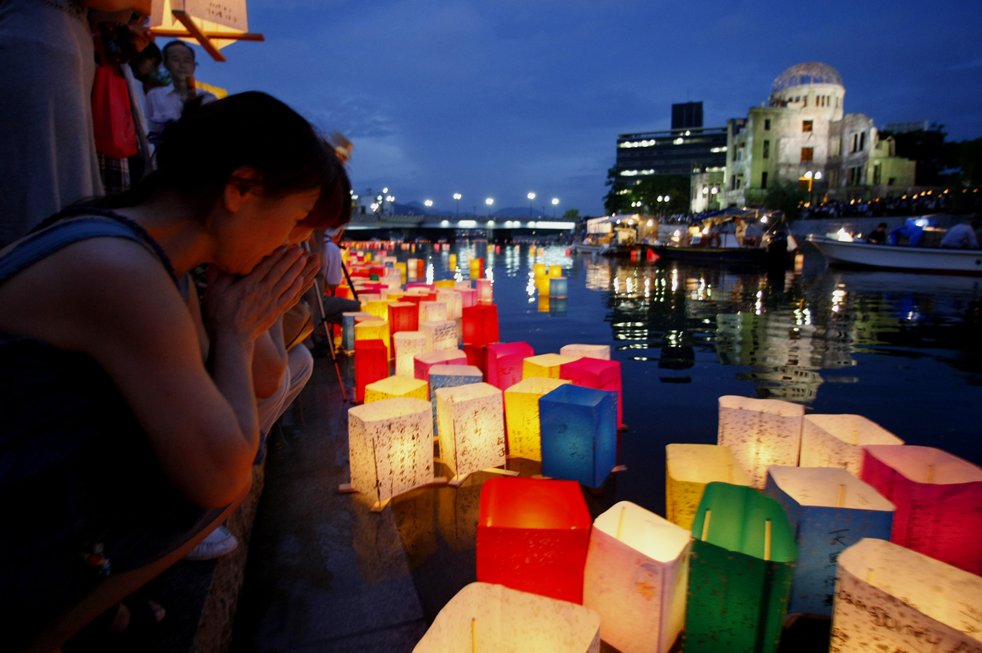
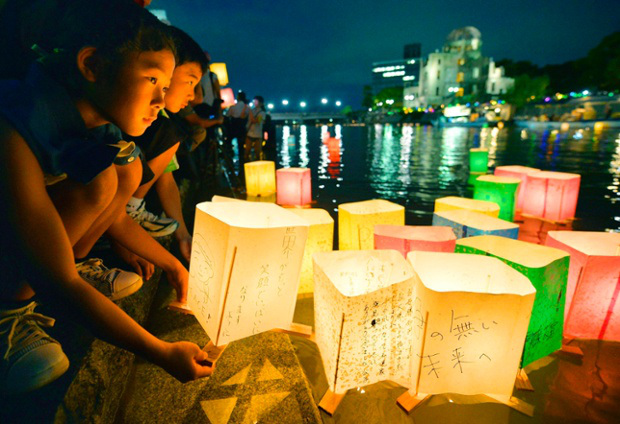
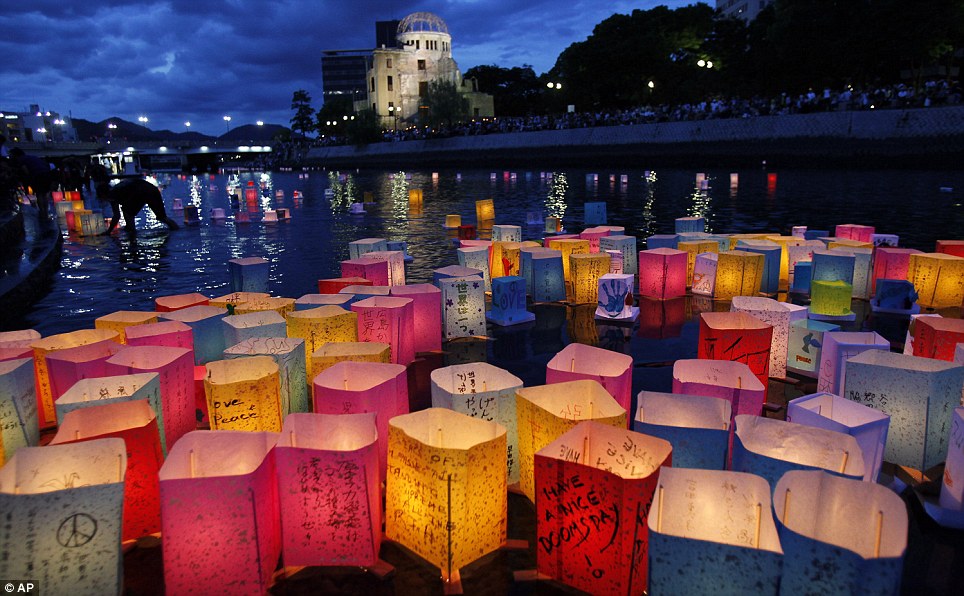
Paper lanterns float down the Motoyasu River in Hiroshima,
in the annual August 6 memorial event, in memory of the lives lost.
The quotation in the title: “Now all this nightmare picture had vanished. In its place was the vision — fair and bright indeed it seemed — of the end of the whole war in one or two violent shocks…. is from Winston Churchill’s self-serving memoiristic history of the end of the war, The Second World War, Vol. VI: Triumph and Tragedy. Churchill is describing his reactions to the first news of the detonation of a working atomic bomb at the Trinity test site, which Harry Truman and his war officials confided to him at the Potsdam Conference with Truman and Josef Stalin. The same conference reiterated the demand for unconditional surrender. Truman later cited the Potsdam Conference demands as justification for destroying the city of Hiroshima with an atomic bomb, in order to force that outcome. The nightmare picture for Churchill was the hypothetical death of huge numbers of American and British soldiers during an invasion of the Japanese home islands. He said this was based on the spectacle of Okinawa island and the terrible death and destruction caused by brutal fighting and the Japanese soldiers’ repeated use of suicide attacks in the last resort.
Donated by Kazuo Nikawa
1,600m from the hypocenter
Kan-on Bridge
Kengo Nikawa (then, 59) was exposed to the bomb crossing the Kan-on
Bridge by bike going from his home to his assigned building demolition site in
the center of the city. He suffered major burns on his right shoulder, back,
and head and took refuge in Kochi-mura Saiki-gun. He died on August 22.
Kengo was never without this precious watch given him by his son, Kazuo.
Seventy-three years ago today, on August 6, 1945, between 8:15 and 8:16 in the morning, the American B-29 bomber Enola Gay dropped an atomic bomb over Hiroshima, Japan. The government of the United States chose Hiroshima as their target because it was still standing. For half a year, the U.S. government had waged a war of unrelenting, devastating low-altitude firebombing of cities throughout the Japanese home island. Within six months, the firebombing had killed hundreds of thousands of Japanese civilians. The firebombing had destroyed over 60 Japanese cities. Hiroshima was still mostly undamaged. So they believed that would make it a good place to test the effects of the new atom bomb. And Hiroshima became the first city ever attacked with nuclear weapons in the history of the world.
It would not be the last.
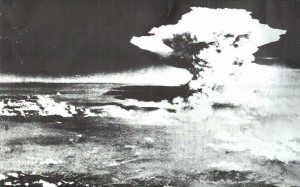
On a bright morning in August, without warning, the B-29 dropped its atom bomb over the densely-populated center of the city. The bomb exploded about 2,000 feet above ground. And it created a 13 kiloton explosion, a fireball, a shock-wave, and a burst of radiation. On the day that the bomb was dropped, there were somewhere around 255,000-300,000 people living in Hiroshima.
There was a sudden flash, brighter than the sun, and then sky went dark, buildings were thrown to the ground, and everything began to burn. People were burned alive and nothing left but a shadow on the wall. People staggered through the ruins, their eyes blinded, their clothing burned off their bodies, skin burned off in the heat.
Everyone was desperate for water, everything was unbearably hot. They begged soldiers for water from their canteens; they drowned themselves in cisterns. Later, black rain began to fall from the darkened sky. And the people escaping from the city center thought it was a miracle. They tried to catch the rain on their tongues, or they caught it and drank it out of cups. They didn’t know that the rain was fallout. They didn’t know that it was full of radiation and as they drank it it was burning them away from the inside. There was no refuge, no sanctuary. There was nobody to help. The city was burning. The doctors and nurses were almost all downtown when the bomb hit. The atom bomb exploded directly over one of the major clinics, and over 90% of the doctors, and over 90% of the nurses, were killed or injured in the bombing.
Because the U.S. bomber targeted the city center, about 85% of the people killed in Hiroshima were civilians.
The explosion completely incinerated everything within a one mile radius of the city center. The shock-wave and the fires ignited by the explosion damaged or completely destroyed about nine-tenths of the buildings in the city. Somewhere between 70,000 and 80,000 people–or, about one quarter to one third of the entire population of the city–died immediately. The heat of the explosion vaporized or carbonized the children and adults who were nearest to Ground Zero when the bomb went off.
Thousands more were further away from the center, and they died when they were crushed to death by the force of the shock-wave, when they were burned by the blast or by the fires raging throughout the ruined city, when they were trapped underneath collapsing buildings or when they drowned in the river as they tried to escape. They died from dehydration; they were killed quickly or slowly by radiation poisoning and infections and cancers that ate their bodies away from the inside out. Some died suddenly, and some died slow, lingering, painful and unavoidable deaths over days or weeks. It is estimated that in all, the atomic bombing killed about 130,000-140,000 people. It left thousands more with permanent disabilities from their injuries and from the radiation that spread in a burst and spread through the fallout.
Almost all of the people who were maimed and killed in the obliteration of the city were civilians.
Although there were some minor military bases near Hiroshima, the bomb was dropped on the city center, several miles away from the military bases on the edge of town. Hiroshima was chosen as a target, even though it had little military importance, because It is a good radar target and it is such a size that a large part of the city could be extensively damaged. There are adjacent hills which are likely to produce a focussing effect which would considerably increase the blast damage.1. And it was one of the cities still standing after the American firebombing campaign. U.S. military planners believed it strategically important to demonstrate as much destruction as possible from the blast.
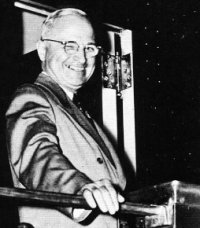
Thomas Ferebee, a bombadier for the United States Army, was the man who dropped the atomic bomb on Hiroshima. His commanding officer was the pilot of the Enola Gay, Paul Tibbets. Tibbets and Ferebee were part of the XXI Bomber Command, directed by Curtis LeMay. LeMay planned and executed the atomic bombings at the behest of Secretary of War Henry L. Stimson and President Harry Truman.
Kengo Nikawa died on August 22nd, 1945 because of the bombing. This is his pocket watch.
We will never know the names of many of the 140,000 other residents of Hiroshima who were killed by the bombing. We have only estimates because the Japanese government was already in a shambles by this point in the war, and countless records, of those that were successfully kept, were consumed by the flames, along with the people whose lives they recorded.
We won the race of discovery against the Germans….
In his radio address on August 9, Truman disingenuously described Hiroshima, a densely populated, industrialized port city of a quarter million souls, as a military base, and then he said, That was because we wished in this first attack to avoid, insofar as possible, the killing of civilians. That was a lie. The bomb was dropped on the city center, over a hospital, far away from military installations.
It is worth remembering that the atomic bombing of the Hiroshima city center — the first use of atomic weapons against human targets in the history of the world — a bombing in which the United States government’s forces deliberately targeted a civilian center — a bombing that the United States government carried out with the explicit intention of obliterating an entire city in seconds, in order to break enemy morale — an attack in which that government’s forces deliberately turned weapons on civilians that destroyed 90% of an industrial metropolis, and killed between a third and a half of all the people living in it — was, and remains, the deadliest act of terrorism in the history of the human world.
And there are other facts, and other stories, also, that you do not need to remind me of today: of course it’s a fact that the government of the Empire of Japan launched a war of aggression against American territory and killed both American military and civilians; and it’s a fact that they conducted brutal wars of conquest against China, Korea, and throughout southeast Asia, in which hundreds of thousands of civilians were mercilessly tortured and killed; and even that down to the very end, some fanatical elements of the military regime wanted to fight the United States down to the last man.
That's all true, but it's quite beyond the point. None of these vicious acts by a vicious government justifies doing this to Japanese people, to civilian men, women and children who had no meaningful role in either the decision-making or in the fighting. No crime or atrocity of the Japanese government excuses a half-year campaign of terror against Japanese cities; no political objective could possibly allow the U.S. government to seek victory by burning 140,000 civilians alive in a single day. No strategic necessity justifies turning such weapons on a city of 300,000 human beings; no need or desire or exigency of war justifies treating 140,000 souls like this.
Nothing ever could.
Paper lanterns float down the Motoyasu River in Hiroshima,
in the annual August 6 memorial event, in memory of the lives lost.
Donated by Kazuo Nikawa
1,600m from the hypocenter
Kan-on Bridge
Kengo Nikawa (then, 59) was exposed to the bomb crossing the Kan-on
Bridge by bike going from his home to his assigned building demolition site in
the center of the city. He suffered major burns on his right shoulder, back,
and head and took refuge in Kochi-mura Saiki-gun. He died on August 22.
Kengo was never without this precious watch given him by his son, Kazuo.
Seventy-two years ago today, on August 6, 1945, between 8:15 and 8:16 in the morning, the American B-29 bomber Enola Gay dropped an atomic bomb over Hiroshima, Japan. The government of the United States chose Hiroshima as their target because it was still standing. For half a year, the U.S. government had waged a war of unrelenting, devastating low-altitude firebombing of cities throughout the Japanese home island. Within six months, the firebombing had killed hundreds of thousands of Japanese civilians. The firebombing had destroyed over 60 Japanese cities. Hiroshima was still mostly undamaged. They believed that would make it a good place to test the effects of the new atom bomb. So Hiroshima became the first city ever attacked with nuclear weapons in the history of the world. It would not be the last.
On a bright August morning, without warning, the bomber dropped its atom bomb over the densely-populated center of the city. It exploded about 2,000 feet above ground, creating a 13 kiloton explosion, a fireball, a shock-wave, and a burst of radiation. On the day that the bomb was dropped, there were about 255,000-300,000 people living in Hiroshima.
There was a sudden flash, brighter than the sun, and then sky went dark, buildings were thrown to the ground, and everything began to burn. People were burned alive and nothing left but a shadow on the wall. People staggered through the ruins, their eyes blinded, their clothing burned off their bodies, skin burned off in the heat. Everyone was desperate for water, everything was unbearably hot. They begged soldiers for water from their canteens; they drowned themselves in cisterns. Later, black rain began to fall from the darkened sky. People escaping from the city center thought it was a miracle. They tried to catch the rain on their tongues, or they caught it and drank it out of cups. They didn’t know that the rain was fallout. They didn’t know that it was full of radiation and as they drank it it was burning them away from the inside. There was no refuge, no sanctuary; there was nobody to help.
The city was burning; the doctors and nurses were almost all downtown. The bomb exploded directly over one of the major clinics, and over 90% of the doctors, and over 90% of the nurses, were killed or injured in the bombing. Because the U.S. bomber targeted the city center, about 85% of the people killed in Hiroshima were civilians.
The explosion completely incinerated everything within a one mile radius of the city center. The shock-wave and the fires ignited by the explosion damaged or completely destroyed about nine-tenths of the buildings in the city. Somewhere between 70,000 and 80,000 people–that is, about one quarter to one third of the entire population of the city–died immediately. The heat of the explosion vaporized or carbonized the children and adults who were nearest to Ground Zero when the bomb went off.
Thousands more, who were further away from the center, died when they were crushed to death by the force of the shock-wave, burned by the blast or by the fires raging throughout the ruined city, trapped underneath collapsing buildings or drowned in the river as they tried to escape. They died from dehydration; they were killed quickly or slowly by radiation poisoning and infections and cancers that ate their bodies away from the inside out. Some died suddenly, and some died slow, lingering, painful and unavoidable deaths over days or weeks. It is estimated that in all, the atomic bombing killed about 130,000-140,000 people. It left thousands more with permanent disabilities from their injuries and from the radiation that spread in a burst and spread through the fallout.
Almost all of the people who were maimed and killed in the obliteration of the city were civilians. Although there were some minor military bases near Hiroshima, the bomb was dropped on the city center, several miles away from the military bases on the edge of town. Hiroshima was chosen as a target, even though it had little military importance, because It is a good radar target and it is such a size that a large part of the city could be extensively damaged. There are adjacent hills which are likely to produce a focussing effect which would considerably increase the blast damage.1. It was one of the largest Japanese cities not yet damaged by the American firebombing campaign. Military planners believed it strategically important to demonstrate as much destruction as possible from the blast.
Thomas Ferebee, a bombadier for the United States Army, was the man who dropped the atomic bomb on Hiroshima. His commanding officer was the pilot of the Enola Gay, Paul Tibbets. Tibbets and Ferebee were part of the XXI Bomber Command, directed by Curtis LeMay. LeMay planned and executed the atomic bombings at the behest of Secretary of War Henry L. Stimson and President Harry Truman.
Kengo Nikawa died on August 22nd, 1945 because of the bombing. This is his pocket watch.
We will never know the names of many of the 140,000 other residents of Hiroshima who were killed by the bombing. We have only estimates because the Japanese government was already in a shambles by this point in the war, and countless records, of those that were successfully kept, were consumed by the flames, along with the people whose lives they recorded.
We won the race of discovery against the Germans….
In his radio address on August 9, Truman disingenuously described Hiroshima, a densely populated, industrialized port city of a quarter million souls, as a military base, and then he said, That was because we wished in this first attack to avoid, insofar as possible, the killing of civilians. That was a lie. The bomb was dropped on the city center, over a hospital, far away from military installations.
It is worth remembering that the atomic bombing of the Hiroshima city center — the first use of atomic weapons against human targets in the history of the world — a bombing in which the United States government’s forces deliberately targeted a civilian center — a bombing that the United States government carried out with the explicit intention of obliterating an entire city in seconds, in order to break enemy morale — an attack in which that government’s forces deliberately turned weapons on civilians that destroyed 90% of an industrial metropolis, and killed between a third and a half of all the people living in it — was, and remains, the deadliest act of terrorism in the history of the world.
Here are some facts you do not need to remind me of today: that the government of the Empire of Japan launched a war of aggression against American territory and killed both American military and civilians; that they conducted brutal wars of conquest against China, Korea, and throughout southeast Asia, in which hundreds of thousands of civilians were mercilessly tortured and killed; that even to the end, some fanatical elements of the military regime wanted to fight the United States down to the last man.
That's all true, but it's quite beyond the point. None of these vicious acts by a vicious government justifies doing this to Japanese people, to civilian men, women and children who had no meaningful role in either the decision-making or in the fighting. No crime or atrocity of the Japanese government excuses a half-year campaign of terror against Japanese cities; no political objective could possibly allow the U.S. government to seek victory by burning 140,000 civilians alive in a single day. No strategic necessity justifies turning such weapons on a city of 300,000 human beings; no need or desire or exigency of war justifies treating 140,000 souls like this.
Nothing ever could.
Paper lanterns float down the Motoyasu River in Hiroshima,
in the annual August 6 memorial event, in memory of the lives lost.
Found in a house near Sanno Shinto Shrine in Sakamoto-machi, about one kilometer from the hypocenter. The clock was shattered by the blast, and its hands stopped at 11:02?@ef;bc;the moment of the explosion.
Seventy years ago today, at 11:02 in the morning, without warning, Major Charles Sweeney flew a U.S. B-29 bomber over the city of Nagasaki. The thing about Nagasaki is that it wasn’t even supposed to be bombed that day. Sweeney was acting on orders from General Curtis LeMay, the head of the XXI Bomber Command, and at the command of Secretary of War Henry L. Stimson, and President Harry S. Truman. A U.S. bomber had already dropped a uranium bomb on Hiroshima only three days before, annihilating 90% of the city and consuming 140,000 lives in the atomic fires. On August 9, while the Japanese government was still gathering information about what had happened at Hiroshima, while the Imperial council was still in session and still debating the question of surrender, without warning, they flew out a second bomber mission. The intended target was Kokura, but when Sweeney reached Kokura at 9:44am, he couldn’t see his target. He couldn’t see it because the U.S. had firebombed another nearby city, Yawata, the day before, and the smoke from the burning city hid Kokura from his sight. So Sweeney flew on to his secondary target — to Nagasaki. Clouds also hid the target in Nagasaki, but the plane was low on fuel and could not fly on to any other targets. So, at 11:02 in the morning, the plane’s bombadier, Captain Kermit Beahan, dropped a 10,200 pound plutonium bomb (nicknamed Fat Man) over this tourist destination, industrial center and sea-port in southwestern Japan with a population of about 230,000.
Known as Urakami, the district around the hypocenter (ground zero) area had been populated for centuries by Japanese people of the Roman Catholic faith. At the time of the bombing, between 15,000 and 16,000 Catholics – the majority of the approximately 20,000 people of that faith in Nagasaki and about half of the local population – lived in the Urakami district. It is said that about 10,000 Catholics were killed by the atomic bomb. Although traditionally a rustic isolated suburb, the Urakami district was chosen as the site for munitions factories in the 1920s, after which time the population soared and an industrial zone quickly took shape. The district was also home to the Nagasaki Medical College and a large number of other schools and public buildings. The industrial and school zones of the Urakami district lay to the east of the Urakami River, while the congested residential district of Shiroyama stretched to the hillsides on the west side of the river.
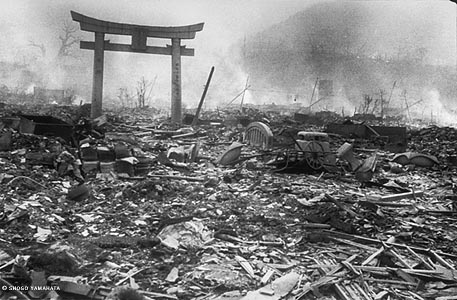
It was over this section of Nagasaki that the second atomic bomb exploded at 11:02 a.m., August 9, 1945. The damages inflicted on Nagasaki by the atomic bombing defy description. The 20 machi or neighborhoods within a one kilometer radius of the atomic bombing were completely destroyed by the heat flash and blast wind generated by the explosion and then reduced to ashes by the subsequent fires. About 80% of houses in the more than 20 neighborhoods between one and two kilometers from the hypocenter collapsed and burned, and when the smoke cleared the entire area was strewn with corpses. This area within two kilometers of the hypocenter is referred to as the hypocenter zone.
The destruction caused by the atomic bomb is analyzed as follows in Nagasaki Shisei Rokujugonenshi Kohen [History of Nagasaki City on the 65th Anniversary of Municipal Incorporation, Volume 2] published in 1959. The area within one kilometer of the hypocenter: Almost all humans and animals died instantly as a result of the explosive force and heat generated by the explosion. Wooden structures, houses and other buildings were pulverized. In the hypocenter area the debris was immediately reduced to ashes, while in other areas raging fires broke out almost simultaneously. Gravestones toppled and broke. Plants and trees of all sizes were snapped off at the stems and left to burn facing away from the hypocenter.
The area within two kilometers: Some humans and animals died instantly and a majority suffered injuries of varying severity as a result of the explosive force and heat generated by the explosion. About 80% of wooden structures, houses and other buildings were destroyed, and the fires spreading from other areas burned most of the debris. Concrete and iron poles remained intact. Plants were partially burned and killed.
The area between three and four kilometers: Some humans and animals suffered injuries of varying severity as a result of debris scattered by the blast, and others suffered burns as a result of radiant heat. Things black in color tended to catch fire. Most houses and other buildings were partially destroyed, and some buildings and wooden poles burned. The remaining wooden telephone poles were scorched on the side facing the hypocenter.
The area between four and eight kilometers: Some humans and animals suffered injuries of varying severity as a result of debris scattered by the blast, and houses were partially destroyed or damaged. The area within 15 kilometers: The impact of the blast was felt clearly, and windows, doors and paper screens were broken. Wall clock found in Sakamoto-machi about 1 km from the hypocenter. The hands stopped at the moment of the explosion: 11:02 a.m.
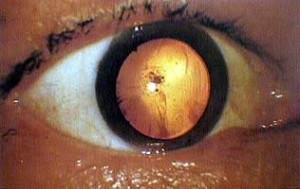
The injuries inflicted by the atomic bomb resulted from the combined effect of blast wind, heat rays (radiant heat) and radiation and surfaced in an extremely complex pattern of symptoms. The death toll within a distance of one kilometer from the hypocenter was 96.7% among people who suffered burns, 96.9% among people who suffered other external injuries, and 94.1% among people who suffered no apparent injuries. These data show that the deaths occurring immediately after the atomic bombing were due not only to burns and external injuries but also to severe radiation-induced injuries. The late medical effects of atomic bomb exposure include keloid scars, atomic bomb cataracts, leukemia and other cancers and microcephaly (small head syndrome) due to intrauterine exposure. Although aware that the atomic bomb had the power to instantly kill or injure all people within a radius of four kilometers, the authorities were unable to determine the death toll and number of injuries in Nagasaki. Still today there is no accurate data on the number of people who died. A variety of factors contributed to this lack of information, such as the paralysis of administrative functions in the aftermath of the bombing and the inability of the postwar government to initiate a proper investigation. Another obstacle was the enduring nature of disorders related to atomic bomb exposure. A progressive increase can be expected, therefore, at whatever point in time calculations are made. There are countless cases of people who suffered injuries on August 9 and died after fleeing to areas outside Nagasaki city and prefecture, only to be registered as dying of causes other than the atomic bombing. Because of the lack of knowledge about radioactive contamination, meanwhile, many radiation deaths were attributed to diseases. The Nagasaki municipal government officially adopted the figure of more than 70,000 deaths on the basis of information from population surveys and the estimate made by the Nagasaki City Atomic Bomb Records Preservation Committee in July 1950. Said the committee in its report: 73,884 people were killed and 74,909 injured, and 17,358 of the deaths were confirmed by post-mortem examination soon after the atomic bombing.
About 24 hours before the incineration of Nagasaki, U.S. planes had begun dropping leaflets all over Japan, threatening more destruction like the massacre of Hiroshima two days before. But they named no targets that might be evacuated. Shortly before these leaflets were dropped, Harry Truman also publicly declared his aims: It was to spare the Japanese people from utter destruction that the ultimatum of July 26 was issued at Potsdam. Their leaders promptly rejected that ultimatum. If they do not now accept our terms, they may expect a rain of ruin from the air the likes of which has never been seen on this earth. The leaflets themselves read:
TO THE JAPANESE PEOPLE:
America asks that you take immediate heed of what we say on this leaflet.
We are in possession of the most destructive explosive ever devised by man. A single one of our newly developed atomic bombs is actually the equivalent in explosive power to what 2000 of our giant B-29s can carry on a single mission. This awful fact is one for you to ponder and we solemnly assure you it is grimly accurate.
We have just begun to use this weapon against your homeland. If you still have any doubt, make inquiry as to what happened to Hiroshima when just one atomic bomb fell on that city.
Before using this bomb to destroy every resource of the military by which they are prolonging this useless war, we ask that you now petition the Emperor to end the war. Our president has outlined for you the thirteen consequences of an honorable surrender. We urge that you accept these consequences and begin the work of building a new, better and peace-loving Japan.
You should take steps now to cease military resistance. Otherwise, we shall resolutely employ this bomb and all our other superior weapons to promptly and forcefully end the war.
The leaflets did not reach Nagasaki at all until August 10, the day after it was destroyed.
The purpose of this massacre was to achieve victory through catastrophic bloodshed and terror. LeMay, when asked about his bombing campaigns, stated There are no innocent civilians, so it doesn’t bother me so much to be killing innocent bystanders. (He also mused, later, I suppose if I had lost the war, I would have been tried as a war criminal.) The interim committee deciding to drop the bomb stated, on May 31, 1945, that we could not give the Japanese any warning before the atomic bombing of Hiroshima. Of course, no specific warning was given to the civilians of Nagasaki, either, at any point. The point of the bombing was to kill as many people as possible while wiping two cities off of the face of the earth.
The massacres at Nagasaki and Hiroshima were at the end of a half-year long terror-bombing campaign that included the Operation Meetinghouse firebombing of Tokyo in March 1945, which killed 100,000 civilians over a single night, and the low-altitude firebombing of over 60 other Japanese cities. The 74,000 souls who died at Nagasaki were among some 800,000-1,000,000 civilians killed by months of low-altitude firebombing, conventional high explosives, and atomic bombs over the course of 6 months. Seventy years ago today also, in a radio address, President Harry S. Truman said: Having found the bomb, we have used it. . . We wished in this first attack to avoid, insofar as possible, the killing of civilians. . . . We have used it in order to shorten the agony of war.
After the war, Truman defended his decision to annihilate two industrial metropolises with atomic weapons, and to kill a quarter of a million civilians within only 72 hours, by claiming that it was the only way to coerce the political goal of an unconditional surrender from the Japanese government, and to reduce the number of U.S. soldiers who might be killed in combat.
Donated by Kazuo Nikawa
1,600m from the hypocenter
Kan-on Bridge
Kengo Nikawa (then, 59) was exposed to the bomb crossing the Kan-on
Bridge by bike going from his home to his assigned building demolition site in
the center of the city. He suffered major burns on his right shoulder, back,
and head and took refuge in Kochi-mura Saiki-gun. He died on August 22.
Kengo was never without this precious watch given him by his son, Kazuo.
Seventy years ago today, on August 6, 1945, between 8:15 and 8:16 in the morning, the American B-29 bomber Enola Gay dropped an atomic bomb over Hiroshima, Japan. The government of the United States chose Hiroshima as their target because it was still standing. For half a year, the U.S. government had waged a war of unrelenting, devastating low-altitude firebombing of cities throughout the Japanese home island. Within six months, the firebombing had killed hundreds of thousands of Japanese civilians. The firebombing had destroyed over 60 Japanese cities. Hiroshima was still mostly undamaged. They believed that would make it a good place to test the effects of the new atom bomb. So Hiroshima became the first city ever attacked with nuclear weapons in the history of the world. It would not be the last.
On a bright August morning, without warning, the bomber dropped its atom bomb over the densely-populated center of the city. It exploded about 2,000 feet above ground, creating a 13 kiloton explosion, a fireball, a shock-wave, and a burst of radiation. On the day that the bomb was dropped, there were about 255,000-300,000 people living in Hiroshima.
There was a sudden flash, brighter than the sun, and then sky went dark, buildings were thrown to the ground, and everything began to burn. People were burned alive and nothing left but a shadow on the wall. People staggered through the ruins, their eyes blinded, their clothing burned off their bodies, skin burned off in the heat. Everyone was desperate for water, everything was unbearably hot. They begged soldiers for water from their canteens; they drowned themselves in cisterns. Later, black rain began to fall from the darkened sky. People escaping from the city center thought it was a miracle. They tried to catch the rain on their tongues, or they caught it and drank it out of cups. They didn’t know that the rain was fallout. They didn’t know that it was full of radiation and as they drank it it was burning them away from the inside. There was no refuge, no sanctuary; there was nobody to help.
The city was burning; the doctors and nurses were almost all downtown. The bomb exploded directly over one of the major clinics, and over 90% of the doctors, and over 90% of the nurses, were killed or injured in the bombing. Because the U.S. bomber targeted the city center, about 85% of the people killed in Hiroshima were civilians.
The explosion completely incinerated everything within a one mile radius of the city center. The shock-wave and the fires ignited by the explosion damaged or completely destroyed about nine-tenths of the buildings in the city. Somewhere between 70,000 and 80,000 people–that is, about one quarter to one third of the entire population of the city–died immediately. The heat of the explosion vaporized or carbonized the children and adults who were nearest to Ground Zero when the bomb went off.
Thousands more, who were further away from the center, died when they were crushed to death by the force of the shock-wave, burned by the blast or by the fires raging throughout the ruined city, trapped underneath collapsing buildings or drowned in the river as they tried to escape. They died from dehydration; they were killed quickly or slowly by radiation poisoning and infections and cancers that ate their bodies away from the inside out. Some died suddenly, and some died slow, lingering, painful and unavoidable deaths over days or weeks. It is estimated that in all, the atomic bombing killed about 130,000-140,000 people. It left thousands more with permanent disabilities from their injuries and from the radiation that spread in a burst and spread through the fallout.
Almost all of the people who were maimed and killed in the obliteration of the city were civilians. Although there were some minor military bases near Hiroshima, the bomb was dropped on the city center, several miles away from the military bases on the edge of town. Hiroshima was chosen as a target, even though it had little military importance, because It is a good radar target and it is such a size that a large part of the city could be extensively damaged. There are adjacent hills which are likely to produce a focussing effect which would considerably increase the blast damage.1. It was one of the largest Japanese cities not yet damaged by the American firebombing campaign. Military planners believed it strategically important to demonstrate as much destruction as possible from the blast.
Thomas Ferebee, a bombadier for the United States Army, was the man who dropped the atomic bomb on Hiroshima. His commanding officer was the pilot of the Enola Gay, Paul Tibbets. Tibbets and Ferebee were part of the XXI Bomber Command, directed by Curtis LeMay. LeMay planned and executed the atomic bombings at the behest of Secretary of War Henry L. Stimson and President Harry Truman.
Kengo Nikawa died on August 22nd, 1945 because of the bombing. This is his pocket watch.
We will never know the names of many of the 140,000 other residents of Hiroshima who were killed by the bombing. We have only estimates because the Japanese government was already in a shambles by this point in the war, and countless records, of those that were successfully kept, were consumed by the flames, along with the people whose lives they recorded.
We won the race of discovery against the Germans….
In his radio address on August 9, Truman disingenuously described Hiroshima, a densely populated, industrialized port city of a quarter million souls, as a military base, and then he said, That was because we wished in this first attack to avoid, insofar as possible, the killing of civilians. That was a lie. The bomb was dropped on the city center, over a hospital, far away from military installations.
It is worth remembering that the atomic bombing of the Hiroshima city center — the first use of atomic weapons against human targets in the history of the world — a bombing in which the United States government’s forces deliberately targeted a civilian center — a bombing that the United States government carried out with the explicit intention of obliterating an entire city in seconds, in order to break enemy morale — an attack in which that government’s forces deliberately turned weapons on civilians that destroyed 90% of an industrial metropolis, and killed between a third and a half of all the people living in it — was, and remains, the deadliest act of terrorism in the history of the world.
Here are some facts you do not need to remind me of today: that the government of the Empire of Japan launched a war of aggression against American territory and killed both American military and civilians; that they conducted brutal wars of conquest against China, Korea, and throughout southeast Asia, in which hundreds of thousands of civilians were mercilessly tortured and killed; that even to the end, some fanatical elements of the military regime wanted to fight the United States down to the last man.
That's all true, but it's quite beyond the point. None of these vicious acts by a vicious government justifies doing this to Japanese people, to civilian men, women and children who had no meaningful role in either the decision-making or in the fighting. No crime or atrocity of the Japanese government excuses a half-year campaign of terror against Japanese cities; no political objective could possibly allow the U.S. government to seek victory by burning 140,000 civilians alive in a single day. No strategic necessity justifies turning such weapons on a city of 300,000 human beings; no need or desire or exigency of war justifies treating 140,000 souls like this.
Nothing ever could.
Paper lanterns float down the Motoyasu River in Hiroshima,
in the annual August 6 memorial event, in memory of the lives lost.
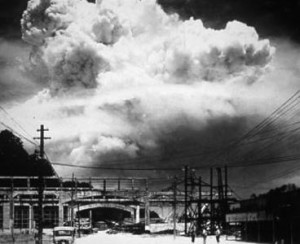
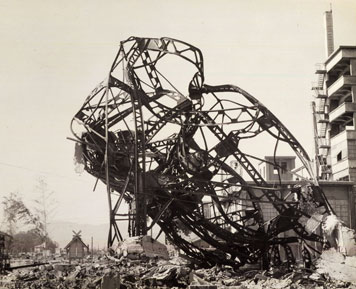
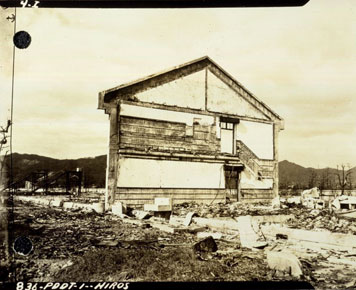
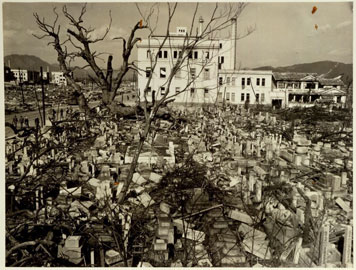

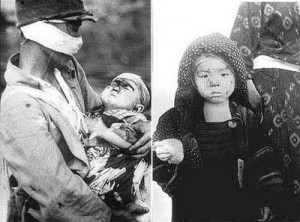
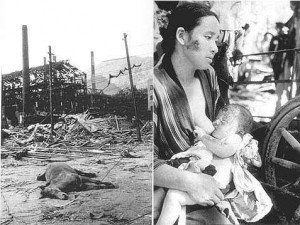
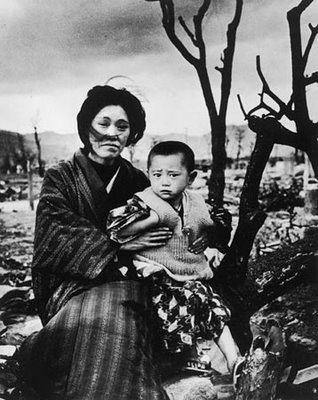
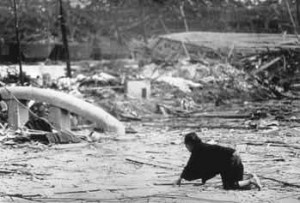
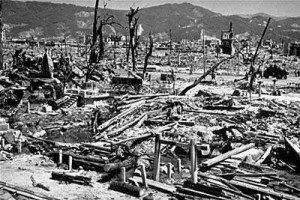
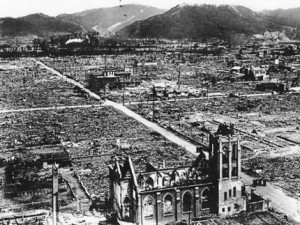
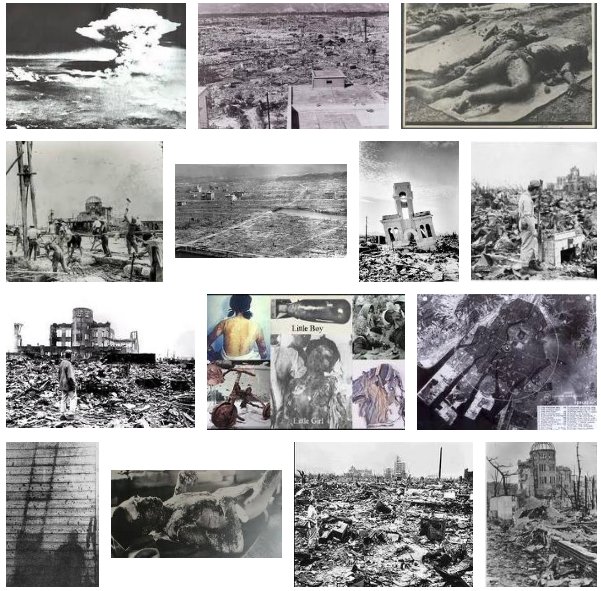


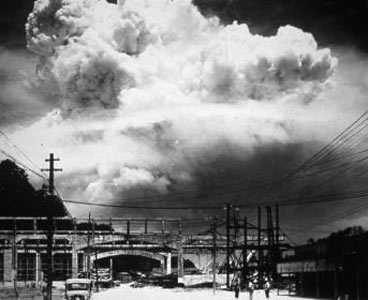
 It was over this section of Nagasaki that the second atomic bomb exploded at 11:02 a.m., August 9, 1945. The damages inflicted on Nagasaki by the atomic bombing defy description. The 20 machi or neighborhoods within a one kilometer radius of the atomic bombing were completely destroyed by the heat flash and blast wind generated by the explosion and then reduced to ashes by the subsequent fires. About 80% of houses in the more than 20 neighborhoods between one and two kilometers from the hypocenter collapsed and burned, and when the smoke cleared the entire area was strewn with corpses. This area within two kilometers of the hypocenter is referred to as the