Liberty, Equality, Solidarity: Toward a Dialectical Anarchism
It’s March 2010. It has now been two years since my essay Liberty, Equality, Solidarity
appeared in Roderick and Tibor’s Anarchism/Minarchism anthology. Which means I can now do this. Enjoy!
Liberty, Equality, Solidarity: Toward a Dialectical Anarchism
Written in 2006, published in print in 2008.
Reprinted with permission of the Publishers from Liberty, Equality, Solidarity: Toward a Dialectical Anarchism
in Anarchism/Minarchism, ed. Roderick T. Long and Tibor R. Machan (Ashgate, 2008). pp. 155-188. If you reprint this article, please retain this attribution.

The purpose of this essay is political revolution. And I don’t mean a "revolution" in libertarian political theory, or a revolutionary new political strategy, or the kind of "revolution" that consists in electing a cadre of new and better politicians to the existing seats of power. When I say a "revolution," I mean the real thing: I hope that this essay will contribute to the overthrow of the United States government, and indeed all governments everywhere in the world. You might think that the argument of an academic essay is a pretty slender reed to lean on; but then, every revolution has to start somewhere, and in any case what I have in mind may be somewhat different from what you imagine. For now, it will be enough to say that I intend to give you some reasons to become an individualist anarchist,[1] and undermine some of the arguments for preferring minimalist government to anarchy. In the process, I will argue that the form of anarchism I defend is best understood from what Chris Sciabarra has described as a dialectical orientation in social theory,[2] as part of a larger effort to understand and to challenge interlocking, mutually reinforcing systems of oppression, of which statism is an integral part—but only one part among others. Not only is libertarianism part of a radical politics of human liberation, it is in fact the natural companion of revolutionary Leftism and radical feminism.
My argument will take a whole theory of justice—libertarian rights theory[3]—more or less for granted: that is, some version of the "non-aggression principle" and the conception of "negative" rights that it entails. Also that a particular method for moral inquiry—ethical individualism—is the correct method, and that common claims of collective obligations or collective entitlements are therefore unfounded. Although I will discuss some of the intuitive grounds for these views, I don’t intend to give a comprehensive justification for them, and those who object to the views may just as easily object to the grounds I offer for them. If you have a fundamentally different conception of rights, or of ethical relations, this essay will probably not convince you to become an anarchist. On the other hand, it may help explain how principled commitment to a libertarian theory of rights—including a robust defense of private property rights—is compatible with struggles for equality, mutual aid, and social justice. It may also help show that libertarian individualism does not depend on an atomized picture of human social life, does not require indifference to oppression or exploitation other than government coercion, and invites neither nostalgia for big business nor conservatism towards social change. Thus, while my argument may not directly convince those who are not already libertarians of some sort, it may help to remove some of the obstacles that stop well-meaning Leftists from accepting libertarian principles. In any case, it should show non-libertarians that they need another line of argument: libertarianism has no necessary connection with the "vulgar political economy" or "bourgeois liberalism" that their criticism targets.
The threefold structure of my argument draws from the three demands made by the original revolutionary Left in France: Liberty, Equality, and Solidarity.[4] I will argue that, rightly understood, these demands are more intertwined than many contemporary libertarians realize: each contributes an essential element to a radical challenge to any form of coercive authority. Taken together, they undermine the legitimacy of any form of government authority, including the "limited government" imagined by minarchists. Minarchism eventually requires abandoning your commitment to liberty; but the dilemma is obscured when minarchists fracture the revolutionary triad, and seek "liberty" abstracted from equality and solidarity, the intertwined values that give the demand for freedom its life, its meaning, and its radicalism. Liberty, understood in light of equality and solidarity, is a revolutionary doctrine demanding anarchy, with no room for authoritarian mysticism and no excuse for arbitrary dominion, no matter how "limited" or benign.
Liberty

Individual liberty is essential to political justice for both minarchist and anarchist libertarians. Both understand political liberty as freedom from organized coercion: force, under libertarian theory, can only be legitimate in defense of an individual person’s liberty, never when initiated against those who have not trespassed against any identifiable victim. Libertarians often draw boundaries between liberty and invasion through the principle of self-ownership: you are rightly your own master, and nobody else, individually or collectively, is entitled to claim you as their property.[5] That includes governments: self-ownership is held to be unconditional and "prepolitical," in that it does not depend on the guarantees of political constitutions or legislation, but rather logically precedes them and constrains the constitutions and legislation that can legitimately be established. Thus anarchists and minarchists agree that political power should be subordinated to the principle of self-ownership, and everyone left alone to do as she pleases with her own person and property provided she respects the same freedom for others. But they disagree over what these principles entail. Minarchists argue that the rights of liberty and self-defense, delegated and institutionalized, establish the legitimacy of a "night-watchman" State,[6] limited by a written constitution and devoted to the rule of law. For anarchists, the rights of liberty and self-defense expose even the "night-watchman" State as professionalized usurpation, and reveal all government laws and written constitutions as mere paper without authority. Such a conflict demands explanation, and clarification of the terms of the dispute.
I won’t hazard a definition of either "government" or "state" here, but some essential features can be described. States have governments, and governments, as such, claim authority over a defined range of territory and citizens. Governments claim the right to issue legitimate orders to anyone subject to them, and to use force to compel obedience.[7] But governments claim more than that: after all, I have the right to order you out of my house, and to shove you out if you won’t go quietly. Governments claim supreme authority over legally enforceable claims within their territory; while I have a right to order you off my property, a government claims the right to make and enforce decisive, final, and exclusive orders on questions of legal right[8]—for example, whether it is my property, if there is a dispute, or whether you have a right to stay there. That means the right to review, and possibly to overturn or punish, my demands on you—to decisively settle the dispute, to enforce the settlement over anyone’s objections, and deny to anyone outside the government the right to supersede their final say on it. Some governments—the totalitarian ones—assert supreme authority over every aspect of life within their borders; but a "limited government" asserts authority only over a defined range of issues, often enumerated in a written constitution. Minarchists argue not only that governments should be limited in their authority, but specifically that the supreme authority of governments should be limited to the adjudication of disputes over individual rights, and the organized enforcement of those rights. But even the most minimal minarchy, at some point, must claim its citizens’ exclusive allegiance—they must love, honor and obey, forsaking all others, or else they deny the government the prerogative of sovereignty. And a "government" without sovereign legal authority is no government at all.
Authority, in the political sense, is correlative with deference. Insofar as Twain is subject to Norton’s authority, Twain is obliged to defer to Norton’s decisions, and Norton can compel him to obey. But the sort of deference must be carefully distinguished. Robert Paul Wolff notes that
An authoritative command must … be distinguished from a persuasive argument. When I am commanded to do something, I may choose to comply even though I am not being threatened, because I am brought to believe that it is something which I ought to do. If that is the case, then I am not, strictly speaking, obeying a command, but rather acknowledging the force or rightness of a prescription. … But the person himself [sic] has no authority—or, to be more precise, my complying with his command does not constitute an acknowledgment on my part of any such authority. (1970, 6)
Reason is no respecter of persons, but authority is personal: if Norton has legitimate authority over Twain, then Twain’s obligation to defer doesn’t come from the nature of what Norton decided, but from the fact that Norton decided it.[9] Wolff’s point could be sharpened by further distinguishing epistemic authority from imperative authority. There are cases where you should defer to an authority because she possesses some special expertise on the issue at hand.[10] But this is more scientific authority than political authority, and not really what Wolff seems to have in mind. The reason that lawyers bring their cases before the Supreme Court is not just that the Nine have some special expertise on the requirements of the law. Maybe they do, but the reason that others are supposed to defer to their judgment has to do with the offices they personally hold; their status is constitutive of the binding force of the judgment. However expert a mere lawyer may be, her opinion still amounts only to a brief, not a ruling, unless and until the judge personally authorizes it. It’s not that the issue lies within the court’s expertise, but that it (supposedly) lies within their prerogative.
It is not enough, then, for a minarchist just to postulate an ideal government that makes some rulings worth enforcing on their own merits. If a judgment is worth enforcing on its own merits, then it surely is perfectly legitimate to enforce it, but then the legitimacy comes from the content of the judgment, not from its source.[11] That justifies enforcing the judge’s ruling, but it does not establish that the judge’s authorization confers any special legitimacy on the enforcement, above or beyond what private citizens could confer, either individually or cooperatively in private "defense associations," given enough wisdom, study, and application. Minarchists need a theory that legitimates exclusive government authority through the special positions that government agents occupy, and the sovereign status of the government they represent. Without one, they have no justification for the special prerogatives claimed by even the most scrupulously limited of governments.
I claim that minarchists cannot consistently offer the kind of theory that they need to offer, because no possible theory can connect sovereign authority to legitimacy, without breaking the connection between legal right and individual liberty. My case for this claim consists of three challenges, each developed in the anarchist literature, which demonstrate a conflict between individual liberty and one of the forms of special authority that minarchists have traditionally wanted governments to exercise.[12] Since the clearest expression of the first, and most basic, challenge is in Roy Childs’s "Open Letter to Ayn Rand," we might call it the Childs challenge. Rand argues that a government must be strictly limited to the defensive use of force in order to be morally distinguishable from a robber gang.[13] She holds that even the legitimate functions of a properly limited government must be funded voluntarily by the governed, condemning taxation in any form.[14] However, she insists on the legitimacy of sovereignty and explicitly rejects individualist anarchism.[15] Childs, accepting Rand’s description of a government as "an institution that holds the exclusive power to enforce certain rules of social conduct in a given geographical area,"[16] argues that no institution can claim that authority and remain limited to the defensive use of force at the same time:
Suppose that I were distraught with the service of a government in an Objectivist society. Suppose that I judged, being as rational as I possibly could, that I could secure the protection of my contracts and the retrieval of stolen goods at a cheaper price and with more efficiency. Suppose I either decide to set up an institution to attain these ends, or patronize one which a friend or a business colleague has established. Now, if he [sic] succeeds in setting up the agency, which provides all the services of the Objectivist government, and restricts his more efficient activities to the use of retaliation against aggressors, there are only two alternatives as far as the "government" is concerned: (a) It can use force or the threat of it against the new institution, in order to keep its monopoly status in the given territory, thus initiating the use or threat of physical force against one who has not himself initiated force. Obviously, then, if it should choose this alternative, it would have initiated force. Q.E.D. Or: (b) It can refrain from initiating force, and allow the new institution to carry on its activities without interference. If it did this, then the Objectivist "government" would become a truly marketplace institution, and not a "government" at all. There would be competing agencies of protection, defense and retaliation—in short, free market anarchism. (Childs 1969, ¶ 8)
Rand’s theory of limited government posits an institution with sovereign authority over the use of force, but her theory of individual rights only allows for the use of force in defense against invasions of rights. As long as private defense agencies limit themselves to the defense of their clients’ rights, Rand cannot justify using force to suppress them. But if citizens are free to cut their ties to the "government" and turn to private agencies for the protection of their rights, then the so-called "government" no longer holds sovereign authority to enforce its citizens’ rights; it becomes only one defense agency among many.[17] Childs formulated his argument as an internal critique of Ayn Rand’s political theory, but his dilemma challenges any theory combining libertarian rights with government sovereignty. Any "limited government" must either be ready to forcibly suppress private defense agencies—in which case it ceases to be limited, by initiating violence against peaceful people—or else it must be ready to coexist with them—abdicating its claim to sovereignty and ceasing to be a government. Since maintaining sovereignty requires an act of aggression, any government, in order to remain a government, must be ready to trample the liberty of its citizens, in order to establish and enforce a coercive monopoly over the protection of rights.[18]
At this point, some minarchists—most famously Robert Nozick—accept that a properly limited government cannot simply suppress competition from rights-respecting defense agencies (without ceasing to be properly limited), but reply that it can rightfully constrain competing defense agencies to obey certain norms, and in particular to respect certain procedural immunities for the accused. A lynch mob has no right to demand that they be allowed to "compete" with courts; a properly limited government has the right to prohibit procedures that impose unacceptable risks of punishment on the innocent.[19] If it can prohibit unreliable procedures, then it can force defense associations either to adopt permitted procedures or disband. But then government sovereignty reasserts itself, as the government becomes "the only generally effective enforcer of a prohibition on others’ using unreliable enforcement procedures … and … oversees these procedures" (Nozick 1974, 113–114). If a properly limited government reserves the right to authorize enforcement by approved defense agencies, and prohibit enforcement by rogue defense agencies, then it remains the sovereign authorizer of enforcement, even if it becomes one of many direct providers.
Governments probably are entitled to forbid enforcement procedures that violate the procedural immunities due to the accused. But unless the minarchist introduces some further reason to reserve this prerogative for the government, the Childs challenge applies as much to the protection of procedural immunities as to the ordinary protection of rights. If the government has a right to suppress rogue agencies, then so does anyone, as a matter of individual self-defense.[20] The universality of the right draws out a second point. Nozick makes the transition from dominant protective agency to minimal State by using language that suggests deputizing private citizens: the government makes a list of who can be trusted to enforce the law, and if you’re not on the list, then the government will stop you from taking the law into your own hands. What matters is whether or not the government has given you permission to act as a law-enforcer. The picture depends on a blurring of the distinction amongst argument, authoritative testimony, and prerogative. Defense associations may have the right to stop other enforcers from using unreliable procedures, but whether a procedure is unacceptably risky or not is a matter of fact, which can be characterized and discovered independently of the say-so of the government. The government’s seal of approval plays no constitutive role in the right of an agency to use procedures that are demonstrably legitimate, and the government’s own procedures must be subject to objective criticism as much as any private enforcer’s. A right to suppress unacceptably risky efforts at enforcement establishes no right to demand direct oversight of agencies’ procedures,[21] or to suppress "unauthorized" enforcers simply for not having the official approval of the government.
The language of "permission," "prohibition," and "oversight" obscures the distinction; but in fact the protection of procedural immunities is not properly understood in terms of giving permission at all, but rather respecting a general right.[22] The more generally and impersonally a defense agency specifies its procedural protections, the less they will resemble anything that could intelligibly be described as "oversight," "giving permission," or , broadly, the exercise of political authority. The more they resemble interventionist "oversight," "giving permission," or political authority, the more they will tread on the freedom of innocent people to enforce their own rights using reliable but unofficial procedures. The government in Nozick’s "minimal State" must either adopt general policies allowing for free competition without requiring grants of official permission—and once again ceases to exercise sovereignty—or else it must enforce its demands of oversight and official approval, even on agencies that are following reliable procedures—and once again ceases to be limited to defensive uses of force.
There is another possible reply I find more promising—indeed, convincing. Strictly speaking, Childs’s dilemma applies to only one branch of the government: he demonstrates that governments cannot claim a monopoly on enforcing the rights of citizens, i.e., on the executive functions of government. It establishes that anyone, not just the government and its official deputies, can enforce citizens’ rightful claims to person and property. But how is it determined which claims are rightful, and which claims are baseless? Robert Bidinotto has objected that anarchism demands not only "’competition’ in the protection of rights," but also "’competition’ in defining what ‘rights’ are" (1994, ¶ 20); without a government established as the "final arbiter on the use of force in society" (1994, ¶ 25), there is no way to fix objective rules for the assertion of rights, and no possibility of meaningful settlement of disputes over rights-claims. So even if a minimal government cannot claim a monopoly on the executive functions, perhaps a "microscopic" government could claim a monopoly on legislation.[23]
Provided that the government legislature and government courts do not try to interfere with protection of rights by private citizens or defense associations, I cannot see how the Childs challenge could undermine sovereignty over legislation. But a second challenge, vigorously expressed in the later works of Lysander Spooner, can. In the "Letter to Grover Cleveland," Spooner argues that all legislation is either criminal, tyrannical, or idle:[24]
Let me then remind you that justice is an immutable, natural principle; and not anything that can be made, unmade, or altered by any human power. … Lawmakers, as they call themselves, can add nothing to it, nor take anything from it. Therefore all their laws, as they call them, – that is, all the laws of their own making, – have no color of authority or obligation. It is a falsehood to call them laws; for there is nothing in them that either creates men’s [sic] duties or rights, or enlightens them as to their duties or rights. … If they command men to do justice, they add nothing to men’s obligation to do it, or to any man’s right to enforce it. They are therefore mere idle wind, such as would be commands to consider the day as day, and the night as night. If they command or license any man to do injustice, they are criminal on their face. If they command any man to do anything which justice does not require him to do, they are simple, naked usurpations and tyrannies. If they forbid any man to do anything, which justice could permit him to do, they are criminal invasions of his natural and rightful liberty. In whatever light, therefore, they are viewed, they are utterly destitute of everything like authority or obligation. (1886, ¶Â¶ 4–7)
Minarchists usually agree that governments have no legitimate authority to command violations of individual rights, or to forbid acts permitted by individual liberty—the motive for limiting government was the idea that legitimate political authority only exists within the boundaries drawn by individual rights. But Spooner’s point about laws that command justice or forbid injustice—prohibiting murder, theft, rape, etc.—may be harder to grasp. It is, after all, true that governments and defense associations are perfectly justified in enforcing those laws. But what must be appreciated here is that the obligation to follow those laws, and the right to enforce them, derives entirely from the content of the laws and not their source. The government is justified in enforcing those laws only because anybody would be justified in enforcing justice, whether or not self-styled legislators have signed off on a document stating "Murder is a crime most foul." The document itself is idle; it neither obliges nor authorizes anyone to do anything they were not already obliged or free to do. The government is not so much making new laws that impose obligations, but (at best!) making declarations that recognize preexisting obligations—which could be objectively specified by anyone, with or without official approval from anyone.[25] Any right to override another’s assessment would derive from objective and impersonal considerations of justice, demonstrated through argument or attested on the basis of expertise,[26] not from political prerogatives invested in the so-called legislature. Anyone, regardless of status, has the right to make correct declarations about justice, and override or ignore incorrect declarations. With no special prerogative to establish rights, and no special prerogative to enforce them (as per the Childs challenge), the claim of "sovereignty" for a "properly limited government" must involve either usurpation or idle pretense.
That said, I do think that there is one final straw for the minarchist to grasp, even after the Childs challenge and the Spooner challenge have been taken into account, relating to a lacuna in Spooner’s account of the possible relationship between a piece of legislation and the background principles of justice. Spooner discussed three possible cases: (1) the legislation may demand something that contradicts what individual rights require—making it criminal; (2) it may demand something that exceeds what individual rights require—making it tyrannical; (3) it may demand something identical to what individual rights require—making it nugatory. Spooner’s argument presumes that the "prepolitical" framework of individual rights determines every question of enforceable obligations, leaving no room for legislators to exercise legitimate prerogative. But while these options cover the bulk of both the criminal and the civil law, Spooner has overlooked one important possibility: there may be cases where the principle of self-ownership does not fully specify how to apply individual rights in the case at hand.
It may be that respect for individual rights requires that cars going opposite directions on a highway should drive on opposite sides—so that drivers will not needlessly endanger each other’s lives. But self-ownership alone surely has nothing to say about whether motorists should drive on the left or the right. It requires that some rule be adopted, and that once adopted, each motorist obey it. But which rule to adopt is a question that needs to be settled by considerations other than individual rights. Medieval legal writers described similar cases as reducing the natural law (in the sense of making it more specific); the idea is to spell out the details for cases where the principles of natural justice underdetermine the correct application of individual rights. It may seem, then, that this ekes out a place for positive law-making in spite of the Spooner challenge: since there has to be some specification of how to apply rights in these cases, but more than one specification is compatible with the requirements of individual rights, a minarchist might think that you need a government to take on the prerogative of specifying which one to adopt.[27]
If the Childs challenge undermined the executive authority of the government, and the Spooner challenge undermined its legislative authority, you might think of this move as preserving judicial authority for a sovereign government. Sovereignty here means the right to serve as the final authority on setting out auxiliary principles for applying individual rights to specific cases where the requirements of self-ownership are vague or contingent. To be sure, the limits put on the scope of its authority by the Childs challenge and the Spooner challenge would be severe. The government would have no executive and no general legislature; it would have no special privileges to enforce and the scope of its law-making would be limited to ironing out minor details within a system of obligations almost entirely predetermined by the non-aggression principle. It would be a sort of "ultramicroscopic government," so small that its influence on the specification and protection of rights could barely be detected at all.
Although I think that the problem of reducing the natural law is one of the hardest problems for anarchist theory to resolve, I do not think that the minarchist is actually in a stronger position than the anarchist. The difficulty for the minarchist solution can be brought out with a final challenge, also from the works of Lysander Spooner. This second Spooner challenge is expressed most clearly in No Treason no. 1:
The question still remains, how comes such a thing as "a nation" to exist? How do millions of men [sic], scattered over an extensive territory – each gifted by nature with individual freedom; required by the law of nature to call no man, or body of men, his masters; authorized by that law to seek his own happiness in his own way, to do what he will with himself and his property, so long as he does not trespass upon the equal liberty of others; authorized also, by that law, to defend his own rights, and redress his own wrongs; and to go to the assistance and defence of any of his fellow men who may be suffering any kind of injustice – how do millions of such men come to be a nation, in the first place? How is it that each of them comes to be stripped of his natural, God-given rights, and to be incorporated, compressed, compacted, and consolidated into a mass with other men, whom he never saw; with whom he has no contract; and towards many of whom he has no sentiments but fear, hatred, or contempt? How does he become subjected to the control of men like himself, who, by nature, had no authority over him; but who command him to do this, and forbid him to do that, as if they were his sovereigns, and he their subject; and as if their wills and their interests were the only standards of his duties and his rights; and who compel him to submission under peril of confiscation, imprisonment, and death?
Clearly all this is the work of force, or fraud, or both.
…. We are, therefore, driven to the acknowledgment that nations and governments, if they can rightfully exist at all, can exist only by consent. (Section III, ¶Â¶ 1–6)
Spooner’s aim in No Treason is, famously, to demonstrate that citizens are only obliged to recognize the sovereign authority when, and only for as long as, they genuinely, individually consent to recognize its authority. What I want to draw attention to are the reasons that Spooner suggests for the requirement. Here, Spooner questions the notion of a political jurisdiction, asking what by what right some gang calling itself "the government," however strictly limited, gains authority over otherwise unrelated people who never had anything to do with them? If there is some question of different ways in which rights could be applied, then what sort of process and what sorts of relationship justify the special claim that even an ultramicroscopic government would make to establish their judgment in preference to all the others?
Spooner suggests that genuine, individual consent can explain their authority over a jurisdiction. Suppose that Twain and Kearney have a dispute over how long land must be left unused before it can be reclaimed as abandoned property. If they both agree to turn the question over to Norton and defer to his judgment, then it’s clear how Norton got jurisdiction over the case: Twain and Kearney agreed to bind themselves to his judgment. But suppose that Twain and Kearney never agreed to turn the question over to Norton, perhaps never even had anything to do with Norton at all. If Norton should insist that they should still defer to his judgment, because he is the Emperor, then Norton has the burden of explaining what binds Twain and Kearney to him in such a way that his judgment is more authoritative than anybody’s arbitrary fiat. Even if the vague boundary between between Kearney’s and Twain’s claims needs to be made more precise, where does Norton, specifically, get the right to enforce his specification, except by consent of the disputing parties?
If consent is the standard, then the consent must be genuine. In particular, it must be possible to refuse consent, or to withdraw it later once given.[28] That means that consent cannot justify any government body claiming permanent and irrevocable sovereignty. If a court’s jurisdiction depends on the consent of those who have put themselves under it, then each of those people must be individually free to take herself out of the jurisdiction and create or align herself with another jurisdiction. But without consent, it’s hard to see what distinguishes the government’s assertion of special authority from arbitrary fiat. If a community has settled on the rule of one year rather than two for abandonment, the government has no authority to arbitrarily override the settled conventions. If folks are divided over the right rule to follow, but have agreed to submit the dispute to some third party whom they trust more than the government, the government has no authority to butt in to enforce its own decision over the agreed terms. If folks are divided over the right rule to follow, and have not made any steps toward resolving the dispute, then the government has no authority to arbitrarily force itself on them as the arbiter.[29]
Liberty cannot coexist with government sovereignty, however "limited." The claim of sovereignty must be backed up by coercion at some point, given up or reduced to a vacuous arrangement of words, whether sovereignty is claimed over the enforcement of rights, the definition of rights, or the application of rights. Any way you slice it, government sovereignty means an invasion of individual freedom, and individual freedom means, ultimately, freedom from the State.
Equality
The standard against which I have been measuring minarchist governments in each of these three challenges is based on an intuitive notion of Liberty that I have taken more or less for granted. That might expose me to allegations that I’ve made my case by misapplying or inflating the concept of "liberty" beyond the conceptual or material context that gives it meaning. In my defense, I want to offer some remarks on the conceptual context within which I think the principles of self-ownership and individual liberty arise, and to consider two possible objections to the argument of the previous section. First, it might be held that I have demonstrated a genuine conflict between individual liberty and government authority, but that coercion is justified in the limited case of establishing government sovereignty, either because some other important value is at stake, or else because a little coercion is a necessary evil to avoid much greater or much worse coercion. Or, it might be held that I have only seemingly demonstrated a conflict between individual liberty and government authority by applying the concepts of liberty and coercion outside of the context within which they are meaningful: in this case, government authority could not be properly characterized as either "coercive" or "non-coercive," perhaps because (for example) notions such as coercion and freedom are only meaningful within a system of rights, and a system of rights is only meaningful in the context of a functioning legal system. I think that either charge reflects a failure to appreciate the conceptual relationship between the revolutionary demands for Liberty and Equality.
Attaching my controversial understanding of liberty to the standard of equality might seem less than prudent, if my interlocutor is a minarchist libertarian. Modern libertarians make demands for individual liberty with passion and urgency; their reaction to demands for social equality is more often tepid if not openly hostile. Criticism of social inequality is much more likely to be heard from the mouths of unreconstructed statists, and "egalitarianism" is hardly a term of praise in most libertarian intellectual circles. But I shall argue that equality, rightly understood, is the best grounds for principled libertarianism. When the conception of individual liberty is uprooted from the demand for social equality, the radicalism of libertarianism withers; it also leaves the libertarian open to a family of conceptual confusions which prop up many of the common minarchist arguments against anarchism.
My task, then, is to explain what I mean by "equality, rightly understood." I certainly do not intend to suggest that liberty is conceptually dependent on economic equality (of either opportunity or outcome), or on equality of socio-cultural status.[30] But the equality I have in mind is also much more substantive than the formal "equality before the law" or "equality of rights" suggested by some libertarians and classical liberals, and rightly criticized by Leftists as an awfully thin glove over a very heavy fist. Formal equality within a statist political system, pervaded with pillage and petty tyranny, is hardly worth fighting for; the point is to challenge the system, not to be equally shoved around by it. The conception of equality that I have in mind has a history on the Left older and no less revolutionary than the redistributionist conception of socioeconomic equality. It is the equality that the French revolutionaries had in mind when they demanded egalité, and which the American revolutionaries had in mind when they stated:
We hold these truths to be self-evident, that all men [sic] are created equal, that they are endowed by their Creator with certain unalienable Rights, that among these are Life, Liberty and the pursuit of Happiness. (Jefferson 1776a ¶ 2)
Jefferson is making revolutionary use of concepts drawn from the English liberal tradition. Equality, for Jefferson, is the basis for independence, and the grounds from which individual rights derive.[31] Locke elucidates the concept when he characterizes a "state of Perfect freedom"—the state to which everyone is naturally entitled—as
A State also of Equality, wherein all the Power and Jurisdiction is reciprocal, no one having more than another: there being nothing more evident, than that Creatures of the same species and rank promiscuously born to all the same advantages of Nature, and the use of the same faculties, should be equal one amongst another without Subordination or Subjection …. (1690, II. 4. ¶ 2)
The Lockean conception of equality that underwrites Jefferson’s revolutionary doctrine of individual liberty is, as Roderick Long (2001a) has argued, equality of political authority. Jefferson and Locke denied, as arbitrary, the Old Regime’s claim of a natural entitlement to lordship over their fellow creatures. Ranks of superior and inferior political authority were not established by natural differences in station or ordained by the will of God Almighty. Political coercion is the material expression of a claim of unequal authority: one person is entitled to dictate terms over another’s person and property, and the other can be forced to obey. Declaring universal equality thus means denying all such claims of lordship, and, thus, asserting that everyone has authority over herself, and over herself alone. Equality is the context within which the principle of self-ownership, and thus the demand for individual freedom, takes root. This connection can be seen most explicitly in the second Spooner challenge above. Spooner’s demand to know how free and independent people are "compacted" together into a State against their will is intimately connected with the protest against arbitrary assertions of a right to dominate the affairs of others. Long points out that neither socioeconomic equality nor formal legal equality "calls into question the authority of those who administer the legal system; such administrators are merely required to ensure equality, of the relevant sort, among those administered. … Lockean equality involves not merely equality before legislators, judges, and police, but, far more crucially, equality with legislators, judges, and police" (¶Â¶ 22–25). Whether or not Jefferson was right to treat the equality of authority as self-evident, a minarchist should hardly want to deny that it is true. The idea that legitimate governments must be constrained by the non-aggression principle no less than private citizens, and the individualist conception of rights, seem clearly rooted in the notion of equal authority.[32]
But whenever a minarchist brandishes equality of authority against statism, she also undermines her case for any form of State sovereignty. Considering liberty in light of equality systematically undermines both of the objections considered above, and justifies the unlimited demand for Liberty that I have employed. Insofar as the first objection depends on consequentialist calculation—holding that liberty can be sacrificed either in the name of other goods, or in the name of maximizing the total amount of liberty going around—it necessarily conflicts with a demand for equal authority. The objection presupposes someone to do the consequentialist calculations, supposedly entitled to treat all goods, no matter whom they belong to, as common booty to be distributed. By claiming the right to volunteer not only her own liberty, but also other people’s liberty for sacrificial duty, the consequentialist exempts herself from the standard of equality, pretending that she is entitled to stand over everyone and pass judgment on their liberty, taking some from Peter and rendering some to Paul in the name of the cause. Equality means that other people’s lives and livelihoods are not hers to give, no matter the results she might get from it.[33]
The second sort of objection conflicts with equality in a different way. It suggests, not that someone can legitimately violate one person’s liberty in order to secure benefits for others, but that the force involved in establishing sovereignty cannot be assessed under standards of liberty at all, because the categorization of force as either aggressive or defensive is only meaningful within the context of a functioning government legal order. Thus, Bidinotto’s argument (1994) that the demand for liberty, when applied unconditionally outside the background context of a limited sovereign government, divorces rights-claims from the "final standard" to settle them, and degrades into a programme for unrestrained tyranny and civil war.
But it is Bidinotto, not the anarchist, who strips the concept of liberty out of its proper context. The objection depends on a particular picture of the State and its laws, which is as metaphysically illusive as it is captivating. The State is imagined as a sort of titan standing over civil society, binding it to its will and acting on it from without. The constraints that a particular government imposes under the mantle of State authority may be tyrannical or just, but whether used properly or abused, the peculiar standpoint and the constraining force of the State seem necessary for any stable social order, and sufficient to decisively settle disputes just by being asserted. Since anarchy dispenses with the external constraints of the State, the minarchist feels that all rights-claims will be left, as it were, hanging in the air, with no final authority to ground them. It is this mystique of the State that Randolph Bourne set out to expose by distinguishing amongst the Nation, the State, and the Government:
The State is the country acting as a political unit, it is the group acting as a repository of force, determiner of law, arbiter of justice. … Government on the other hand is synonymous with neither State nor Nation. It is the machinery by which the nation, organized as a State, carries out its State functions. Government is a framework of the administration of laws, and the carrying out of the public force. Government is the idea of the State put into practical operation in the hands of definite, concrete, fallible men. It is the visible sign of the invisible grace. It is the word made flesh. And it has necessarily the limitations inherent in all practicality. Government is the only form in which we can envisage the State, but it is by no means identical with it. That the State is a mystical conception is something that must never be forgotten. Its glamor and its significance linger behind the framework of Government and direct its activities. (Bourne 1919, § 1 ¶Â¶ 8-9)
Equality of authority dulls the mystical glamor of State authority. The law is a human institution, and the legitimate authority of individual rights-claims does not need to be grounded in the dominance of a sovereign, or proclaimed from a standpoint beyond the fragile social relationships among fallible, mortal human beings. A good thing, too, since there is no Olympian standpoint for the State to occupy; governments are made of people with no more special authority than you or I—even when they are speaking ex cathedra in the name of the State. Rights are grounded in the claims that each of us, as ordinary human beings, are entitled to hold each other to, and are implemented not by paper laws but by the concrete social and cultural relationships we participate in. Roderick Long (2008) shows that if the "final standard" demanded by Bidinotto is the realistic finality that comes from a broad consensus that an issue has been settled and should not be revisited, then it can be achieved through anarchist institutions no less than through a government; if the "finality" demanded is some sort of self-applying, self-grounding finality immune to even the possibility of further dispute, then that is not available even under a government, the mystique of State authority notwithstanding.[34] The choice is not between a system where disputes are never meaningfully settled and one where they are, but between one in which they are settled through a decentralized network of institutions holding each other in check, or through a centralized hierarchy forcing others to defer to it. And, as Long argues, anarchy actually provides a better hope for disputes to be settled justly than minarchy—especially when an arbitrator is herself a party to the dispute—because under anarchy the watchers are themselves watched, and are less able to force through unjust rulings simply in virtue of their dominant position.
The context of a concept is often conceived as a constraint on the concept, and context-dropping as a matter of applying the concept more widely than it should be applied. But dropping the context of a concept could make you go wrong in either of two ways: improper abstraction might inflate the application of the concept beyond its domain of significance; or it might conceal the concept’s significance in cases where it should be applied. Understood in the context of Equality, the principle of Liberty becomes more radical, not less, challenging all forms of State mysticism with the standard of individual sovereignty. Dispelling the mystical conception of the State also reveals the need for concrete attitudes, practices and relationships to sustain a free society, not just paper laws to "limit" tyranny. Which brings me to Solidarity.
Solidarity

I have chosen the word "Solidarity" to stand for a family of cultural and political commitments usually associated with the radical Left, among them labor radicalism, populism, internationalism, anti-racism, gay liberation, and radical feminism. These commitments share a common concern with the class dynamics of power and a sensitivity to expressions of non-governmental forms of oppression. They demand fundamental change in the cultural and material conditions faced by oppressed people, and propose that the oppressed organize themselves into autonomous movements to struggle for those changes. They also emphasize strikes, boycotts, mutual aid, worker cooperatives, and other forms of collective action, both as a means to social transformation and also as foundational institutions of the transformed society once achieved. These shared concerns and demands have often been summed up in the call for "social justice"—a slogan assailed by Hayek (1978) and reflexively associated, by libertarians and state Leftists alike, with expansion of the anti-discrimination and welfare bureaucracies.
But solidaritarian ends can be separated from authoritarian means, and the relationship between Liberty and Solidarity has not always been so chilly. 19th century libertarians, particularly the individualist anarchists associated with Benjamin Tucker’s magazine Liberty, identified with the cultural radicalism of their day – including the labor movement, abolitionism, First Wave feminism, freethought, and "free love." Indeed, while Tucker described his position as "Absolute Free Trade; … laissez faire the universal rule" (1888, ¶ 21), he and his circle routinely identified themselves as socialists—not to set themselves against the ideal of the free market, but against actually existing big business. They argued that plutocratic control over finance and capital was the creature of, and the driving force behind, government economic regimentation and government-granted monopolies.[35] The Tuckerite individualists saw the invasive powers of the State as intimately connected and mutually reinforcing with the exploitation of labor, racism, patriarchy, and other forms of oppression, with governments acting to enforce social privilege, and drawing ideological and material support from existing power dynamics.[36] From their point of view, attacking statism alone, without addressing the broader social context, would be narrow and ultimately self-frustrating.
Today the leading intellectual force in the effort to connect libertarianism with a comprehensive vision of human liberation is Chris Sciabarra,[37] who has advanced the argument in a series of books and articles over the past two decades, most extensively in his "Dialectics and Liberty" trilogy (1995b, 1995a, 2000). Sciabarra persuasively advocates a dialectical orientation in libertarian social thought, which attends not only to the structural dynamics of statism but also to the extragovernmental context of statism in cultural, psychological, and philosophical dimensions. But unlike the 19th century individualists, Sciabarra argues that dialectics pose a substantial challenge to libertarian anarchism. In Ayn Rand: The Russian Radical, he sympathetically interprets Rand’s polemical defense of minarchism as a dialectical effort to transcend a false dualism between statism and anarchism (1995a, 278-283). In Total Freedom he devotes four chapters to a charitable but systematic critique of Rothbard’s anarcho-capitalism, and the underlying conception of liberty as "universally applicable, regardless of the context within which it is embedded or applied" (2000, 218). Sciabarra argues that, at crucial junctures, Rothbard idealizes the market and the State into dualistic, opposed spheres, related only through "the external, mutually antagonistic relationship between voluntarism and coercion" (2000, 355). This dualism leads Rothbard to romanticize market processes, proposing "the monistic, utopian resolution of anarcho-capitalism, in which the state’s functions were fully absorbed by the market" (360). Thus Rothbard limits libertarianism to a narrow focus on structural and political questions, and exhibits a "lack of attention to the vast context within which [libertarian principles] might exist, evolve, and thrive" (355).[38]
Whether or not Rothbard himself is actually guilty of the "unanchored utopianism" Sciabarra attributes to him (2000, 202), Sciabarra’s criticism identifies real strands of thought within the individualist anarchist tradition.[39] But in light of the discussion of Equality above, it seems that minarchists are actually far more prone to synoptic delusions and narrowly political reform than anarchists: the mystique of State authority depends on a picture of the State as an external constraint on civil society, whereas egalitarian anarchism highlights the fact that freedom is a matter of concrete relations within society. In any case, the best response to Sciabarra’s challenge is to exhibit a dialectical anarchism, which connects anarchism with a systematic understanding and critique of the dynamics of social power, both inside and outside of the State apparatus. To aid in doing so, I’d like to set out some of the different possible relationships between libertarianism and "thicker" bundles of socio-cultural commitments, which would recommend integrating the two:
Entailment thickness: the commitments might just be applications of libertarian principle to some special case, following from non-aggression simply in light of non-contradiction.[40]
Application thickness: it might be that you could reject commitments without formally contradicting the non-aggression principle, but not without in fact interfering with its proper application. Principles beyond libertarianism alone may be necessary for determining where my rights end and yours begin, or stripping away conceptual blinders that prevent certain violations of liberty from being recognized as such.
Strategic thickness: certain ideas, practices, or projects may be causal preconditions for a flourishing free society, giving libertarians strategic reasons to endorse them. Although rejecting them would be logically compatible with libertarianism, it might make it harder for libertarian ideas to get much purchase, or might lead a free society towards poverty, statism or civil war.
Grounds thickness: some commitments might be consistent with the non-aggression principle, but might undermine or contradict the deeper reasons that justify libertarian principles. Although you could consistently accept libertarianism without the bundle, you could not do so reasonably: rejecting the bundle means rejecting the grounds for libertarianism.
Conjunction thickness: commitments might be worth adopting for their own sakes, independent of libertarian considerations. All that is asserted is that you ought to be a libertarian (for whatever reason), and, as it happens, you also ought to accept some further commitments (for independent reasons).
The two extreme cases, entailment thickness and conjunction thickness, can largely be set aside, since the "relationship" between libertarianism and the further commitment is either so tight (identity) or so loose (mere conjunction) as to make the point vacuous. But the three intermediate cases of application thickness, strategic thickness, and grounds thickness make deeper connections between libertarianism and a rich set of further commitments that naturally complement libertarianism.
Consider the conceptual and strategic reasons that libertarians have to oppose authoritarianism, not only as enforced by governments but also as expressed in culture, business, the family, and civil society. If libertarianism is rooted in the principle of equality of authority, then there are good reasons to think that not only political structures of coercion, but also the whole system of status and unequal authority deserves libertarian criticism. And it is important to realize that that system includes not only exercises of coercive power, but also a knot of ideas, practices, and institutions based on deference to traditionally constituted authorities. In the political realm, these patterns of deference show up most clearly in the honorary titles, submissive etiquette, and unquestioning obedience extended to heads of state, judges, police, and other visible representatives of government "law and order." Although these rituals and habits of obedience exist against the backdrop of statist coercion and intimidation, they are also often practiced voluntarily. Similar expectations of deference show up, to greater or lesser degrees, in cultural attitudes towards bosses in the workplace, and parents in the family. Submission to traditionally constituted authorities is reinforced not only through violence and threats, but also through art, humor, sermons, historiography, journalism, childrearing, etc. Although political coercion is the most distinctive expression of inequality of authority, you could—in principle—have an authoritarian social order without the exercise of coercion. Even in an anarchist society, everyone might voluntarily agree to bow and scrape when speaking before the (mutually agreed-on) town Chief. So long as the expectation of deference was backed up only by means of verbal harangues, social ostracism of "unruly" dissenters, culturally glorifying the authorities, etc., it would violate no-one’s individual liberty and could not justifiably be resisted with force.
But while there’s nothing logically inconsistent about envisioning these sorts of societies, it is certainly weird. If the underlying reason for committing to libertarian politics is rooted in the equality of political authority, then even strictly voluntary expressions of inequality are hard to reasonably reconcile with libertarianism. Yes, the meek could voluntarily agree to bow and scrape, and the proud could angrily but nonviolently demand obsequious forms of address and immediate obedience to their fiat. But why should they? Libertarian equality delegitimizes the notion of a natural right to rule or dominate other people’s affairs; the vision of human beings as rational, independent agents of their own destiny renders deference and unquestioning obedience ridiculous at best, and probably dangerous to liberty in the long run. While no-one should be forced to treat her fellows with the respect due to equals, or cultivate independent self-reliance and contempt for the arrogance of power, libertarians certainly can—and should—criticize those who do not, and exhort our fellows not to rely on authoritarian social institutions, for reasons of both grounds and strategic thickness.
General commitments to anti-authoritarianism, if applied to specific forms of social power, have far-reaching implications for the relationship between libertarianism and anti-racism, gay liberation, and other movements for social transformation. I have written elsewhere on the strategic and conceptual importance of radical feminist insights to libertarianism, and vice versa.[41] The causal and conceptual interconnections between patriarchal authority, the cult of violent masculinity, and the militaristic State have been discussed by radical feminists such as Andrea Dworkin and Robin Morgan, as well as radical libertarians such as Herbert Spencer and, more recently, Carol Moore.[42] Moreover, the insights of feminists such as Susan Brownmiller into the pervasiveness of rape, battery, and other forms of male violence against women, present both a crisis and an opportunity for the application of libertarian principles.
Libertarianism professes to be a comprehensive theory of human freedom; what supposedly distinguishes the libertarian theory of justice is that we concern ourselves with violent coercion no matter who is practicing it. But what feminists have forced into the public eye in the last 30 years is that we live in a society where one out of every four women faces rape or battery by an intimate partner,[43] and where women are threatened or attacked by men who profess to love them, because the men coercing them believe they have a right to control "their" women. Male violence against women is nominally illegal but nevertheless systematic, motivated by the desire for control, culturally excused, and hideously ordinary. For libertarians, this should sound eerily familiar; confronting the reality of male violence means nothing less than recognizing the existence of a violent political order working alongside, and independently of, the violent political order of statism.[44] Male supremacy has its own ideological rationalizations, its own propaganda, its own expropriation, and its own violent enforcement; although often in league with the male-dominated State, male violence is older, more invasive, closer to home, and harder to escape than most forms of statism. To seriously oppose all political violence, libertarians need to fight, at least, a two-front war, against both statism and male supremacy. It is, then, important to note how the ideological dichotomy between "personal" and "political" problems, so often criticized by feminists,[45] has tended to blank out systemic male violence from libertarian analysis. And also how the writings of some libertarians on the family—especially those identified with the "paleolibertarian" political-cultural project—have amounted to little more than outright denial of male violence. Hans-Hermann Hoppe, for example, goes so far as to indulge in the conservative fantasy that the traditional "internal layers and ranks of authority" in the family are actually bulwarks of "resistance vis-a-vis the state" (Hoppe 2001 § IV). Those "ranks of authority" in the family mean the pater familias; but whether father-right is, at a given historical moment, in league with or at odds with State prerogatives, the fact that it is so widely enforced by the threat or practice of male violence makes enlisting it in the struggle against statism look much like enlisting Stalin to fight Hitler—no matter who wins, we all lose.
Considerations of grounds and strategy also suggest important connections between anarchism and the virtue of voluntary mutual aid between workers, in the form of community organizations, charitable projects, and labor unions. Once again, the underlying reasons for valuing Liberty also give good reasons for committing to voluntary solidarity with your fellow people. One could in principle believe that everyone ought to be free to pursue her own ends while also holding that nobody’s ends actually matter except her own.[46] But again, while the position is possible, it is weird; one of the best reasons for being concerned about the freedom of others to pursue their own ends is a certain generalized respect for the importance of other people’s lives and the integrity of their choices, which is intimately connected with the libertarian conception of Equality. That says nothing in favor of forcing you to participate in welfare schemes,[47] or robbing Peter to pay Paul; but it does say something for working with your neighbors in voluntary cooperative efforts to improve your own lives or the lives of others. It’s likely also that networks of voluntary aid organizations would be strategically important to individual flourishing in a free society, in which there would be no expropriative welfare bureaucracy for people living with poverty or precarity to fall back on. Projects reviving the bottom-up, solidaritarian spirit of the independent unions and mutual aid societies that flourished in the late 19th and early 20th centuries, before the rise of the welfare bureaucracy, may be essential for a flourishing free society, and one of the primary means by which workers could take control of their own lives, without depending on either bosses or bureaucrats.[48]
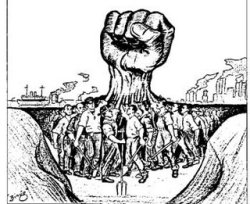
If 20th century libertarians have mostly failed to emphasize the potential for cooperative mutual aid, the failure can be traced to two related confusions, born of undialectical analysis and the failure to integrate Liberty with Solidarity. The first conflates the principles of mutual aid with government coercion in the name of "social welfare"—most dramatically in the visceral hostility most 20th century libertarians expressed towards labor unionism. Libertarian critics have often condemned unions as "bands of thugs,"[49] the government-privileged foot soldiers of a stagnant, interventionist political economy. Currently existing labor unions do use coercive means to organize—in the United States, employers are forced to enter into collective bargaining with unions that gain National Labor Relations Board recognition, and non-violent means of opposing unionization drives, such as retaliatory firing, are legally prohibited. The official, government-privileged union establishment also has for decades sought more government planning and economic intervention. But treating the existing union establishment as representative of the essential features of organized labor disregards the historical process by which unions were co-opted, captured, and domesticated by the expanding State bureaucracy during the 1920s-1950s. The process was achieved with the collaboration of one conservative faction within the labor movement, represented most visibly by the "business unionism" of the AFL, which gained leverage over its many competitors and seats in the back-rooms of power through the new system of patronage.[50] It would be hard to discover from the writings of anti-union libertarians that labor unions existed before the Wagner Act of 1935, or that around the turn of the century one of the most vibrant wings of organized labor were the radical, anarchist-led unions, most famously the I.W.W., which rejected all attempts to influence or capture State power.[51] They argued that putting economic power into the government’s hands deprived workers of control over their own fate, and wasted unions’ resources on bureaucracy and partisan maneuvering. Although they worked for incremental improvements in wages and conditions, they ultimately hoped to win not reforms of the existing capitalist system, but workers’ ownership of the "means of production"—the land, factories, and tools they labored with—not through the political means of expropriation (as the Marxists suggested), but through the economic means of free association, agitation, direct action, voluntary strikes, union solidarity, and mutual aid between workers, which would "build a new society within the shell of the old." The emerging new society, far from the central planning boards of state socialism, would be a world of independent contractors and worker-owned co-ops, organized from the bottom up by the workers themselves.
It was only through the political collaboration of the establishmentarian union bosses and the "Progressive" business class—in the form of violent persecution of the radicals, such as the Palmer raids, and government patronage to establishment unions through the NLRB—that the centralized, statist unionism of the AFL-CIO rose to dominance within the labor movement.[52] Union methods are legally regulated and union demands effectively constrained to modest (and easily revoked) improvements in wages and conditions—with issues such as workers’ voice in the workplace, let alone control of the means of production, dropped entirely. The only real power remaining to effect more substantial changes comes through their power as organized blocs for lobbying and electioneering. If unionism is today mostly statist, then it is because unions are largely what the State has made them, through the usual carrots and sticks of government interventionism.
General Motors has benefited at least as much from government patronage as the UAW, yet libertarian criticism of the magnates of state capitalism is hardly extended to business as such in the way that criticism of existing unions is routinely extended to any form of organized labor. The difference in treatment is no doubt closely connected with the emphasis many 20th century libertarians placed on defending capitalism against the attacks of state socialists. While they were right to see that existing modes of production should not be further distorted by even greater government regimentation, this insight was often perverted into the delusion that existing modes of production would be the natural outcome of an undistorted market. The confusion has been encouraged by systematic ambiguity in the term "capitalism," which has been used to name at least three different economic systems:
The free market: any economic order that emerges from voluntary exchanges of property and labor, free of government intervention and other forms of systemic coercion.
The corporate State: government intervention favoring cartelized big business, through subsidies, tax-funded infrastructure, central banking, production boards, eminent domain seizures, government union-busting, etc.
Alienation of labor: a specific form of labor market, in which the dominant economic activity is production in workplaces strictly divided by class, where most workers work for a boss, in return for a wage, surviving by renting out their labor to someone else. The shop, and the tools and facilities that make it run, are owned by the boss or by absentee owners to whom the boss reports, not by the workers themselves.
Since government intervention always ends with the barrel of a gun, free market "capitalism" and corporate state "capitalism" cannot coexist at the same time and in the same respect. "Capitalism" in the third sense—the alienation of labor—is a category independent of "capitalism" in either of the first two senses. There are many ways that a labor market might turn out; it could be organized into traditional employer-employee relationships, worker co-ops, community workers’ councils, or a diffuse network of shopkeeps and independent contractors. Unflinching free marketeers might advocate any of these, or might be indifferent as to which prevails; interventionist statists might also favor traditional employer-employee relationships (as under fascism) or any number of different arrangements (as under state communism). Once these three senses are disentangled, it is important to see how 20th century libertarian defenses of "capitalism" against interventionist critique have fallen into a second conflation, between economic defenses of (1) the free market, and (2, 3) the way that big business operates in the unfree market that actually exists today. This confused approach, aptly dubbed "vulgar libertarianism" by Kevin Carson,[53] obscures the ways in which actually existing businesses benefit from pervasive government intervention, and blinds "capitalist" libertarians to the affinity between anti-statist models of labor organizing and libertarian defenses of free markets.
Disentangling free market economics from the particular market structure of alienated labor reveals some good reasons to think that there are serious economic problems with bureaucratic, centralized corporate commerce that rose to dominance in the 19th and 20th centuries under the auspices of "Nationalist" and "Progressive" interventionism.[54] Central planners face the knowledge problems identified by Mises, Hayek, and Rothbard whether those planners are government or corporate bureaucrats.[55] If workers are often deeply unhappy with the regimented, authoritarian structure of corporate workplaces, then there is also reason to believe that many would happily dump the bosses off their backs in favor of more autonomous forms of work, as those become widespread, successful, and economically reliable. Thus there is reason to think that in a free market less hierarchical, less centralized, more worker-focused forms of production would multiply and bureaucratic big business would wither under the pressure of competition.[56] Since the cooperative, bottom-up model of labor unionism offers one of the best existing models for practically asserting workers’ self-interest, and ultimately replacing boss-centric industry with decentralized, worker-centric production, there are good reasons for libertarians to integrate wildcat unionism into their understanding of social power.
Solidaritarian considerations may also shed some light on the standing debate amongst libertarians over secession and constitutional centralism. Liberty in the abstract demands a universal right of secession; to keep any one person or any group of people under a government that they wish to exit requires you to violate their individual liberty in at least one of the three ways challenged above. But voluntarily organized protection agencies, arbiters, etc. could still claim wide or narrow jurisdictions, and could organize their administrative and juridical functions into rigid hierarchies or take a more "horizontal," decentralized approach. Affirming a right of secession does not answer the constitutional question of which free arrangement libertarians ought to prefer. But the same solidaritarian considerations that tell against centralization and hierarchy in making widgets should tell even more strongly against centralization and hierarchy in political power. The pretensions of the powerful threaten a free society when it is hard to defend yourself physically against abuses of the power entrusted to defense associations, or intellectually against the allure of State mysticism. And there are good prima facie reasons to suppose that people will be better able to resist both threats by devolving power from centralized seats of power down to the local level, with arbitration and enforcement handled face-to-face through diffuse networks of local associations, rather than mediated through powerful, bureaucratized hegemons.
Centralists may object that the historical record is more complex, and less
favorable to decentralism, than prima facie considerations would suggest.
While a centralized political power has more resources and a wider scope to
enforce coercive demands, local powers are often more subject to parochial
prejudices, and can often enforce them with force that is less diffuse, closer
to home, and therefore more intense than anything a mighty but remote central
government could muster. American history seems to illustrate this point
dramatically with the case of the Confederacy, in which the opponents of federal
power urged secession in order to strengthen and perpetuate the absolute tyranny
of chattel slavery.[57] But what is needed here is a more
radical decentralism, dissociated from the humbug of "states’ rights."
Decentralist libertarians are perfectly justified in supporting the
white Southerners’ right to secede, and condemning the bayonet-point Unionism of
the Civil War—provided that they also support black slaves’
rights to secede from the Southern states, and condemn the bayonet-point
paternalism of the Southern slave-lords.
 The approach here is to condemn the
federal war against secession, while also supporting the efforts of black
Southerners to free themselves, through escape or open rebellion.[58]
The problem with the Confederacy was not the defiance of federal
authority, but the elevation of state authority over the objections of
poor whites and black slaves: too much, not too little, centralized power.
Nothing other than pure mysticism limits secession to states or provinces:
provincial governments enjoy no more sovereign authority over their citizens
than the federal government does, and the same principles that justify the
withdrawal of states from the federal union also justify counties or cities
withdrawing from state governments, and neighborhoods or individual
citizens withdrawing from local governments, or from any government
anywhere.
The approach here is to condemn the
federal war against secession, while also supporting the efforts of black
Southerners to free themselves, through escape or open rebellion.[58]
The problem with the Confederacy was not the defiance of federal
authority, but the elevation of state authority over the objections of
poor whites and black slaves: too much, not too little, centralized power.
Nothing other than pure mysticism limits secession to states or provinces:
provincial governments enjoy no more sovereign authority over their citizens
than the federal government does, and the same principles that justify the
withdrawal of states from the federal union also justify counties or cities
withdrawing from state governments, and neighborhoods or individual
citizens withdrawing from local governments, or from any government
anywhere.
Liberty, understood in the context of Equality and Solidarity, calls for political revolution against all forms of government, no matter how "limited," and overweening centralization of power even in non-coercive institutions. But "revolution" itself takes on a different character when the obscuring haze of State mysticism has been dispelled. If "revolution" means the process of dissolving the legal authority of a government, then revolution is quite easy to achieve. You have no obligation to obey any government longer than you choose to remain under it; once you have declared your intent to withdraw from the State, no government on earth has the authority to force you to recognize its authority over you—let alone to force you to pay taxes or regiment your behavior. If a government’s orders invade your rights—and all governments’ orders eventually do—then you have every right to withdraw from, ignore, defy, or resist it however seems best to you. Earlier, I stated that this essay’s purpose was political revolution; then I stated that it was merely to convince you to become an anarchist. But it should now be clear that I was not moving the goalposts. If you become an anarchist, then you have already completed the revolution: no government on earth has any legitimate authority to bind you to any obligation that you did not already have on your own. It’s a mistake to think of the State as holding you under its authority while you struggle to escape; at the most, it has power, not authority over you. As far as your former government is concerned, you have the moral standing not of a subject, but of the head of a revolutionary state of one.
Of course, that leaves the question of how best to defend your revolutionary state from counter-revolutionary invasion. Declaring yourself independent really is enough to release you from any obligation to your former government—but try telling that to the judge. Still, the first task is to recognize your situation for what it is. Minarchism, by leaving the myth of legal authority unchallenged, concedes moral dignity to the statists that they have not earned. The point is to challenge not only the abuses of government authority, but the normal uses of that authority—to see the taxmen, policemen, hangmen, and Congressmen who invade your liberties not as unruly representatives of a State with authority over you, but a sanctimonious gang of robbers, swindlers, and usurpers bringing war upon you. Once you have recognized that, you can begin to think intelligently about the best cultural and material arrangements for defending against them. I have already discussed a few of the particulars above; the rest is another discussion for another essay.[59]
Charles Johnson (2008)
References
- Barnett, Randy (2004). Restoring the Lost Constitution: The Presumption of Liberty. Princeton: Princeton University Press.
- Beito, David T. (2000). From Mutual Aid to the Welfare State: Fraternal Societies and Social Services, 1890-1967. University of North Carolina Press.
- Bidinotto, Robert J. (1994). "The Contradiction in Anarchism."
- Block, Walter (2006). "Libertarianism is unique; it belongs neither to the right nor the left: a critique of the views of Long, Holcombe, and Baden on the left, Hoppe, Feser and Paul on the right." Mises Institute Working Paper.
- Bourne, Randolph (1919). "The State."
- Brownmiller, Susan (1975). Against Our Will: Men, Women, and Rape. New York: Simon and Schuster.
- Buhle, Paul (1999). Taking Care of Business: Samuel Gompers, George Meany, Lane Kirkland, and the Tragedy of American Labor. New York: Monthly Review Press.
- Byock, Jesse L. (2001). Viking Age Iceland. New York: Penguin Books.
- Carson, Kevin A. (2004). Studies in Mutualist Political Economy. Fayetteville, Arkansas: self-published.
- Childs, Roy A. (1969). "Objectivism and the State: An Open Letter to Ayn Rand." In Joan Kennedy Taylor (Ed.) (1994), Liberty Against Power: Essays by Roy A. Childs, Jr. San Francisco: Fox and Wilkes. 145-56.
- Dworkin, Andrea (1983). "I Want a Twenty-Four Hour Truce During Which There Is No Rape." In Letters from a War Zone (1993). Brooklyn: Laurence Hill Books. 162-171.
- Hanisch, Carol (1969). "The Personal is Political." In Redstockings (Ed.) (1978), Feminist Revolution. New York: Random House. 204-205.
- Hayek, Friedrich A. (1978). Law, Legislation, and Liberty, Vol. 2: The Mirage of Social Justice. Chicago: University of Chicago Press.
- Hoppe, Hans-Hermann (2001). "Secession, the State, and the Immigration Problem, at LewRockwell.com.
- Hummel, Jeffrey R. (1996). Emancipating Slaves, Enslaving Free Men: A History of the American Civil War. Peru, Illinois: Open Court Publishing.
- Jefferson, Thomas (1776a). "Declaration of Independence."
- Jefferson, Thomas (1776b). "Original Rough Draft of the Declaration of Independence."
- Johnson, Charles and Roderick T. Long (2005). "Libertarian Feminism: Can This Marriage Be Saved?"
- Kolko, Gabriel (1963). The Triumph of Conservatism: A Reinterpretation of American History, 1900-1915. Chicago: Quadrangle Books.
- Locke, John (1690). Second Treatise of Government.
- Long, Roderick T. (2001a). "Equality: The Unknown Ideal." Presented for the Philosophy of Liberty Conference at the Ludwig von Mises Institute in Auburn, Alabama, Saturday, September 29, 2001.
- Long, Roderick T. (2001b). "The Benefits and Hazards of Dialectical Libertarianism," in The Journal of Ayn Rand Studies, Vol. 2, No. 2 (Spring 2001). 395-448.
- Long, Roderick T. (2002a). "Privatization, Viking Style: Model or Misfortune?" At LewRockwell.com (6 June 2002).
- Long, Roderick T. (2002b). "Why Does Justice Have Good Consequences?" Alabama Philosophical Society Presidential Address, Orange Beach, Alabama (26 October 2002).
- Long, Roderick T. (2005). "Freedom and the Firm." At Austro-Athenian Empire (4 December 2005).
- Long, Roderick T. (2006). "Rule-Following, Praxeology, and Anarchy." In New Perspectives on Political Economy, Vol. 2, No. 1.
- Long, Roderick T. (2007). "Market Anarchism As Constitutionalism," In Anarchism/Minarchism: Is Government Part of a Free Country?, ed. Roderick T. Long and Tibor R. Machan. Aldershot: Ashgate. 133–154.
- MacKinnon, Catharine A. (1986). Toward a Feminist Theory of the State. Cambridge, Massachusetts: Harvard University Press.
- Moore, Carol (2006). "Woman Vs. The Nation-State" (revised edition). Originally published in Liberty, November 1991.
- Morgan, Robin (1989). The Demon Lover: On the Sexuality of Terrorism. New York: W. W. Norton.
- Nozick, Robert (1974). Anarchy, State, and Utopia. New York: Basic Books.
- Rand, Ayn (1964). The Virtue of Selfishness: A New Concept of Egoism. New York: New American Library.
- Rothbard, Murray N. (1962). Man, Economy, and State. Auburn, Alabama: Ludwig von Mises Institute.
- Rothbard, Murray N. (1965). "Left and Right: The Prospects for Liberty," in Left and Right: A Journal of Libertarian Thought I.1 (Spring 1965).
- Sciabarra, Chris M. (1995a). Marx, Hayek, and Utopia. Albany, NY: SUNY Press.
- Sciabarra, Chris M. (1995b). Ayn Rand: The Russian Radical. University Park: Pennsylvania State University Press.
- Sciabarra, Chris M. (2000). Total Freedom: Toward a Dialectical Libertarianism. University Park: Pennsylvania State University Press.
- Sciabarra, Chris M. (2002). "Dialectical Libertarianism: All Benefits, No Hazards." In The Journal of Ayn Rand Studies Vol. 3, No. 2 (Spring 2002). 381-400.
- Spencer, Herbert. (1851). Social Statics: or, The Conditions essential to Happiness specified, and the First of them Developed. Online Library of Liberty.
- Spooner, Lysander. 1858. "To the Non-Slaveholders of the South: A Plan for the Abolition of Slavery." Molinari Institute Online Library.
- Spooner, Lysander. (1867-1870). No Treason, Nos. 1, 2, and 6. Molinari Institute Online Library.
- Spooner, Lysander. (1882a). "A Letter to Congressman Thomas F. Bayard: Challenging His Right – And That of All the Other So-Called Senators and Representatives in Congress – To Exercise Any Legislative Power Whatever Over the People of the United States." Molinari Institute Online Library.
- Spooner, Lysander. (1882b). "Natural Law; or, the Science of Justice." Molinari Institute Online Library.
- Spooner, Lysander. (1886). "A Letter to Grover Cleveland on His False Inaugural Address: The Usurpations and Crimes of Lawmakers and Judges and the Consequent Poverty, Ignorance, and Servitude of the People." At LysanderSpooner.org.
- Tjaden, Patricia and Nancy Thoennes. (2000). Full Report of the Prevalence, Incidence, and Consequences of Violence Against Women: Findings from the National Violence Against Women Survey. Washington, DC: Office of Justice Programs. Research Report NCJ 183781.
- Tucker, Benjamin R. (1888). "State Socialism and Anarchism: How Far They Agree, and Wherein They Differ." Molinari Institute Online Library.
- Warshaw, Robin. (1994). I Never Called It Rape: The Ms. Report on Recognizing, Fighting, and Surviving Date and Acquaintance Rape. New York: HarperCollins.
- Wolff, Robert Paul. (1970). In Defense of Anarchism. Berkeley: University of California Press.
[1] For the purposes of this essay, I will mostly be using the term "anarchism" as shorthand for "individualist anarchism;" since the defense of anarchism I will offer rests on individualist principles, it will not provide a cogent basis for communist, primitivist, or other non-individualist forms of anarchism. And I will use the term "individualist anarchism" in a broad sense, to describe any position that (1) denies the legitimacy of any form of (monopoly) government authority, (2) on individualist ethical grounds. As I will use it, the term picks out a family of similar doctrines, not a particular self-description or historical tradition. Thus it includes, but is not limited to, the specific 19th and early 20th century socialist movement known as "individualist anarchism," whose members included Benjamin Tucker, Victor Yarros, and Voltairine de Cleyre. It also includes the views of 20th and 21st century"anarcho-capitalists" such as Murray Rothbard and David Friedman; contemporary self-described "individualist anarchists" and "mutualists" such as Wendy McElroy, Joe Peacott, and Kevin Carson; and of others, such as Gustave de Molinari, Lysander Spooner, or Robert LeFevre, who rejected the State on individualist grounds but declined (for whatever reasons) to refer to themselves as "anarchists." Many self-described "socialist" anarchists deny that "anarcho-capitalism" should be counted as a form of anarchism at all, or associated with individualist anarchism in particular; many self-described "anarcho-capitalists" deny that "socialist" anarchism should be counted as a form of genuine individualism, or genuine anarchism. With all due respect to my comrades on the Left and on the Right, I will use the term in an ecumenical sense, for reasons of style, and also because the relationship between anarchism, "capitalism," and "socialism" is one of the substantive issues to be discussed in the course of this essay.
[2] See Chris Matthew Sciabarra (2000), Total Freedom: Toward a Dialectical Libertarianism. See also Sciabarra 1995a and 1995b.
[3] "Libertarianism" as discussed in this essay is a theory of political justice, not a position on the Nolan Chart. "Small government" types who speak kindly of economic freedom or civil liberties may or may not qualify as "libertarians" for the purpose of my discussion. Those who treat liberty as one political good that must be balanced against other goods such as social stability, economic prosperity, democratic rule, or socioeconomic equality, and should sometimes be sacrificed for their sake, are unlikely to count. Since they are not committed to the ideal of liberty as a principled constraint on all political power, they are no more likely to be directly convinced by my arguments than progressives, traditionalists, communists, etc.
[4] Of course, the male Left of the day actually demanded fraternité, "brotherhood." I’ll speak of "solidarity" instead of "brotherhood" for the obvious anti-sexist reasons, and also for its association with the history of the labor movement. There are few causes in America that most 20th century libertarians were less sympathetic to than organized labor, but I have chosen to speak of "the value of solidarity," in spite of all that, for the same reasons that Ayn Rand chose to speak of "the virtue of selfishness:" in order to prove a point. The common criticisms of organized labor from the 20th century libertarian movement, and the relationship between liberty and organized labor, are one of the topics I will discuss below.
[5] Thus the libertarian emphasis on both personal freedom and private property rights. One way to treat someone as if she were your slave is to force her to serve your ends rather than her own: by forcing her to apply her own labor and property to some end that she would not have freely agreed to support, or by forcing her to withhold her own labor and property from some end that she would have freely agreed to support. Another way to treat someone as if she were your slave is to force her to labor for your profit. Even if you do not force her to work on one job rather than another, you are still effectively enslaving her by taking the fruits of her labor for your own purposes.
[6] Thus Jefferson 1776a: "… That to secure these rights, Governments are instituted among Men [sic], deriving their just powers from the consent of the governed" (¶ 2).
[7] It should be clear that this is a necessary but not a sufficient condition for counting as the government of a given State. Anybody might claim the right to issue enforceable legal orders, but only some of the claimants are part of the government. (I gather that there are still Bourbon pretenders who claim the right to rule France; but whatever their aspirations, they are not currently the government of France.) But for any institution to count as the government, it must at least make the claim, or act in a way that manifests the claim: an institution that did not even claim the right to make enforceable legal orders might very well issue political position papers; it might give advice on how to live; but it would not be making laws.
[8] This is a deliberate revision to the Weberian conception of the State as a monopoly on the use of legally accepted force. While most modern governments claim such sweeping authority over enforcement, it is sheer anachronism to try to build a claim of territorial monopoly into the definition of the State. Historically many constitutions have taken it for granted that certain forms of force (e.g. by parents against children, by husbands against wives, by masters against slaves) are simply outside of the purview of the law. It’s true that under most States throughout history, parents have been able to beat their children without legal repercussions. But it would be a serious mistake to infer from this that the government (as sole arbiter of legal enforcement in the territory within which the family lives) has authorized or deputized parents to beat their children. Rather, the enforceable authority of parents over children was thought simply to be a "private" matter, beyond the "public" realm of questions that the State claims to address. The enforceability of parental authority is quite arguably treated as a political given that the State recognizes, more akin to one State’s recognition of the sovereignty of other States than to the State’s authorization of the use of force by deputies, posses, or militias. Some implications of this idea are teased out below in the discussion of "application thickness."
[9] By using "legitimate" as a modifier on "authority," I’ve illustrated an important point, but also run a serious risk. If I speak of "legitimate authority," that might seem to suggest that I’m not distinguishing authority from mere power, but rather distinguishing two different kinds of authority—the legitimate kind and the illegitimate kind. Then it would seem that the issue between minarchists and anarchists is not whether governments have the authority they claim, but rather whether the authority they have is legitimate authority or illegitimate authority. But this is a serious mistake, which I think leads to other mistakes. For now, it will be enough to note that, as I am using the terms "legitimacy" and "authority," all genuine authority is legitimate authority. "Illegitimate authority" is not a special kind of authority which is illegitimate, any more than "counterfeit money" is a special kind of money which is counterfeit. Illegitimate authority is, rather, mere power, fraudulently portrayed as rightful authority.
[10] Suppose, for example, that Norton is an avid birder, and Twain cannot tell a jackdaw from a magpie. Then when Norton points out a bird and says, "That is a jackdaw," Twain ought to consider it a jackdaw, because Norton said so—even if Twain has no other reason for considering it a jackdaw besides Norton’s say-so. Why? Because Norton said so, and Norton knows something about jackdaws whereas Twain knows nothing about them, so Twain ought to defer to Norton’s judgment.
[11] Similarly, it is not enough for a minarchist to show that if you organize government officials into such-and-such a constitutional order, the institution you’ve organized will systematically tend towards making correct rulings on matters of legal right. While the source of the ruling may justify a (defeasible) presumption that it can legitimately be enforced, the way that it justifies has nothing to do with government authority.
[12] Taken severally, each challenge poses a problem for one of forms of special authority that minarchists have traditionally wanted governments to exercise. I think the import of each individual challenge is actually less than anarchists have historically thought: minarchists could respond to any individual challenge by revising their theory, and promoting an even more minimalist government that abdicates the function that each challenge called into question. But taken together, the three challenges jointly whittle a "properly limited government" down to no government at all: any institution that minarchists could make consistent with liberty, in light of all three challenges, would have abandoned all claims of sovereign authority, and thus abdicated the throne.
[13] See, for example, "The Nature of Government," in Rand 1964, 113.
[15] "The Nature of Government," in Rand 1964, 112-113.
[17] It could go on calling itself a "government," of course—just as Emperor Norton went on calling himself Emperor of North America even though he had no subjects except those who voluntarily played along with his game. But it would no longer be a "government" in any sense that’s incompatible with individualist anarchism. (Specifically, whatever it fancied itself, it would no longer be claiming the sovereign authority of the State; see the section on Equality below.)
[18] Classical liberals and minarchist libertarians have sometimes tried to sidestep anarchist objections by appealing to the consent of the governed. Even if government sovereignty entails limitations on private citizens’ freedom to defend themselves directly, not all limitations on liberty violate libertarian principles: free people can bind themselves to new obligations by agreeing to contracts. Liberal theorists draw up the analogy of a "social contract," and claim that private citizens can be bound to recognize the government’s sovereignty by explicit, or tacit, or hypothetical consent to the terms of the political system. This sort of reply could be made to any of the three challenges that I pose, and so deserves a response. Unfortunately, constraints of space prevent me from giving an adequate response. Fortunately, excellent systematic critiques of the claim already exist in Spooner 1867-1870 and the first chapter of Barnett 2004. In any case minarchists should be very hesitant to draw on appeals to tacit consent: exactly the same argument could just as easily be used to justify all forms of taxation (on the theory that citizens consented to pay for government expenses when they consented to the contract), many forms of invasive laws (on the theory that citizens consented to abide by the government’s standards of conduct or hygiene), etc. Most serious defenders of minarchism in the 20th century have seen this difficulty and have tried to develop theories which provide for the legitimacy of government without the need for unanimous consent, whether tacit or explicit.
[19] Cf. Nozick 1974, 105-108.
[20] Nozick, unlike some who advance the procedural argument, takes this point in stride: his argument is not that the government enjoys a special right over and above what private citizens enjoy, but rather that a locally dominant defense association, in the course of carrying out its daily business, will be put in the special position of either permitting or forbidding any efforts at private enforcement within its sphere of influence, due to its special position as the local hegemon. Nozick argues that this gives the agency a de facto monopoly on the authorization of force, without the exercise of special prerogatives and without treading on the liberty of the defense associations and private citizens constrained by the procedural protections. If this argument worked, then Nozick would have established a legitimate path for a locally dominant defense agency to assert sovereignty, without treading on the liberty of others. He also would have made the argument in precisely the way that I suggested a minarchist would need to: his argument would have demonstrated the connection between sovereignty and the special position of the government within society—specifically the special position conferred by being the sole dominant protective agency in a given locality. But as I shall argue presently, Nozick’s transition from procedural protection to ex ante procedural "oversight" will not bear scrutiny.
[21] A defense association (A) may very well be entitled to suppress a would-be enforcer (B) who refuses to disclose the procedures that she used to determine guilt. If A cannot discover whether a procedure is reliable or completely arbitrary, then they may be entitled to treat the claim as arbitrary pending further investigation. But it is up to A to do the leg-work of finding out what B’s procedures are before they declare that they cannot discover them. A can try to find out about B’s procedures by directly asking B, or by sending someone to sit in on B’s proceedings, or by asking former participants in B’s proceedings, or by finding out whether B has informed anyone else of her procedures, or in any number of other ways. A cannot simply sit back and demand that B submit to "oversight" as defined by A, or suppress B simply for failing to fill out the right forms. If A fails to make serious efforts at discovery, then it is they, not B, who are guilty of arbitrary and unreliable enforcement procedures.
[22] Suppose I announce, "I will stop anyone who tries to stab me with a knife. But I will not stop anyone who is only using a knife to slice a loaf of bread." Have I claimed the right to oversee the use of knives? Have I permitted you to slice bread with a knife?
[23] Although this reply would indeed preserve a form of sovereignty against the Childs challenge, it is worth noting how radical a reduction in the size and scope of the "minimal State" is required to meet the challenge. A government that maintained only a monopoly on legislating and adjudicating rights, but left enforcing them up to private efforts, would be a very limited government indeed; it might very well have no police, no executive bureaucracy, no intelligence agencies, no border guards, and no armies. The microscopic State that resulted would be far more limited than Rand’s "limited government," even more minimal than Nozick’s "ultraminimal state." Sovereignty would be asserted by a properly limited government only insofar as general laws and rulings on specific legal disputes would be made under the authority of a single government. The microscopic State would have no authority to override or exclude private citizens from just efforts to protect their own rights, or the rights of others; its sovereignty would rest in its authority to act as a "final standard" on the definition and application of rights. In fact the closest historical analogue would be the constitution of medieval Iceland—a society most often discussed in libertarian literature for illustrations of what a functioning anarchy might look like. The Icelandic Free State was not an anarchy: there was a sovereign legislature (the Althing), which also served as a court of final appeal; but it remains interesting to anarchists because the legal order in Iceland functioned with no central executive. (For a detailed discussion of the constitution of medieval Iceland, see Byock 2001. Long 2002a sets out the both the continuities and departures from anarchist principles in the constitution of the Free State, and explains the eventual collapse of the Free State as the growth of the microscopic germs of government into bases of power for warlordism and civil war.)
[24] See also Spooner’s "Letter to Thomas F. Bayard" (1882a) and "Natural Law; or, the Science of Justice" (1882b) for close variations on the same challenge. Childs himself also anticipates something like this line of argument, and makes arguments that Rand’s epistemological and ethical positions demand a similar conclusion. I’ve picked out Spooner’s version of the challenge in the letter to Cleveland because it provides the most systematic exposition of the point.
[25] If the government passed a resolution stating that the square of the hypotenuse in a right triangle is always equal to the square of the other two sides, then the resolution would say something true, and something that everyone is obliged to believe. But it would hardly justify the claim that we need a properly geometrical government to serve as the "final arbiter" of the properties of right triangles.
[26] Spooner 1882b argues that the principles of justice are "usually a very plain and simple matter, easily understood by common minds" (Section IV ¶ 1), and that "Men [sic] living in contact with each other, and having intercourse together, cannot avoid learning natural law, to a very great extent" (Section IV ¶ 2). If so, then the "commands" of natural justice could all be understood as conclusions of arguments, without the need to appeal to the authority of experts. While I think that this is true of most if not all cases, nothing turns on it for the purposes of the challenge to legislative authority. If there are cases where understanding or applying the principles of justice requires expertise, then all those hard cases should be turned over to some expert for judgment. But it would be fallacious to infer from that that there must be some expert to whom all hard cases are turned over. In any case, the basis for the authority of the judgment would be acknowledged wisdom and judgment, not personal political position.
[27] It’s a dirty job, but someone’s got to do it…
[28] That does not mean that Twain can later renege and ignore Norton’s decision, if he consented to let Norton decide the case. It does mean that Twain can later decline to let Norton decide any more cases for him. See note 10 on the failure of historical liberal theories to meet the criteria for genuine consent, including those that rely on claims of "tacit consent."
[29] Perhaps under dire enough circumstances – if, for example, the dispute is not only unresolved but careening towards a violent feud – the parties to the dispute could rightfully be forced to the bargaining table by an impartial third party. I am not confident that this is true, but I am not confident that it is false, either. What I am confident of is that, if third parties ever have the right to force arbitration, then the right is possessed by everyone, and has nothing to do with the special prerogatives of a government to arbitrate. For the government to claim an exclusive or superior authority to intervene within an arbitrarily asserted jurisdiction might not usurp the natural liberty of the disputants. But if it did not, then it would usurp the natural liberty of other potential arbiters, who would have just as much of a right to intervene as the self-styled "government."
[30] I do, actually, think that the relationship between libertarianism and these forms of egalitarianism is more complex than many 20th century libertarians have suggested; but that’s an issue for later discussion.
[31] Jefferson makes this point even more explicitly, if less elegantly, in his original draft of the Declaration, where the same passage reads: "We hold these truths to be sacred and undeniable: that all men are created equal and independent; that from that equal creation they derive rights inherent and inalienable, among which are the preservation of life, and liberty, and the pursuit of happiness" (1776b ¶ 2, emphasis added).
[32] The original conception of Equality from the revolutionary Left appreciates human plurality and supports an uncompromising individualism in politics—not the anonymizing mass politics of the statist Left, in both its "progressive" and "radical" incarnations. Nozick expresses the point admirably: "Side constraints express the inviolability of other persons. But why may not one violate persons for the greater social good? …. But there is no social entity with a good that undergoes some sacrifice for its own good. There are only individual people, different individual people, with their own individual lives. Using one of these people for the benefit of others, uses him [sic] and benefits the others. Nothing more. What happens is that something is done to him for the sake of others. Talk of an overall social good covers this up. (Intentionally?) To use a person in this way does not sufficiently respect and take account of the fact that he is a separate person, that his is the only life he has. He does not get some overbalancing good from his sacrifice, and no one is entitled to force this upon him—least of all a state or government" (1974, 32-33).
[33] The point here is not that deliberation about consequences is completely irrelevant to questions of justice. Like Roderick Long (2002b), I hold that, while deliberation about consequences cannot trump deliberation about rights, our understanding of the content of rights can be revised in light of consequences. (Thus, for example, consequentialist considerations can be important to determining the proper judgment in a case of reducing the natural law.) But if our judgments about the requirements of justice can be revised in light of reflection on the consequences, the revision can (indeed must) go the other way, too. What counts as a "good consequence" also partly depends on what justice demands; in particular, if bringing about a situation S involves you in initiating force against an innocent person, then S is not a good consequence: being unjust is a defeater for an end counting as something worth pursuing. It is in this sense that rights act as "side constraints" (Nozick 1974, 28-33) on moral deliberation.
[34] Government edicts have no more magical power to enforce themselves than decisions by anarchistic arbitrators. If someone is unhappy with the way a case was decided on final appeal, she can lobby Congress to change the law, or try to convince the President to appoint more congenial justices, or simply defy the ruling and try to find followers to stage a coup or a revolution…. See also Long 2006, which connects the mystical political conception behind the minarchist quest for legal finality with the mystical logical conception behind the metaphysical quest for a self-applying rule, as exposed by Wittgenstein’s writing on rule-following.
[35] See Tucker 1888 for an overview of the "four monopolies" that he believed to be at the root of both statism and the exploitation of labor: the land monopoly, the money monopoly, the tariff monopoly, and the patent monopoly. Chapter Five of Carson 2004 offers an excellent systematic overview of the views of Tucker and his fellow 19th century individualists on the four monopolies.
[36] Cf. Johnson and Long 2005, §3.
[37] This holistic picture of social power has been endangered and marginalized, but never completely eradicated, from libertarian theory in the 20th century. During the late 1960s and 1970s it was partially and fitfully revived by the efforts of libertarians such as Murray Rothbard, Karl Hess, and Sam Konkin to make common cause with anti-imperialist and anti-authoritarian elements in the New Left. For the locus classicus of this approach in the late 20th century libertarian movement, see Rothbard 1965.
[38] Sciabarra is at pains to make clear that his critique does not aim at a refutation of anarchism as such; his emphasis is methodological, and for his critique "The essential issue is not whether anarchism or minarchism is preferable—to some extent, the jury is still out on many of the important questions raised by either side" (341). But he suggests that dialectics call for substantial revision to existing defenses of anarchism, stating in reply to a review that "I remain profoundly suspicious of anarchism and the non-dialectical premises that seem to inspire it" (2002, 394).
[39] See Long 2001b for a detailed defense of Rothbard against Sciabarra’s criticism. But if the anti-dialectical Rothbard did not exist, Walter Block has invented him.
[40] An Aztec libertarian might urge, "Of course libertarianism has upshots for religious beliefs! It means you have to give up human sacrifice to Huitzilopochtli."
[42] Cf. Dworkin 1983/1993, 165-166; Morgan 1989; Spencer 1851, Chapter XVI § 4; Moore 2006.
[43] See Tjaden and Thoennes 2000 on the findings of the NIJ/CDC National Violence Against Women Survey in 1995-1996. Statistics on violence against women have been hotly contested, and some of these disputes have been taken up by libertarian authors such as Wendy McElroy. But most of the discussion has focused on the findings of a single study, Mary Koss’s 1985 study of sexual assault amongst college women (which found that one in four college-aged women had suffered at least one act of rape or attempted rape in her lifetime). I think the criticisms of Koss are largely unfounded, but in any case Tjaden and Thoennes surveyed a broader sample, using more detailed questions, and definitions substantially more conservative than Koss; see pp. 3-12 for a discussion of the survey methodology. Detailed explanation and defense of the NVAWS figures, and of related feminist research into the prevalence and nature of gender violence is, as they say, beyond the scope of this essay, but for an excellent discussion of Koss’s findings that raises many salient general points, see Warshaw 1994, which includes both an analysis of the findings and a concluding methodological discussion by Koss.
[44] Thus Susan Brownmiller writes that "Man’s discovery that his genitalia could serve as a weapon to generate fear must rank as one of the most important discoveries of prehistoric times, along with the use of fire and the first crude stone axe. From prehistoric times to the present, I believe, rape has played a critical function. It is nothing more or less than a conscious process of intimidation by which all men keep all women in a state of fear" (1975, 15). Libertarian critics often dismiss Brownmiller’s and similar analyses on the grounds that not all men are rapists and not all women are raped, but this badly misunderstands Brownmiller’s point. Brownmiller is concerned with the systemic role of rape, considered as a social fact that affects all men and all women, whether or not the particular man commits rape or the particular woman suffers it. The fact that rape is so prevalent—even more prevalent than Brownmiller realized in 1975—and the constraints that the threat of rape imposes on all women in ordinary life systematically structures the social relationships between men and women, as Brownmiller details throughout her book. Similar remarks could be made about other pervasive forms of violence against women, such as wife beating. The systemic violence of male dominance ought to be recognizable to libertarians as a politically coercive order, even though it is usually carried out in "society," independently of the State apparatus; as Catharine MacKinnon writes, "Unlike the ways in which men systematically enslave, violate, dehumanize, and exterminate other men, expressing political inequalities among men, men’s forms of dominance over women have been accomplished socially as well as economically, prior to the operation of the law, without express state acts, often in intimate contexts, as everyday life" (1989, 161).
[45] See Hanisch 1969/1978 for the original formulation of the idea that "the personal is political:" "So the reason I participate in these meetings is not to solve any personal problem. One of the first things we discover in these groups is that personal problems are political problems. There are no personal solutions at this time. There is only collective action for a collective solution." It must be stressed that for Hanisch and other radical feminists, "collective action" and "political action" do not necessarily entail State action. The point is to recognize the conditions faced by individual women as expressions of an overarching system of social power, rather than sweeping it under the rug of the "private." Cf. Johnson and Long 2005, §2.
[46] Perhaps that’s what Max Stirner believed.
[47] Quite the contrary; respect for your fellow human beings entails that you must respect each person’s perfect right to refuse or to withdraw her support, and vice versa—and that anyone who tries to force the unwilling to participate in their collective project is nothing more than a sanctimonious highwayman.
[48] During the late 19th and early 20th century, before the rise of the modern welfare State, there was in fact a vast and growing network of mutual aid societies in which low-income workers pooled their resources to gain affordable healthcare, small-scale credit, lifelong education, information about wages and conditions in workplaces, worker-run hiring halls, labor bargaining, strike relief, personal and cultural connections, old-age pensions, life insurance, and many other important services which were later co-opted and colonized by the emerging welfare bureaucracy. Sometimes the independent, government-free societies withered due to obsolescence; in other cases—particularly radical labor unions such as the Industrial Workers of the World—they were destroyed by violent government persecution. See Beito 2000 for an excellent discussion in the context of the rise and fall of voluntary "fraternal society" or "friendly society" lodges. Reconnecting with this history would have direct strategic benefits for libertarians, insofar as similar voluntary associations are likely to be an important part of any healthy free market. Besides those direct benefits, it may also be worth considering the likelihood that mutual aid projects based on free association and self-help could help divorce well-meaning Leftists from the mystique of the welfare State. (Even if it does not cure their souls, it may at least give them something less destructive to do with their time and resources.)
[49] Most recently by Walter Block (2006), in his working paper criticizing "thick libertarianism," whether allied with Left-wing or Right-wing cultural politics.
[50] See Buhle 1999, especially Chapter 1 and pp. 119-136, on the consolidation of establishmentarian unionism and the "tripartite" system of managerial planning between the government, the captains of industry, and the labor bosses of the official unions.
[52] Under the smothering patronage of the Wagner/Taft-Hartley labor bureaucracy, official unions gained new political privileges that made them the most effective vehicles for workers’ short-term goals, allowing them to out-compete the unsubsidized unions. But the price of government privileges were government controls: the NLRB system constrained union goals to mediated settlements with management, and in 1947 the Taft-Hartley Act pulled official union tactics firmly into the regulatory grip of the managerial State. Union methods are legally restricted to collective bargaining and limited strikes. Strikes cannot legally be expanded to secondary or general strikes, and any strike can be—as many strikes have been—broken by the arbitrary fiat of the President of the United States. Obvious violations of the freedom of contract—such as the ban on union hiring halls and "closed shop" contracts—strip officially-recognized unions of effective tactics and sap their resources. The emphasis on collective bargaining and bureaucratic mediation favors centralized union bureaucracies over more decentralized, democratic forms of organization. Thus both the internal culture of the post-Wagner union establishment and the external controls of federal and state regulations have conspired to enrich a select class of professional unionists while hamstringing the labor movement as a whole and limiting progress for rank-and-file workers.
[53] "Vulgar libertarian apologists for capitalism use the term ‘free market’ in an equivocal sense; they seem to have trouble remembering, from one moment to the next, whether they’re defending actually existing capitalism or free market principles. So we get the standard boilerplate article in The Freeman [on sweatshop labor] arguing that the rich can’t get rich at the expense of the poor, because ‘that’s not how the free market works’—implicitly assuming that this is a free market. When prodded, they’ll grudgingly admit that the present system is not a free market, and that it includes a lot of state intervention on behalf of the rich. But as soon as they think they can get away with it, they go right back to defending the wealth of existing corporations on the basis of ‘free market principles’" (Carson 2004, 142).
[54] For an extensive discussion of the nature of the corporate State and the role of government patronage in the formation of actually existing capitalism, see especially part two of Carson 2004 and Kolko 1963.
[55] It is important to remember that the calculation problem, as variously formulated, has to do either with the lack of market pricing or with the dispersal of idiosyncratic knowledge, not essentially with the use of coercive means. Political coercion is one of the most effective ways to stifle negotiation and shove people with idiosyncratic knowledge out of the way. But it is not the only way; voluntary structures can block the flow of knowledge no less than coercive ones. Cf. Rothbard 1962, Chapter 10, Section F on the calculation problems that would be faced by One Big Cartel, even without government intervention.
[56] See Long 2005 for an economic analysis of the trade-offs involved in increasing the size of firms and the economic factors that would tend towards greater decentralization in a free market.
[57] Whether or not Southern secessionism was closely linked with slavery is – God help us all – still a matter of considerable controversy in libertarian intellectual circles. But see Hummel 1996 for a persuasive argument that while the Federal government’s motives in pursuing the Civil War had little to do with freeing slaves, the Confederate states’ motives for seceding were dominated by the desire to perpetuate and expand race slavery.
[58] The most dramatic historical example of this line of argument can be found in the work of Lysander Spooner, who penned No Treason (1867-1870) as a defense of the moral right of the Southern states to secede from the Union, but also published a "Plan for the Abolition of Slavery" (1858) which called on slaves and non-slaveholding whites to launch a guerrilla war against Southern slaveholders, with aid and comfort provided by Northern abolitionists. Thus in No Treason, Spooner stated that "The result – and a natural one – has been that we have had governments, State and national, devoted to nearly every grade and species of crime that governments have ever practised upon their victims; and these crimes have culminated in a war that has cost a million of lives; a war carried on, upon one side, for chattel slavery, and on the other for political slavery; upon neither for liberty, justice, or truth" (No. II, § X ¶ 2). Hummel 1996 offers an excellent historical defense of a similar view of the secession crisis and the Civil War.
[59] A project like this one cannot be undertaken without accumulating debts. My own are too numerous to give an accounting of them all; but in particular I would like to thank my companion Laura and my teacher Roderick for patience, inspiration, collaboration, encouragement, and detailed and very helpful comments.