Posts tagged Associated Press

Limited-time offer

(Via a private correspondent.)

If you hope to be officially recognized as an enemy of the state of South Carolina (as per South Carolina Code Title 23 Chapter 29), you’d best move quick and make sure you send in your notice that you directly or indirectly advocate, advise, teach or practice the duty or necessity of overthrowing the government of the United States, the state of South Carolina, or any political division thereof. You may be running out of time.

COLUMBIA, S.C. (AP) — In South Carolina, any group that plans to overthrow the federal government — or any other government in the U.S. — must register its activities.

It’s the law.

Now some state legislators are looking to repeal it.

State Sen. Larry Martin said Monday the 1951 McCarthy-era statute that’s meant to deter communists is one more thing making South Carolina look bad, since bloggers and talk radio picked up on it last month. A misconception spread that the statute, on the books for nearly six decades, had only recently become law.

[…] His bill to repeal it comes up for debate this week in a Senate panel.

The “subversive activities registration act” requires any group that advocates overthrowing local, state or federal governments to pay $5 and register the group’s name, its leader’s address, beliefs, all members living in South Carolina and check yes or no to the following: “Do you or your organization directly or indirectly advocate, advise, teach or practice the duty or necessity of controlling, seizing or overthrowing the government?”

[…] Until February, no one had registered, said Secretary of State Mark Hammond.

Now, about 10 have filed, apparently in jest, as political commentary. Two actually paid the fee, according to his office.

Seanna Adcox, Associated Press (2010-03-01): SC bill would get rid of filing law for terrorists

I’m glad to be one of the 10, but if they think that my letter was meant in jest, then they have certainly misunderstood my intent. I certainly do intend to overthrow the government of South Carolina by means that are against the so-called laws passed by that government. For real. And I really don’t mind if they know it; hence the letter. (If it had any ulterior intent, it was not primarily to make a joke; it was to encourage other people to speak and act like that there’s nothing really wrong with saying that you want to overthrow tyrannical governments. Because there’s not. Tyrannical governments ought to be overthrown.)

In any case: I expect it’s likely that they are going to try to move quickly to save face, and go back to simply presuming popular acquiescence to their rule. If you want to be honored with official recognition as an enemy of the arbitrary governments over the state of South Carolina, the United States of America, and all the local political regiments that they have inflicted without consent on the people of South Carolina, you’d best get those letters sent in quickly, before the opportunity passes.

While we’re on the subject:

Our organization is in fact so dastardly that we have refused to remit the fee, writes someone claiming to represent the Las Vegas-based Alliance of the Libertarian Left.

Seanna Adcox, Associated Press (2010-03-01): SC bill would get rid of filing law for terrorists

Speaking as the someone in question, I’d like to say for the record that the Alliance of the Libertarian Left is not based in Las Vegas. I’m based in Las Vegas, but A.L.L. is all over the place, and has no Politburo and no national or international office to be based anywhere.

Hope this helps.

See also:

In twenty words or fewer: simple solutions to stupid problems

OMAHA, Neb. — When Danielle Nitzel found her three-year-old marriage drawing its last breath in 2004, she couldn’t afford the minimum of $1,000 she was told she would need to hire a divorce lawyer.

So she did what more and more Americans are doing: She represented herself in court.

I looked online and just tried to figure out how to write out the paperwork, said Nitzel, a nursing student who at the time had little money and a pile of education loans. I think it cost us $100 to file it ourselves.

The number of people serving as their own lawyers is on the rise across the country, and the cases are no longer limited to uncontested divorces and small claims. Even people embroiled in child custody cases, potentially devastating lawsuits and bankruptcies are representing themselves, legal experts say.

It’s not just that poor people can’t afford lawyers. This is really a middle-class phenomenon, said Sue Talia, a judge from Danville, Calif., and author of Unbundling Your Divorce: How to Find a Lawyer to Help You Help Yourself.

The trend has resulted in court systems clogged with filings from people unfamiliar with legal procedure. Moreover, some of these pro se litigants, as they are known, are making mistakes with expensive and long-lasting consequences — perhaps confirming the old saying that he who represents himself has a fool for a client.

Paul Merritt, a district judge in Lancaster County, Neb., said he knows of cases in which parents lost custody disputes because they were too unfamiliar with such legal standards as burden of proof.

There is a lot on the line when you have a custody case, Merritt said. There are a lot of things that judges take into consideration in determining what’s in the best interest of the child, and if you’re a pro se litigant, the chances that you will know what those things are, and that you will present evidence of all those issues, are really small.

While the fees lawyers charge vary widely, the average hourly rate ranges from around $180 to $285 in the Midwest, and from $260 to more than $400 on the West Coast, according to legal consultant Altman Weil Inc.

Tim Eckley of the American Judicature Society in Des Moines, Iowa, said no national figures are kept on how many people represent themselves, but I don’t think anybody who’s involved in the courts would deny that this is a growing trend in the last 10 to 15 years.

In California, about 80 percent represent themselves in civil family law cases — such as divorce, custody and domestic violence cases — according to the Self-Represented Litigation Network. In San Diego alone, the number of divorce filings involving at least one person not represented by a lawyer rose from 46 percent in 1992 to 77 percent in 2000.

In Nebraska in 2003, 13,295 people represented themselves in civil cases in state district courts. By 2007, the number had risen to 32,016, or 45 percent.

The result?

Courts are absolutely inundated with people who do not understand the procedures, Talia said. It is a disaster for high-volume courts, because an inordinate amount of their clerks’ time is spent trying to make sure that the procedures are correctly followed.

Talia has traveled to nearly every state to speak to lawyers, judges and court workers about measures to handle the growing number of people representing themselves.

Margery A. Gibbs, Associated Press (2008-11-24): More Americans serving as their own lawyers

Why not just make the procedures simpler?

Do courts really need to stand on ceremony at the expense of justice?

See also:

We need government cops because private protection forces would be accountable to the powerful and well-connected instead of being accountable to the people.

NEW YORK — The wail that came up from the crowd was as if they heard that Sean Bell had died again.

No! they shouted, while dozens of people, wearing Bell’s face on hats, T-shirts and buttons, burst into sobs.

The scene unfolded outside the courthouse Friday as three police officers were cleared of all charges in the 2006 shooting of Bell, who died in a hail of 50 bullets on his wedding day.

Hundreds of friends of Bell and others wanted vindication for what they called a racially motivated shooting, and they reacted with tears and explosive anger to the officers’ acquittal.

Many people in the predominantly black crowd began reciting other cases where black New Yorkers were shot by police, and the officers, they said, got away with it.

This was a disgrace, what happened today, shouted Calvin Hutton, a Harlem resident. We prayed for a different result, but we got the same old bull——.

Inside the packed Queens courtroom, gasps could be heard when Judge Arthur Cooperman acquitted the officers. Bell’s mother cried; her husband put his arm around her and shook his head. Bell’s fiancee, Nicole Paultre Bell, left the courtroom immediately. […] Scores of police officers formed lines in the middle of traffic to block the crowd from charging the courthouse.

[…] Patrick Lynch, president of the Patrolmen’s Benevolent Association, said the judge sent a message to officers that when you’re in front of the bench, that you will get fairness.

[…] William Hardgraves, 48, an electrician from Harlem, brought his 12-year-old son and 23-year-old daughter to hear the verdict. […] I hoped it would be different this time. They shot him 50 times, Hardgraves said. But of course, it wasn’t.

Assocated Press 2008-04-25: Sean Bell Supporters Angry About Detectives’ Acquittal in Wedding Day Killing

Further reading:

Bordercrats Against Joy and Plenty

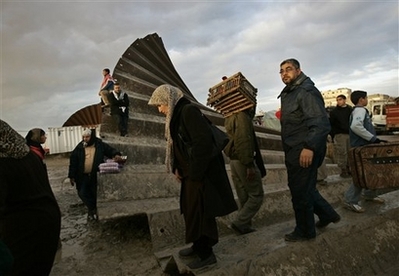
Here's a photo of Gazans stepping over a destroyed border wall.
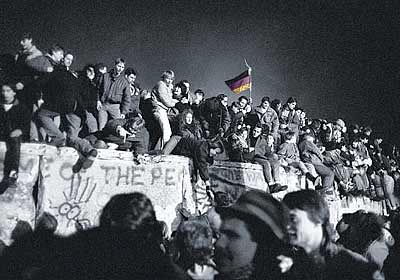
Here's a photo of Germans standing on top of the Berlin Wall as it is being torn down.

The Gaza strip is surrounded on every side either by the sea, or by a border wall erected and guarded by the military forces of the Israeli and Egyptian governments. The one and a half million people locked down in this tiny strip of sand have suffered grinding poverty and cultural deprivation, as a direct result of the extreme difficulty, or, for the past seven months, the complete impossibility, for peaceful workers or merchants to make their way over the government-created borders within which they are imprisoned, or to ply their trades in either Israel or Egypt. The walled-off border-crossing into Egypt has been repeatedly closed off for indefinite periods of time at the discretion of the Israeli government, and now has been locked down completely since June 2007. Last week, Palestinian militants, probably with the backing of Hamas, blew a hole in the wall near the Rafah Border Crossing in the middle of the night. Here’s what happened the next morning:

RAFAH, Gaza Strip - On foot, in cars and in donkey carts, tens of thousands of Gazans flooded into Egypt on Wednesday through a border fence blown up by militants — puncturing a gaping hole in Israel’s airtight closure of the Gaza Strip and giving a boost to Hamas.

In a shopping spree that was both festive and frenzied, Gazans cleared out stores in an Egyptian border town, buying up everything from TV sets to soft drinks to cigarettes.

… For ordinary Gazans, it was a day of joy and plenty.

Osama Hassan, 25, said the border opening will enable him to marry his 17-year-old fiancee next week, because they were able to get items they need to set up a household. He bought a special mattress for his injured back and she assembled kitchen supplies.

Freedom is good. We need no border after today, said Mohammed Abu Ghazal, a 29-year-old out-of-work Gazan.

Children bought soft drinks and chocolate, women scooped up cheese and cleaning products, and men stocked up on cigarettes — all expensive or simply unavailable in Gaza because of Israel’s shutdown of cargo crossings.

Other Palestinians staggered over toppled metal plates that once made up the border fence, carrying TV sets, cell phones, tires and plastic bottles filled with fuel. Some brought in goats and chickens.

Four Palestinians in wheelchairs were pushed over the border, where ambulances picked them up for treatment in Egypt. At one point, a dozen people crowded around a motorcycle to lift it over a low border wall in Egypt.

… After news of the breach spread, people across Gaza boarded buses and piled into rickety pickup trucks heading for Egypt. It was a rare chance to escape Gaza’s isolation.

Moussa Zuroub, 28, carried his young daughter, Aseel, on his shoulders through the muddy streets of Rafah, which is divided by a wall into Egyptian and Gazan segments. I’m coming just to break that ice — that all my life, I’d never left Gaza before, he said.

By nightfall, more than 1,000 Gazans reached El-Arish, an Egyptian town about 37 miles south of Rafah, walking the streets and shopping in stores that stayed open late.

… The chaotic scenes came almost a week after Israel imposed a tight closure on Gaza, backed by Egypt, in response to a spike in Gaza rocket attacks on Israeli towns. On Tuesday, Israel eased the blockade slightly, transferring fuel to restart Gaza’s only power plant.

But true relief came with the toppling of the wall. Egyptian shopkeepers took advantage of the surge in customers, swiftly raising prices of milk, taxi rides and cigarettes. Shops quickly ran out of most of their goods.

In Gaza City, the price of cigarettes, which had skyrocketed during the closure, started to drop. Local money changers began charging extra to change Israeli shekels into dollars, as Gazans were using the U.S. currency in Egypt.

Crowds waited along roads in Gaza City, trying to catch rides to the border. Taxi driver Mahmoud Abu Ouda made one trip to Rafah, but stopped because he had no more fuel.

The city is empty of cabs. They are all in Rafah, he said.

Ibrahim Barzak, Associated Press (2008-01-23): Gazans flood Egypt after border breach

Meanwhile, here’s the official reaction — which is the dignified term that the press uses to describe the ranting power-trips of a tiny, parasitic minority sitting in comfortable government offices far away from the millions of people upon whose lives and livelihoods they constantly render their sanctimonious opinions and summary judgments — to thousands of desperate people suddenly having a momentary taste of joy and freedom:

Official reaction to the day’s events ranged from dismay to embarrassment to outright anger.

The United States expressed concern about the border breach. Israel demanded that Egypt take control of its border. Hamas called on its rivals to help come up with new arrangements for Gaza’s crossings.

Egypt’s leader said he had no choice but to let in the beleaguered Palestinians. But Arab and U.S. officials in Washington said the Egyptian government assured the United States the border would be closed quickly.

We are concerned about that situation and frankly I know the Egyptians are as well, State Department deputy spokesman Tom Casey said.

… An Arab diplomat in Washington said Egypt indicated to the U.S. that the flow of people would end by midday Thursday and pledged to rebuild the smashed barrier. A senior U.S. official, however, said Egypt was not specific on when the border would be closed but promised the situation would not continue for long.

They will make an effort first to contain the crowd on their side of the border so they don’t go anywhere, and then coax people back. We’ll see tomorrow how that has worked, said the official, who like the Arab diplomat, insisted on not being quoted by name in return for describing the conversations between the two governments.

Ibrahim Barzak, Associated Press (2008-01-23): Gazans flood Egypt after border breach

Please note that in the minds of the bellowing blowhard lords of the world, assembled under the banner of Peace Through International Apartheid, the free and jubilant movement of hundreds of thousands of ordinary people, their ability to, for once, get enough food and seek healthcare and even get a few minor luxuries and pleasures like chocolate for their children or cigarettes—and, for once, to trade with equals for the things they want, rather than being forced to take hand-outs from the all-pervasive U.N. relief agencies and NGOs that provide minimal relief in Gaza’s permanent state of emergency—is chaos that a government needs to take control of, a situation to be defused, a breach to be repaired—in short, a violation of sanctified bordercrat prerogatives which provokes concern and demands a prompt solution—which, in the mind of the Commissar, means a gang of armed men coaxing and corralling thousands of happily freed people back into their pens, and rebuilding the walls that shut them in as quickly as possible. To hell with joy and plenty—there are National Interests and Security Concerns involved.

It should go without saying that I have nothing but contempt for Hamas, the quasi-governmental terrorist force that uses Gaza as a base for exchanging dick-swinging shows of belligerence with the Israeli government, each armed faction playing off the other while their innocent neighbors, both Jewish and Arab, pay for it in death, terror, and ruined livelihoods. But even the most despicable creeps can be the occasion of something good, and I wonder—with fear and trembling—what kind of psychology it could possibly take to look at the Gazan’s jubilee days and see nothing but a menace to be eradicated and a situation to be coaxed and jostled and hammered back into the status quo ante.

Tear down the walls and bury the stones from which they were made.

(Via Mike Linksvayer 2008-01-27.)

Talking about the French rioters

There’s been a lot of talk about the rioters in France, and a lot of analysis of why they rioted.

Jocelyn Gecker (2005-11-02), for the Associated Press, reports on the seventh day of rioting. Experts are said to say that Islamic radicals seek to recruit disenchanted youths by telling them that France has abandoned them; sociologist Manuel Boucher suggests that French society is in a bad state … increasingly unequal, increasingly segregated, and increasingly divided along ethnic and racial lines, and that some youths turn to Islam to claim an identity that is not French, to seize on something which gives them back their individual and collective dignity. Gecker says that some said that the unrest — sparked by the accidental deaths of two teenagers last week — is an expression of frustration over grinding unemployment and police harassment in the communities, and cites direct quotes to that effect from the president of the Clichy-sous-Bois mosque, the Socialist mayor of Clichy-sous-Bois, and a 22 year old Moroccan-French resident of Clichy-sous-Bois. On the other hand, there are no direct quotes from any of the rioters as to why they are rioting.

Franck Prevel, reporting for Reuters (2005-11-07), discussed the escalating violence against police. He quoted a statement from the French police union, President Chirac, a police officer, Interior Minister Sarkozy, Prime Minister de Villepin, and mentioned a fatwa against the riots issued by one of France’s largest Muslim organizations in response to official suggestions that Islamist militants might be stoking some of the protests. Prevel mentions that rioting began with the accidental electrocution of two youths fleeing police in Clichy-sous-Bois outside Paris and cites frustration among ethnic minorities over racism, unemployment and harsh treatment by police. On the other hand, he doesn’t cite any direct quotes from any of the rioters as to why they are rioting.

Meryl Yourish (2005-11-03) linked to Gecker’s AP report; she suggested that there is a global war being driven by radical Islamism in European slums, and remarks that first they came for the Jews, and many did not speak out, because they were not Jews. Her post has a lot of analysis, but no direct quotes from any of the rioters on why they are rioting.

She added a later update which links to an article by Paul Belien (2005-11-02) in his Brussels Journal blog. The article cites Theodore Dalrymple’s poignant analysis the crisis faced by British Muslims, and articles from FOX News, the Associated Press and Agence France-Presse, Knack, and a Danish blog called Viking Observer on the dangers faced by police and other emergency workers in Muslim slums in Malmo and Brussells, and rioting by mostly Muslim youths in France and Denmark. Belian suggests that these are problems all across Europe, and that they’ve resulted from a naive belief in universal cultural compatibility, the harsh reality of looming permanent conflict, and weak-kneed appeasement by the government officials in European countries. He suggests that the proximate cause of the French riots was unreasonable resentment over reasonable attempts by the French police to do their job; and that they were exacerbated by the unwillingness of the French government to take a more militant response. He quotes Viking Observer’s translation of some direct quotes from Danish rioters, as reported in the Danish press; on the other hand, he has no direct quotes, and links to no stories with direct quotes, from French rioters on why they are rioting.

At Positive Liberty, Jason Kuznicki (2005-11-07) argues that evidence for radical Islamist involvement is thin at best, and argues that it has much more to do with the material and the cultural conditions faced by young men in communities marked by poverty, dependency, desperation, and ghettoization, in turn caused by the French government’s restrictive economic and social policies. He cites some comments by Mark Brady at Liberty and Power, who in turn cites commentary by British sociologist Frank Furedi, attributing the riots to the exhaustion of national politics in Western Europe, and commentary by British writer James Heartfield, who suggests that It is not that assimilation has failed, but that France only pays lip service to assimilation, while practically refusing it to the descendants of North African migrants. Timothy Sandefur dissents, arguing that there is good reason to believe that at least a large part of the Islamic world does see the situation in France as an Intifada. He offers some subtle comments aimed at demonstrating the ways in which an extremely insular immigrant population and a stagnant, stultified economy can, by producing an an angry mass of economic and social outcasts, which comes to see itself as exploited by another large segment of the community, provide an opportunity for violent, hatred-fueled ideologies such as fascism or terrorist Islamism. He suggests that in such a situation the causal threads tying together the material conditions and the Islamist ideology can intertwine so thoroughly that it may not make any sense to try to separate the one from the other when trying to give causal explanations of the violence that ensues. He cites commentary from the Affordable Housing Institute, which discusses the alienation and insularity created by France’s public housing policy and mentions statements by Interior Minister Sarkozy, President Chirac, Prime Minister de Villepin, Foreign Minister Philippe Douste-Blazy, authorities (who anonymously say that it’s Islamist militants and drug traffickers), and A Clockwork Orange. He also cites two news articles — one on the arrests, back in September, of some suspected members of an Algerian terrorist group living in France; and another from a reporter who seems to have actually found a website in which the rioters make bellicose statements and brag about their martial accomplishments. On the other hand, neither that article nor any of the others, nor Sandefur’s commentary, nor Kuznicki’s, nor Brady’s, nor Furedi’s, nor Heartfield’s, contains any direct quotes from any of the rioters on why they are rioting.

Brad Spangler (2005-11-04) thinks that it’s racialized violence and the ghettoization created by the welfare state, with conditions that have far more in common with the recent riots in Toledo (or in Watts a generation earlier) than they do with events in the Middle East.

French fascist demagogue Jean-Marie Le Pen blames mass immigration, the moral corruption of the country’s leaders, disintegration of the country and social injustice.

David Brooks (2005-11-10) thinks it’s French gangsta rap.

Victor Davis Hanson (2005-11-07) thinks that the riots are a clear example of what happens to a society that doesn’t ask the immigrant to integrate, and the immigrant doesn’t feel that he has to integrate, or to learn the language, or learn the traditions of the West, and further blames the French govement’s appeasement of Muslim immigrants.

Colby Cosh (2005-11-07) argues that France has undeniably been more aggressive than the Anglo-Saxon countries in asserting a unitary national culture and blames the despair and anger created by a government housing policy that amounts to warehousing members of a particular ethnic group in horrible, unsightly, cheaply-made housing projects.

Rox’s friend from Paris says that it’s not an Islamic riot at all, but rather drug dealers defending their turf from the police.

Emma Kate Symons (2005-11-12) thinks it’s the expression of a violently male supremacist adolescent culture.

Mark Steyn (2005-11-10) thinks this is the start of a long Eurabian civil war we’re witnessing here.

On the other hand, none of them cite any direct quotes from any of the rioters as to why they’re rioting.

So why did all those rioters set towns across France afire? Don’t ask me. How would I know? If you want to find out, ask a rioter Pourquoi? You might even wait for the answer before you start offering an analysis.