Posts tagged Dean Scoville
Siege mentality (posted 23 January 2010)
Last month, POLICE: The Law Enforcement Magazine published another ill-tempered tirade by retired L.A. cop Dean Scoville in the magazine’s Patrol Tactics
section. (You may recall Sergeant Scoville from his previous ill-tempered tirade in which he openly praised police brutality against captive prisoners.) This most recent tirade, Four More Cops Killed: Where Is The Outrage?
launches into this subject with the following claims of imminent and growing danger that people
(non-police) pose to government police:
Shortly before I retired, I openly speculated that we were on the cusp of a new era where people would increasingly bring the fight to us. Moreover, I said they would prove to be greater threats, less predisposed to
gangsta-style shooting and actually recognize the significance of sight alignment and trigger control.I also noted that technology has helped the people who want to kill us develop better eye-hand coordination and tactics via video games and other poor man’s combat simulators, …. They have also become more sophisticated in their choice of weaponry, and are fast becoming better armed than us, accessorizing with everything from laser sights to cop-killer bullets.
… More recently, economic stress, racial strife, a resurrection of militia types, and spillover from Mexican cartel activity have made this toxic cocktail even deadlier.
He closes the article with the following credo:
Yes, I believe that the job is increasingly dangerous. And it is made more so by what is put out there about it.
(This is used as a springboard for a couple pages’ worth of rambling complaints against society
at large
for our willingness to embrace anti-cop sentiments and stereotypes,
with a special focus on the
alleged anti-cop drum beating of Hollywood, rap music, and those segments of society who have fundamentally failed
to hold their own [sic] accountable
— and, just so we’re clear, by those segments
of society,
Scoville means niggers,
[1]
Also, I guess he’s pissed off that Dick Wolf decided to cast Ice-T as a cop in Law and Order: SVU.)
Scoville’s claim that being a government cop is increasingly dangerous
is not an isolated claim. For example,
down in the comments section on the article, another retired government cop, mtarte,
writes:
I’m retired now and still wish I could do the job, but today’s cops are in much more dangerous situations than ever before.
In Milwaukee, by way of explanation for why Milwaukee Police Department had begun arming regular patrol cops with semiautomatic rifles:
It’s obvious that our officers are facing an increasingly dangerous threat to their safety as well as the safety of the community as represented by these weapons ….
—Police Chief Ed Flynn, quoted in Officer.com (2009-04-24): Milwaukee Police Increase Firepower
CRIPT Academy, a tactical training outfit for government cops, says that it:
… provides cutting edge training, information, and service that is continually updated to adapt to today’s fluid environment which is becoming increasingly dangerous for those professionals that must operate in harm’s way.
If you spend much time at all reading articles and public statements by government police, you’re likely to see this received factoid over and over again. Time never alters it; things only get more and more dangerous. No matter what year it is, it’s always this year that’s poised to become the most dangerous year for police ever; in 2007, in an article on how government cops can better confuse detained Suspect Individuals about their rights to refuse searches, former government cop and government prosecutor Devallis Rutledge offered the following:
So far, 2007 is the deadliest year for law enforcement officers in nearly three decades.
The thing is that all these claims are false. Both in factual detail and in overarching narrative. They could easily have been discovered to be false by taking even a cursory glance at statistics about police deaths in the line of duty. In fact, 2009, when Dean Scoville declared the job
to be increasingly dangerous,
was the safest year for government police in the U.S. since 1959, in terms of absolute numbers of police officers killed while on duty. With only a few exceptions, the number of government police killed on the job had been decreasing steadily for the past 35 years. Here’s the annual data for the past 35 years, as reported by the Officer Down Memorial Page yearly reports.[2]
| Year | Total line-of-duty deaths | Deaths from violent attacks (Excluding terrorist attacks.) |
Total violent deaths adjusted to 2009 population |
|---|---|---|---|
| 1974 | 279 | 149 | 215.48 |
| 1975 | 240 | 148 | 211.93 |
| 1976 | 202 | 117 | 165.92 |
| 1977 | 189 | 108 | 151.63 |
| 1978 | 215 | 109 | 151.42 |
| 1979 | 214 | 120 | 164.87 |
| 1980 | 210 | 113 | 153.44 |
| 1981 | 201 | 105 | 141.18 |
| 1982 | 194 | 100 | 133.18 |
| 1983 | 193 | 92 | 121.41 |
| 1984 | 184 | 83 | 108.59 |
| 1985 | 179 | 85 | 110.23 |
| 1986 | 178 | 80 | 102.79 |
| 1987 | 182 | 84 | 106.97 |
| 1988 | 194 | 85 | 107.26 |
| 1989 | 196 | 79 | 98.75 |
| 1990 | 162 | 71 | 87.76 |
| 1991 | 148 | 75 | 91.47 |
| 1992 | 170 | 72 | 86.60 |
| 1993 | 163 | 83 | 98.53 |
| 1994 | 180 | 86 | 100.84 |
| 1995 | 185 | 77 | 89.22 |
| 1996 | 143 | 64 | 73.30 |
| 1997 | 177 | 76 | 86.00 |
| 1998 | 176 | 66 | 73.82 |
| 1999 | 151 | 49 | 54.18 |
| 2000 | 163 | 55 | 60.13 |
| 2001 | 242 | 67 | 72.45 |
| 2002 | 159 | 63 | 67.41 |
| 2003 | 147 | 51 | 54.22 |
| 2004 | 164 | 56 | 58.99 |
| 2005 | 164 | 54 | 56.37 |
| 2006 | 156 | 54 | 55.84 |
| 2007 | 193 | 65 | 66.56 |
| 2008 | 138 | 42 | 42.62 |
| 2009 | 120 | 49 | 49.00 |
Or, if you prefer, here’s the chart. The blue line represents the absolute number of cops killed that year in the line of duty;
the yellow line best represents the overall danger to cops from violent attacks (specifically, the number killed in violent attacks against police, adjusted to the U.S. population at the end of 2009).
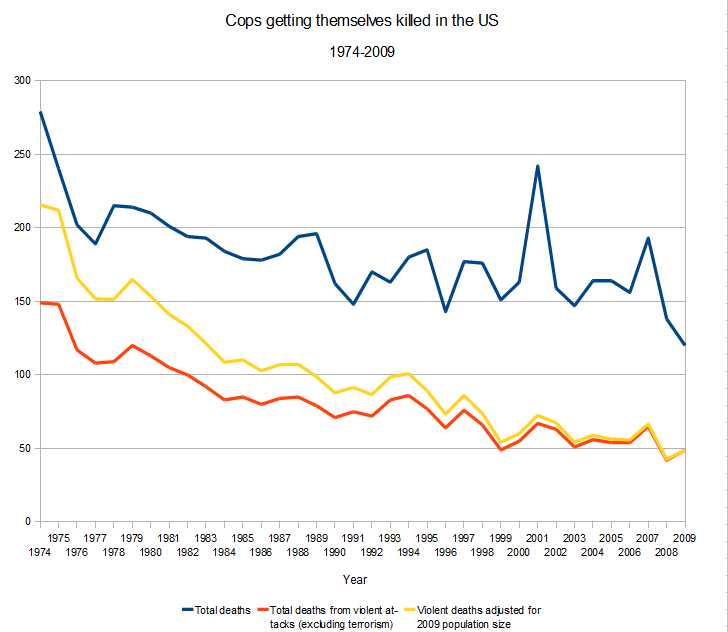
Coming back to Devallis Rutledge’s deadliest year in nearly three decades,
it’s true that 2007 saw a sudden jump in the number of police killed, compared to 2006. (The next two years saw a sudden drop back to the trend of decreasing police deaths.) But the main reason for that was a jump in deaths due to automobile accidents and other accidental deaths; the number of cops killed in violent attacks — 65 total — was less than the total number killed in 2001, let alone the much higher rates of violent deaths in the 1970s, 1980s, and 1990s. And in fact, if you adjust for the increases in the total population, and the absolute number of police on the streets, it turns out that the increasing safety of government police over the past 35 years is only the tail end of a general trend that has been going on since 1921. (The temporary uptick in violent police deaths from the early 1960s to the mid-1970s never ended up producing more per-capita violent deaths than there had been in 1935.) Following the yellow line, you can see that 2008 and 2009, at the tail end of this trend were the safest years to be a police officer in over 110 years.
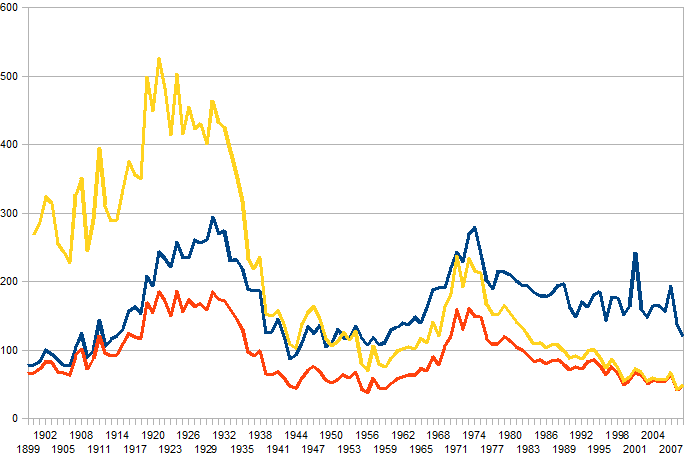
In other words, it’s never been safer to be a cop in America than it has been over the past 2 years. Yet boss cops, spokespeople for the government police, and articles written by cops and for cops, constantly repeat the demonstrably false claims that criminals are more violent than ever before, and that government cops somehow face more danger on their patrols now than they ever have before. That this is a complete lie would be obvious to anyone who had spent 15 minutes perusing the police’s own institutions and resources for honoring their fallen comrades.
The interesting question, then, is what kind of purpose the constant refrain of this unfact from government police serves — what it means when ever-more-heavily-armed government cops keep insisting on a completely mythical ever-present, ever-increasing danger to their politically-sacred persons, in spite of the evidence of the senses and the consistent trends over the last century of historical reality. When you see heavily-armed, well-protected men trying so very hard to psych themselves up to believe in a growing danger that does not actually exist — and when this constantly repeated Big Lie is used to slam pop-culture for any attempt to portray any abuse of police power; to swat down real-life complaints about police belligerence or invasions against civil liberties; to explain the alleged need for assault rifles, tanks, cordoning off strategic hamlets in inner cities, and a niche industry in warrior mindset
trainings — I couldn’t much blame you if you did see some real danger in this concerted effort to inculcate and reinforce a consciously-constructed, fact-resistant permanent siege mentality among patrol cops. But not danger for the cops.
Do you feel safer now?
[1] These cop haters are often composed of those segments of society who have fundamentally failed to hold their own accountable, the likes of whom celebrated the King riots, the O.J. acquittal, and the Oakland shootings.
This is followed up by out-of-left-field references to
Al Sharpton, Jesse Jackson, and Earl Ofari Hutchinson.
[2] If you’re interested in getting the dataset in spreadsheet format, just drop me a line and I’ll send it along. For what it’s worth, if you compare thse figures with figures from other sources, like the National Law Enforcement Officers Memorial Fund annual statistics, the numbers are typically very similar, but differ by a few. I presume that this is from differences over which agencies to count as law enforcement officers
(Officer Down, for example, counts MPs deployed on overseas assignments.) In
any case, the numbers tend to reveal the same trends over time. I used Officer Down’s numbers because they provided an easily-accessible breakdown on causes of
death over the years they covered.
See also:
- Radley Balko, The Agitator (2007-12-28): Just how dangerous is police work?
- GT 2008-10-06: No, seriously, I could swear the water in this pot is getting a little hotter… (#7)
- GT 2010-01-18: In Their Own Words: Master and Commander edition
- GT 2009-05-28: How cops see themselves (#2). National Police Memorial Week and El Monte, California.
- GT 2009-06-02: The Police Beat
- GT 2008-09-25: How cops see themselves
- GT 2008-09-19: No, seriously, I could swear the water in this pot is getting a little hotter… (#6)
- GT 2008-08-22: No, seriously, I could swear the water in this pot is getting a little hotter… (#5)
- GT 2008-07-12: No, seriously, I could swear the water in this pot is getting a little hotter… (#4)
- GT 2008-06-05: Neighborhood Safety Ghettoes in D.C.
- GT 2008-05-15: No, seriously, I could swear the water in this pot is getting a little hotter… (#3)
- GT 2008-05-12: No, seriously, I could swear the water in this pot is getting a little hotter… (#2)
- GT 2008-05-06: No, seriously, I could swear the water in this pot is getting a little hotter…
- GT 2008-04-28: Is it just me or is the water in this pot getting a little hotter?

The Police Beat (posted 2 June 2009)
I recently mentioned a story that POLICE: The Law Enforcement Magazine ran a couple weeks ago, in which Dean Scoville was outraged by the outrage over an El Monte police kicking a prone Suspect Individual in the head after he’d already surrendered to police. (Scoville also openly praises extrajudicial punitive police beat-downs as an institutional practice, longing for a time when post pursuit ass-kickings were obligatory.
)
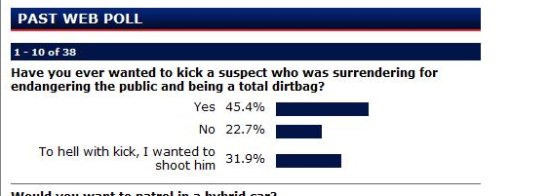
Anyway, the week after they ran Scoville’s ill-tempered tirade in praise of police brutality, the POLICE magazine website decided to run this funny little web poll:
WEB POLL: Have you ever wanted to kick a suspect who was surrendering for endangering the public and being a total dirtbag?
a. Yes
b. No
c. To hell with kick, I wanted to shoot him
Here are the final results as of Monday:
You can see the results for yourself here. 45.4% of POLICE readers responding to the poll said that they have at some point wanted to kick suspect
people after they’ve already surrendered to police. The cop editors of POLICE: The Law Enforcement Magazine thought they’d add a funny little joke option for their cop readers, To hell with kick, I wanted to shoot him.
31.9% of POLICE readers responding to the poll went with that one.
Ho, ho, ho.
Speaking of which, in Oakland, Officer Johannes Mehserle is now on trial for murder in the execution-style shooting of Oscar Grant. Here’s some recent testimony from the trial:
(05-27) 17:00 PDT OAKLAND — A colleague of the former BART police officer who shot and killed an unarmed man early New Year’s Day testified Wednesday that the victim would still be alive if he and his friends had cooperated with police.
If they would have followed orders, this wouldn’t have happened,said Officer Marysol Domenici at a preliminary hearing in Oakland for former Officer Johannes Mehserle, who is charged with murder.—Demian Bulwa, San Francisco Chronicle (2009-05-28): Cop: Had Grant cooperated, he would be alive
According to Officer Marysol Domenici, ordinary civilians like you and me are always under the command of the police, so that when a cop gives an order
you’d damn well better follow,
and if you don’t, well then, you’re resisting,
and you have nobody to blame but yourself when they slam you into the wall, throw you to the ground and shoot you in the back while you’re prone and physically restrained.
Also:
Domenici said she did not see Mehserle shoot Grant because she had been facing the other direction. Immediately after the shot was fired, she said, some train riders were so angry that she started thinking about using her gun.
**
I said to myself,Domenici said.Oh, Jesus Christ, if I have to, I’m going to have to kill somebody,—Demian Bulwa, San Francisco Chronicle (2009-05-28): Cop: Had Grant cooperated, he would be alive
Note that when her buddy-cop shot a man who was prone on the ground and physically restrained by the police, her first thought was not that she might have to defend the public from this killer cop; it was that she might have to open fire on the crowd of bystanders.
In Metro Detroit, the Warren city government’s police chased down Robert Mitchell — an unarmed, 16 year old black boy, weighing in at about 110 pounds — and killed him with non-lethal force
in an abandoned house of Eight Mile. This extrajudicial electrocution of an unarmed young man was carried out in the attempt to arrest him; the reason the cops were chasing him down and trying to force him to surrender himself to them is that he jumped out of the passenger side of his cousin’s car during a traffic stop for an expired license plate. For, that is, trying to leave the scene in a situation where he himself was not suspected of any crime. Boss cop William Dwyer believes that his forces had no alternative
to blasting an unarmed 16 year old with a 50,000-volt electric shock in order to force him to surrender to arrest. Of course they did have an alternative; they could have let him leave, since they had no probable cause to suspect him of any particular crime. But government cops in America aren’t actually interested in dealing with crimes; they are interested in targeting suspects, and are willing to summarily declare you a suspect
sort of guy based solely on your failure to follow their arbitrary bellowed commands, or your decision to try to leave the scene when they are present. They are quite willing to say that running away from cops, just as such, without any evidence of any specific crime, is considered good enough grounds for chasing you down, beating, shooting, or electrocuting you first and asking questions later, and arresting you on suspicion of resisting arrest. Presumably because the sheep are supposed to stay where they’ve been herded.
The commissioner called Mitchell’s death
a tragedy,but said police who watch someone run from themcan only assume he committed a crime or is wanted for a crime.
Boss cop William Dwyer adds that, since the cops have been trained by a bunch of other cops to use 50,000-volt electric shocks to torture anyone resisting arrest
until they surrender, regardless of the risks involved and even if their chosen target is unarmed and poses no physical threat to anyone present, as a form of pain compliance,
well, that makes it O.K. for them to do so. Just following orders, you know:
The officers had been trained to use Tasers on people resisting arrest,
so there was nothing wrong with using that Taser,Dwyer said.
Renea Mitchell, the mother of the victim, says They are here to protect us. There’s no reason for what they’ve done…. There’s no reason, no excuse.
She also calls what happened to her son a murder
at the hands of police. And that’s about the size of it. Her son was not suspected of any crime; he was not even on the scene for anything more serious than an expired license plate. He tried to leave because he doesn’t feel safe around cops — and, given that cops are the ones who eventually killed him, why should he have? — and the cops took this as good enough reason to treat him as presumptively criminal, and therefore to use any level of violence necessary to stop him from leaving — whether or not they have any knowledge of his having been involved in any specific crime, or even whether or not any specific crime has been committed, and regardless of the fact that he was completely unarmed and posed no threat to absolutely anyone’s person or property. They had no reason to use force at all, let alone the potentially lethal force of a taser.
Meanwhile, back over at POLICE magazine, editor David Griffith believes that political correctness is killing a lot of Americans
because cops in some major cities can’t use suspicion of immigration violation as [Probable Cause] to roust any gang member.
Apparently suspicion of immigration violation
means looking Latino.
Griffith asks and answers a few clarifying questions: Would that be profiling? Absolutely. Would some American citizens get hassled? Surely. Would there be a lot less violent crime in our cities if we deported many gang members who are probably illegal aliens [sic]? You tell me.
In other words, in the name of controlling crime by controlling entire populations, Griffith wants for cops to have unilateral authority to roust
absolutely anyone based solely on their ethnic status, without any evidence of having committed any crime whatsoever, and so to bring them under the control of the police unless and until they can prove, to the police’s own satisfaction, that they have a permission slip from the government for existing in this country. Griffith asks, rhetorically, What is our priority? Do we want to make Americans safer?
But which Americans
does he have in mind, and what does he hope to make them safer from? Apparently not the Americans
he explicitly expects to be hassled
, that is, terrorized, manhandled or, if necessary
, killed in order to put them under, and to keep them under, the physical control of those cops who Griffith would like to grant unlimited discretionary authority to detain anybody that they want, for absolutely any reason or for no reason at all, based solely on their ethnic status, and without any connection to any known crime.
In the same article, Griffith mentions an Atlanta cop, Scott Kreher of the local Fraternal Order of Pigs, who is pissed off about inadequate bennies for Atlanta city cops; so he told the city council that the situation made him want to beat Mayor Shirley Franklin in the head with a baseball bat.
(Griffith doesn’t have anything worse to say about this than a weak joke about how he hopes that Kreher does not command the APD’s crisis negotiation team.
)
Does a police state, staffed by men who deal with stress like Sergeant Scott Kreher does, with the powers that David Griffith wants to give them, make you feel safer? Probably depends on what side of the taser, or the baseball bat, you expect to end up on.
See also:
How cops see themselves (#2). National Police Memorial Week and El Monte, California. (posted 28 May 2009)
Continuing in the vein of GT 2009-05-07: Occupying forces, GT 2009-03-28: It doesn’t take much imagination, and GT 2008-09-25: How cops see themselves, see also this all-too-earnest article by Robert O’Brien, in POLICE: The Law Enforcement Magazine (2009-05-13): National Police Memorial Week: Never Forget, written in honor of Washington, D.C.’s annual drunken police riot, in which we are informed, along the way, that Law enforcement deaths could easily weaken our profession’s resolve [sic] to protect and serve. However, the exact opposite is true. Instead of weakening us, our thin blue line strengthens into a solid steel band of brothers. We may bend, but we will never break.
I’m not sure how many solid steel bands of brothers bend without breaking. However, the important upshot of this purple-blue prose is this:
As Lt. Dave Grossman says, you are society’s sheepdogs, and you willingly and selflessly protect your flock—with your lives if necessary.
Cops believe that they are like big dogs corralling a flock of sheep (for their protection
). Guess who’s the sheep?
And then what follows:
You are our nation’s domestic warriors and heroes. And I thank you for your continuing dedication and service.
Meanwhile, in Kicking Up a Stink Over California Incident (the incident
was a cop kicking a prone man in the head after he had already surrendered, and then high-fiving his buddy-cop after; hence the cutesy title), Dean Scoville is outraged by the outrage, and openly longs for the good old days of you can beat the rap, but you can’t beat the ride:
There is one thing the cop is unquestionably guilty of: Working in the wrong era.
There was a time when post pursuit ass-kickings were obligatory. Cops knew it, suspects knew it, and there are enough old timers on both sides of the fence that will verify the assertion when I say that what this officer did was NOTHING compared to what would have happened in another place and time. This might account for why back in the day punks thought twice before running. Nowadays, they’ll flip off a cop and run for the hell of it with little fear of reprisal (unless, perhaps, it’s El Monte PD doin’ the pursuin’).
Scoville is disgusted by simplistic arguments that all life—however vile, wicked, or inconsequential it might actually be—is valuable.
He believes that it’s impractical for them to be expected not to inflict extrajudicial punitive rage-beat-downs on Suspect Individuals:
… I am forced to ask if we’re being practical.
Perhaps matters of practicality shouldn’t even be considered in a profession that embraces terms like
war on drugs,war on organized crime,andwar on gangs,but is not allowed the means to fight them as such. These are our domestic Vietnams. They are wars we could win, if only we could really fight them.
Cops believe that they are domestic warriors
, a class separate from mere civilians
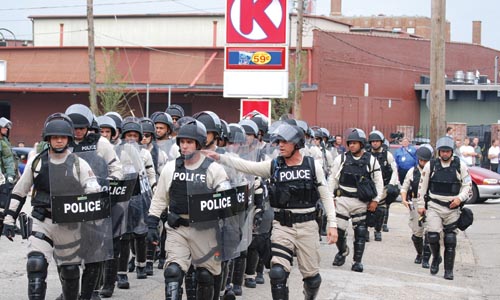
like you and your neighbors. They are fighting a battle in your hometown’s streets, as part of an ongoing occupation of hostile territory. They believe that they are in the midst of several Wars,
wars which are like the United States government’s occupation and counter-insurgency campaign against South Vietnam, and that they need to be freed from restraints on the tactics that they can use in order to really fight
like a military force engaged in total war. (Complete, no doubt, with the usual free-fire zones and strategic hamlets.)
Who gives a damn about Posse Comitatus, or about whether or not the Army patrols American cities, when the local police forces already patrolling them are already indistinguishable from an the Army in self-conception, attitude, tactics, arsenal, personnel, and just about everything else except the cut of the uniform?