You are here:
Geekery Today: posts tagged Drug War Chronicle
Two cheers for police corruption (posted 12 September 2008)
So there are a lot of cops who are involved, somehow or another, in the drug trade. Sometimes they sling the drugs themselves; often, they just protect drug dealers from arrest. Like any form of Prohibition, government Drug Prohibition creates a condition in which there are lots of black market operators who are willing to pay bribes, and lots of cops who are willing to take them, in order to keep the drug trade running without police interference. The cost of the bribe is a drain, but the profits from a well-run drug dealing outfit make up for it, and the cost of the bribe is less than the cost of getting locked up in prison for several years. In fact, the Drug War Chronicle runs a regular feature called This Week’s Corrupt Cop Stories,
which I guess is intended to show how the conditions fostered by Drug Prohibition inevitably produce police corruption. A point which is pretty well conveyed just by the fact that they have plenty of stories to run every single week, as much as by any of the individual stories that they run.
But there’s a problem with the word corrupt.
To become corrupt is to become impure, damaged, or worse. To be corrupt is to be doing something wrong — and when we apply it to people, it usually means that someone is bribed into doing something depraved in exchange for some form of material reward — most commonly violating personal or professional ethics in exchange for money. But protecting a drug dealer from arrest is only unethical if you have an ethical obligation to arrest drug dealers. If, on the other hand, Drug Prohibition is unjust — if enforcing drug laws means violating the rights and the freedoms of innocent people, often by locking nonviolent offenders
in a cage for years at a time even though they violated nobody else’s rights — then cops have no ethical obligation to arrest drug dealers, because nobody has an ethical obligation to do an injustice to innocent people. Then a lot of what commonly gets called police corruption
is really nothing of the sort; so-called corrupt cops
may be turncoats in the Drug War, but they are turning from the wrong side to the right side. Those who protect drug dealers from arrest are no more dirty
than cops in antebellum America who refused to turn fugitive
slaves over to the slave-catchers, or cops in Nazi Germany who refused to turn hiding Jews over to the Gestapo.
Of course, someone who has to be bribed into doing the right thing may not deserve blame for what she does; but she probably doesn’t deserve praise either. And so-called corrupt cops
may in fact do other things that do deserve blame. (Many, if not most, of the narcs or patrol cops who get involved in the drug trade do end up acting much like Terrence Richardson in Houston — that is, as thieves, thugs, or shake-down artists, using their police power or threats of violence in order to intimidate and coerce competing drug dealers who don’t have the same connections to the Gangsters in Blue. But here the problem isn’t that the cop is slinging drugs. The problem is that the cop is cracking skulls of other people who sling drugs, and getting the drugs he slings by stealing them from other drug dealers.) Hence the two cheers, rather than three. But then consider a case like that of Keenan Colson, a cop in Lake Wales, Florida:
Lake Wales police officer Keenan Colson, 50, was arrested Wednesday by the Polk County Sheriff’s Department on multiple charges stemming from information he leaked to 25-year-old Clayton Hoerler, a known criminal offender, including blowing the cover of an undercover cop, said LWPD Chief Herbert Gillis.
[…] Colson faces one count of conspiracy to engage in a pattern of racketeering action, five counts unlawful use of two-way communications device, and four counts unlawful use of computer access after he was tied to an investigation that ultimately netted 18 people arrested in conjunction with what was described by county law enforcers as a
violentmarijuana distribution ring.Polk County Sheriff Grady Judd agreed with Gillis, noting in a phone interview Thursday that the blame rests solely on Colson and his actions.
It’s important to point out we don’t in any way suspect anyone other than Keenan Colson. We don’t want to leave any impression of that being anything other than an ethical police department. They run a great shop there. The men and women there are very dedicated. This is just one crooked cop,he said.But it was one cop nobody seems to have expected to compromise the integrity and safety of his fellow police officers.
Colson’s actions sent shock waves throughout the LWPD.
Captain Patrick Quinn said he was
hurt and shockedbecause he regarded Colson asthe rock,a man whowas always there, went to his calls, took his reports, was dependable.Quinn, who was not involved in the investigation, was briefed about the situation on Tuesday.
Several people fall from grace,he said.That stinks, that hurts. We hire people, unfortunately people are going to do stupid things sometimes.Quinn said Colson made a bad choice and was going to have to answer for his bad choice, but added that everyone in the department was upset.
We have lost a member of our family for his bad choice,he said.What frustrated the chief so much is the concept that the lives of other officers were put in danger. Undercover work presents challenges of it own, he noted, calling it
one of the most dangerous jobs in law enforcementbecause of its vulnerability.
And for Keenan Colson to identify to criminal offenders, this undercover officer, this undercover deputy, could have caused him to be killed, and could have caused the deputies that were working with him, the undercover officers to be injured,he said.That is something that will never be forgiven.Gillis said Colson’s arrest was about justice for the police officers that are doing a good job every day. And it is those who trusted Colson that wonder what went awry with him.
Having had no prior indications to believe that Colson was capable of betraying his fellow officers, the chief described Colson as a
very likable guy, very respectful, very quiet, very courteous.How he got hooked up with a known criminal offender still stumps investigators, Gillis said.
Judd said he isn’t sure of the connection either, but said investigators did believe there was a prior relationship. In the late 1990s, Colson was an officer in Lake Hamilton, and Clayton Hoerler, identified as being one of the alleged ring leaders, apparently lived in Lake Hamilton at that time as well. Hoerler, 25, was identified this week by the county sheriff’s office as being a Lake Alfred resident.
We know from the investigation that they were good friends,Judd said.We know they discussed criminal activity freely, and that Colson give him intricate instructions in how to avoid arrest and how to protect himself from covert investigation. He was certainly the consultant for Hoerler.
If that’s what Keenan Colson did, then good for Keenan Colson.
The Drug War is an aggressive war by the government against innocent people. Neither using marijuana, nor selling marijuana violates anybody else’s rights. Like all so-called victimless crimes,
it is in fact not a crime at all in any moral sense; crimes have identifiable victims, and consensual exchanges between willing parties have none. Cops who use force to shut down drug dealing outfits — and that is the only way that cops shut anything down, by beating people, tasering them, pepper-spraying them, pulling guns on them, restraining them, handcuffing them, confining them in police cars and holding cells, and ultimately by having them locked up in cages for years at a time, all of it backed up by the threat of inflicting pain, injuring you, or killing you if you should resist their orders — those cops, I say, are using violence against peaceful people; they are hurting, restraining, and imprisoning people who have never violated the rights of any identifiable victim. If they come after your friends on the basis of these unjust drug laws, then, morally speaking, they are the criminals, and using your connections and your knowledge of the system in order to defend your friend and his livelihood from their aggression — by telling him how to avoid detection, by telling him how to keep from getting unjustly arrested, and by exposing the undercover police spies who have been sent to infiltrate his circle and facilitate the narcs’ efforts to seize innocent people and locking them in cages for the next several years, is not corrupt.
It’s certainly not an unforgivable sin.
That’s protecting the innocent, and doing so while putting yourself at considerable personal risk from the same uniformed gang that you are trying to protect your friend from. It is, in fact heroic, and Keenan Colson deserves the title of hero
far more than the vast majority of the arrogant, preening, entitled cops who never stop hollering about their own heroics
and the protection
they inflict on unwilling recipients every day.
Meanwhile, the police chief in Lake Wales has decided to engage in a low form of farce:
If your officers do commit criminal acts, they need to be arrested just like anyone else,the chief said.A lot of times things may be handled where people may be just terminated or let go. That’s not the way you are supposed to do things, that’s why I told the officers around here hold your heads up. We’ve been through a lot, we’ve been in the paper a lot with our officers who have done stuff wrong.
We are going to hold offenders accountable, because we hold our people accountable. To me that is a good thing because we hold ourselves accountable first, we hold offenders accountable second. And that’s a position you want to be in law enforcement, that’s accountability, that’s integrity,he added.
That’s bullshit, is what that is.
When cops harass, unjustly imprison, beat, hurt, torture, rape, or kill the people that they contemptuously dismiss as civilians,
there isn’t a damn bit of accountability. They may be transferred to another precinct; they may be given a paid vacation for a few months before fellow cops exonerate them in administrative hearing for a few months; in really extraordinary circumstances, where evidence of guilt is undeniable and has also, by the way, been reeased to the public, someone might actually lose their job over it. But they will almost certainly never face jail time, or any criminal responsibility whatsoever, for what they do. As the victim, you might, if you are very lucky, get an Oops, our bad
; realistically, what you’re more likely to get is Fuck you, civilian.
The reason that Keenan Colson has been arrested and is now threatened with jail has exactly nothing to do with any general commitment by the police force to accountability
or integrity.
The unforgivable sin
for which he is being arrested and prosecuted is the fact that he gave out information that messed with the game of the other cops who were coming after his friend. Cops protect their power, and they’ll do just about anything to anybody who endangers that by valuing the safety of a friend over the ability of his gang brothers to go on with their activities unimpeded. Keenan Colson is only the latest to get the long knife treatment for the unforgivable sin
of acting like a responsible human being at the expense of gang loyalty. He won’t be the last.
(Via Drug War Chronicle 2008-08-29 and Drug War Chronicle 2008-08-22.)
Ihre Papiere, bitte (posted 11 September 2008)
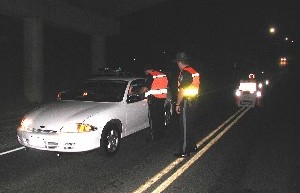
In its 2000 decision in Indianapolis v. Edmond, the US Supreme Court held that the city’s effort to attack the drug trade by holding a checkpoint to look for drugs was an unconstitutional violation of the Fourth Amendment’s protection of the right to be free from unwarranted searches and seizures. But in the years since then, a handful of departments across the county, usually in the South, have brazenly trumpeted their resort to drug checkpoints.
The latest department to step into the breach was Louisiana’s Beauregard Parish Sheriff’s Office, which held such a checkpoint last Thursday night near the town of Starks. Following the lead of sheriff’s deputies, the local newspaper was all over the story.
Narcotics checkpoint a success,blared the headline in Monday’s Derrider Daily News story on the police action. The article went on to explain how, following complaints of drug dealing in the neighborhood, police decided to take action:
The Beauregard Parish Sheriff’s Office set up a Narcotics Checkpoint Thursday night near Starks, Louisiana,the local paper reported.Due to several complaints coming from the Fields area, the BPSO put together a joint operation with the help of Sheriff Ricky Moses and the DeRidder city police department. The operations utilized several BPSO deputies as well as the new Drug Interdiction team led by Detectives Dale Sharp and Greg Hill. Seven police units total were used for the operation in addition to four other units performing regular patrols.The checkpoint resulted in three arrests for marijuana and hydrocodone possession, a quarter pound of marijuana being tossed from an unknown vehicle’s window, and a number of traffic citations.
If this really was a drug checkpoint, it is clearly unconstitutional,said Steve Silverman, executive director of the constitutional rights defense group Flex Your Rights.
Well, O.K., whatever. If you are ever hauled into court as the result of one of these checkpoints, that’s important information to have. But the problem is that cops are, as a rule, better at manipulating the court than you are; they are trained in how to exploit loopholes, how to manipulate people, and how to get cheap sympathy from judges and juries. As Silverman himself says:
If people went to court and fought it, the evidence would be dismissed — unless they consented to a search. The sheriff down there must know checkpoints like this are constitutionally questionable, but they can still ask people to consent, and they know how to phrase that request in such a way that people are likely to consent,he said.
The problem with these roadblocks and checkpoints
by uniformed highwaymen, which impose blanket screening of ordinary people by police and which intimidate or force everyone to submit to interrogation and searches, treating anyone who happens to be on a particular road as a presumptive criminal, who needs to prove her innocence to the police in order to be left alone to go about her own business, based on no probable cause whatever — and all in order to find and imprison a handful of nonviolent drug traffickers, who are violating absolutely nobody’s rights, who are doing a peaceful and productive service for willing customers, whose only crime
was to defy a senseless government prohibition on the kinds of chemicals that people may willingly put into their own bodies — the problem with that, I say, has nothing to do with whether these internal checkpoints and constrictions on peaceful people’s freedom of movement and security in their persons and effects, happen to be consistent or inconsistent with a fundamentalist reading of the words scribbled onto a 200-year-old piece of paper. The real problem is not that this kind of Ihre Papiere, bitte
treatment is unconstitutional; it’s that it’s tyrannical. Tyranny is bad enough whether or not the Nine can be convinced that it can be excused on a legal technicality, and the reasons why are moral, not constitutional. Even when cops can invent absurd technicalities in order to convince a judge (who is always willing to be convinced that another State employee was acting within bounds) that their extraction of searches through intimidation, coercion, and the inevitable recourse to the threat of arbitrary arrest on any of the countless vague laws that nobody can possibly avoid violating in daily life, all somehow amounts to consent.
And those of us who oppose the drug war, and the police state that has emerged in order to prosecute it, ought to be more clear and less timid about saying so. We don’t need The Law on our side to be right. If the Constitution allows that kind of brigandry and tyranny, then the Constitution itself is tyrannical. If the Constitution does not allow it, then it has been demonstrated as thoroughly as you please that the Constitution can do nothing effective to prevent it. In either case it is unfit to exist, and certainly undeserving of our deferential appeals.
In related news, holiday bloggers should keep in mind that there are only 7 more ranting days left before International Ignore the Constitution Day.