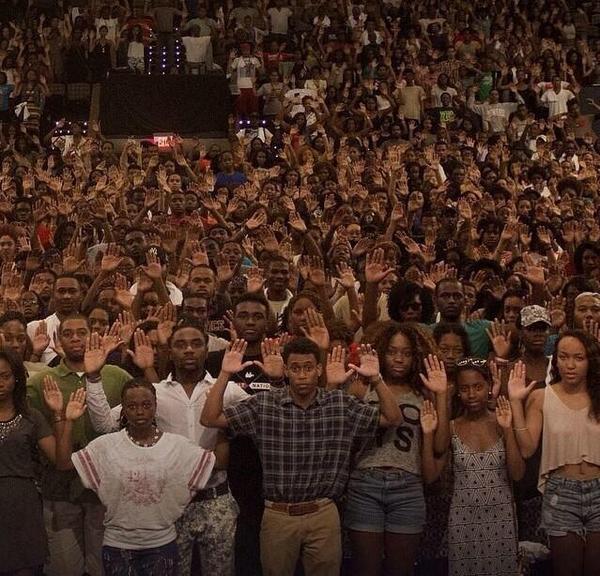
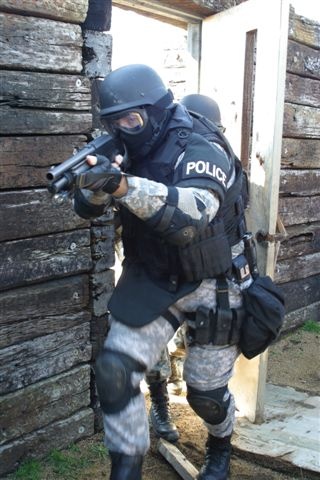
We need government cops because private protection forces would be accountable to the powerful and well-connected instead of being accountable to the people.
A St. Louis County grand jury on Monday decided not to indict Ferguson, Missouri, police Officer Darren Wilson in the August killing of teenager Michael Brown. The decision wasn't a surprise — leaks from the grand jury had led most observers to conclude an indictment was unlikely — but it was unusual. Grand juries nearly always decide to indict.
Or at least, they nearly always do so in cases that don't involve police officers.
Former New York state Chief Judge Sol Wachtler famously remarked that a prosecutor could persuade a grand jury to
indict a ham sandwich.The data suggests he was barely exaggerating: According to the Bureau of Justice Statistics, U.S. attorneys prosecuted 162,000 federal cases in 2010, the most recent year for which we have data. Grand juries declined to return an indictment in 11 of them.Wilson's case was heard in state court, not federal, so the numbers aren't directly comparable. Unlike in federal court, most states, including Missouri, allow prosecutors to bring charges via a preliminary hearing in front of a judge instead of through a grand jury indictment. That means many routine cases never go before a grand jury. Still, legal experts agree that, at any level, it is extremely rare for prosecutors to fail to win an indictment.
If the prosecutor wants an indictment and doesn't get one, something has gone horribly wrong,said Andrew D. Leipold, a University of Illinois law professor who has written critically about grand juries.It just doesn't happen.Cases involving police shootings, however, appear to be an exception. As my colleague Reuben Fischer-Baum has written, we don't have good data on officer-involved killings. But newspaper accounts suggest, grand juries frequently decline to indict law-enforcement officials. A recent Houston Chronicle investigation found that
police have been nearly immune from criminal charges in shootingsin Houston and other large cities in recent years. In Harris County, Texas, for example, grand juries haven't indicted a Houston police officer since 2004; in Dallas, grand juries reviewed 81 shootings between 2008 and 2012 and returned just one indictment. . . .–Ben Casselman, It's Incredibly Rare For A Grand Jury To Do What Ferguson's Just Did
FiveThirtyEight (November 24, 2014).
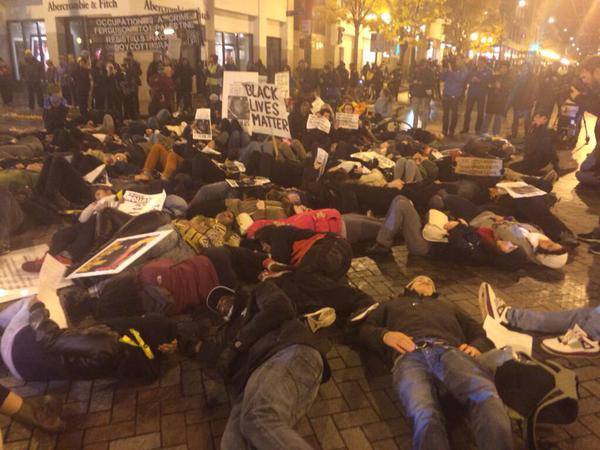
I'm not invested in indicting Darren Wilson though I understand its (symbolic) import to many people, most especially Mike Brown's family and friends. Vincent Warren of the Center on Constitutional Rights speaks for many, I think, when he writes:
Without accountability, there can be no rule of law. If Wilson is not indicted, or is under-indicted, the clear message is that it is open season on people of color, that St. Louis has declared that Darren Wilson is not a criminal but that the people who live under the thumbs of the Darren Wilsons of this country are. It would say to the cry that "Black lives matter" that, no, in fact, they do not.
I understand the sentiment that Warren expresses. Yet I don't believe that an indictment of Wilson would be evidence that black lives do in fact matter to anyone other than black people. Nor do I think his indictment would mean that it was no longer open season on people of color in this country. If we are to take seriously that oppressive policing is not a problem of individual "bad apple" cops then it must follow that a singular indictment will have little to no impact on ending police violence. As I type, I can already feel the impatience and frustration of some who will read these words.
? It feels blasphemous to suggest that one is disinvested from the outcome of the grand jury deliberations. "Don't you care about accountability for harm caused?" some will ask. "What about justice?" others will accuse. My response is always the same: I am not against indicting killer cops. I just know that indictments won't and can't end oppressive policing which is rooted in anti-blackness, social control and containment. Policing is derivative of a broader social justice. It's impossible for non-oppressive policing to exist in a fundamentally oppressive and unjust society. . . .
The pattern after police killings is all too familiar. Person X is shot & killed. Person X is usually black (or less frequently brown). Community members (sometimes) take to the streets in protest. They are (sometimes) brutally suppressed. The press calls for investigations. Advocates call for reforms suggesting that the current practices and systems are !!!@@e2;20ac;2dc;broken' and/or unjust. There is a (racist) backlash by people who "support" the police. A very few people whisper that the essential nature of policing is oppressive and is not susceptible to any reforms, thus only abolition is realistic. These people are considered heretic by most. I've spent years participating in one way or another in this cycle. . . .
–Mariame Kaba, Whether Darren Wilson Is Indicted or Not, the Entire System Is Guilty
In These Times (November 17, 2014).
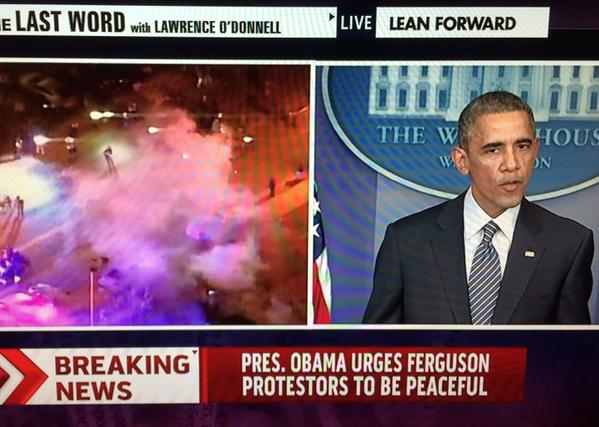
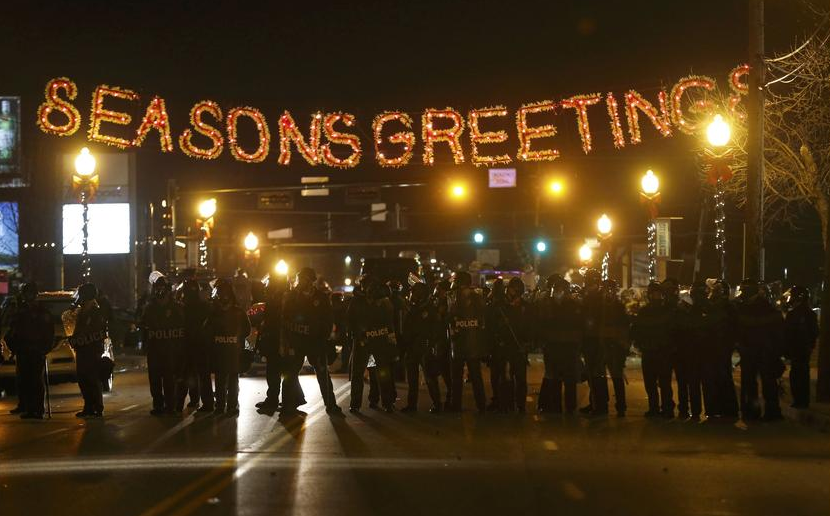
So, to those in Ferguson, there are ways of channeling your concerns constructively and there are ways of channeling your concerns destructively. . . . Those of you who are watching tonight understand that there's never an excuse for violence . . . .
–President Barack Obama Remarks by the President After Announcement of the Decision by the Grand Jury in Ferguson, Missouri
November 24, 2014
Barack Obama, President of the United States and Commander-in-Chief of the largest and most heavily armed military force in the world, got onto the television to tell us that there’s never an excuse for violence
just as heavily-armed police throughout Ferguson began launching teargas against everyone in sight on the streets. Of course, when he said violence
he meant violence by protesters. It is eerily reminiscent of Lyndon Banes Johnson in July 1967, going on national television to announce that We will not endure violence. It matters not by whom it is done or under what slogan or banner,
— saying this at the height of the Vietnam War, and on the specific occasion of his decision to send U.S. soldiers and tanks down Woodward Avenue.
The police are irresponsible and unaccountable. That is what makes them the police. Unless we hold them accountable. The law, for its part, will never curtail the racist violence of the law. Only social accountability for police officers, not legal processes, can do that.
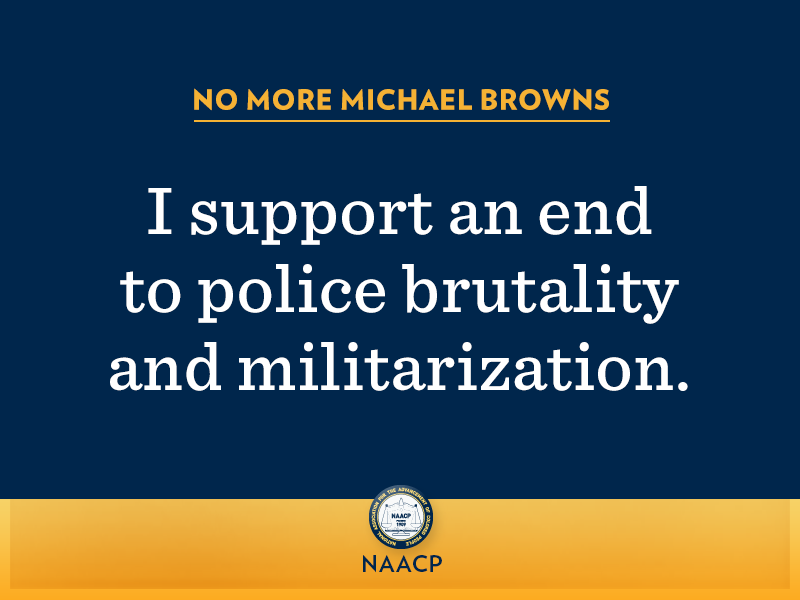
I support an end to police.
Abolish the police.
Also.
- GT 2008-04-25: We need government cops because private protection forces… (killing of Sean Bell)
- GT 2008-06-23: We need government cops because private protection forces… (strip search of Hope Steffey — t/w sexual assault)
- GT 2009-10-13: We need government cops because private protection forces… (filmed police beating of three men in Philadelphia)
- GT 2001-04-25: Legal lynching (cont’d)