Posts tagged St. Petersburg

Law and Orders #6: Pigs at the trough

(Thanks to Austro-Athenian Empire 2008-01-28 and Wendy McElroy 2008-01-22, which each have some excellent comments. Read the whole thing and all that.)

Cops in America are heavily armed and trained to be bullies. They routinely shove their way into situations where they aren’t wanted, aren’t invited, and have no business being; they deliberately escalate confrontations in order to stay in control through superior belligerence; they commonly use force to end an argument and then blame it on their victim; and they invariably pass off even the most egregious abuses of power as self-defense or as the necessary means to accomplish a completely unnecessary goal. Cops carry a small armory of weapons and restraints that they can freely use to hurt or immobilize harmless or helpless people, and a small library of incredibly vague laws (disorderly conduct, resisting a police officer) that they can use as excuses for hurting, restraining, and arresting their victims, with virtually no danger of ever being called to account for their actions as long as other cops, who already have a professional interest in minimizing or dismissing complaints about abusive pigs, can figure out some way to fit the use of these incredibly vague offenses into the police department’s incredibly vague Official Procedures for arrests and for the use of force. The practical consequence of their training and the institutional culture of impunity within which they operate are squads of arrogant, unaccountable, irresponsible hired thugs with massive senses of entitlement, organized into a paramilitary chain of command, who contemptuously regard their neighbors as mere civilians, who treat anyone who dares to give them lip or who questions their bellowed commands as a presumptive criminal, who have no scruple against using pain or arrest in order to force you to comply with their arbitrary orders, and who excuse any sort of abuse by sanctimoniously informing you that it became necessary to stomp on you in order to protect you — whether or not you ever asked for the protection in the first place.

Thus, a couple weeks ago, in Clearwater, Florida, Jean Merola, a 75-year-old grandmother of eight, got served and protected at the drive-thru of her neighborhood McDonald’s by Officer Matthew Parco, who happened to be behind her in the line and who took it upon himself to do some policing of the McDonald’s parking lot — without ever having been asked to by anybody at McDonald’s, of course, and in fact hassling, escalating a confrontation with, and then finally handcuffing and arresting Jean Merola for parking her car exactly where the cashier at McDonald’s had told her to park:

About 4 p.m. Thursday, Merola pulled her gray Lincoln Town Car up to the drive-through window of a Clearwater McDonald’s minutes from her home. She ordered the coffee and medium fries, no salt.

No salt on fries being a special request, the teller told Merola to pull forward to an area of striped asphalt where customers are typically asked to wait if their orders will take some minute.

Suddenly, Merola heard a car horn blasting behind her. In his cruiser sat Officer Matthew Parco, 30, a member of the force since December 2006. He kept honking and waving his arms, Merola said.

She did nothing.

Then he stepped out of his cruiser, walked up to Merola’s driver side door and asked for her license and registration. Merola bristled. Not until you tell me what I’ve done wrong, she told him.

He told me something about being parked in this particular place, Merola said Friday. I told him this is where the people from McDonald’s told me to park.

— Will Van Sant, St. Petersburg Times (2008-01-19): Her wait for french fries ends with a taste of jail

Little did she know that the McDonald’s parking lot, just like everywhere else in the city, happens to be Officer Matthew Parco’s proprietary domain, and if he tells her to move her car away from where the business occupying the lot told her to move it, she’d better ask How fast, damnit. If she doesn’t recognize her civic duty, it’s probably because she’s old and crazy:

In his report, Parco says he asked Merola to move the Town Car forward a foot to allow cars in line to go around. If he did, Merola said she doesn’t remember it. And it was actually his cruiser blocking people, she said.

But Merola said she was really offended when Parco called a supervisor to say he had a possibly demented woman on his hands who might need to be held under the state’s Baker Act.

— Will Van Sant, St. Petersburg Times (2008-01-19): Her wait for french fries ends with a taste of jail

The Baker Act is a Florida state law which allows any government cop, more or less at his pleasure, to legally declare that you must be crazy and arrest you so that he can force you to undergo a psychiatric exam, possibly to be followed by involuntary commitment to a government-approved psychoprison hospital ward. This unchecked and almost completely discretionary power to ruin your life on a cop’s whim is all For Your Own Good, of course.

He was aggravating me by saying that, Merola said. I said, I don’t have dementia, tell your supervisor.

By then, Merola had called Parco a brat, but the dementia comment stirred anger. Merola upped the ante and called him a smart a— and a dumb s—-.

She’s never been easily pushed around, her daughter said Friday.

She’s not a meek and mild little old lady, said Deborah Burge of Palm Harbor. She’s going to say, Hey, what did I do wrong?

Parco handcuffed Merola behind her back and put her in his cruiser. Another officer arrived and drove her to the Pinellas County Jail, where the widow of 10 years was booked for disorderly conduct. She had no previous criminal record.

— Will Van Sant, St. Petersburg Times (2008-01-19): Her wait for french fries ends with a taste of jail

The cops kept her handcuffed for an hour, to protect themselves from the obvious danger posed by a crying 75-year-old woman. For the terrible and dangerous crime of demanding to know what she did to deserve a cop getting in her face, for not flashing her papers on demand, and for offending against the grave dignity of a petulant, pushy, and insulting Officer Of The Law, Officer Matthew Parco had Jean Merola locked in a cage for the afternoon, and meanwhile impounded her car (which it cost her $160 to recover once she was free).

Trying to account for her own behavior, Merola said she was taught to respect the police because they are there to protect and help you. It’s a message she said she had passed on to her three children.

Despite the uniform, she suggested, Parco just didn’t seem like the real thing.

I guess I felt he wasn’t a police officer, Merola said. He wasn’t there to help me, he was there to be mean to me.

— Will Van Sant, St. Petersburg Times (2008-01-19): Her wait for french fries ends with a taste of jail

Jean Merola no doubt meant that in a metaphorical sense. But I think there’s a very literal sense in which she is right. Professional police are, and ought to be regarded as, ordinary mortals, just like you and me. They are not a special or superior class, and they neither require special privileges nor deserve special immunities from what we normally expect from ordinary decent and honest people. If I got up in an old lady’s face face, implicitly called her crazy, threatened to have her committed, and then responded to the insults that my unhinged behavior so clearly merited by pulling her out of her car, cuffing her behind her back, and locking her in a cage, you’d consider me an asshole, at least. If I did all that based on a complete mistake, in which I barged onto somebody else’s property, ignorantly ordered around people in their parking lot, and then, when corrected about the owner’s policy for use of the parking lot, insisted that I was entitled to tell them how they should run their own damn parking lot and to yell at or arrest anybody who didn’t pay attention to my ideas about how it should be used, you would consider me not only an asshole, but a dangerous lunatic and a menace to public safety. Respect and courtesy are for those who earn it, not for any two-bit punk who figured out how to put on a uniform and swing a night-stick. Those who are actually protecting identifiable innocent people from harm—and I mean in their actions, not in their mission statements—have every right to do what they are doing, and every right to use force to defend others against aggression. Those who think their dress-up games entitle them to shove around old ladies, tell McDonald’s how to do their own job, and lock away anyone who dares question or insult them have no right to exercise force and no entitlement to be treated with anything other than the contempt that any violent bully deserves.

Further reading:

Rad Money w/ John Brill

One of Mikhaela Reid’s latest cartoons, besides being grimly funny, makes an excellent point about the financial-advice industry: it offers sensible advice for people who have the time, money, security, and leisure to take advantage of it, but nothing beyond moralistic hectoring for those who don’t. (Not that this is the fault of, say, Suze Orman; it’s the fault of the way that comfortable members of the middle and upper classes use the ideas they get from the financial advice industry as another way to bully people who make less than they do.) As Mikhaela glosses it on her website,

I am of course, referencing financial-advice programs like the Suze Orman Show and CNBC’s Mad Money w/ Jim Cramer (a popular show described by Businessweek as Louis Rukeyser meets televangelism meets Pee-wee’s Playhouse). Not that Suze Orman doesn’t have sound financial advice, because she does—budget, save, invest, take realistic vacations, etc. (Jim Cramer, on the other hand, just strikes me as off his rocker, telling people to invest in crazy random stocks, but hey, what do I know?)

All of that is all very well for middle-class people (although maybe not as well as it could be when you think about college tuition and other skyrocketing costs). But there’s only so much people can do personally when they’re in really, truly horrible money situations and the social safety net has been pulled out from under them (see How Tax Cuts for the Rich Can Help You!).

With cuts to federal student aid, health-care programs, child-care programs, retirement programs, etc., the burden falls more and more on individuals. We hear more and more about individual responsibility to save for health-care, for retirement, for college. But you know what? When you make barely enough to feed your family, that’s a goddamned cruel joke. Expecting people who can hardly pay their rent in the moment to put away for the future is just bizarre. The math just doesn’t add up. There’s only so far you can squeeze a penny.

And these same jerks in the Bush Administration and Congress who are cutting the social safety net (didn’t they learn ANYTHING about poverty from the aftermath of Hurricane Katrina?) are happy to spend billions on the Pentagon, which then uses the money that could have gone to education and sound investments in the future of our country to bomb the crap out of innocent civilians in Iraq.

— Mikhaela’s News Blog (2006-01-15): New Cartoon: $AD MONEY! w/ Susie Poorman!

All of that’s true, of course. And well taken. But of course it leaves open the question: now what do we do about it?

One option that’s always available is to despair and do nothing. This seems, in fact, to be one of the most popular plans among professional-class Progressives who don’t actually need to worry about these issues in their everyday lives. Actually, that’s not a bad plan for them to follow; I’d be quite happy if all the Progressives out there kept doing nothing, given what happened the last time Progressives got enthusiastic and active. But not everyone has that luxury, so let’s move on.

Another option is that you could get back into the lists and fight to recover the alleged government protections that have been lost: more social welfare programs, more regulations demanding that bosses give such-and-such benefits or such-and-such a wage to workers, repeal of free trade agreements, nationalized medicine, or whatever your bag is. But besides having any number of moral and economic objections to these ideas, I also just think that this is unworkable advice for people who don’t have the money, time, security, or leisure to get involved in politics. If the kind of advice that Suzy Orman has to offer isn’t going to get you very far in personal finance when you’re living on the minimum wage, it’s not going to get you very far in politics either, because politicians respond to political pull, and rich people have more resources for buying political pull than you do. The welfare programs that you do get out of a strategy like this typically amount to little more than the bait on the steel trap of social control (government schooling, to take one obvious example; the government-sponsored dead-end employment agency known as TANF to take another). And what politicians give, they can easily take away, as recent experience shows. The labor regulations that you get, when you get anything at all, are no less easily taken away, and also usually amount to yet another silver cord to bind workers to the bosses. (These days a lot is made of the fact that boss-provided medical coverage and pensions are in a state of crisis. That’s true. It might help demonstrate why the tax and regulatory structure that encouraged workers to depend on the bosses for their pensions and medical insurance was a bad idea to begin with.)

So, fellow workers, here’s my financial planning advice for you. Planning, investing, and saving is as important for folks working at or near the minimum wage as it is for the comfortable and the wealthy, but a different situation means different strategies. My suggestion is that you invest in membership dues for a fighting union, plan on firing your boss, and save yourself from depending on the milder sentiments of corporate or government bureaucrats for your money, your raise, your benefits, or your retirement. Let’s call it the John Brill Working-Class Rad Money Plan.

Like any other financial planning advice program, this one needs some Real Life Success Stories. Need a raise? Immokalee farm-workers joined a fighting union, and that’s what it got them. Need more money and a better benefits package? New York transit workers joined a fighting union, and that’s what they got.

But that’s not all, either. Here’s a couple of new stories. Neal Rysdahl joined a fighting union, and here’s what it did for him:

On January 14, 2005, members of the Chicago General Membership Branch of the Industrial Workers of the World labor union (IWW) called for an informational picket to boycott the Ideal Hand Car Wash in Chicago’s Albany Park neighborhood after the managers and owners of the business refused to pay Neal Rysdahl, a longtime member of the IWW, the $227.50 he was owed for over 45 hours of work he preformed for them.

The highly visible protest began at 8 AM, with a small but dedicated group of picketers banging bucket drums, shaking noisemakers, passing out leaflets, and carrying signs reading, Ideal Car Wash Cheats Workers, and An Injury to One is an Injury to All! Notably, one picketer dressed in a clown costume held a sign reading, Ideal Bosses Are Bozos! to mock the clown Ideal usually uses to attract customers.

Humboldt Park Food Not Bombs showed up to serve bread, pastry, hummus, and coffee, and joined in the picket. I knew this was an important picket to support because it was an opportunity to make a real difference in someone’s life through direct action, said Robert Clack, a member of Humboldt Park Food Not Bombs.

The picket effectively shut down business at the car wash for the morning, as most drivers who intended to patronize Ideal drove away after talking with picketers or seeing signs blasting the business for unfair labor practices.

After only three hours of picketing, Eduardo Eddie Amanero, a manager of the car wash, agreed to pay Rysdahl in full, in cash, on the spot, in order to bring an end to the picket.

The point of all this is, if you mess with one of us, you mess with all of us, said Patrick Brenner, a members of the National Executive Board of the IWW. We stick up for our members.

… When asked what he was going to do with his back wages, Rysdahl said, I’m going to catch up on some debts. And, of course, I’m going to pay all of the back dues I owe to the IWW!

— Industrial Workers of the World (2006-01-15): Direct Action Gets the Goods! - IWW Chicago Victory for Unpaid Worker

And it’s important to remember that the success of the Brill Plan doesn’t depend on filling out the right set of forms. Of course a formalized union structure can help, but it isn’t necessary. The Brill Plan works from the bottom up; it begins when you get to know your fellow workers and agree to stand by each other. With no formal union and no government recognition, Wal-Mart employees in Florida still made a fighting union of their own, and here’s what it did for them:

In central Florida, Wal-Mart workers are fighting and sometimes winning campaigns using collective action to solve both shop floor and larger industry-wide problems.

In one rural Florida town, over 20 percent of workers in the local Wal-Mart had their hours cut. In response, workers went into their community with a petition to reinstate the workers’ lost hours, and collected 390 signatures in three days. Their hours were returned.

In South St. Petersburg, a popular third-shift employee was accused of theft and fired. The next day, half the day shift quit in protest. In another store, 20 workers marched on management after a 70-year-old workplace leader had her schedule changed. Her schedule was returned within days.

Several workers rode their bikes to work even though Wal-Mart didn’t provide a bike rack. With some co-workers, they demanded management buy a bike rack. When management refused, they bought a rack with their own money and demanded that management install it. Management gave in, and donated the cost of the rack to a local charity.

These actions were initiated and led by members of the Wal-Mart Workers Association (WWA), a growing group of 300 current and former Wal-Mart workers in over 40 stores.

This is a protest movement of Wal-Mart workers uniting to make their lives better at work and in their communities, said Rick Smith, WWA organizer and Florida director of the Wal-Mart Association for Reform Now (WARN), a coalition of labor, community, homeowner, and anti-poverty groups. It’s about Wal-Mart workers sticking together, honoring their work, arranging carpools, and providing child care for each other.

Non-majority unions such as the WWA don’t wait for a court to license workers’ use of collective action. They harness that anger and ingenuity to both win day-to-day victories and launch longer-term pressure campaigns. The strategy has roots in industries in which union recognition is rare: retail chain workers, state workers, and computer programmers and manufacturers.

We have the right to organization, regardless of what the boss or the state do, said Smith.

Infoshop News (2006-01-03): Even Without a Union, Florida Wal-Mart Workers Use Collective Action to Enforce Rights

There’s only so far you can squeeze a penny, but a fighting union means more dollars to squeeze or spend as you see fit. The Brill Plan works. When workers stand together, workers win. So if you’re working for a living and barely scraping by, the best financial advice that I can offer is: stop being sad and start getting rad.

Peace Officers

(Thanks to Marian Douglas for shining light on this.)

We already knew that Florida cops were willing to electrify a 6 year old boy and a 12 year old girl with a 50,000 volt blast from a taser. The 6 year old was distraught and threatening to hurt himself (after all, why hurt yourself when you can have a cop immobilize you with pain?); the 12 year old’s crime was playing hooky and maybe being a little tipsy, and the incredibly dangerous imminent threat she posed was that she ran away from the cop and so might have been able to skip school. Back when it happened, I mentioned that the main reaction from the police brass was to review the decision to equip cops with tasers—as if the equipment were the primary problem here. I also mentioned that we might be better served by scrutinizing the paramilitary police culture that we have, in which peace officers are trained to take control of every situation at all times, by any means necessary, and where any notion of proportionality between the possible harm and the violence used to maintain control is routinely chucked out the window in the name of law and order and winning the war on crime.

I hate being proven right.

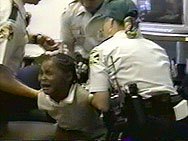
It doesn’t take fancy electric tasers for Florida cops to be overbearing, brutal assholes. They can do it the old-fashioned way: for example, by sending three adult officers to pin a five year old girl’s arms behind her back and handcuff her.

A lawyer has threatened to sue police officers who handcuffed an allegedly uncontrollable five-year-old after she acted up at a Florida kindergarten.
The officers were called by the school after a teacher and assistant principal failed to calm down the little girl.

The incident was caught on a video camera which was rolling in the classroom as part of a self-improvement exercise at the St Petersburg school.

A lawyer for the girl’s mother said the episode was ncomprehensible.

The video, made public by the lawyer this week, shows the unfolding of the violent tantrum, which started when the little girl refused to take part in a maths lesson.

She then ripped some papers off a bulletin board and lashed out at staff trying to calm her down.

After calling her mother and learning she would not be able to pick up the child for at least one more hour, the teachers resorted to calling the police.

Three officers rushed to the scene and handcuffed the girl, by that time apparently calm, after pinning her arms behind her back.

The footage showed her in distress after being handcuffed.

— BBC 2005-04-23: U.S. police handcuff five-year-old

One of the minor consolations of subjecting schoolchildren to a school police state is that the surveillance has left a video record of the handcuffing.

So a kindergardner is uncontrollable and this justifies calling the cops, and then (even though she wasn’t doing anything anymore, just in case she got any ideas) hand-cuffing her as she screams.

By the way, this is not the first time that this has happened

Trayvon McRae is 6 years old.

After throwing a tantrum in music class, and kicking and hitting a St. Petersburg police officer who was taking him home, this kindergartener was handcuffed and arrested on a charge of battery on a law enforcement officer. Both of his wrists fit neatly into a single cuff.

Mikey Rao was 8 when he got arrested.

He didn’t want to go to the principal’s office, so he ran out of his class and kicked and scratched a teacher’s aide. He spent several hours in the Citrus County Jail.

Demetri Starks turned 9 last week.

One day this summer, when he was still 8, he swiped a neighbor’s jar of change. Police stopped the 60-pound St. Petersburg boy wearing a T-shirt covered with monsters from the cartoon Digimon. They handcuffed him and sent him to a detention center where he stayed locked up for nine days.

— St. Petersburg Times 2000-12-17: Under 12, Under Arrest

Hell, it’s not even the only time that it’s happened recently.

Two boys, aged 9 and 10, were charged with second-degree felonies and taken away in handcuffs by the police because they drew stick figures depicting violence against a third student.

There was no act of violence, no weaponry. According to news reports, the arrested children had no prior history of threatening the student depicted in the drawing. The parents were not advised or consulted. The school’s immediate response was to call the police and level charges “of making a written threat to kill or harm another person.”

The incident was not an aberration but one of three similar occurrences in the Florida school system during the same week. In another case, a 6-year-old was led away in handcuffs by police. And those three incidents are only the ones that managed to attract media attention.

— Wendy McElroy 2005-02-10: On Handcuffed and Felonious Children

(Just in case you Blue Staters were thinking about getting smug about those barbarians down yonder in Florida, you might also be interested to know about the California cops who beat the shit out of a non-verbal autistic teenager who didn’t follow their orders—using bludgeons, a taser, and pepper spray.)

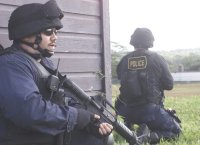
photo: Two cops hunker down with tactical gear and assault rifles

Hello, we’re the cops, and we’re here to keep you safe!

The cops, of course, continue to treat these cases as a P.R. management problem, not a public safety problem created by out-of-control cops. That’s because the cops aren’t out of control; they are doing what cops normally do in our society; we only know about it here because the victims were vulnerable enough that their caretakers were able to get the attention of the newsmedia and the civil courts. We are not talking about a few bad apples here; we are talking about a systematic feature of policing in our society. We’re not talking about something that a bit of administrative hand-wringing and P.R. management and tinkering with equipment will solve. Police brutality, especially police brutality against unruly Black people, ain’t exactly new. This is what happens when the means of defense are almost entirely in the hands of a professionalized paramilitary force. You get an institutional culture of command-and-control. You get unaccountable peace officers who go on a rampage when their orders are questioned, and who apparently don’t have any principled inhibitions about using force on people that is wildly out of proportion to any possible threat. (Restraint can especially go out the window if they are Black. Or if they are otherwise thought to be unlikely to get sympathetic attention from the courts.)

So just remember, Johnny: the cops are here to keep you safe. By hurting you for no reason when you pose absolutely no threat to anyone.

Further reading