You are here:
Geekery Today: posts tagged Will Wilkinson
Left-Libertarian Engagement (posted 25 November 2008)
Lew Rockwell’s recent
interview
of Naomi Wolf for his podcast — the scare quotes are there because it quickly turns into a very two-sided conversation, and works very differently from a conventional interview — is really remarkable, and a paradigm for the kind of engagement that could build a vibrant libertarian Left. Naomi Wolf is not my favorite feminist, and Lew Rockwell is certainly not my favorite libertarian, but this is great stuff. Naomi Wolf now says she thinks she’sbeen a secret libertarian for many years in many, many ways
and mentions that she’s feeling increasingly sympathetic toward radical libertarianism; she insists on the importance of challenging both Democratic- and Republican-sponsored power grabs, and expresses sympathy for the libertarian case for abolishing federal control over schooling. Rockwell does a tolerable job of explaining the libertarian case against the Fed as a instrument of class warfare, does a good job of cautioning against premature jumps into statist political action, and comes out that the conservative movement has been anengine of fascism
for the past 50 years. Also, Wolf has some great material at about 23:45 in the interview about the way in which media producers deliberately encourage false-alternative shouting matches and instruct their guests that serious deliberation is notgood television.
Socialist Alexander Cockburn writes a libertarian article for the Buchananite newsjournal The American Conservative, discussing the ongoing bipartisan assault on civil liberties, in which he points out the continuity between Clinton’s and Bush’s anti-terrorism and drug war rackets, decrying Social Security Numbers and the Kelo decision, while praising the defense of the individualist reading of the Second Amendment in Heller.
There’s been a lot more discussion of Roderick’s Corporations Versus the Market piece on Cato Unbound. Roderick’s Keeping Libertarian, Keeping Left replies to the initial responses from the Danny Bonaduce of the Blogosphere, Steven Horwitz, and Dean Baker. Roderick’s Owning Ideas Means Owning People makes the case for libertarian radicalism against Intellectual Protectionism (indeed, for a position even more radical than those advocated by Cato minimal-statist Tim Lee and by anti-IP, but pro-governmental Leftist Dean Baker).
Yglesias, in reply to Roderick and Steven Horwitz, says he is a bit puzzled by pragmatic arguments for left-libertarianism, based on the claim that markets do more for human flourishing than government programs, writing:
If this means that the absence of governance à la Joseph Stalin is a more important determinant of our well-being than is, say, the existence of unemployment insurance then, yes, of course this is true. But the question facing government programs is not whether they are more or less beneficial than the existence of a market economy, the question is whether the programs are more beneficial than would be the absence of programs.
Roderick does a great job of responding to Yglesias (as well as to some another reply by Dean Baker) here. Let me just add a bit more about the fundamental problem with Yglesias’s proposed methods for assessing whether or not a given government program is warranted.The problem here is that Yglesias seems to be treating this as a ceteris paribus comparison: as if the right question to ask is whether people would be better off with the government program in place or in a situation which is exactly identical, but without the government program.
There are two problems with this. First, unless there is some strong reason to believe that ceteris will stay paribus in the absence of a government program, the real alternative is between a government program and market alternatives to that program. So, for example, Yglesias mentions ex ante environmental regulations. But he rigs the match by apparently comparing outcomes with ex ante environmental regulations to outcomes from a market situation which is basically the same as the present, but in which corporate polluters are free to go on polluting with impunity. An un-rigged comparison would be one between ex ante environmental regulations and free market means of addressing pollution that the ex ante regulations have either directly suppressed or crowded out — like the use of pollution nuisance suits or a more robust use of free market grassroots activism, through boycotts,
sustainability
certification, social investing, and so on. Maybe these kind of tactics would not be as effective as ex ante regulation, or maybe they would be more effective; but in either case, this is the comparison that actually needs to be made, and as far as I can tell Yglesias hasn’t given any argument to support a claim that market methods would do worse. Indeed, there’s some good reasons to think that they might do better. Since freed-market methods are by their nature decentralized, and not dependent on political lobbying or electioneering, they are also not subject to the same problems of regulatory capture by those who can puta lot of money and political influence behind
their interests.Second, Yglesias also more or less explicitly suggests that, when you’re deliberating over whether to favor government programs or freed-market alternatives, any given government program ought to be assessed in isolation from all the others (on a
case-by-case
basis). But of course libertarian Leftists have repeatedly stressed the importance of seeing particular social or political processes in the context of how many different processes interlock and interact with each other. So, for example, as Roderick has repeatedly stressed, if you want to know about whether to prefer unfettered free markets or regulatory command-and-control in financial markets, it doesn’t make sense to compare a rigged market where finance capital is tightly regulated and can reasonably expect government bail-outs in case of failure to a rigged market where finance capital is loosely regulated but can still reasonably expect government bail-outs in case of failure. Whether the latter or the former turns out to have better results is a question we could debate, but the important point, from a left-libertarian point of view, is that it would be more interesting and fruitful to compare the rigged markets to a free market with neither ex ante regulation nor bail-outs. Similarly, if we are looking at environmental regulations then we have to consider not only market alternatives to ex ante environmental regulation; we also have to consider other government programs which may indirectly contribute to environmentally destructive practices — like subsidizing corporate centralization and capital-intensive production; or stealing land from homeowners and small businesses for large, polluting manufacturing plants, garbage incinerators, and other forced-modernization boondoggles; or subsidizing fossil fuel dependence; or highway-driven suburban sprawl — and whether the absence of those other programs, taken together with the absence of ex ante environmental regulation, would make freed-market alternatives to ex ante environmental regulation even more palatable than they would be when considered in isolation. (For some similar points in the context of health care, see GT 2007-10-25: Radical healthcare reform.)Meanwhile, Roderick’s article has also prompted a lot of discussion outside of Cato Unbound, most notably interesting but misguided replies from Peter Klein, Will Wilkinson, and an extremely ill-conceived response by Walter Block and J.H. Huebert. I’ve already discussed Block’s and Huebert’s comments, with a focus on their distortion of my own expressed views (cited favorably by Roderick) on radical labor unionism.. There’s a lot of fascinating exchange among Klein, some other right-libertarians and agnostic-libertarians, and a number of libertarian Leftists in the comments thread on Klein’s article; note especially the exchange among Araglin, Klein, P.M. Lawrence and others over the legitimacy and viability of the corporate form, limited liability, etc., under freed markets, and this short comment by Jesse Walker:
It seems clear to me that, at the very least, the “more local and more numerous” claim is correct, if not in every sector than certainly in the economy as a whole. Removing occupational licensing laws alone would unleash such a flood of tiny enterprises — many of them one-man or one-woman shows, sometimes run part-time — that I doubt the elimination of antitrust law and small-business setasides would offset it. Especially when large businesses have proven so adept at using antitrust and setasides for their own purposes. […].
(Jesse promises a more detailed follow-up at Hit and Run; I look forward to it.)Meanwhile, as promsied, Roderick has added his own (detailed, excellent) reply on most of the points raised by Klein, Wilkinson, Huebert, and Block back over at Cato Unbound, entitled Free Market Firms: Smaller, Flatter, and More Crowded.
Read the whole damn thread. It’s great.
On the activist front, this past Monday, New Jersey ALLy Darian Worden announced a new series of Alliance of the Libertarian Left outreach flyers and
subversion squares
available from the NJ ALL website. Enjoy! (I also think there will be some interesting news in the near future about ALL in Southern California, England, Denver, and some new activities for ALL in Las Vegas. But I’m not going to tip my hand more than that in public, just yet. If you’re curious — and especially if you are in one or more of those geographical areas — drop me a line in private.
In reply to a reply by J.H. Huebert and Walter Block (posted 25 November 2008)
J.H. Huebert and Walter Block have recently published an essay which claims to be a reply to Roderick Long’s essay on left-libertarianism for Cato Unbound. Huebert and Block insist that they are going to set the record straight on the correct libertarian view of these matters.
But it’s not clear that they have succeeded in even setting the record straight on Roderick’s view of these matters. For example, I think they have clearly and grossly misread him on the question of selective tax breaks for politically-connected big businesses. (Roderick never claimed that getting selective tax breaks are morally equivalent to receiving a government subsidy; only that firms or practices that get a comparative advantage from government taxes on their competitors are, like firms or practices that get a comparative advantage from government subsidies, not good examples of the free market at work.) Similarly, their attempt at a response to Roderick’s claims about big-box retailers like Wal-Mart, and the importance of using government-subsidized roads to the success of their business model, wavers between an attack on a claim that Roderick never made — that Wal-Mart deserves blame for their successful exploitation of government-subsidized roads — and willfully obtuse replies to the claim that he did make — that Wal-Mart’s road-dependent business model shouldn’t be counted as an example of the free market at work, and that if Wal-Mart had to pay the full costs of its business model, without government subsidies to cross-country freight trucking, it would lose some or all of the comparative advantage that it currently holds over smaller and more local competitors. (Did you know that, since we all use government roads sometimes, that means we are all getting a subsidy like Wal-Mart? Hey, you know, back in May I got a $600 check from the U.S. Department of the Treasury, which was supposed to be for economic stimulus. Just like how AIG gets $85,000,000,000 checks from the U.S. Department of the Treasury, for the sake of economic stimulus! So how could I possibly claim that AIG gets government privileges that I don’t enjoy? Well. See my discussion with Will Wilkinson in a comment thread about the original article.)
In any case, though, Roderick has promised a reply, which I eagerly look forward to. My main reason for mentioning Huebert and Block’s essay here is that it contains a link to my old post Free the Unions (and all political prisoners)! (2004-05-01), and four paragraphs which purport to be a reply to my argument, and the claims Roderick makes on the basis of that argument. Here are those four paragraphs:
Those Poor Unions
Long also laments that our hampered free market doesn’t give unions enough power. He writes:
Legal restrictions on labor organizing also make it harder for such workers to organize collectively on their own behalf.Given that the law allows some workers to not only organize themselves but also coercively organize others, it’s not clear what Long is talking about. To support his claim, he cites a blog post which laments that U.S. labor laws do not go far enough. We should support current labor laws, says Long’s source, but ideally we will return to the days of more
militantunions.You remember
militantunions – the kind that used to (and, well, still do) beat and kill workers who do not cooperate with them. Long and hiscomrade,of course, make no mention of the unions’ bloody history.Unions are like a tapeworm on the economy, sucking sustenance out of businesses. The entire rust belt is a result of unions demanding wages higher than worker productivity. The present problems of the Detroit Three (Ford, Chrysler, General Motors) are mainly dues to their foolishness in not withstanding the unwarranted demands of the United Auto Workers. But, Long can rejoice: under an Obama administration, these economic scourges are likely to obtain even more power.
—J. H. Huebert and Walter Block (2008-11-24): In Defense of Corporations, Tax Breaks, and Wal-Mart
This is a bizarre misinterpretation of my post, and hard to understand how anyone could make it other than through utter carelessness or willful misreading.
The post that they are referring to was the first in a series of annual May 1 posts, commemorating International Workers’ Day — a grassroots labor holiday originally organized by anarchists, to honor the memory of the five anarchist organizers and agitators who were murdered by the state of Illinois after the Haymarket Riot.
Block and Huebert claim to be puzzled by what Roderick could mean when he says that, due to government regimentation of labor unions, labor organizing is substantially more restricted than it would be in a free market. I’m unclear as to what they find unclear, because if it was not clear to them already, the footnoted post by me, which they claim to have read, goes ahead and lists several of the restrictions in question.
The Wagner Act was the capstone of years of government promotion of conservative, AFL-line unions in order to subvert the organizing efforts of decentralized, uncompromising, radical unions such as the IWW and to avoid the previous year’s tumultuous general strikes in San Francisco, Toledo, and Minneapolis. The labor movement as we know it today was created by government bureaucrats who effectively created a massive subsidy program for conservative unions which followed the AFL and CIO models of organizing—which emphatically did not include general strikes or demands for worker ownership of firms. Once the NRLB-recognized unions had swept over the workforce and co-opted most of the movement for organized labor, the second blow of the one-two punch fell: government benefits always mean government strings attached, and in this case it was the Taft-Hartley Act of 1947, which pulled the activities of the recognized unions firmly into the regulatory grip of the federal government. Both the internal culture of post-Wagner mainstream unions, and the external controls of the federal labor regulatory apparatus, have dramatically hamstrung the labor movement for the past half-century. Union methods are legally restricted to collective bargaining and limited strikes (which cannot legally be expanded to secondary strikes, and which can be, and have been, broken by arbitrary fiat of the President). Union hiring halls are banned. Union resources have been systematically sapped by banning closed shop contracts, and encouraging states to ban union shop contracts—thus forcing unions to represent free-riding employees who do not join them and do not contribute dues. Union demands are effectively constrained to modest (and easily revoked) improvements in wages and conditions.
—GT 2004-05-01: Free the Unions (and all political prisoners)!
Of course Block and Huebert are right that government patronage grants substantial illegitimate privileges to a certain kind of union (the establishmentarian, conservative unionism of the AFL-CIO and Change to Win
[sic]). But those privileges come at the cost of accepting an extensive and intrusive set of government regulations on official union activity. The result is not only a violation of the rights of employers to refuse to bargain with union reps, but also a substantial government subsidy for conservative unionism as against competing forms of union organizing, like those practiced by anti-establishmentarian, radical unions like the Industrial Workers of the World — tactics like minority unionism (crowded out of the market by government-subsidized majoritarian collective bargaining), wildcat strikes (illegal under the Wagner Act), secondary strikes and boycotts (illegal under the Taft-Hartley Act), general strikes (ditto), union hiring halls (double ditto), and so on. The combination of government privilege with government controls may benefit the select outfits that toe the establishmentarian line and get their hands on the government loot. But it does so at the expense of the goals that those organizations supposedly support — in this case, organizing workers for the sake of greater control over the conditions of their labor. I know that Walter Block is perfectly well aware of the way this works when it comes to tax-funded education vouchers for private schooling: although the selected schools that receive the vouchers may profit, the availability and quality of education suffers, because of the way that government privileges squash unofficial competitors who do not qualify for the government hand-out, and also because of the way that government controls restrain the activities that the remaining privileged-and-regulated schools can perform. Have Block and Huebert failed to apply the same analysis to privileged-and-regulated labor unions, and the availability and quality of labor organizing, because they are simply ignorant of the restrictions imposed on NLRB-recognized unions? Or because they are aware of the restrictions, but it hasn’t occurred to them that they might matter as much as the government-granted subsidies?
One way or the other, the post closes by calling for the immediate and complete repeal of the Wagner Act and the Taft Hartley Act, and the complete abolition of the National Labor Relations Board, and all other forms of political patronage and political control in labor organizing, which I argued would always hold the labor movement back from its professed goals:
Don’t get me wrong: the modern labor movement, for all its flaws and limitations, is the reflection (no matter how distorted) of an honorable effort; it deserves our support and does some good. Union bosses, corporate bosses, and government bureaucrats may work to co-opt organized labor to their own ends, but rank-and-file workers have perfectly good reasons to support AFL-style union organizing: modern unions may not be accountable enough to rank-and-file workers, but they are more accountable than corporate bureaucracy; modern unions bosses don’t care enough about giving workers direct control in their own workplace, but they care more than corporate bosses, who make most of their living by denying workers such control. The labor movement, like all too many other honorable movements for social justice in the 20th century, has become a prisoner of politics: a political situation has been created in which the most rational thing for most workers to do is to muddle through with a co-opted and carefully regulated labor movement that helps them in some ways but undermines their long-term prospects. It doesn’t make sense to respond to a situation like that with blanket denunciations of organized labor; the best thing to do is to support our fellow workers within the labor movement as it is constrained today, but also to work to change the political situation that constrains it, and to set it free. That means loosening the ties that bind the union bosses to the corporate and government bureaucrats, by working to repeal the Taft-Hartley Act, and abolish the apparatus of the NLRB, and working to build free, vibrant, militant unions once again.
—GT 2004-05-01: Free the Unions (and all political prisoners)!
The comments expressing some watered support for the actually-existing labor movement are grossly misrepresented by Block and Huebert as support [for] current labor laws
(in fact, the point was that the labor movement deserves some watered support in spite of the baleful effects of government labor laws on it). And my call for all existing government labor laws to be repealed and replaced with nothing but free association is, astonishingly, glossed by Block and Huebert as a [lament] that U.S. labor laws do not go far enough.
This is followed by a tirade about my use of the word militant
to describe my ideal for free unionism. This is apparently taken, just as such, to be an endorsement of vigilante violence against non-union or anti-union workers, by unions of the kind that used to (and, well, still do) beat and kill workers who do not cooperate with them.
This is an absurd and unwarranted misreading. Of course, there have been unions whose members used vigilante violence to achieve their goals. I find the use of aggressive violence, against fellow workers or against anyone else, to be completely reprehensible. But that’s not what militancy
refers to in the context of labor organizing. Labor militancy is a term of art that refers to the degree to which unions are willing to use confrontational tactics with bosses, as opposed to back-room negotiations or appeasement of the boss’s demands — where confrontational
means just that, not violent.
Some militant unions endorsed confrontation in the form of violence against bosses, or their property, or scabs. Others refused to on principle, and expressed their militancy through strictly nonviolent forms of confrontation. I agree with the latter, and what I have argued for in more or less everything I have ever written about unions is the principle that fellow worker Joe Ettor set out when he was working to help organize the great Lawrence textile strike of 1912 with the IWW:
If the workers of the world want to win, all they have to do is recognize their own solidarity. They have nothing to do but fold their arms and the world will stop. The workers are more powerful with their hands in their pockets than all the property of the capitalists. As long as the workers keep their hands in their pockets, the capitalists cannot put theirs there. With passive resistance, with the workers absolutely refusing to move, lying absolutely silent, they are more powerful than all the weapons & instruments that the other side has for attack.
Block and Huebert complain that I make no mention of the unions’ bloody history.
(An odd claim, since they seem to think that my use of the adjective militant
is an explicit reference to it.) But I may as well complain that Block and Huebert make no mention of the bloody history of bosses who called out hired muscle, injunction-wielding courts, city cops, state militia, or the federal military to commit every sort of atrocity against striking workers, their wives, and their children. If Block and Huebert have not mentioned the extensive use of aggressive violence by bosses, who have always been far more politically powerful and had far greater resources for hiring on thugs than the unions had, and who were frequently able to call out the repressive forces of the State itself in addition to their own thugs — if they have not mentioned it, I say, because (of course, of course) they don’t agree with it, and intend only to defend the actions of bosses that are consonant with libertarian principles, then that’s fine; but then the reason that I didn’t spend a long time talking about vigilante violence by unionists is because (of course, of course), I don’t agree with that, and intend only to defend the actions of union organizers that are consonant with libertarian principles. But if Block want violence mentioned, then it is totally irresponsible for them to insist on such a wildly distorted and one-sided presentation of the matter, since unionists were victims of far more intense and far more systematic violence than they ever committed, and since much (but by no means all) of the violence
attributed to unionists was in fact defensive force against those same company and government thugs.
Huebert and Block close with a laughably overheated ritualistic denunciation of labor unions as a tapeworm on the economy, sucking sustenance out of businesses,
and an astonishing monocausal theory of middle-American industrial decline, on which the entire rust belt is a result of unions demanding wages higher than worker productivity
(!). Apparently decades of unsustainable malinvestment, public-private partnerships with city, state, and federal governments, corporate welfare, protectionist tariffs, bail-outs of failed business models, etc. have nothing to do with it.
But whether all that is accurate or inaccurate is something best hashed out elsewhere. For right now, my main concern is how wildly Block and Huebert have misrepresented the position that they claim to be arguing against, in the attempt to make it seem as though this overheated denunciation of state unionism had anything to do with the freed-market unionism that I advocate, or that Roderick endorsed via footnote. It is inconceivable that a post whose primary purpose was to condemn the effects of government labor laws and to call for the repeal of the Taft-Hartley Act and the Wagner Act, for the immediate and complete abolition of the National Labor Relations Board, and in general for the exorcism of all political command-and-control (including all enforced recognition, all political patronage, and all political regulation) from organized labor could be reasonably read as support for current coercive labor laws, let alone a call for their expansion (!). An error like that must either be the cause of extraordinarily careless reading, or willful misrepresentation. In either case, Block and Huebert ought to be embarrassed that they have published it.
The ALLied invasion of Cato (posted 10 November 2008)
(Via Austro Athenian Empire 2008-11-10 and a bunch of other places.)
Congratulations to Roderick for heading up a round-table discussion in the latest Cato Unbound on corporate power, with a fine introductiory essay on left-libertarianism, and left-libertarian takes on corporatism, the alliance of big government and big business, class, and vulgar libertarian conflation of freed markets with actually-existing capitalism. Our efforts to cover the world with lying, thieving mutualism proceed apace.
Defenders of the free market are often accused of being apologists for big business and shills for the corporate elite. Is this a fair charge?
No and yes. Emphatically no—because corporate power and the free market are actually antithetical; genuine competition is big business’s worst nightmare. But also, in all too many cases, yes —because although liberty and plutocracy cannot coexist, simultaneous advocacy of both is all too possible.
First, the no. Corporations tend to fear competition, because competition exerts downward pressure on prices and upward pressure on salaries; moreover, success on the market comes with no guarantee of permanency, depending as it does on outdoing other firms at correctly figuring out how best to satisfy forever-changing consumer preferences, and that kind of vulnerability to loss is no picnic. It is no surprise, then, that throughout U.S. history corporations have been overwhelmingly hostile to the free market. Indeed, most of the existing regulatory apparatus—including those regulations widely misperceived as restraints on corporate power—were vigorously supported, lobbied for, and in some cases even drafted by the corporate elite.[1]
Corporate power depends crucially on government intervention in the marketplace.[2] This is obvious enough in the case of the more overt forms of government favoritism such as subsidies, bailouts,[3] and other forms of corporate welfare; protectionist tariffs; explicit grants of monopoly privilege; and the seizing of private property for corporate use via eminent domain (as in Kelo v. New London). But these direct forms of pro-business intervention are supplemented by a swarm of indirect forms whose impact is arguably greater still.
[…] So where does this idea come from that advocates of free-market libertarianism must be carrying water for big business interests? Whence the pervasive conflation of corporatist plutocracy with libertarian laissez-faire? Who is responsible for promoting this confusion?
There are three different groups that must shoulder their share of the blame. (Note: in speaking of “blame” I am not necessarily saying that the “culprits” have deliberately promulgated what they knew to be a confusion; in most cases the failing is rather one of negligence, of inadequate attention to inconsistencies in their worldview. And as we’ll see, these three groups have systematically reinforced one another’s confusions.)
Culprit #1: the left. Across the spectrum from the squishiest mainstream liberal to the bomb-throwingest radical leftist, there is widespread (though not, it should be noted, universal)[10] agreement that laissez-faire and corporate plutocracy are virtually synonymous. David Korten, for example, describes advocates of unrestricted markets, private property, and individual rights as
corporate libertarianswho champion aglobalized free market that leaves resource allocation decisions in the hands of giant corporations[11]—as though these giant corporations were creatures of the free market rather than of the state—while Noam Chomsky, though savvy enough to recognize that the corporate elite are terrified of genuine free markets, yet in the same breath will turn around and say that we must at all costs avoid free markets lest we unduly empower the corporate elite.[12]Culprit #2: the right. If libertarians’ left-wing opponents have conflated free markets with pro-business intervention, libertarians’ right-wing opponents have done all they can to foster precisely this confusion; for there is a widespread (though again not universal) tendency for conservatives to cloak corporatist policies in free-market rhetoric. This is how conservative politicians in their presumptuous Adam Smith neckties have managed to get themselves perceived—perhaps have even managed to perceive themselves—as proponents of tax cuts, spending cuts, and unhampered competition despite endlessly raising taxes, raising spending, and promoting
government-business partnerships.Consider the conservative virtue-term
privatization,which has two distinct, indeed opposed, meanings. On the one hand, it can mean returning some service or industry from the monopolistic government sector to the competitive private sector—getting government out of it; this would be the libertarian meaning. On the other hand, it can meancontracting out,i.e., granting to some private firm a monopoly privilege in the provision some service previously provided by government directly. There is nothing free-market about privatization in this latter sense, since the monopoly power is merely transferred from one set of hands to another; this is corporatism, or pro-business intervention, not laissez-faire. (To be sure, there may be competition in the bidding for such monopoly contracts, but competition to establish a legal monopoly is no more genuine market competition than voting—one last time—to establish a dictator is genuine democracy.)Of these two meanings, the corporatist meaning may actually be older, dating back to fascist economic policies in Nazi Germany;[13] but it was the libertarian meaning that was primarily intended when the term (coined independently, as the reverse of “nationalization”) first achieved widespread usage in recent decades. Yet conservatives have largely co-opted the term, turning it once again toward the corporatist sense.
[…]
Culprit #3: libertarians themselves. Alas, libertarians are not innocent here—which is why the answer to my opening question (as to whether it’s fair to charge libertarians with being apologists for big business) was no and yes rather than a simple no. If libertarians are accused of carrying water for corporate interests, that may be at least in part because, well, they so often sound like that’s just what they’re doing (though here, as above, there are plenty of honorable exceptions to this tendency). Consider libertarian icon Ayn Rand’s description of big business as a
persecuted minority,[14] or the way libertarians defendour free-market health-care systemagainst the alternative of socialized medicine, as though the health care system that prevails in the United States were the product of free competition rather than of systematic government intervention on behalf of insurance companies and the medical establishment at the expense of ordinary people.[15] Or again, note the alacrity with which so many libertarians rush to defend Wal-Mart and the like as heroic exemplars of the free market. Among such libertarians, criticisms of corporate power are routinely dismissed as anti-market ideology. (Of course such dismissiveness gets reinforced by the fact that many critics of corporate power are in the grip of anti-market ideology.) Thus when left-wing analysts complain aboutcorporate libertariansthey are not merely confused; they’re responding to a genuine tendency even if they’ve to some extent misunderstood it.—Roderick Long, Cato Unbound (2008-11-10): Corporations versus the Market; or, Whip Conflation Now
Read the whole thing. It’s great.
The post has already provoked a lot of discussion. Some of it — for example, from Wirkman 2008-11-10, Peter Klein 2008-11-10, and Will Wilkinson 2008-11-10 — is insightful and raises important issues. I’ll also be interested to see the upcoming promised replies from Steven Horwitz, Dean Baker, and the Danny Bonaduce of the Blogosphere. The commentary is a bit much to cover fully here, and is getting hashed out in comments threads, anyway; but I will say that I’m a bit puzzled about this from Will Wilkinson:
But this hints at a thicket of trickier issues. We want a system in which profit-seeking behavior creates the greatest net positive externalities (like continuously increasing the consumer’s share of the cooperative surplus from mundane purchases). But positive spillover maximization within the constraints of a sub-optimal overall system is really desirable, despite the less-than-best incentive structure.
Dude, I just want Sam Walton to get his cold, dead hands out of my pockets. The rest is all details, as far as I’m concerned.
In any case, it seems to me that whether or not Wal-Mart and its business practices ought to be regarded with admiration, contempt, or indifference is really an importantly separate question from the question of whether or not Wal-Mart would have a sustainable business model under freed markets. If Wal-Mart as we know it could not exist but for State privileges, that’s reason enough for libertarians to be wary of reflexively defending Wal-Mart’s bidniz practices as examples of the free market at work, even if it’s not yet clear whether or not libertarians ought to find Wal-Mart objectionable (as a matter of thickness from consequences, and it seems to me that Roderick’s point has to do more or less entirely with the simpler point about sustainability, not the more complicated point about how to feel about the State-dependent business in question.
Meanwhile, Jesse Walker also kindly posted a notice over at Hit and Run, which provoked a discussion in which Hit and Run commenters were fully able to live up to their reputation for fair, insightful, and thought-provoking discussion of issues in libertarianism. For example, here’s the top comment in its entirety:
joshua corning | November 10, 2008, 2:14pm | #
If libertarians are accused of carrying water for corporate interests, that may be at least in part because, well, they so often sound like that’s just what they’re doing
Fuck you Roderick Long.
I mention the Hit and Run thread, though, mainly because it contains the nicest illustration you could possibly hope for of vulgar libertarian reasoning. Roderick wrote:
In a free market, firms would be smaller and less hierarchical, more local and more numerous
I don’t see why. Just to take one example of a market that is pretty free of overt government intervention of the kind listed above: Bookstores. Most
smaller, less hierarchicallocal bookstores are now history, replaced by Big Box Bookstores and on-line booksellers that have huge inventories and lower prices.
So, you see:
Big box bookstores are more successful than smaller, more localized bookstore in the (unfree, government-regulated, privilege-infused,
development
machine-driven) actually existing market.…
Therefore, big box bookstores will be more successful than smaller, more localized bookstores in the free market.
Far be it from me to bag on Borders and Barnes and Noble — I like them each a lot. But this notion that we can just look at their current market success, under the constrained and distorted conditions of the actually-existing unfree capitalist market, in which their business model is fundamentally dependent on the use of government highways to ship huge piles of books, on the use of the government development
machine to seize huge tracts of land and lucrative subsidies to artificially encourage big box retail outlets, and, lest we forget, on government copyright laws that forcibly restrict booksellers to a limited number of centralized, monopoly-priced suppliers; without them, any jackass with a printer or a Kinko’s card could start her own local bookstore for little more than the cost of ink and paper — the notion, I say that we can just look at their current success on the unfree market and immediately infer it to be the result of processes that would continue with no noticeable reduction in a freed market, is desperately in need of a substantive argument that has not been given. Economies of scale
only seem to matter here because, as usual, the costs of scale (like, the freed-market cost of consensually acquiring big blocks of contiguous land; like, the freed-market cost of competing with hyperlocal, extremely low-cost competitors that current laws force out of business) are being ignored, and while the rest of the (artificially centralized, subsidized, monopoly-protected) corporate market is assumed to remain fixed just as it is, even though the whole supply chain would in fact be radically altered by freed markets.
See also:
- GT 2008-05-29: Dump the rentiers off your back
- GT 2008-10-24: How the United States government looks out for small business
- GT 2008-09-29: Not One Damned Dime
- GT 2008-09-12: What’s good for General Motors is good for American state capitalism
- GT 2008-06-06: Carson in the Freeman: Hierarchy or the Market
- GT 2008-03-19: Small enough to fail
- GT 2008-02-13: Liberty, Equality, Solidarity: Toward a Dialectical Anarchism
- GT 2008-01-04: Cognitive Dissonance of the Non-Libertarian Left
- GT 2007-11-08: Sprachkritik:
Privatization
- GT 2004-05-02: Écrasez l’Wal-Mart
- GT 2008-08-08: Proof by ostention
- GT 2008-01-26: In which I fail to be reassured
Sprachkritik (im Sinne Krauses) #2 (posted 21 April 2008)
That’s all fine and good and I make no excuses whatsoever for Jefferson’s slavery issue. NONE. But what I didn’t see in that entire article was something about Jefferson’s general views on governance and commerce. I was hoping to see laws or views he supported/held that showed an anti-libertarian POV.
There, slavery aside, I see very little to nothing.
—John V., comment to Will Wilkinson at The Fly Bottle (2008-04-18)
Just shut the fuck up (posted 18 April 2008)
I don’t mean to be rude. But this issue is important.
There are lots of reasons to despise Alexander Hamilton — given his record as a Caesarian centralizer, rampaging war-luster, and the spiritual and political father of U.S. state capitalism. There are also lots of cases where Thomas Jefferson was better than Hamilton on things that Hamilton was rotten on. This should be taken into account if you are ever trying to rank U.S. revolutionaries according to their libertarian merits. But the reverse is also true, and the issues that Jefferson was rotten on — like, oh, slavery — were not small potatoes or minor personal foibles. And while I think that Will Wilkinson is making several interrelated mistakes, among them misrepresenting and unfairly minimizing the case against Hamilton, when he says…
If you think central banks are a bigger issue for liberty than human enslavement, trade, or the growth of capitalism then your priorities are screwed.
—Will Wilkinson (2008-04-07), comments on ABJ @ The Fly Bottle
… what I would like to stress, at the moment, is that if you ever, ever find yourself thinking that it might possibly be appropriate to reply to a remark like that by saying something like this:
Central banking is one of the worst forms of human enslavement, actually. You should try going out more often, WW, and read some Hoppe and DiLorenzo for good measure.
—Alberto Dietz (2008-04-09), comments on ABJ @ The Fly Bottle
Then you need to stop. Right there. And just—well, you know the rest.


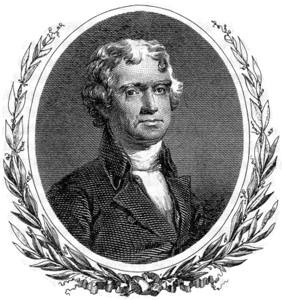
Thomas Jefferson wrote a couple of documents that I admire very much. One of them I consider to be one of the finest and most important political documents written in the history of the world. But Jefferson was a man, not just the signature on a series of essays, and he also did many other things in his life. He was an overt and at times obsessive white supremacist. He was a rapist. He was a posturing hypocrite. He was President of the United States. He was himself a war-monger, who launched the United States’ first overseas war within months of his first inauguration. Most of all, he was a active slaver, a lifelong perpetrator of real, not metaphorical, chattel slavery. He violently held hundreds of his fellow human beings in captivity throughout their lives and throughout his, with the usual tools of chains and hounds and lashes. He maintained himself in an utterly idle life as a landed lord of the Virginia gentry by forcing his captives to work for his own profit, and living off of the immense wealth of things that they built and grew by the sweat of their own brows and the blood of their own backs. He had no conceivable right to live this life of man-stealing, imprisonment, robbery and torture, and no justification for it other than racist contempt for his victims and the absolute, violent power that he (with the aid of his fellow whites) held over the life and limb of hundreds of victims. He knew that his own words in the Declaration of Independence condemned his own actions towards his
slaves, who were by right his equals, beyond appeal, but he went on enslaving them anyway for the rest of his life and would not even make any provisions in his will to set them free when he finally died. He was a hereditary tyrant, claiming, based solely on his descent, the right to go on perpetrating a reign of terror over his prison-camp plantation more hideous and invasive than anything ever contemplated by the most absolutist Bourbon or Bonaparte. Not because he was in any way extraordinary or at all harsher than the average, compared to other white slavocrats, in how he treated his
slaves—but rather because that kind of terror and violence is part and parcel of what forcing hundreds of people into chattel slavery means. As insidious and destructive as government-centralized banking and the money monopoly may be — and I am the last person to deny that — it is callous, counter-historical, inhuman bullshit to try and pass it off as one of the worst forms of human enslavement
in comparison to American chattel slavery. It’s bullshit that needs to stop.
A side note. When trying to explain Jefferson’s view on slavery, one thing that a lot of people seem to take as a point in his favor is his opposition to the trans-Atlantic slave trade. In 1807, Jefferson in fact signed a bill banning the trans-Atlantic slave trade (which could not take effect until 1808 because the U.S. Constitution only granted Congress the power to regulate the international slave trade 20 years after its ratification). It comes up a couple of different times in the same comments thread.
Unfortunately, it doesn’t actually speak in Jefferson’s favor. Jefferson, like many other white Virginian slave-camp commandants, was indeed for banning the trans-Atlantic slave trade, which he, like many other white Virginian slavers, sometimes fiercely denounced as infamous and inhumanly cruel. They were right about that part, and they were right that the trans-Atlantic slave trade ought to have been banned, but their primary reasons for wanting it banned were quite different from what people reading them today often conclude. If, after all, they were actually against the slave trade for humanitarian reasons, then they certainly ought to have the same problems with the internal slave trade in the United States, and the exportation of slaves out of the United States (for example, down to the death-plantations of the Caribbean). Those parts of the slave trade also involved the hellish passage of hundreds of slaves, shackled below decks, in sea voyages from New England or the upper South to the far-away places they were sold down to. But you’ll find little of that from Jefferson or his fellow white Virginian slavers, and the reason is that they profited from the internal slave trade. By the late 18th and early 19th century, Virginia was in the process of a long decline in agricultural productivity, but the landed lords held on to their stream of pirated wealth — by becoming the leading exporter of slaves to other, more productive plantations, down in the Deep South and in the Caribbean. Jefferson’s opposition to the slave trade, like that of many of his fellow Virginia slavers, was not nascent abolitionism. It was pure protectionism, designed to prop up the Virginian slave-traders’ profits while they retained the same absolute, violent power over their
slaves at home.
Hope this helps.