Rad Geek People's Daily

official state media for a secessionist republic of one

Posts filed under Politics

We put the “Arch” in “Anarchy” #2
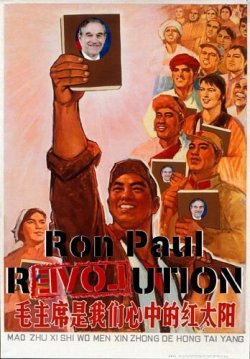
David Gordon — a Rothbardian anarchist and frequent contributor to anti-state, anti-war, pro-market LewRockwell.com — wrote an Open Letter To Libertarians on Ron Paul in which he denounces the running-dog radical libertarians who oppose Chairman Ron’s Great Libertarian Electoral Revolution. Here’s what he has to say about opposition to Chairman Ron’s position on abortion:

No power to regulate abortion is granted to the federal government. Some of course claim that the Fourteenth Amendment changes matters, but it requires very strained interpretation to conjure a right to abortion out of the text of this Amendment. One critic of Ron Paul has admitted that Roe v. Wade is bad law but thinks we should somehow get to the correct pro-abortion view. Is this not to surrender the possibility of constitutional limits on the federal government?

Yes. So what?

Anarchists don’t believe in constitutional government.

On Ron Paul’s support for an even more aggressive police state to enforce international apartheid:

Some object to Ron Paul because he does not support an open borders immigration policy. But why should one take this position to be essential to libertarianism? Hans Hoppe has raised strong objections to open borders; and Murray Rothbard, in his last years, abandoned the view. Free immigration combined with a welfare state is a dangerous brew: does it make sense to reject Ron Paul because he cannot accept it?

Yes.

Anarchists don’t believe in national borders and they don’t believe in a federal police state to enforce them.

It may be true that when you combine something fundamentally moral — free immigration — with something completely immoral — a coercive welfare state funded by expropriated tax funds — you’ll get bad consequences from the combination. But that’s a good reason to try to limit or eliminate the immoral part of the combination, by undermining or dismantling the apparatus of taxation and government welfare. It’s certainly not a good reason to try to limit or eliminate the moral part of the combination by escalating the federal government’s surveillance, recording, searching, beating, jailing, and exiling innocent people. Anarchists have no reason to accept the latter, either as a policy position, or even as a matter about which reasonable libertarians can agree to disagree.

Oddly, some of the same people who condemn Ron Paul for apostasy are themselves so devoted to left libertarianism that they subordinate libertarian principles to certain cultural values. They favor gender equality and are concerned lest we think ill of certain preferred minority groups. Libertarianism, they think, will best promote these values, and this fact is for them a chief reason to support libertarianism.

Since Gordon refuses to identify any individuals whose specific positions he is criticizing, it’s hard to tell whether he’s referring to the essay on libertarian feminism that Roderick Long and I co-authored, or whether he means to refer to somebody else. (If so, whom?) So it’s hard to know whom he expects to answer him when he asks:

Does not the question then arise, should libertarianism be subordinated to these values?

If he does intend to refer to my position, then he’s made two serious mistakes.

First, I don’t think that libertarianism should be subordinated to certain cultural values such as radical feminism. I believe that libertarianism, rightly understood, is both compatible with and mutually reinforcing with the cultural values of radical feminism, rightly understood. (For a more detailed explanation of the different kinds of links that there may be between libertarianism and radical feminism, see my reply to Jan Narveson on thick libertarianism.) The independent merit of radical feminism is one reason to support libertarianism as a political project (because opposing the patriarchal State is of value on feminist grounds), but that’s never been the sole reason or the primary reason I have suggested for being a libertarian. The primary reason to be a libertarian is that the libertarian theory of individual rights is true. From the standpoint of justice, the benefits that a stateless society offers for radical feminism are gravy. If there were some kind of proposal on the table to advance radical feminist goals by statist means, then I would reject the proposal, in favor of proposals that advance radical feminist goals by anti-statist means.

Second, libertarianism is not conceptually equivalent to actively supporting the most libertarian candidate in a government election. Libertarianism is a theory of political justice, not a particular political party or candidate. If one invokes feminist, anti-racist, or any other reasons not to actively support Ron Paul’s candidacy, those reasons may be good reasons or they may be bad reasons. But they are reasons for subordinating one particular strategy for libertarian outreach and activism — a strategy which, by the way, has basically zero empirical evidence whatever in favor of its effectiveness — to other concerns. But so what? There’s no reason for libertarians, and especially not for anarchists, to treat government elections as the be-all and end-all of libertarian principle.

Further reading:

Letter to a privacy guy

I don’t normally spend a lot of time writing letters to strange men in Congress, aside from authorizing the occasional form e-mail to be sent on my behalf. But I made an exception yesterday. Here is the letter that I sent to Rep. John Campbell (R-CA) in light of his recent appearance in the pages of Reason. Mainly because the argument in question is one of my pet peeves.

Rep. John Campbell
1728 Longworth Building
Washington, DC 20515

Dear Sir:

I notice that in a recent interview with Reason ("This Is John Campbell Speaking," December 2007, pp. 16-18), you defended government surveillance of citizens’ telephone calls by saying:

I’m very much a privacy guy …. It’s something I feel very strongly about. But there’s something I feel even more strongly about: I don’t want to be blown up. I am willing to give them some limited access to my phone records because of this war on terror.

But, sir, the question was not about whether you, personally, are willing to turn over your own phone records for the government to sniff around in. If your your fear of physical danger is so strong that it overcomes your desire for basic privacy, then I’d be the first to say that you should feel free to give the government as much access to your own phone records as you like. But I certainly object if you intend to use your willingness to sacrifice privacy for protection as an excuse for having the government force me to turn over my records. If I have different ideas from you about the importance of privacy, then what have your own personal preferences got to do with how my records should be treated?

Just where do you get off, sir, proposing government policies to enforce your own cowardice on the rest of us in the country, whether or not we share your fear of physical danger, and whether or not we are as willing as you are to submit to protective monitoring?

Sincerely,
etc.

Veterans Against Individual Freedom

Usually, if somebody chooses to decorate his business in a way that you don’t like, there are a lot of ways that you could try to deal with the situation. You could grit your teeth and ignore it. Or you could try to have a talk with the business owner. Or you could mount a pressure campaign or a boycott of the business.

Or you barge your way onto somebody else’s property, whip out a huge knife, and use it to deface their private property in order to fix the problem.

Normally, if you acted like this just about everyone would figure you for a two-bit thug and dangerous nut. As well they should.

Unless, of course, you’re an Anglo dude defacing a Hispanic bar-owner’s private property in order to force everyone to follow your own military etiquette towards the flag of the United States. See, there’s this Hispanic bar up in Reno, and a few days ago the local news got a tip that something terrible was happening there. To wit, the owner chose to fly a Mexican flag above an American flag on his own private flagpole. After they rushed out to cover this absolutely riveting breaking story, local two-bit thug and dangerous nut Jim Brossert decided to deal with the situation by grabbing his old army knife and going down to the bar, with a camera man following him. Against the owner’s will, he cut down the flags, then stole the bar owner’s American flag and threw the bar owner’s Mexican flag down onto the ground. Just for good measure, he went on a tirade for the camera about how having been a soldier gives him the right to trash other people’s property for the sake of his flag-worship power trip, and, just for good measure, he bellows that he wants one of the (unarmed) bystanders to fight him. All the while swinging his huge combat knife around.

I’m Jim Brossert and I took this flag down in honor of my country with a knife from the United States army. I’m a veteran, I am not going to see this done to my country. if they want to fight us, then they need to be men, and they need to come and fight us, but I want somebody to fight me for this flag. They’re not going to get it back.

Of course, this bit of inquisitorial theo-nationalist violence has earned this unhinged prick a sympathetic mention from InfoWars and a steady stream of praise from the Great Americans at the local news station’s message board, on Digg, etc., who apparently believe that, in the Sweet Land of Liberty that they are so keen to defend, this barkeep’s right to freely express his own cultural or political priorities is worth less than nothing against the delicate sensibilities of a retired government thug about how flags that don’t belong to him ought to be displayed. Along the way, several of the bellowing blowhard brigade dutifully cite their own military records, as if that proved anything. Several are appalled by the local authorities’ statements that Brossert could be prosecuted for his actions, if the barkeep presses charges, and indignantly assert that Brossert has a First Amendment right to express himself by destroying or stealing other people’s property.

Almost all of the commentators insist on repeating a lie, which originated with the local news report, to the effect that the bar owner was violating federal law by flying another flag above the United States flag. (One of them goes so far as to say that the bar owner is guilty of the federal crime of treason.) In fact there is no such federal law. The Federal Flag Code (4 U.S.C. §Â§ 4–10), which has no enforcement section and assigns no penalties for non-compliance, explicitly states that it is a set of voluntary guidelines for the use of such civilians or civilian groups or organizations as may not be required to conform with regulations promulgated by one or more executive departments of the Government of the United States. Now, if there were any federal law against flying your own flag however you see fit to fly it, that law would be an obvious and stupid form of tyranny, and every one of us would have a perfect right to defy and resist such a law on our own property. But the fact that so many of the self-appointed Home Guard have a manifest felt need to believe in a State that can and will use violence to punish offenses against the dignity of their flag, the visible incarnation of the State, should tell you something about what sort of America these creeps hope to protect against the scourge of peaceful migrant workers.

Ten years ago, Timothy Madigan interviewed Barbara Ehrenreich for Free Inquiry, on Blood Rites, her recently published book on the religious roots of war. Along the way, she had this to say about the emergence of the civic religion in modern Europe, Japan, and America:

EHRENREICH: … With the invention of the gun, of course, the foot soldier became preeminent. It was the end of the mounted elite warrior, and so the religion of war had to change, too. It had to become much more inclusive. … Ordinary people were encouraged to identify with a new kind of deity–the nation-state.

FI: This, as you point out, models the conventional religions.

EHRENREICH: And can replace them. In my book there are two very striking cases that I look at briefly. One was state Shintoism in Japan in the 1930s and 40s, where you have an existing religion, Shintoism, that sort of grafts onto it European-style nationalism to form something new. It becomes emperor worship. It has the old religion in it, but it really is something new. In the case of Nazism, Hitler displaced Christianity. He very consciously set out to make a free-standing, new religion out of nationalism, which would be centered on him, just as the Japanese were centered on their emperor.

FI: You say the American version is not as virulent as Germany or the Shinto case, but I wonder if you could just talk a little bit about what you call the cult of the flag?

EHRENREICH: We make a fetish out of our flag; we treat it as an object of veneration. Every year a proposed amendment to the Constitution comes up that would make it illegal to desecrate the flag. Fascinating word, desecrate.

I think that, like the Japanese and the Germans in the 1930s and 40s, we are equally wrapped up in nationalism as our unofficial–and unexamined–religion.

We certainly saw that coming to a frenzied peak in the Gulf War with flags being waved everywhere. It became actually dangerous or at least perhaps just a little awkward to express dissent because there was such a powerful onrush of feelings at that moment.

–Timothy Madigan and Barbara Ehrenreich, Free Inquiry. (1997-12-22): Dissecting the passions of war

There is an elaborate and formalized liturgy of theo-nationalist rites surrounding the military colors of the United States–a liturgy replete with hymns, recited creeds, high holy days, and solemn processions officiated by a uniformed military priesthood. The liturgy is instilled and practiced with great care through government schools, in federal bureaucracy buildings, and (of course) throughout the intensely ritualistic culture of the government’s military cadres. But that is hardly enough for the state and its minions. Busybodies and prigs ensure that an officious and rigid reverence for the flag, based directly on military etiquette and codified by the federal government, is practiced in social clubs, sports matches, and even carried into putatively Christian churches, where the flags of a worldly nation often occupy more visual space in the sanctuary than the Cross. Any lack of reverence for these arbitrary rites is painted as the most despicable sort of vice, and indeed an affront to all the true believers, if not an outright crime against God Himself.

Update 2007-12-03: Minor edits for clarity.

Further reading:

Masculinity Studies 102: Let’s ask the experts.

Over at Hit and Run, Kerry Howley, a contributing editor at Reason, explains part of what she finds lacking in a common anti-feminist argument to the effect that large-scale socioeconomic disparities between men and women are the result of inborn differences, rather than pervasive forms of sexism.

The different-preferences-create-different-outcomes argument is ambitiously superficial and question begging. Absent any account of how preferences are shaped, I’m not sure why anti-feminists think they’re saying something intelligent when they boldly assert that men and women want different things. IWF loves to talk about Title IX, and it’s a great example of a cultural shift affecting preferences in young women. Did 14-year-old girls just not like sports before Title IX and the rise of the girl jock? Or did Title IX help create a culture where a broader range of interests could be engendered and cultivated? Does the fact that girls in 1950 did not aspire to captain high school soccer teams say anything interesting about women? I don’t think so.

— Kerry Howley, Hit and Run (2007-11-29): Men Are From North Dakota and Women Are From South Dakota

I’m sure she’s entitled to her opinion. But now let’s see what a real expert has to say about whether or not women experience discrimination in America today: Mr. Brian Sorgatz!

What gender inequality? I ask in earnest. In 2007 in the United States, discrimination based on gender is like highway robbery. Technically, it still exists, but it’s been shrunk to a tiny remnant of the problem it once was.

— Brian Sorgatz, 29 November 2007, 1:55 pm

Well, that’s that. If some dude can’t think of any major examples of inequalities that American women face in 2007, must not be a problem after all. Any woman who thinks she has noticed counterexamples had better get on board with a theory that can make some kind of peace with the realities of human nature.

Like this one, offered by another male expert on discrimination against women:

I think it has much more to do with mate selection criteria — women tend to place more emphasis on men who earn large amounts of money, while men tend to place more emphasis on women who are physically attractive and have the personality traits to make a good mother. This sexual selection pressure would result in men making the tradeoffs and sacrifices that result in higher average salaries, while women would be more likely to pursue other values. Both are rationally pursuing the goals that they perceive benefit them most.

— prolefeed, 29 November 2007, 4:01 pm

Did you know that if you take a series of 1950s sitcom punchlines and slap a sticker with the words mate selection criteria on top of them, that makes it Scientific?

Meanwhile, three minutes later:

Prolefeed, you just raised the I.Q. of the entire thread. Thanks for that.

(Again, it’s not that Prolefeed is necessarily right in every particular. But his thinking is admirably sophisticated.)

— Brian Sorgatz, 29 November 2007, 4:04 pm

The hedge is important. We do have to leave room for other well-researched theories proposed by other men. For example, we must remain open to the possibility that 13,000 years and more of patriarchy turns out to all be the result of the (probably genetic) advantage in upper-body strength that the very strongest men have over the very strongest women. Who knew that so much could turn on a bench-press?

Further reading:

Men in Uniform

Somewhere in Alabama, an all-male gang of elite cops from New Jersey spent some down-time from protecting and serving by getting off on sexy drunken displays of power and violence.

HOBOKEN, N.J. — The Hoboken Police Department’s SWAT team has been disbanded, just days after officials learned of racy photos showing the unit’s commander and other officers cavorting with waitresses from a Hooters restaurant in Alabama.

Judging from the selection from the photo slide show, it seems that these photos involve more than just a trip to Hooters, and include some that are more explicit than just racy.

On the same day Hoboken’s new public safety director was sworn in, he gave the city’s police chief orders to disband the SWAT team and to order the lieutenant at the center of the controversy to desk duty.

After seeing the photos of Lt. Angelo Andriani and other members of the Hoboken police SWAT, newly appointed Public Safety Director Bill Bergin said he had to act decisively.

Bergin listed his reasons for disbanding the SWAT team in a phone interview with Newschannel 4’s Pei-Sze Cheng: The brazenness of the whole situation, because everything in the photographs, which I was shocked at, had Hoboken all over it, from the uniforms, to the police car, the bus that was involved.

Bergin ordered the police chief to disband the SWAT team and to have Andriani return from his extended vacation and assign him to desk duty immediately.

The photos were taken last year on a return trip from Louisiana, where the Hoboken officers helped with the Hurricane Katrina relief effort.

They show the waitresses holding shotguns and other weapons belonging to officers under Andriani’s command.

— WNBC (2007-11-16): N.J. SWAT Team Disbanded After Racy Hooters Photos Emerge

Elsewhere in New Jersey, another man in uniform, Anthony Senatore, used his power as a professional narc to extort sexual favors from a woman he’d pressured into becoming a drug informant. Then, after she tried to put a stop to it, he stalked her, forced his way into her house, and raped her. After his victim filed a lawsuit, Senatore was reassigned to a desk job. Although the boss cops and everybody else do concede that Senatore repeatedly exploited his position to coerce sex from the woman, the state A.G. has decided to sweep it under the rug and declined to prosecute on the rape charge. This, apparently, is what passes for having found no wrongdoing on the officer’s part in the eyes of the (male) mayor and the (male) police chief.

JACKSON — The state Attorney General has decided not to prosecute a police detective who is accused, in a civil lawsuit, of raping a drug informant in 2005 and impregnating her with a son who was born eight months later, township officials confirmed Wednesday. Advertisement

The lawsuit filed last year by the informant, identified only as Jane Doe, still is pending in federal court. However, Mayor Mark A. Seda said Wednesday that the attorney general’s decision exonerates Officer Anthony Senatore.

Apparently they found no wrongdoing on the officer’s part, Seda said, adding that Senatore remains on the Jackson force but is no longer a detective.

According to the lawsuit, Senatore enlisted Jane Doe in April 2005 as a drug informant, in exchange for money and prosecutorial considerations for her children and estranged husband, all of whom have been investigated by the Jackson police.

But soon after Jane Doe became an informant, the detective’s behavior changed, according to the suit.

By means of intimidation, threat, harassment, coercion and/or promises of judicial and prosecutorial consideration for plaintiff and her family, Senatore repeatedly propositioned and solicited plaintiff for sexual relations from late April through July 2005, the suit alleges.

During that time, he had sex with her in her home, in police vehicles and in wooded locations in and around Jackson, according to the suit.

When Jane Doe tried to break off the relationship, Senatore’s deviant, predatory behavior intensified, culminating in a savagely brutal rape in her home on July 25, 2005, according to the suit. As a result of that rape, the plaintiff became pregnant and gave birth to a son March 26, 2006, according to the suit.

The suit accuses the township, the police department and then-Public Safety Director Samuel DiPasquale of permitting and encouraging police officers, including Senatore, to sexually harass and have sex with female informants, female defendants and other women they encountered while on duty.

In case you were curious, this is how seriously the boys in blue take their job of protecting you and me from all the weirdoes and creeps running around out there:

Shortly after the suit was filed, Senatore was removed from the detective bureau and placed on administrative duty where his only responsibilities included paperwork, the mayor said.

Senatore is now back in circulation as a patrolman, though, because the police department is short staffed, Seda said. He did not know whether the officer will be reinstated to the detective bureau.

But don’t worry. They are seriously concerned about how this predator’s pattern of bullying, sexual harassment, sexual coercion, and rape against a woman substantially under his legally-backed power — which they dignify as a relationship with an informant — will adversely affect their P.R., and maybe a court case. Senatore may be back patrolling the streets, but hey, they might consider adding a couple of clauses to their internal policies.

When an officer’s character is in question, it puts us at risk, Seda said. We didn’t want to give any criminal a loophole to get out of charges.

… With the Attorney General’s investigation complete, the town and the police department are looking into how Senatore was able to take advantage of his job and engage in a relationship with an informant [sic], Seda said.

That’s certainly something we wouldn’t want to see happen again, the mayor said. We’re looking at our policy internally to see what we can do to prevent that.

— Fraidy Reiss, Asbury Park Press (2007-11-08): Detective won’t be prosecuted; Detective won’t be prosecuted

(Stories via Lindsay Beyerstein 2007-11-17 and ACLU Blog 2007-11-17.)

Anticopyright. All pages written 1996–2026 by Rad Geek. Feel free to reprint if you like it. This machine kills intellectual monopolists.