Rad Geek People's Daily

official state media for a secessionist republic of one

Posts filed under Politics

The only man ever to enter Parliament with honourable intentions

Remember, remember the Fifth of November,
The Gunpowder Treason and Plot,
I know of no reason
Why Gunpowder Treason
Should ever be forgot.

Guy Fawkes, Guy Fawkes, t’was his intent
To blow up King and Parli’ment.
Three-score barrels of powder below
To prove old England’s overthrow….

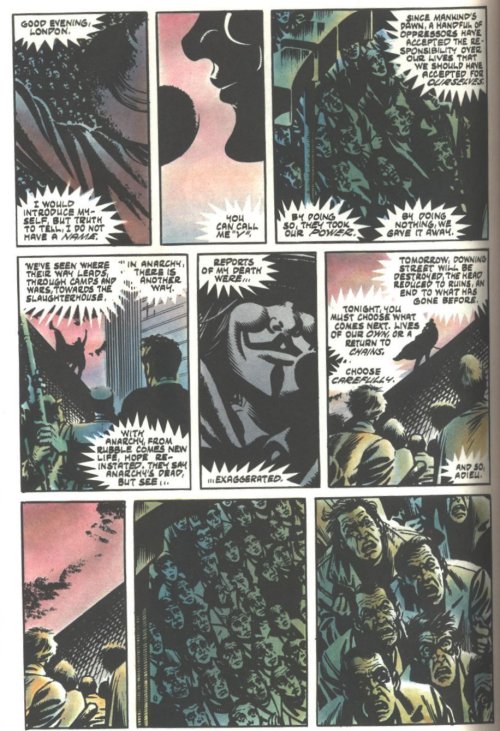
Good evening, London.

I would introduce myself, but truth to tell, I do not have a name.

You can call me V.

Since mankind’s dawn, a handful of oppressors have accepted the responsibility over our lives that we should have accepted for ourselves.

By doing so, they took our power.

By doing nothing, we gave it away.

We’ve seen where their way leads, through camps and wars, towards the slaughterhouse.

In Anarchy, there is another way.

With Anarchy, from rubble comes new life, hope reinstated. They say Anarchy’s dead, but see…

Reports of my death were…

… Exaggerated.

Tomorrow, Downing Street will be destroyed, the Head reduced to ruins. An end to what has gone before.

Tonight, you must choose what comes next. Lives of our own, or a return to chains.

Choose carefully.

And so, adieu.

Opinion Columns of the Libertarian Left

Here’s some Halloween treats for radicals who have been working for alliance between left-friendly libertarians and anti-authoritarian Leftists. These are all articles that have appeared over the past week Alexander Cockburn and Jeffrey St. Clair’s anti-imperialist Left magazine CounterPunch:

One of the things that I’m especially pleased about with Hornberger’s article is that it’s not just a column covering some point of substantial pre-existing agreement between committed libertarians and committed Leftists (anti-imperialism, civil liberties, etc.). The article has that, and that kind of thing is very important and very valuable. But Hornberger’s article goes even further; not only is he crossing the bridges that are already there, but he is also building some new ones. One of Hornberger’s main analytical claims has to do with the way in which the bureaucratic State’s pervasive and byzantine regulation puts tremendous coercive power into the hands of the Stasi, and the way in which the State’s regulatory carrots and sticks serve to keep the interests of big business and the State firmly aligned:

First, as we have long pointed out, the real value of the regulated society is not any protection it provides to people. All that protection talk is just a sham. The real purpose of the regulated society is to keep the business and banking community in line — meaning in conformity with federal policy. The real purpose of the rules and regulations is to serve as a Damocles sword, ready to fall on any business or bank that refuses to go along with the feds.

… Of course, the feds would argue that the law is the law and that Nacchio broke it and therefore has to pay the price. That, of course, is not the point. The point is that in the regulated society, everyone breaks the law, one way or another, which then provides the feds with the option of prosecuting anyone they want whenever they want.

Consider, for example, the IRS code. Despite never-ending railing among political candidates about how complex the code is, the feds love the complexity. Why? Because they know that no one can ever file a perfect income-tax return and especially not wealthy and influential businessmen. If the feds looked hard enough, they could prosecute anyone they wanted at any time for income-tax violations.

It’s the same with insider-trading laws, Sarbanes-Oxley, hiring illegal aliens, or a multitude of other economic crimes. If they hadn’t gotten Nacchio on insider trading, they would have undoubtedly gone after him for other things. The point is, he refused to go along with illegality and wrongdoing, and they went after him for it.

To add insult to injury, President Bush and some of his federal cohorts in Congress are seeking to give civil immunity to the telephone companies that allegedly chose to become federal informers. They are trying to get Congress to pass a law that would prohibit the customers of the telephone companies from suing for the companies’ allegedly wrongful (and cowardly) misconduct.

In other words, become a federal informer and we’ll protect you. Refuse to do so, and we’ll send you to jail.

What is the difference between neighborhood captains in Castro’s Cuba, who report people’s activities to their government, and U.S. telephone companies who report people’s activities to their government? Don’t they all rationalize their conduct under the same warped sense of patriotism?

— Jacob G. Hornberger (2007-11-01): The War on Telephone Privacy: The Meaning of the Nacchio Case

When libertarians challenge the regulatory State, well-intentioned Leftists will often point to all kinds of sharp dealing, exploitation, and irresponsible behavior that big business engaged in prior to the massive expansion of government regulation during the Progressive and New Deal eras. The case for this is often impressionistic and overstated, and usually glosses over the way in which byzantine State regulations allow for new kinds of market-cornering, agency-capturing, sharp dealing, and legal insulation from corporate responsibility. But too many conventional libertarians miss the point by responding with little more than apologia for big business. The right response is to point out that there is more than one way to deal with nasty business practices. The question is whether the means are going to be coercive or voluntary. Coercive solutions tend to deal with the problem from the top down, through a class of professional bureaucrats; voluntary methods tend to favor dealing with these problems from the bottom up, with you and your neighbors working together in grassroots efforts like fighting unions, organized boycotts, consumer associations, mutual aid societies, or watchdog pressure groups.

The grassroots approach puts power into the hands of ordinary people, who enjoy a lot of choice over what causes to support, how to organize responses, when to participate, when to withdraw, and so on. The bureaucratic approach takes power out of the hands of ordinary people and puts it in the hands of professional lawyers and bureaucrats; it tries to fight the unaccountable power of Behemoth by building up the unaccountable power of Leviathan. But the State has its own reasons for doing what it does, and it’s extraordinarily hard, indeed practically impossible, to keep those reasons aligned with anything like ordinary people’s real interests or concerns. Business and government simply get involved in elaborate power plays, as each tries to convert departments of the other into a captured agency for their own purposes, variously using the tools of campaign contributions, front groups, astroturf, cronyism, tax breaks, tax revenue, regulation, prosecution, extortion, and other forms of mutual back-scratching and mutual terrorizing. This is exactly what happened with the government’s successful efforts to turn telecom companies into multibillion dollar snitches for the Securitate creeps; as usual, the end result is that they all get in it together against the rest of us. That’s not an unhappy accident; it’s the way it’s always going to be as long as State agencies can arrogate power that individual people cannot opt out of.

All power to the people; the bureaus can go to hell.

Further reading:
Sauce for the goose

In the federal government’s ongoing efforts to salvage COINTELPRO from the dustbin of history, the House of Representatives recently passed H.R. 1955, a bill that would, if it also passes the Senate, create a new National Commission on the Prevention of Violent Radicalization and Homegrown Terrorism and a Center of Excellence for the Study of Violent Radicalization and Homegrown Terrorism in the United States (sic!), which would study the social, criminal, political, psychological, and economic roots of violent radicalization and homegrown terrorism in the United States and methods that can be utilized by Federal, State, local, and tribal homeland security officials to mitigate violent radicalization and homegrown terrorism.

Here are the definitions for the unwieldy jargon used in the bill:

(2) VIOLENT RADICALIZATION–The term violent radicalization means the process of adopting or promoting an extremist belief system for the purpose of facilitating ideologically based violence to advance political, religious, or social change.

(3) HOMEGROWN TERRORISM–The term homegrown terrorism means the use, planned use, or threatened use, of force or violence by a group or individual born, raised, or based and operating primarily within the United States or any possession of the United States to intimidate or coerce the United States government, the civilian population of the United States, or any segment thereof, in furtherance of political or social objectives.

(4) IDEOLOGICALLY BASED VIOLENCE–The term ideologically based violence means the use, planned use, or threatened use of force or violence by a group or individual to promote the group or individual’s political, religious, or social beliefs.

Well, O.K., fine. If that is what the Center for Excellence &c. is going to study, then they may as well start with the worst offenders. May I suggest that they begin with studying the social, criminal, political, psychological, and economic roots of the extremist propaganda coming out of Office of National Drug Control Policy, which promotes the use of force or violence by armed narcs to promote the Drug Warriors’ political and social beliefs against the will of the civilian population? Or perhaps the Internal Revenue Service, which routinely engages in the use, planned use, or threatened use, of force or violence to intimidate or coerce the civilian population of the United States, in furtherance of the United States government’s political objectives with respect to the war on Iraq, Social Security, corporate welfare, government schooling, the drug war, etc.? Or perhaps the Department of Defense, which has used repeated, massive, and merciless ideologically-based violence in order to promote the federal government’s ideology with respect to parliamentary government, nuclear disarmament, etc., etc., etc., in countries all over the world?

I fully expect that they will get right on it. After all, you’d hardly expect a double-standard from the State when it comes to ideologically-based violence.

(Story thanks to Stephanie McMillan 2007-10-28.)

For her own good

Someone must have slandered Jean Gambell, for one morning in 1937, without having done anything truly wrong, she was arrested. Gambell, a poor working girl in England, was falsely convicted of stealing two and a half shillings from her boss. She didn’t steal the money, and in fact the money was later found, but by then it was too late. She had already been convicted, and, more to the point, she had already come under the eye of State psychiatry. Declared feeble-minded, this fifteen year old girl was locked up in English psychoprisons for seventy years over a trivial crime that she never committed. Her family desperately tried to get her released, but could not. Eventually she simply disappeared into the system, and her brothers no longer even knew whether she was alive or dead. Jean Gambell herself repeatedly told her prison guards in a care home that she had family she could go to, but they kept her locked up, because she had been officially declared crazy and stupid and could, therefore, be dismissed as a liar. All for her own good.

Jean Gambell finally escaped the talons of the therapeutic State last month–at the age of 85, with a lifetime stolen from her–when her brother finally learned that she was alive and confined in Macclesfield Mews Care Home.

Seventy years locked up in institutions hardly seems to be a punishment that befits the crime of stealing half-a-crown.

However, it is just such a fate that befell Jean Gambell when at the age of 15, in 1937, she was falsely accused of stealing 2s 6d (12.5p) from the doctor’s surgery where she worked as a cleaner.

She was sectioned under the 1890 Lunacy Act and even though the money was later found, she has been moved from mental institution to mental institution. More recently, she went into a care home and has been lost to her family, who thought she was dead.

But last month, by chance, her brother stumbled across correspondence which led to the discovery of her existence and the family was reunited.

Her brother David Gambell, 63, who still lives in his mother’s old home in Wirral, Merseyside, received a questionnaire addressed to his mother from Macclesfield Mews Care Home.

I thought it was just a survey for old people and I was about to throw it away when I saw Jean’s name pencilled in on one corner, he said yesterday.

I couldn’t believe it. I suddenly realised that my sister was still alive. I rang the care home straight away and they confirmed that our sister was there. He and his brother Alan, who had last seen their sister as small children when she was allowed to visit home with two wardens as guards, travelled to the Macclesfield home.

They were told by staff that their 85-year-old sister was deaf, could only communicate in writing and was very unlikely to remember them.

A little old lady on walking sticks came in, said Alan. She looked at us and cried out: Alan…David. Then she put her arms around us. It was very emotional.

I am sure that what has kept her going all these years was the challenge of proving to the authorities that she had a family. The trouble was, nobody would listen to her.

The brothers spent much of their childhood in orphanages because their parents were so poor. They said that they had later discovered that their father had tried for years to get Jean freed after she was put in Cranage Hall mental hospital in Macclesfield for being of feeble mind, but was unsuccessful because her records had been mislaid.

She spent years, lost in a maze of instutitons and care homes, trying to convince people in authority that she had a family. But nobody would believe her.

— David Sapsted, The Telegraph (2007-09-29): Falsely accused woman freed after 70 years

There is one thing that is even more terrifying than the savage cruelty of the hangman State, and that is the dispassionate sadism of psychiatric State–the therapist armed with the law, the straight-jacket, the lobotomy, and a near-absolute entitlement to take your freedom and destroy your life, and call that care for your professionally-reckoned best interests.

(Link thanks to Austro-Athenian Empire 2007-10-21: The Coldest of All Cold Monsters and Anthony Gregory @ LewRockwell.com Blog 2007-10-21: Innocent Woman Freed After 70 Years.)

Corrections officers

In Florida, a white prison gang brutally beat a Black 14-year-old named Martin Lee Anderson to death last year. Anderson had been sentenced to a juvenile boot camp prison in rural Florida as punishment for taking his grandmother’s car for a joyride and then violating the terms of his probation. Within hours of his arrival, gang members surrounded him, held him down, punched him, kicked him, and, while restraining him, held hands over his mouth for up to five minutes at a stretch. They went on beating him for half an hour. They kept on beating him even as he lay limp and unable to move. The attack was captured on tape in a surveillance video, and the autopsy report concluded that Anderson died of suffocation. But just a couple weeks ago, in spite of the video, in spite of the report, the thugs who murdered Martin Lee Anderson were acquitted by an all-white jury in Panama City, Florida. Why? Because when they battered Martin Lee Anderson to death, the gang colors they were wearing looked like this:

Here is a photo of five uniformed prison guards holding down a young black man.

An uneasy sense of dèjá vu swept over Florida last week after an all-white jury acquitted seven juvenile boot camp guards and a nurse charged with aggravated manslaughter in the death of a black teen last year.

The shocking verdict came down despite a half hour of videotape that showed the guards hitting and kicking the 14-year-old, Martin Lee Anderson, and holding their hands over his mouth for as long as five minutes at a time, while the nurse stood by and watched. The jury seemed persuaded by the first and widely discredited autopsy report that blamed the boy’s death on a sickle-cell condition, even though a second autopsy ordered by the state had ruled Anderson died from suffocation (the Justice Department has since announced it will investigate whether federal civil rights violations charges should be brought in the case). It’s wrong! Anderson’s mother, Gina Jones, shouted as she stormed out of the Panama City courtroom after the verdict was read.

— Tim Padgett, TIME 2007-10-17: What’s Wrong With Florida’s Prisons?

(Story thanks to Alas, A Blog 2007-10-25 and The Bias Committee 2007-10-18.)

There’s more. Because there is always fucking more. For example, there are the repeated efforts by state and local officials to cover up the murder. Or there are the other cases.

The Anderson decision was reminiscent of another bewildering verdict five years ago, when three Florida state prison guards charged with stomping 36-year-old inmate Frank Valdes to death in his cell in 1999 were acquitted — even though the guards’ boot prints were found all over his back.

… The state is facing lawsuits alleging that its prisons subject too many inmates, including the mentally ill, to a prisoner “warehousing” culture of unlawfully extreme isolation and deprivation, usually with little or no rehabilitation efforts to prevent recidivism. Other suits decry what one calls excessive as well as malicious and sadistic use of pepper spray and other chemicals to keep mentally ill prisoners under control. In many cases the sprays have burned off inmates’ skin, according to the suit. Florida prisons still need to end this kind of outrageous conduct, says Randall Berg, executive director of the Florida Justice Institute in Miami, which is participating in a suit filed against the state’s current Corrections head, James McDonough, along with other department officials.

… In June of 2003, Omar Paisley, 17, an inmate at a juvenile detention center in Miami that was filled 135% beyond capacity, died when nurses ignored his pleas for help after his appendix burst. The nurses were later charged with manslaughter and third-degree murder, to which they have pleaded not guilty, and their trials are pending. Prosecutors at the trial of Valdes — who was awaiting execution for murdering a Palm Beach County corrections officer in 1987 — contended that one of the reasons he was beaten was the letters he’d begun writing to the media about abuses at Florida State Prison under its then warden, James Crosby. That made it all the more surprising when Bush appointed Crosby secretary of the state’s Corrections Department in 2003. Then last year Crosby was convicted after a sweeping federal probe of corruption inside the state’s prisons — and he’s now serving eight years in prison himself.

Whenever these kind of atrocities happen, mainstream media sources routinely decry and marginalize them in the same breath, by describing the sadism and the violence as abuses within the prison system, rot within the corrections culture, etc. This admits the problem while not really taking it seriously. In fact, intimidation and violence are the currency of control in prisons as we know them, and these practices bear no meaningful relationship whatsoever to any defense against imminent threats: convicts are imprisoned and coerced whether or not their crimes were violent, whether or not their crimes were even particularly serious, and whether or not there is any realistic chance that they will pose an ongoing threat to anybody in the future, because the hangman State exercises its power in the name of after-the-fact deterrence of unrelated parties, in the name of rehabilitation, and sometimes in the name of punishment and vengeance. This is not a matter of some fundamentally humane institution being perverted, under the influence of corrupt individuals or a corrupt internal culture, into an abuse of power. The thing itself is the abuse.

Related:

Anticopyright. All pages written 1996–2026 by Rad Geek. Feel free to reprint if you like it. This machine kills intellectual monopolists.