Rad Geek People's Daily

official state media for a secessionist republic of one

Posts filed under Politics

Exit Strategy

It seems like everybody is coming up with an exit strategy from Iraq now. Rox (2005-11-17) tells me that John Murtha is now a man with a plan. Even Tony Blair is trying to work something out. According to the fashion of the times, I’ve got an exit strategy for the U.S. and U.K. forces to consider too. The best part about it is that it doesn’t set an arbitrary time-table and it only imposes three simple conditions to fulfill in order to get us out of Iraq with honor. Here’s the plan:

Map of metropolitan Baghdad thanks to GlobalSecurity.org.

My plan calls for:

  1. Getting to here as quickly as you can while flying or driving safely.
  2. Then, driving down this highway.
  3. Then, flying home, preferably on a large jet, from here.

You might complain that this exit strategy sets a time-table. Well, not really, unless immediately counts as a schedule. But in any case it’s not an arbitrary time-table. The war was never justified to begin with and the occupation continues to make things worse the longer it continues. You might complain that this exit strategy doesn’t solve all of Iraq’s problems, doesn’t give us the opportunity to Iraqitize (sic) or internationalize or train more police officers or root out more insurgents or guide Iraq further down the primrose path to liberal democracy. I agree that it doesn’t, but I consider its simplicity a virtue, not a defect. What have we been trying to do for the past 2 1/2 years, if not all that? How’s that been working out for us?

Conventional weapons

US forces yesterday made their clearest admission yet that white phosphorus was used as a weapon against insurgents in Iraq. A Pentagon spokesman told the BBC last night that it had been used as an incendiary weapon during the assault last year on Falluja in 2004.

— The Guardian 2005-11-16: US admits using white phosphorous in Falluja

But it’s not, technically speaking, a chemical weapon. And it doesn’t violate any international treaties. That the U.S. has ratified, anyway.

WASHINGTON, Nov 16 (Reuters) — The Pentagon on Wednesday acknowledged using incendiary white-phosphorus munitions in a 2004 offensive against insurgents in the Iraqi city of Falluja and defended their use as legal, amid concerns by arms control advocates.

It’s part of our conventional-weapons inventory and we use it like we use any other conventional weapon, added Bryan Whitman, another Pentagon spokesman.

— Reuters 2005-11-16: US defends use of white phosphorus weapons in Iraq

Emphasis is mine.

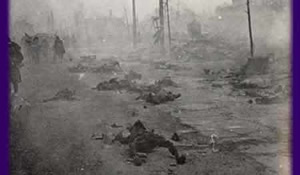
Here are some legal uses of conventional weapons.

Napalm. Tokyo, 10 March 1945.

ashes and charred bodies in a desolate street

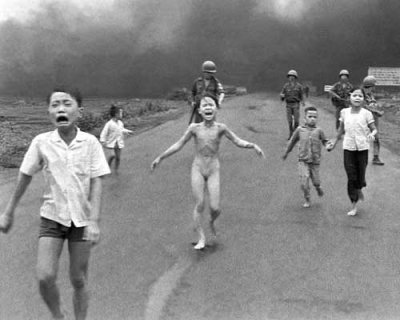
Napalm and white phosphorus. Trang Bang, Vietnam, 8 June 1972.

White phosphorus and napalm explode over the village of Trang Bang
Phan Thi Kim Phuc screams in pain after being burned by napalm in her village

White phosphorus. Fallujah, November 2004.

shower of white fire exploding over Fallujah FallujahRainingFire.jpg

a baby, dead, with severe burns a boy, dead, with skin burned black

a dead woman's hand, charred down to the bone, still clutching subha prayer beads FallujahAerialPhoto.jpg

White phosphorus firebombing of Fallujah

This is conventional aerial warfare using conventional weapons adhering to the letter of all the treaties that the goverment of the United States is a party to. This is imperial power in its fullest glory, restrained by all the civilized restraints that it deems necessary and proper for itself. This is its morality. This is its justice. This is its law.

engraving: a ghastly skeleton, robed and crowned, holds a scepter and a polished glass with the words, THE MIRROR THAT FLATTERS NOT

Talking about the French rioters

There’s been a lot of talk about the rioters in France, and a lot of analysis of why they rioted.

Jocelyn Gecker (2005-11-02), for the Associated Press, reports on the seventh day of rioting. Experts are said to say that Islamic radicals seek to recruit disenchanted youths by telling them that France has abandoned them; sociologist Manuel Boucher suggests that French society is in a bad state … increasingly unequal, increasingly segregated, and increasingly divided along ethnic and racial lines, and that some youths turn to Islam to claim an identity that is not French, to seize on something which gives them back their individual and collective dignity. Gecker says that some said that the unrest — sparked by the accidental deaths of two teenagers last week — is an expression of frustration over grinding unemployment and police harassment in the communities, and cites direct quotes to that effect from the president of the Clichy-sous-Bois mosque, the Socialist mayor of Clichy-sous-Bois, and a 22 year old Moroccan-French resident of Clichy-sous-Bois. On the other hand, there are no direct quotes from any of the rioters as to why they are rioting.

Franck Prevel, reporting for Reuters (2005-11-07), discussed the escalating violence against police. He quoted a statement from the French police union, President Chirac, a police officer, Interior Minister Sarkozy, Prime Minister de Villepin, and mentioned a fatwa against the riots issued by one of France’s largest Muslim organizations in response to official suggestions that Islamist militants might be stoking some of the protests. Prevel mentions that rioting began with the accidental electrocution of two youths fleeing police in Clichy-sous-Bois outside Paris and cites frustration among ethnic minorities over racism, unemployment and harsh treatment by police. On the other hand, he doesn’t cite any direct quotes from any of the rioters as to why they are rioting.

Meryl Yourish (2005-11-03) linked to Gecker’s AP report; she suggested that there is a global war being driven by radical Islamism in European slums, and remarks that first they came for the Jews, and many did not speak out, because they were not Jews. Her post has a lot of analysis, but no direct quotes from any of the rioters on why they are rioting.

She added a later update which links to an article by Paul Belien (2005-11-02) in his Brussels Journal blog. The article cites Theodore Dalrymple’s poignant analysis the crisis faced by British Muslims, and articles from FOX News, the Associated Press and Agence France-Presse, Knack, and a Danish blog called Viking Observer on the dangers faced by police and other emergency workers in Muslim slums in Malmo and Brussells, and rioting by mostly Muslim youths in France and Denmark. Belian suggests that these are problems all across Europe, and that they’ve resulted from a naive belief in universal cultural compatibility, the harsh reality of looming permanent conflict, and weak-kneed appeasement by the government officials in European countries. He suggests that the proximate cause of the French riots was unreasonable resentment over reasonable attempts by the French police to do their job; and that they were exacerbated by the unwillingness of the French government to take a more militant response. He quotes Viking Observer’s translation of some direct quotes from Danish rioters, as reported in the Danish press; on the other hand, he has no direct quotes, and links to no stories with direct quotes, from French rioters on why they are rioting.

At Positive Liberty, Jason Kuznicki (2005-11-07) argues that evidence for radical Islamist involvement is thin at best, and argues that it has much more to do with the material and the cultural conditions faced by young men in communities marked by poverty, dependency, desperation, and ghettoization, in turn caused by the French government’s restrictive economic and social policies. He cites some comments by Mark Brady at Liberty and Power, who in turn cites commentary by British sociologist Frank Furedi, attributing the riots to the exhaustion of national politics in Western Europe, and commentary by British writer James Heartfield, who suggests that It is not that assimilation has failed, but that France only pays lip service to assimilation, while practically refusing it to the descendants of North African migrants. Timothy Sandefur dissents, arguing that there is good reason to believe that at least a large part of the Islamic world does see the situation in France as an Intifada. He offers some subtle comments aimed at demonstrating the ways in which an extremely insular immigrant population and a stagnant, stultified economy can, by producing an an angry mass of economic and social outcasts, which comes to see itself as exploited by another large segment of the community, provide an opportunity for violent, hatred-fueled ideologies such as fascism or terrorist Islamism. He suggests that in such a situation the causal threads tying together the material conditions and the Islamist ideology can intertwine so thoroughly that it may not make any sense to try to separate the one from the other when trying to give causal explanations of the violence that ensues. He cites commentary from the Affordable Housing Institute, which discusses the alienation and insularity created by France’s public housing policy and mentions statements by Interior Minister Sarkozy, President Chirac, Prime Minister de Villepin, Foreign Minister Philippe Douste-Blazy, authorities (who anonymously say that it’s Islamist militants and drug traffickers), and A Clockwork Orange. He also cites two news articles — one on the arrests, back in September, of some suspected members of an Algerian terrorist group living in France; and another from a reporter who seems to have actually found a website in which the rioters make bellicose statements and brag about their martial accomplishments. On the other hand, neither that article nor any of the others, nor Sandefur’s commentary, nor Kuznicki’s, nor Brady’s, nor Furedi’s, nor Heartfield’s, contains any direct quotes from any of the rioters on why they are rioting.

Brad Spangler (2005-11-04) thinks that it’s racialized violence and the ghettoization created by the welfare state, with conditions that have far more in common with the recent riots in Toledo (or in Watts a generation earlier) than they do with events in the Middle East.

French fascist demagogue Jean-Marie Le Pen blames mass immigration, the moral corruption of the country’s leaders, disintegration of the country and social injustice.

David Brooks (2005-11-10) thinks it’s French gangsta rap.

Victor Davis Hanson (2005-11-07) thinks that the riots are a clear example of what happens to a society that doesn’t ask the immigrant to integrate, and the immigrant doesn’t feel that he has to integrate, or to learn the language, or learn the traditions of the West, and further blames the French govement’s appeasement of Muslim immigrants.

Colby Cosh (2005-11-07) argues that France has undeniably been more aggressive than the Anglo-Saxon countries in asserting a unitary national culture and blames the despair and anger created by a government housing policy that amounts to warehousing members of a particular ethnic group in horrible, unsightly, cheaply-made housing projects.

Rox’s friend from Paris says that it’s not an Islamic riot at all, but rather drug dealers defending their turf from the police.

Emma Kate Symons (2005-11-12) thinks it’s the expression of a violently male supremacist adolescent culture.

Mark Steyn (2005-11-10) thinks this is the start of a long Eurabian civil war we’re witnessing here.

On the other hand, none of them cite any direct quotes from any of the rioters as to why they’re rioting.

So why did all those rioters set towns across France afire? Don’t ask me. How would I know? If you want to find out, ask a rioter Pourquoi? You might even wait for the answer before you start offering an analysis.

Sad news: Joan Kennedy Taylor has died.

Sad news from the world of libertarianism feminism: Joan Kennedy Taylor died last week, at the age of 79, after a long battle with cancer and kidney disease. (Alina Stefanescu’s post reminded me that I’ve been meaning to post a note on the sad news; it also has a good round-up of tributes from fellow libertarians and links to a couple of Kennedy Taylor’s essays online.)

Besides her legitimate claim to being the leading female intellectual in the libertarian movement, tout court, over the past 20 years, Joan Kennedy Taylor ought to be remembered for her pioneering efforts for a renewed libertarian feminism, and (in general) for her astonishing ability to bridge cultural and political divides in order to relate to the best in people wherever she could find them (from her political work with the libertarian wing of the Goldwater Republicans, to her friendships with people ranging from Ayn Rand and Nathaniel Branden, to Jack Kerouac and Allen Ginsberg). Although she didn’t hesitate to confront issues head on, she didn’t believe that that head-on confrontation meant slash-and-burn political jockeying; and (as I’ve remarked before) this made her efforts towards a libertarian feminism genuinely transformative and not just oppositional — a conversation between libertarianism and feminism instead of just a shouting match. (Rather than haranguing statist feminists to be less statist, she offers a chance for anti-statists and feminists to understand each other better, and to appreciate what an unapologetic, full-bodied libertarianism and an unapologetic, full-bodied feminism, have to offer one another.

I know because that’s just what she did for me, personally. I remember reading Joan Kennedy Taylor’s essays for the first time during the summer of 1999, just after I’d graduated from high school. Her Ayn Rand and the Concept of Feminism: A Reclamation in Feminist Interpretations of Ayn Rand was one of a few essays that really convinced me that libertarian feminism and feminist libertarianism were viable projects. And also that libertarianism and feminism were more than just logically compatible; that they might have a lot to contribute to each other. In an important sense that essay was one of the essays that really allowed me to become an anarchist. And, strangely enough, it’s also one of the essays that really allowed me to become a more radical feminist; it opened my eyes to the possibility of an uncompromising feminism that wasn’t tethered to the half-hearted welfare liberal statism that I’d spent most of my high school years half-heartedly believing in. I have my differences with what Joan Kennedy Taylor has to say — sometimes rather sharp ones. But if it weren’t for her I might very well not be a libertarian at all, and I would be a worse feminist too.

May she rest in peace.

Further reading

Boobs against breasts

New Brunswick’s alterna-weekly, [here], recently decided that they wanted to gain some Progressive street cred on the Woman Question. Thus a cover story on breast-feeding, focusing on some women’s efforts to destigmatize it, and the need for nosy busybodies and self-appointed decency police to get over their hang-ups about women breastfeeding in public:

We don’t have a lot of support for women, says Storr. She says there are a myriad of reasons why women don’t breastfeed, but the lack of support on a few fronts is the biggest reason.

Some people will say (to breastfeeding mothers), I formula fed you, and you’re fine. Beyond this, there is a public perception that breastfeeding is something that belongs behind closed doors, she says.

In Vancouver, people breastfeeding in malls and the public is common, she says. In NB, it’s not. Christina Taylor, a 31 year old mother of two who is currently nursing a five and a half month old, says she has a friend who found some trouble in an NB mall.

She was in a food court in a mall, she says.

She had a lady tell her she should feed her baby in the bathroom. She was feeding her baby in a place where everybody else was feeding. Taylor breastfed her now three year old son, but she says at times, she felt housebound.

Here, people frown on you when you nurse in public, she says.

— Brent MacDonald, [here] 2005-10-06: Breast Asssured

A point well taken. And what better way to reinforce it than for the alterna-publishers of the alterna-weekly to pull the issue off shelves and sack the editor, Miriam Christensen, for daring to put this perfectly lovely and tender photograph on the cover:

Original cover of the 6 October 2005 issue.

… because the sight of a woman breastfeeding an infant is, apparently, inappropriate for the public sphere, and we are all of us better off for their much more appropriate replacement cover, helping to demystify breastfeeding with a pastel cartoon of a mother not breastfeeding her child. Which was apparently lifted from a 1950s Kotex ad:

… with even the word Breast dropped out of the top headline — just to make sure, I guess — in favor of First Food, a euphemism apparently summoned from of the eighth circle of Whole Foods hell.

What else is there to do other than just to point to the damn thing — from Princess Aurora to the pastel roses floating in the air behind her? Congratulations are due to the Irving newspaper group: they have officially outpaced any possibility of satire.

Further reading

Anticopyright. All pages written 1996–2026 by Rad Geek. Feel free to reprint if you like it. This machine kills intellectual monopolists.