Rad Geek People's Daily

official state media for a secessionist republic of one

Posts filed under Politics

State of grace

The outstanding problem of the Progressive-dominated American Left is that they do not believe that the State exists. I don’t mean that they think it is a nullity; rather, they do not think that it exists in the same concrete plane of reality as the rest of us, or operates with the constraints in knowledge, wisdom, and virtue that the rest of us have. One Leftist who did see things clearly was Randolph Bourne; as he put it in The State (a bitter reaction to the eager embrace of World War I by most of his former colleagues in the American liberal press):

Government … is synonymous with neither State nor Nation. It is the machinery by which the nation, organized as a State, carries out its State functions. Government is a framework of the administration of laws, and the carrying out of the public force. Government is the idea of the State put into practical operation in the hands of definite, concrete, fallible men. It is the visible sign of the invisible grace. It is the word made flesh. And it has necessarily the limitations inherent in all practicality. Government is the only form in which we can envisage the State, but it is by no means identical with it. That the State is a mystical conception is something that must never be forgotten. Its glamor and its significance linger behind the framework of Government and direct its activities.

— Randolph Bourne (1918): The State § 1 ¶ 9

I mention this because I know so many people who are otherwise perfectly sane, who understand human limitation and the dangers of concentrated power, who suddenly blank out as soon as the humans in question have government business cards and the power in question is the most systematic and reliable form of power available — access to enforcement powers of the State. Here’s an example that I noticed just today, which I picked out precisely because it’s so mundane: it turns out that there’s been something of a scuffle between Level 3 Communications and Cogent over networking contracts; hardball business dealing has led to a disconnection that left people unable to communicate with web hosts and other Internet services on the wrong side of the break. Well, that sucks, to be sure, but what’s the first thing that consumer groups shoot for on hearing about it?

However, as the Net has evolved from an academic and research curiosity into a vital part of the world’s commercial and communications infrastructure, some have called for a basic set of rules that would keep traffic flowing.

Mark Cooper, director of research for the Consumer Federation of America, compares the state of today’s Internet to the development of roads, or the creation of national telephone networks 100 years ago. Government acted in both cases to ensure the free flow of economically important traffic, he said.

There comes a point where some of these functionalities, such as the seamless interoperation of the Internet, are too important to leave to the private interest of businesses, Cooper said. We like to think that people won’t do antisocial things, but when push comes to shove they will defend their economic interests even at the expense of the public.

My problem is not with the negative things that Cooper says about busineses; many libertarians might dig in and object at that point, but I think he’s right to point out how businesses often do things that are foolish or destructive in pursuit of narrowly private gain. My problem is with the inference he draws from this: he goes from businesses sometimes make bad decisions about how to use this resource, to government ought to make the decisions about how to use this resource. But the premises only support the conclusion if you have shown that government control would not make things worse. And that brings us to important questions that Cooper has left unanswered, because — not believing in the mundane existence of the State — he left them unasked. We have to ask, If these things are too important to leave to the private interests of business, then why the hell aren’t they too important to leave to the political interests of the government? And if the typical run of people have enough of a capacity for antisocial behavior that they’ll defend their economic interests even at the expense of the public, why the hell don’t you think that, when push comes to shove, they’ll defend their political interests even at the expense of the public? No answer is forthcoming, because government is being thought of as an anonymous and benign force to be harnessed, rather than the real actions of real people blundering their way through.

If there’s anything of real value in Leftist economic analysis, it’s the way that the Left insistently points out that businesses are not large automata; that they are run by people, that people are limited in knowledge and are also easily corrupted when they have a great deal of power to gain at the expense of others. As a result, large corporations with critical resources often act in ways that are foolish, selfish, exploitative or destructive. If you’re trying to understand the economic world while ignoring the fact that it is made of people you will always go seriously astray. But if there’s one thing that’s been going wrong with the Left’s economic analysis during the past several decades (basically, since the 1930s, when Marxism and Progressivism each rose to the top of the heap in the radical and reformist wings of the Left), it’s the way in which they have refused to apply exactly the same analysis to the agents of the State. If it’s vital to remember that people run businesses, it is even more vital to remember that people run the government. And that is exactly what is being forgotten, because it is covered over by the shimmering mystical glow of the State. If Leftists are willing to call out cheerleaders for business when they fetishize the anonymous, undirected forces of the market and their supposedly reliable and benign march towards equilibrium, then they had better stop being cheerleaders for the State, and stop fetishizing the anonymous, undirected rules of the government and their supposedly reliable and benign pursuit of the public interest. That ain’t how it works now (just pick up any newspaper) and — this is the important part — it ain’t how it would work under any government. Bureaucracies are run by fallible human beings blundering their way through no matter what the party in power is; in the government they face the same knowledge problems and incentive problems that corporate bureaucrats face. In fact, they face even more severe knowledge problems and incentive problems — beacause, as agents of the government they hold a monopoly on whatever resources they control, and that monopoly is backed with handcuffs, guns, and bombs.

If critical resources are too important to leave in the hands of private businesses, then yes, they are damn well too important to put under the monopolistic control of government bureaucrats.

Now, pro-State Leftists might object at this point that I’m being unfair; the position is not that government is run by people any more perfect than business is, but rather that people in a democratic society, the people in government have restraints put on them that tends to direct them towards the public interest, whereas the environment in which business decisions are made is one that rewards the irresponsible pursuit of private advantage. But this, again, relies on a mystical conception of the State; here the mysticism comes in not with the conception of government intervention, but rather with the conception of control by the people. The idea that government officials — and appointed government bureaucrats especially, who are after all the people who run all the regulatory bodies — are responsive to what people like you and me want under most circumstances is so obviously refuted by a quick look at the daily operations of government that I must conclude that people who make these kind of arguments are being stopped from looking, because democratic mysticism is used as a substitute for observation.

If, to put it another way, the pro-State Left’s is making their argument for government control over some resource or another by claiming that you can always vote the jerks out of office if you don’t like how they are running things … well, then, how’s that been working out for y’all lately?

Small-government conservatives

Everything old is new again.

Here’s how principled conservatives in the Indiana state legislature propose to follow through on the Republican promise of making the government accountable to the people, not the people to the government: a suggested law to require government parenting licenses for people who want to conceive through artificial insemination. Queahs and single hussies need not apply:

Sec. 5. (a) A petition to establish parentage may be filed by an intended parent.

(b) The intended parents must be married to each other, and both spouses must be parties to the action to establish parentage.

(c) An unmarried person may not be an intended parent.

And nothing says small government like government-controlled reproduction and piles of bureaucratic paperwork to manage it all!

Sec. 6. (a) A petition to establish parentage must be filed in triplicate.

(b) The original copy of a petition to establish parentage must be verified by the oath or affirmation of each petitioner.

Sec. 7. (a) A petition to establish parentage must be made under oath and specify the following:

(1) The:

(A) name, age, and place of residence of each petitioner; and

(B) place and date of marriage of the petitioners.

(2) The name and place or residence, if known, of the donor or donors.

(3) The name and address of the agency that performed the assessment under section 12 of this chapter.

(4) The name and address of the physician who performed the medical procedure that resulted in the pregnancy of the child who is subject to the parentage action.

(5) The type of assisted reproduction procedure that was used.

(6) Whether a petitioner has been convicted of:

(A) a felony; or

(B) a misdemeanor relating to the health and safety of children;

and, if so, the date and description of the conviction.

(7) Additional information consistent with the purpose and provisions of this chapter that is considered relevant to the proceedings.

(b) The following documents must be attached to the petition to establish parentage:

(1) The consent of the petitioners required under section 13 of this chapter to the medical procedure that resulted in the pregnancy for the child who is the subject to the parentage action.

(2) The consent of each donor, if known, to the use of the donation for the assisted reproduction medical procedure.

(3) The certificate of satisfactory completion of the assessment required under section 12 of this chapter.

(4) The certificate of the physician required under section 14 of this chapter. …

Sec. 11. … (b) A physician may not commence an assisted reproduction technology procedure that may result in a child being born until the intended parents of the child have received a certificate of satisfactory completion of the assessment required under section 12 of this chapter. …

Sec. 12. (a) Before intended parents may commence assisted reproduction, the intended parents shall obtain an assessment from a licensed child placing agency in the intended parents’ state of residence.

(b) The assessment must follow the normal practice for assessments in a domestic infant adoption procedure and must include the following information:

(1) The intended parents’ purpose for the assisted reproduction.

(2) The fertility history of the intended parents, including the pregnancy history and response to pregnancy losses of the woman.

(3) An acknowledgment by the intended parents that the child may not be the biological child of at least one (1) of the intended parents depending on the type of artificial reproduction procedure used.

(4) A list of the intended parents’ family and friend support system.

(5) A plan for sharing any known genetic information with the child.

(6) Personal information about each intended parent, including the following:

(A) Family of origin.

(B) Values.

(C) Relationships.

(D) Education.

(E) Employment and income.

(F) Hobbies and talents.

(G) Physical description, including the general health of the individual.

(H) Birth verification.

(I) Personality description, including the strengths and weaknesses of each intended parent.

(7) Description of any children residing in the intended parents’ home.

(8) A verification and evaluation of the intended parents’ marital relationship, including:

(A) the shared values and interests between the individuals;

(B) the manner in which conflict between the individuals is resolved; and

(C) a history of the intended parents’ relationship.

(9) Documentation of the dissolution of any prior marriage and an assessment of the impact of the prior marriage on the intended parents’ relationship.

(10) A description of the family lifestyle of the intended parents, include a description of individual participation in faith-based or church activities, hobbies, and other interests.

(11) The intended parents’ child rearing expectations and values.

(12) A description of the home and community, including verification of the safety and security of the home.

(13) Child care plans.

(14) Statement of the assets, liabilities, investments, and ability of the intended parents to manage finances, including the most recently filed tax forms.

(15) A review of the local police records, the state and violent offender directory, and a criminal history check as set forth in subsection (c).

(16) A letter of reference by a friend or family member.

(17) A written consent from each donor, if known, to use of the donation in the assisted reproduction medical procedure.

(18) The recommendation for participation in assisted reproduction.

… (f) After completing the assessment described in this section, and if the child placing agency approves the intended parents to commence the assisted reproduction procedure, the agency shall issue a certificate that the intended parents have satisfactorily completed the assessment and are ready to commence assisted reproduction.

(g) A certificate issued under subsection (f) is valid for two (2) years.

(h) A physician may rely upon a certificate issued under this section to commence assisted reproduction with an intended parent.

(i) A certificate issued under subsection (f) must be filed with the petition to establish parentage.

… Sec. 14.(a) After a viable pregnancy has been achieved by artificial reproduction, the physician who performed the artificial reproduction procedure shall issue a certificate to the intended parents stating:

(1) the child was conceived under the care of the physician;

(2) the type of artificial reproduction procedure that was used;

(3) whether the donor is known or anonymous; and

(4) whether the physician is aware of any compensation being paid to the donor.

(b) The certificate must be:

(1) on the physician’s letterhead stationary; and

(2) notarized.

(c) The certificate required under this section shall be filed with the petition to establish parentage.

(d) form by x agency?

Sec. 15. (a) If the court finds that:

(1) the petition to establish parentage satisfies the requirements of this chapter;

(2) the certificate from a licensed child placing agency required under section 12 of this chapter has been filed and meets the requirements of this chapter;

(3) the certificate by the physician required under section 14 of this chapter has been filed and meets the requirements of this chapter; and

(4) the consent required under section 13 of this chapter has been obtained; the court shall grant the petition to establish parentage and enter a decree establishing parentage without a hearing or further court action unless the court finds by clear and convincing evidence that granting the petition is not in the best interests of the child.

(b) The court may deny the petition to establish parentage if a petitioner has been convicted of a crime described in section 7(a)(5). …

Of course, covenants without the sword are but breath:

Sec. 17. (a) If the court dismisses a petition to establish parentage, the court shall determine the person who should have custody of the child. …

Sec. 20. (a) An intended parent who knowingly or intentionally participates in an artificial reproduction procedure without establishing parentage under section 15 of this chapter commits unauthorized artificial reproduction, a Class B misdemeanor.

You can read the whole damn thing, if you’re into that sort of thing.

The proposed bill is the work of State Senator Pat Miller (R-Indianapolis). Here’s what she had to say on its behalf:

Miller said the state often reacts to problems and she instead wants to be proactive on this issue.

We’re not trying to stop people from having kids; we’re just trying to find some guidelines, she said.

She did concede it would stop single people from using methods other than sexual intercourse but said all the studies indicate the best environment for a child is to have a two-parent family — a mother and a father.

Meanwhile, her Republican colleagues recoil in horror at the existence of an unregulated industry:

Sen. Gary Dillon, R-Pierceton, is a member on the commission and said parts of the legislation have valid points. He does have some reservations about limiting the reproductive rights of single people [that’s awful big of him -RG] but quoted the same studies as Miller about the health of a child in two-parent homes.

There’s a concern that there’s no regulation over this whole industry, he said.

You can let Senator Miller know what you think at:

Senator Patricia Miller
(317) 232-9400
(800) 382-9467

Let’s kill this thing dead.

Update (2005-10-10): It’s dead. Huzzah!

Meanwhile, I’m just waiting with baited breath for some federalist libertarian to come along and tell me how the real evil would be for the federal courts to strike this down on the obvious privacy grounds. Because, you know, it’s not so bad, as long as a state is doing it.

Further reading

Andrea Dworkin Was Right #5

I’m a bit late to this party, and Jill at Feministe (2005-09-29) does a fine job of taking on the substantial claims made in Judge Posner’s latest contribution at Econo-Creep Central. So instead of a warmed-over version of Jill’s critique, I’d just like to point out how Posner begins–by drawing on a textbook example of a Backlash trend story that recently made Page One of the New York Times:

An article in the New York Times of September 20 by Louise Story, entitled “Many Women at Elite Colleges Set Career Path to Motherhood,” reports the results of surveys and interviews concerning career plans of women at the nation’s most prestigious colleges, law schools, and business schools. Although not rigorously empirical, the article confirms–what everyone associated with such institutions has long known–that a vastly higher percentage of female than of male students will drop out of the work force to take care of their children.

Now, in fact, the not rigorously empirical article is a weasel-worded, anecdotal retread of the Times‘ old standby, the evidentially-empty, vaguely quantified Backlash “mommy crisis” trend story. In fact the story could just as well have been copied from a nearly identical Page One piece from 25 years ago; neither story is anything more than a grab-bag of sexist presuppositions, misrepresented anecdotes, and vague hand-waving at the “many women” who these hand-picked selection of interviewees from Yale allegedly represent. It contributes nothing to anyone’s knowledge, because it does not even rise to making any claim about reality that can be pinned down; it teaches us nothing and confirms nothing about gender and career paths at elite professional schools.

On the other hand, the story’s front-page publication in the Newspaper of Record, and Posner’s happy use of it, does confirm something else:

While gossip among women is universally ridiculed as low and trivial, gossip among men, especially if it is about women, is called theory, or idea, or fact.

–Andrea Dworkin (1978)

Twenty years ago this morning

photo: a building, collapsed, in Mexico City

México, D.F., 19 September 1985.

7:19 am, 19 September 1985

BBC (19 September 1985): Mexico suffers devastating earthquake:

A massive earthquake has hit Mexico not far from its capital, Mexico City, causing untold casualties and widespread damage.

Officials say at least 170 people have been killed and thousands injured, but it is feared the death toll may rise into the thousands.

The quake hit the west coast near the resort town of Acapulco early this morning, and was measured by the US Geological Survey at a magnitude of 7.8.

It lasted for 50 seconds, and devastated three states on the Pacific coast.

A part of a mountain just slid away, falling on the peasants who were just getting up to go to work, said Lieutenant Manuel Sanchez, from the fire department’s headquarters in the state of Jalisco.

Most of the damage, however, was caused 250 miles (400 km) away in Mexico City, which was declared a disaster zone.

Telephone links were cut, and a communications tower burst into flames, leaving television broadcasts monitored in neighbouring Guatemala the only source of information.

Television reports said hundreds of people are trapped in rubble, and more than a third of all buildings have been damaged.

Clouds of dust hung over the city centre, and broken glass and chunks of cement littered the streets.

There was a strong smell of gas and the city government issued a radio appeal for people not to light matches.

Manuel Maga?@c3;b1;a Contreras, Excelsior (September 20, 1998): The greatest catastrophe ever suffered by Mexico City:

Of all the scenes of terror in which tears mixed with cries for help, sorrow, etc., what survives is the coldness of the numbers.

Officially, the records which were put at the disposal of the authorities listed 4,541 casualties. Nevertheless, non-official versions put the number of people killed at more than 30,000.

Assistance to the injured required the staffing of 131 first-aid stations, and even so a greater number of such installations would have been necessary. Figures finally provided by the Federal District authorities certified that 14,286 injured were attended to. It was necessary to transfer 4,900 people from damaged hospital buildings to other health institutions. It is said that 38,605 additional patients were looked after. Among them, 22,296 for injuries other than physical, 10,188 for minor injuries, and 5,748 for major injuries, with 2,637 requiring hospitalization.

It’s funny the things that you remember. Aryxael remembers riding in the family’s LeBaron on the way to school, when his mother said That’s weird, I feel like the car is being yanked away from me. Cuervo del D.F. remembers that he was playing at wrestling on the bed with his brother, and when his mother screamed they first thought she was yelling at them again to stop fighting.

Of course, you also remember the fear:

Tampoco había luz en su casa y la angustia de mi mamá ya era para saber como estaba mi papá. El trabajaba de velador en la catedral metropolitana (z?@c3;b3;calo) y a la hora del temblor era exactamente la hora en la que se dispon?@ef;bf;½a a regresar a casa. Mis tíos tenía un radio de pilas y lo encendieron, muchas estaciones no estaban al aire, pero fue cuando escucharon la narraci?@c3;b3;n hecha por Jacobo Zabludowski (reportero mexicano). Al escuchar que el centro de la ciudad estaba casi en ruinas mi mamá nos dej?@c3;b3; con mis tíos para ella regresara a casa y saber si ya había llegado mi papá.

Una vida cualqiuera en Chilangotitlán 2005-09-19: Un día como hoy pero hace 20 a?@c3;b1;os (parte I)

The lights weren’t on in their house either, and now my mother was anguished to know how my father was. He worked as a vigil-keeper at the Metropolitan Cathedral (Z?@c3;b3;calo [a square in central Mexico City]) and the hour of the quake was exactly the hour he planned to leave for home. My aunt and uncle had a battery radio and they fired it up; many stations weren’t on the air, but then we heard the narration made by Jacobo Zabludowski (a Mexican reporter). When she heard that the city center was almost in ruins, my mother left us with my aunt and uncle to go back to the house and find out if my father had made it back.

— Una vida cualqiuera en Chilangotitlán 2005-09-19: A day like today but 20 years ago (part I)

There are millions of stories like this one. And tens of thousands that did not end with a safe return. Partly because we are all very small and vulnerable to the tremendous power of nature. But partly also because of the callousness and criminal incompetance of the PRI government:

In 1985 a terrible earthquake hit Mexico. As analyzed by vulcanologists it was of a type that would maximize the damage to the kinds of buildings that abound in Central Mexico City, and it created havoc there. Whole city blocks disappeared, the apartment towers of Tlaltelolco were either damaged or destroyed, but the worst damage was done in “Porifirian” Mexico City where sprawling three and four story buildings not only housed thousands of families in cheap apartments, but also assembly and textile factories that employed thousands of workers. Fortunately the earthquake struck before the morning shift went in, but still thousands of people (perhaps as many as 20,000) were killed. The government response was weak and ineffectual. The President appeared, too well turned out in an expensive leather jacket, to tour the affected areas. U.S. and world help was refused because of what outsiders considered misplaced pride, with a resulting shortage of the very kind of heavy earthmoving equipment that alone could disinter the victims, And when it did arrive, the zones were cordoned off by the army, which allowed, or so it was said, the machinery to be used to save heavy equipment and business records rather than the people or their remains. The earthquake was important because it laid bare the lack of imagination and energy in government circles, and its tendency to defend itself first in any time of crisis, rather than concern itself with the living conditions of Mexicans.

— The Sociodemographic Effects of the Crisis in Mexico

The one thin ray of light through the darkness was the spontaneous courage, humanity, and solidarity shown by ordinary Mexicans, while their government ignored and betrayed them. When the government was unable or unwilling to rescue the wounded and dying, the people did it for themselves:

One of the lessons we mustn’t squander is the example shown by neighbours when it came to saving people trapped under the wreckage. In the Tlatelolco Unit, especially in the ‘Nuevo Le?@c3;b3;n’ building, many people young and old came to help trapped people and they were called ‘the moles’ [because they dug through the rubble, often with their bare hands, to rescue the people buried under it]. From the Merced zone, a very short person by the name of Sari?@c3;b1;ana, a native of the state of Morelos, became famous and was nicknamed ‘the flea’, saving many people who would otherwise have suffered a prolonged death, had they not be saved by ‘the flea’.

Manuel Maga?@c3;b1;a Contreras, Excelsior (September 20, 1998): The greatest catastrophe ever suffered by Mexico City

Only after a second quake [a huge aftershock the following day] hit and the staggering loss of life could no longer be denied did the government react in a more serious fashion. But, as in 1968, the PRI authorities showed more concern with restoring order than with saving lives. It placed the ruins off-limits to the public, claiming they were unsafe. And, instead of digging, many troops devoted their energy to blocking the neighbors, relatives and thousands of students who turned out to assist in rescue efforts. The official rescue attempt was lackluster, and the authorities, seeing the buried bodies as potential sources of disease rather than potential survivors, sent in heavy equipment to clear the rubble.

Again it was the university students who stood up to the government, clashing with troops who sought to prevent them from digging in the ruins and lying down in front of bulldozers sent to clear the rubble. At the site of a collapsed hospital, students managed to stop the bulldozers long enough for rescuers to tunnel through to a maternity ward and rescue eight babies.

— The Nation 2004-04-01: Democracy Is in the Streets

Courage, love, and humanity don’t need the permission of the law.

For more …

International Ignore the Constitution Day

So, it turns out that today is the 218th anniversary of the signing of the United States Constitution. In honor of this formal declaration of intent to impose a centralized government over the people of the Americas, some gang of jerks in Washington have decided to declare today Constitution Day, and to celebrate the occasion with the following charming Spontaneous Demonstration:

Americans around the world will unite on Friday, September 16, 2005, in the simultaneous recitation of the Preamble to the United States Constitution. General Tommy Franks will lead the Preamble which has previously been led by President George Bush Sr., U.S. Supreme Court Associate Justice Anthony Kennedy, Chief Justice of Alabama Roy Moore, and Pennsylvania Governor Edward Rendell. The celebration will begin at 11 AM Pacific/12 PM Mountain/1 PM Central/2 PM Eastern time.

Hawaii television and radio stations are urged to do a simultaneous broadcast and to reflect and discuss the significance of the Preamble. Newspapers are also urged to promote Constitution Day and to print the Preamble on September 16, 2005, and on September 17, 2005.

President George W. Bush signed a bill on December 8th, 2004 (public law 108-447) which designated every September 17th as Constitution Day.

— Hawaii Reporter 2005-09-15: Celebrating Constitution Day — September 17, 2005

Incidentally, thanks to Senator Robert Byrd, students and teachers in government-run schools will be forced to participate in this joyous nation-wide celebration of the federal government.

Therefore, the Ministry of Culture of this secessionist republic of one calls upon all sovereign individuals to celebrate International Ignore the Constitution Day on September 17th.

The Constitution, in its origins, was an act of naked usurpation: the imposition of a government on millions of sovereign individuals and all of their descendents. Many of those who were asked did not consent to it, and the vast majority of the population of the Americas at the time (who were by turns unpropertied, Black, Indian, and/or female) never were asked whether they wanted it or not. Certainly you have not, 218 years on, and neither do I. If I got together with a group of my buddies at the coffee-shop, wrote We are your Grand High Poo-bahs, and you must do as we say on a napkin, signed it at the bottom, and then (just to be sure you understood) scrawled This is a Constitution for the United States across the top, you would consider me a lunatic if I went around insisting that the napkin I was holding obligated you to do as I say. Yet in what relevant respect are the obligations imposed on us by the U. S. Constitution any different? Did a self-selected gang of ambitious delegates somehow gain the prerogative to impose a novel, centralized, invasive government on other people against their will–the same prerogative you would think I was crazy for asserting? If so, how did they get it? If they had some kind of right, under natural law, to impose a new order of government when they saw fit, then why don’t I have the authority to do the same, for myself, whenever I decide I don’t like what they set up? (Is it because they wore powdered wigs?) If neither they nor I have the right, under natural law, to impose a new order of government, then why do their written commands have any authority than the orders of a mafioso (which may be quite consistently enforced, but which few would consider themselves morally bound to obey)? If they did have the right to do so but only with the consent of the governed, then what obligation has the Constitution ever had over those who voted against ratification, or those who never were asked for their consent? (Which, today, means everybody.)

You might say that, however dubious the notion of the consent of the governed may be, in connection with the authority of the Constitution, still, the Constitution was a wise act of statecraft and it would be wise for us to go along with it no matter how much the moralists might scowl. But is it? Hardly. The Constitution today is read, by the powers that be, to authorize the monster State that today senselessly lies and murders tens or hundreds of thousands of people around the world, pushes starvation Drug War policies and murderous patent monopolies (the latter under the mantle of Free Trade!) at home and throughout the Third World, that now continually threatens women’s basic human rights over their own bodies, and much more — and, by the way, steals trillions of your hard-earned dollars to do it all. The highest legal authorities have ruled (and thus, made it the effective policy of the State) that the Constitution authorizes federal policies such as military tribunals, the military draft, and Japanese internment. Either the Constitution does authorize these abominations and more (in which case it is the handbook for a monster State) or else it failed to prevent them (in which case it is utterly useless even for its stated purpose of securing the blessings of liberty). In either case, it ought morally to be treated like a dead letter.

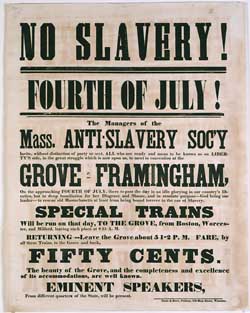
You might say, O.K., fine. I realize that the current federal government isn’t much to cheer for. But isn’t Constitution Day all about celebrating how it was in its origins? But that move will certainly not get you any further. In its origins the Constitution was a pro-slavery document, which authorized (indeed, demanded) federal laws for the capture and re-enslavement of fugitive slaves; it protected Southern slavery also by authorizing the the use of the federal military against slave uprisings — supporting Southern slavery with Northern bayonets. The Northern whites compromised with the Southern slave power: support for an invasive central State in return for the protection that such a central State could offer for slavery. It was, as William Lloyd Garrison declared it, a covenant with Death and an agreement with Hell, and he knew how to celebrate its achievements:

The [4th of July 1851] rally began with a prayer and a hymn. Then Garrison launched into one of the most controversial performances of his career. To-day, we are called to celebrate the seventy-eighth anniversary of American Independence. In what spirit? he asked, with what purpose? to what end? The Declaration of Independence had declared that all men are created equal … It is not a declaration of equality of property, bodily strength or beauty, intellectually or moral development, industrial or inventive powers, but equality of RIGHTS–not of one race, but of all races.

Massachussets Historical Society, July 2005

We have proved recreant to our own faith, false to our own standard, treacherous to the trust committed to our hands; so that, instead of helping to extend the blessings of freedom, we have mightily served the cause of tyranny throughout the world. Garrison then spoke about the prospects for the success of the revolutionary spirit within the nation, prospects he regarded as dismal because of the insatiable greed, boundless rapacity, and profligate disregard of justice prevalent at the time. He concluded his speech by asserting, Such is our condition, such are our prospects, as a people, on the 4th of July, 1854! Setting aside his manuscript, he told the assembly that he should now proceed to perform an action which would be the testimony of his own soul to all present, of the estimation in which he held the pro-slavery laws and deeds of the nation

— from Thoreau: Lecture 43, 4 July, 1854

Producing a copy of the Fugitive Slave Law, he set fire to it, and it burst to ashes. Using an old and well-known phrase, he said, And let all the people say, Amen; and a unanimous cheer and shout of Amen burst from the vast audience. In like manner, Mr. Garrison burned the decision of Edward G. Loring in the case of Anthony Burns, and the late charge of Judge Benjamin R. Curtis to the United States Grand Jury in reference to the treasonable assault upon the Court House for the rescue of the fugitive–the multitude ratifying the fiery immolation with shouts of applause. Then holding up the U.S. Constitution, he branded it as the source and parent of all the other atrocities,–“a covenant with death, and an agreement with hell,”–and consumed it to ashes on the spot, exclaiming, So perish all compromises with tyranny! And let all the people say, Amen! A tremendous shout of Amen! went up to heaven in ratification of the deed, mingled with a few hisses and wrathful exclamations from some who were evidently in a rowdyish state of mind, but who were at once cowed by the popular feeling.

–from The Liberator, 7 July 1854 (boldface added)

You, too, can celebrate Ignore the Constitution Day! Today, completely ignore all claims to authority granted in the Constitution. Live your life as if the Constitution had no more claim on you than the decrees of Emperor Norton. Enjoy your rights under natural law; you have them whether or not the Constitution says one mumbling word for them. While you’re at it, treat the Constitution as completely irrelevant in political arguments too; instead of complaining that unbridled war powers for the President are unconstitutional, for example, complain that they are evil; instead of reciting that damn Davy Crocket bed-time story again and complaining that government-controlled disaster relief is unconstitutional, complain that government-controlled disaster relief is foolish and deadly. (If the Constitution clearly authorized unilateral war powers for the President, or abusive and incompetant government-controlled disaster relief, would that make it okay?) And, hell, while you’re at it, quit complaining that forced Constitution Day celebrations may be unconstitutional; complain instead that they force children to participate in cultish praise for the written record of a naked usurpation.

Just go ahead. Ignore the Constitution for a day. See what happens. Who’s it gonna hurt? And if your political reasoning becomes sharper, your discourse no longer bogs down in a bunch of pseudo-legal mummeries, and you have a pleasant day without having to ask anybody’s permission for it, then I suggest you continue the celebration, tomorrow, and every day thereafter.

Further reading

Other national holidays:

Anticopyright. All pages written 1996–2026 by Rad Geek. Feel free to reprint if you like it. This machine kills intellectual monopolists.