Rad Geek People's Daily

official state media for a secessionist republic of one

Posts filed under Politics

The Spitting Image, “They Walk Among Us” edition

I have shocking news to convey. The disturbing truth about the papacy of Benedict XVI was only the beginning. New photographic evidence from Rox Populi 2005-08-19 has shown unmistakably that this reaches to the very highest levels, not only of the Church, but also of the State:

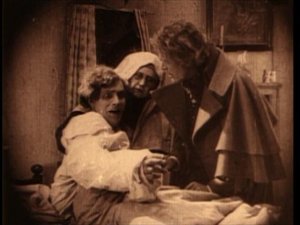
The raftsmen little suspected what terrible cargo they carried down the valley…

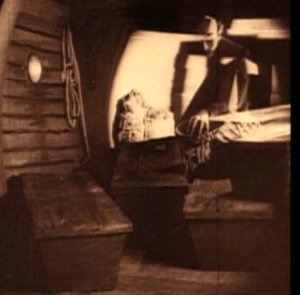
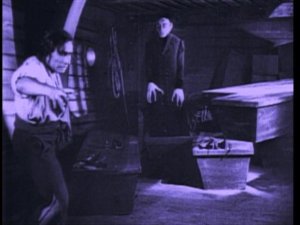
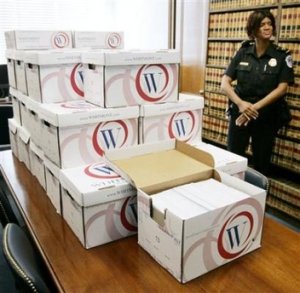
photo: a pile of boxes marked W film still: a pile of coffins on-board the ship, from Nosferatu film still: Thomas Hutter cries out, from Nosferatu

Coffins! Coffins filled with earth!

film still: the first mate sees the vampire rising out of his coffin

The ship of death has a new captain.

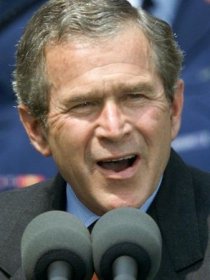
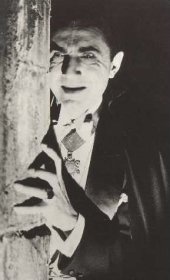
photo: Bush at a press conferece film still: Count Dracula, from Dracula

It would explain a lot, wouldn’t it?

Satire’s obituary will be featured in Sunday’s Times

The posts have been coming a bit slowly lately because of a couple of different projects that I’ve been fiddling with for the past few days (more on that in the very near future). Recent discoveries in the public arts, though–thanks to No Treason 2005/08/12–demand notice.

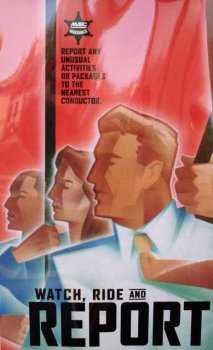
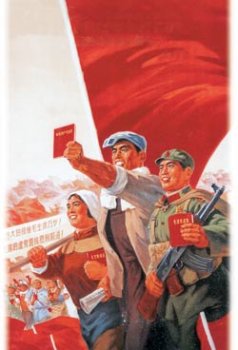
You may have already known about the Baltimore city government’s post-2001 revival of Socialist Realist agitprop:

poster: Watch, Ride, and Report poster: a Chinese propaganda poster

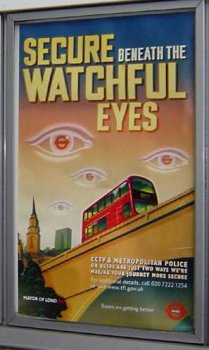
What you may not have known about yet is that the British government has decided to make everyone feel much safer with the following poster:

poster: creepy eyes floating in the air with the caption SECURE BENEATH THE WATCHFUL EYES

I’d make a joke, but the problem is that reality is outpacing any parody I could try to draw up.

Jesus. Don’t these people read?

A day that will live in infamy

The easiest way to begin is with the numbers.

Some 60 years ago today, at 11:02 in the morning, the American B-29 bomber dropped a 10,200 pound plutonium bomb (nicknamed Fat Man) over the city of Nagasaki, a tourist destination, industrial center and sea-port in southwestern Japan with a population of about 230,000. The bomb exploded about 500 yards above Nagasaki, creating a fireball, a shockwave, and a massive burst of radiation. Some 74,000 civilians — about 1/3 of the population of Nagasaki — were burned alive, crushed to death by the shockwave, or sickened and died over the next few months due to severe radiation poisoning (the burning away of their internal organs by intense radiation) and cancer.

Three days before, with no prior warning, a B-29 bomber had dropped an enriched uranium bomb over Hiroshima, an industrial center in western Japan, with a population of about 255,000. The bomb had exploded about 670 yards above the city. 80,000 civilians were burned alive or crushed to death by the explosion. By the end of 1945, another 60,000 people died due to severe radiation poisoning and cancer, raising the death toll to about 140,000–about 55% of the city’s population.

One of the reasons that Hiroshima and Nagasaki were chosen as targets is that they were considered to be good sites to demonstrate the killing power of the Bomb: they had been mostly untouched during the six months of low-altitude firebombing of Japanese cities. The first major raid of that campaign was the firebombing of Tokyo in the middle of the night on March 9-10, 1945. 334 American B-29 bombers raced over the city at about 7,000 feet, and dropped about 1,700 tons of napalm bombs. It is estimated that about 100,000 civilians were burned to death in one (1) night. Over the next 6 months, from March 10 to Japan’s surrender on August 15, over 100 Japanese cities were firebombed; about 500,000 civilians were burned to death.

All told, the firebombing and nuclear attacks and conventional air raids on Japan killed somewhere between 800,000 and 1,000,000 Japanese civilians over the course of half a year.

Then there are the names.
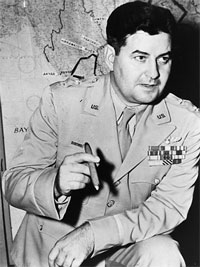
portrait: LeMay

Curtis LeMay

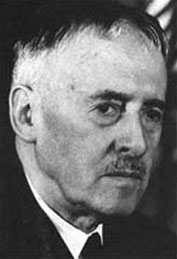
portrait: Stimson

Henry L. Stimson, Secretary of War

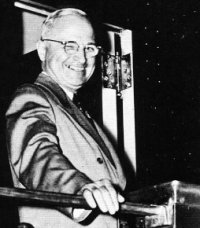
press photo: Truman

Harry Truman, President

The B-29 Bockscar, which incinerated one third of the people of Nagasaki, was piloted by Major Charles Sweeney. The actual dropping of the bomb was carried out by the plane’s bombadier, Captain Kermit Beahan.

The B-29 Enola Gay, which incinerated over half of the people of Hiroshima, was piloted and commanded by Colonel Paul Tibbets. The plane’s bombadier, Major Thomas Ferebee, dropped the bomb over Hiroshima.

Sweeney, Beahan, Tibbets, and Ferebee were members of the XXI Bomber Command, directed General Curtis LeMay. LeMay opposed the nuclear attacks, but he directed it under orders from Secretary of War Henry L. Stimson and President Harry S. Truman, who had made the decision to use atomic weapons in order to terrorize Japan into unconditional surrender. LeMay was also the architect of the low-altitude firebombing campaign, acting on advice and research from his subordinate, Lt. Col. Robert McNamara.

We will never know the names of most of the 1,000,000 or so civilians who were killed in the onslaught. The Japanese government was in disarray in the closing months of the war, and many of the records were consumed by the flames along with the lives of the victims.

Then there are the statements of intent.

The purposes of the bombing was to achieve victory through catastrophic bloodshed and terror. LeMay, when asked about his bombing campaigns, stated There are no innocent civilians, so it doesn’t bother me so much to be killing innocent bystanders. (He also mused, later, I suppose if I had lost the war, I would have been tried as a war criminal.) The interim committee deciding to drop the bomb stated, on May 31, 1945, that we could not give the Japanese any warning before the atomic bombing of Hiroshima. About 24 hours before the incineration of Nagasaki, U.S. planes began dropping leaflets all over Japan, threatening more destruction but naming no targets that could be evacuated. The leaflets did not reach Nagasaki at all until August 10, the day after it was destroyed. The leaflets read:

TO THE JAPANESE PEOPLE:

America asks that you take immediate heed of what we say on this leaflet.

We are in possession of the most destructive explosive ever devised by man. A single one of our newly developed atomic bombs is actually the equivalent in explosive power to what 2000 of our giant B-29s can carry on a single mission. This awful fact is one for you to ponder and we solemnly assure you it is grimly accurate.

We have just begun to use this weapon against your homeland. If you still have any doubt, make inquiry as to what happened to Hiroshima when just one atomic bomb fell on that city.

Before using this bomb to destroy every resource of the military by which they are prolonging this useless war, we ask that you now petition the Emperor to end the war. Our president has outlined for you the thirteen consequences of an honorable surrender. We urge that you accept these consequences and begin the work of building a new, better and peace-loving Japan.

You should take steps now to cease military resistance. Otherwise, we shall resolutely employ this bomb and all our other superior weapons to promptly and forcefully end the war.

Shortly before the leaflets were dropped, Harry Truman also publicly declared his aims: It was to spare the Japanese people from utter destruction that the ultimatum of July 26 was issued at Potsdam. Their leaders promptly rejected that ultimatum. If they do not now accept our terms, they may expect a rain of ruin from the air the likes of which has never been seen on this earth.

Of course, no specific warning was given to the civilians of Nagasaki, at any point.

After the war, Truman defended his decision to burn nearly 1,000,000 civilians to death on the grounds that it was necessary to secure the unconditional submission of Japan to surrender and occupation without a costly marine invasion of the home islands.

Then there are the effects. For most of these there are no words.
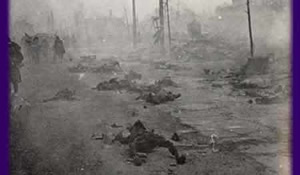
photo: burnt corpses lie in a ruined street

Aftermath of the Tokyo firebombing, 10 March 1945
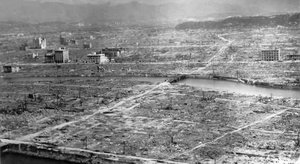
photo: an aerial view of Hiroshima, leveled

Aftermath of the atomic bombing of Hiroshima, 6 August 1945
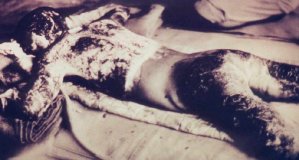
photo: body of a burn victim

A boy caught by the bombing in Hiroshima
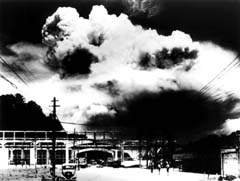
photo: a photo of the mushroom cloud rising over Nagasaki, taken from ground level in the city

The explosion and mushroom cloud, seen from ground level in Nagasaki on 9 August 1945.
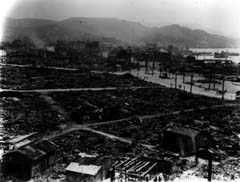
photo: leveled houses around the Nagasaki railroad station

Nagasaki railroad station

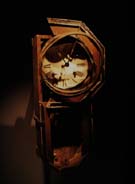
photo: a shattered clock, stopped at 11:02 AM

A clock from Nagasaki, stopped at 11:02 AM
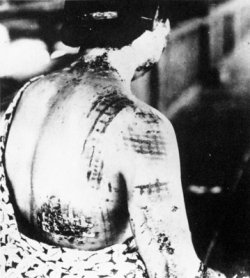
photo: a woman with the pattern of her kimono burnt into her back

A woman caught by the bombing in Nagasaki
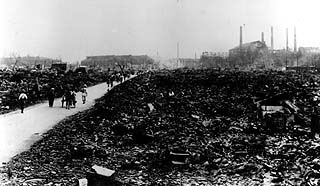
photo: a ruined residential neighborhood, with all the homes burnt or toppled

Iwakawa-machi residential neighborhood, Nagasaki

Here are some facts you do not need to remind me of today: that the government of the Empire of Japan launched a war of aggression against American territory and killed both American military and civilians; that they conducted a brutal war of conquest against China in which hundreds of thousands of civilians were mercilessly tortured and killed; that some fanatical elements of the military regime wanted to fight the United States down to the last man. That’s all true, but it’s quite beyond the point. None of these vicious acts by a vicious government justifies doing this to people, to civilians who had no meaningful role in either the decision-making or in the fighting. Nothing could. If you want to make a plea on behalf of terror-bombing, fine; do so. But not here. I’ll post again tomorrow or in a couple days, and we can argue there about the merits and demerits of burning 1,000,000 innocent people alive when you think you can get good results from it. But for now, the dead deserve at least a day of quiet mourning.

Today there’s a memorial for the victims standing in the Hiroshima Peace Park, with an inscription that reads Rest in peace, for this mistake will not be repeated. Let us remember the dead, and pray that those words are true.

Further reading
Pet Peeves

There’s quite the debate raging over at Catallarchy, in reply to comments condemning Harry Truman as a terrorist as bad, or worse, than Osama bin Laden:

My view is the direct opposite of what they teach in government run schools. They teach that Truman’s action [the use of atomic weapons] was a heroic choice that saved many American lives. With a similar line of reasoning, a friend of mine argued that the massacre of civilians during war may be justified if the reward is high enough. He hesitated to make a judgment in the particular instance of Harry Truman’s wartime actions, claiming that the good of saving American troops at least partially offset the bad of incinerating Japanese homes and families.

Many other men have used logic similar to Truman’s supporters to justify attacking civilian targets to further national objectives. However, I don’t think my American friends would hesitate to condemn their actions because they don’t bat for the home team.

For example, the name Osama bin Laden has taken its place among Hitler and Satan in the pantheon of evil. The reason? He thinks freeing the Arab world from Western imperial influences is important enough to sacrifice civilian lives. We might call him the Harry Truman of the Middle East.

As most Americans condemn bin Laden for putting civilians in harm’s way, so too do I condemn Truman. If bin Laden is a terrorist, then so is Truman. In fact, Truman’s actions are more indefensible because eventual victory was available through conventional military means. For bin Laden, direct military action, against the most feared armed force in all of history, is out of the question.

Americans have a perverse and dangerous view of their place in the world. Until we realize that our civilians are not worth more than other country’s civilians and that our leaders do not operate within a sacred halo that allows them to turn ugly sins into holy acts, America will continue to be a source of great suffering.

Now, I think that Jacob is right on here, and that the shameless apology for mass murder, as long as it happens under the Stars and Stripes, may very well be the most sickening feature in all of American education. But the fish I want to fry today is meta-ethical, not political, so if you want to argue about the massacres at Hiroshima, Nagasaki, Tokyo, etc., feel free to do so, but the point I want to call attention to is actually off to one side of the debate. Here’s a comment in the thread from Dave, howling in protest (emphasis added):

Jacob’s post is about moral relativism gone out of control. Maybe next this libertarian will compare Timothy McVeigh to Murray Rothbard because both harbored anti-government feelings. Look at the passive posture he wants the United States to assume. …

And blah, blah, blah.

I pick this out because it highlights a pet peeve of mine. The Right–thanks to the influence of the Christian Right and fundamentalist ideas about the nature of secular modernism–have been throwing around the phrase moral relativism in public debate over the past ten or twenty years, and every year that goes by they seem to get further and further from having any clue at all what it means. Here we have a particularly dramatic case in point: not only is there there is absolutely nothing in Jacob’s post which either entails or even suggests moral relativism. In point of fact, Jacob’s comments demand that moral relativism be rejected, and that moral principles be applied universally, rather than applied ad hoc depending on your relationship to the agent being judged.

It’s no sin not to know meta-ethical theory, but if you’re going to use the terms, you ought to know what they mean. Moral relativism does not mean being lax about taboos that you shouldn’t be lax about; far less does it mean drawing a mistaken comparison in ethics. Moral relativism is the doctrine that one and the same action can be both right and wrong at the same time–that is, that questions of moral value can only be answered relative to some frame of reference that can change from one judgment to the next. For example, some people have believed (wrongly) that whether an action is right or wrong depends on whether the person making the moral judgment has a feeling of approval or disapproval towards it; other people have believed (also wrongly) that whether an action is right or wrong depends on whether or not the person making the moral judgment lives in a society in which the action is generally praised, generally condemned, or generally considered neutral. (For an excellent discussion of, and critical reply to, actual moral relativism, see Chapter III of G. E. Moore’s Ethics [1912].)

Now, Dave might think that Jacob’s moral principles (for example, that deliberately slaughtering thousands or hundreds of thousands of civilians in pursuit of your goals is wrong, no matter what) are mistaken. I don’t think they are, but that’s not the point here. The point is that Jacob is insisting on principled ethical judgments (even if you think the principles are wrong) and he is not claiming anywhere, ever, that the applicability of those principles is relative to the speaker’s feelings, or culture, or relation to the person carrying out the slaughter, or relation to the victims, or anything of the sort. Quite the contrary; he’s insisting that moral principles, which he claims we insist on in bin Laden’s case, ought to be applied absolutely and for everyone. That’s an outright rejection of relativism and the excuses for atrocities that relativism so happily provides.

On the other hand, I can’t say the same for these comments:

If you don’t believe that your country’s citizens are worth more than the citizens of other countries — that is, entitled to live even if it means the death of citizens of other countries — I don’t want to be in the same foxhole with you.

But of course the comments come not from Jacob, but from the hawkish Tom, in protest of Jacob’s point. The implied conclusion — that subjects of other States shouldn’t be treated as though they have as much of a right to life as the subjects of your own State — is a textbook case of moral relativism. (Specifically, in this case, the claim that fundamental moral obligations, like the rights of innocents not to be burned alive as a sacrifice for others, can only be decided relative to the relationship between the you and the victim–if you are subjects of the same State then it is not O.K., but if you are subjects of different States, then anything up to and including dropping a fucking nuclear bomb on their heads is, apparently, acceptable.) Maybe Jacob’s principles are right and maybe they’re wrong; but he is employing principles, and insisting that they are universally binding. Tom, on the other hand, is explicitly stating that moral principles are binding relative to one group of people and mere breath relative to another. Yet it is Jacob, not Tom, who is denounced as a moral relativist; this is nothing but darkening counsel with words without knowledge.

The kind of argument that Tom uses is, of course, a method of excuse used all the time by the Right: the idea that any means at all are acceptable in warfare, because our moral obligations end at borders on a map, and so the pursuit of victory can trump any and every other moral consideration. Of course, just saying that a view is relativist is not the same thing as saying that it is false; maybe there are some good arguments for relativism. I haven’t found any, and I think there are decisive arguments against it, but it’s an open philosophical topic. But my concern here is about the proper use of terms, and about consistency; if you are going to support a bloody and unapologetic form of relativism, then you had better argue for it, and you had better not pretend that you’re opposed to it. Yet it seems that somehow the self-appointed arch-nemeses of moral relativism never do get around to condemning this sort of blatant disregard for universality in ethics–perhaps because their situation is as the Prophet has written: We have met the enemy, and they is us.

In Their Own Words: Sausages and Soundbites edition

I add only that I do my best not to swallow the results of sausage-making, either.

THE WHITE HOUSE
Office of the Press Secretary

For Immediate Release
July 11, 2005

PRESS BRIEFING BY SCOTT McCLELLAN

James S. Brady Press Briefing Room

Q Does the President stand by his pledge to fire anyone involved in the leak of a name of a CIA operative?

MR. McCLELLAN: Terry, I appreciate your question. I think your question is being asked relating to some reports that are in reference to an ongoing criminal investigation. The criminal investigation that you reference is something that continues at this point. And as I’ve previously stated, while that investigation is ongoing, the White House is not going to comment on it. The President directed the White House to cooperate fully with the investigation, and as part of cooperating fully with the investigation, we made a decision that we weren’t going to comment on it while it is ongoing.

Q Excuse me, but I wasn’t actually talking about any investigation. But in June of 2004, the President said that he would fire anybody who was involved in this leak, to press of information. And I just want to know, is that still his position?

MR. McCLELLAN: Yes, but this question is coming up in the context of this ongoing investigation, and that’s why I said that our policy continues to be that we’re not going to get into commenting on an ongoing criminal investigation from this podium. The prosecutors overseeing the investigation had expressed a preference to us that one way to help the investigation is not to be commenting on it from this podium. And so that’s why we are not going to get into commenting on it while it is an ongoing investigation, or questions related to it.

Q Scott, if I could — if I could point out, contradictory to that statement, on September 29th, 2003, while the investigation was ongoing, you clearly commented on it. You were the first one who said, if anybody from the White House was involved, they would be fired. And then on June 10th of 2004, at Sea Island Plantation, in the midst of this investigation is when the President made his comment that, yes, he would fire anybody from the White House who was involved. So why have you commented on this during the process of the investigation in the past, but now you’ve suddenly drawn a curtain around it under the statement of, We’re not going to comment on an ongoing investigation?

MR. McCLELLAN: Again, John, I appreciate the question. I know you want to get to the bottom of this. No one wants to get to the bottom of it more than the President of the United States. And I think the way to be most helpful is to not get into commenting on it while it is an ongoing investigation. That’s something that the people overseeing the investigation have expressed a preference that we follow. And that’s why we’re continuing to follow that approach and that policy.

Now, I remember very well what was previously said. And at some point, I will be glad to talk about it, but not until after the investigation is complete.

Q So could I just ask, when did you change your mind to say that it was okay to comment during the course of an investigation before, but now it’s not?

MR. McCLELLAN: Well, I think maybe you missed what I was saying in reference to Terry’s question at the beginning. There came a point when the investigation got underway when those overseeing the investigation asked that it would be their — or said that it would be their preference that we not get into discussing it while it is ongoing. I think that’s the way to be most helpful to help them advance the investigation and get to the bottom of it.

Q Scott, can I ask you this; did Karl Rove commit a crime?

MR. McCLELLAN: Again, David, this is a question relating to an ongoing investigation, and you have my response related to the investigation. And I don’t think you should read anything into it other than we’re going to continue not to comment on it while it’s ongoing.

Q Do you stand by your statement from the fall of 2003 when you were asked specifically about Karl and Elliott Abrams and Scooter Libby, and you said, I’ve gone to each of those gentlemen, and they have told me they are not involved in this — do you stand by that statement?

MR. McCLELLAN: And if you will recall, I said that as part of helping the investigators move forward on the investigation we’re not going to get into commenting on it. That was something I stated back near that time, as well.

Q Scott, I mean, just — I mean, this is ridiculous. The notion that you’re going to stand before us after having commented with that level of detail and tell people watching this that somehow you decided not to talk. You’ve got a public record out there. Do you stand by your remarks from that podium, or not?

MR. McCLELLAN: And again, David, I’m well aware, like you, of what was previously said, and I will be glad to talk about it at the appropriate time. The appropriate time is when the investigation —

Q Why are you choosing when it’s appropriate and when it’s inappropriate?

MR. McCLELLAN: If you’ll let me finish —

Q No, you’re not finishing — you’re not saying anything. You stood at that podium and said that Karl Rove was not involved. And now we find out that he spoke out about Joseph Wilson’s wife. So don’t you owe the American public a fuller explanation? Was he involved, or was he not? Because, contrary to what you told the American people, he did, indeed, talk about his wife, didn’t he?

MR. McCLELLAN: David, there will be a time to talk about this, but now is not the time to talk about it.

Q Do you think people will accept that, what you’re saying today?

MR. McCLELLAN: Again, I’ve responded to the question.

(Text thanks to Catallarchy 2005-07-11.)

Further Reading

Anticopyright. All pages written 1996–2026 by Rad Geek. Feel free to reprint if you like it. This machine kills intellectual monopolists.