Rad Geek People's Daily

official state media for a secessionist republic of one

Posts filed under Politics

Moore summer reading

Two things that you ought to know if you ever want to teach for CTY are: (1) it’s a thrilling, challenging, wonderful experience that changes the lives of nearly everyone involved in it for the better; and (2) you will have almost no time whatsoever to yourself for six weeks, and certainly no time to follow the news. Whether this is a good thing or a bad thing for you is a question I leave to you and your god.

But though I may be in no position to offer any timely analysis, I do at least have time to offer some analysis. So, hot off the presses from October 1903, I’m glad to announce that the completed transcription of Chapter V of G. E. Moore’s Principia Ethica is now available online from the Fair Use Repository. This chapter is Moore’s treatment of Ethics in Relation to Conduct, and it highlights one of the odder parts of Moore’s ethical system. Moore was, as I’ve mentioned before (in GT 2005-06-01 and GT 2005-06-28) a sharp critic of utilitarianism, and has given the philosophical tradition what I think is one of the loveliest arguments ever given against it. But he wasn’t a critic of consequentialism; in fact, he seems to have regarded consequentialism as more or less obviously true, and a direct consequence of properly distinguishing things good as ends from things good only as means. Although he alludes to this early on, it’s Chapter V that does the real heavy lifting for the argument. If Moore’s arguments go through, then it will turn out that no human action is good as an end in itself, but rather that actions are good only insofar as they are the causes of good effects. But unlike most consequentialists, Moore does not think there is any reason, other than prejudice, to start out assuming that the kinds of effects that are relevant for moral questions are effects on human consciousness at all, let alone the specific effects of promoting happiness (or pleasure, or satisfaction) and minimizing misery (or pain, or frustration). In fact, he takes himself to have shown already (with the Open Question Argument) that there’s no reason, other than prejudice, to start out assuming that you can characterize the quality that all good effects have in common in any terms except the bare fact that they are indeed good. (N.B.: That doesn’t mean that it can’t be the case; Moore thinks that the OQA proves only that if there is some non-ethical property that all good effects in fact have in common, that’s a substantive, synthetic finding about ethics, which will have to be justified by an appeal to ethical intuitions, rather than logical analysis of ethical terms. His discussion in Chapter III is intended to give some ethical reasons why even if there is such a property, it can’t be pleasantness; his positive reasons for thinking that there isn’t any such common quality will have to wait until the forthcoming transcription of Chapter VI.)

The upshot of all this is that although I think Moore goes seriously astray in his argument in Chapter V, he can’t be engaged on the same terms that most criticisms of consequentialism work from–because most criticisms of consequentialism are criticisms of utilitarianism and Moore is no utilitarian. Since he defends, at some length, the intrinsic value of many things (beauty, knowledge, friendship, some character traits, etc.) against utilitarian attempts to treat them as mere means, he can easily stand with anti-consequentialists during most of the common criticisms of utilitarianism–that it requires you to be willing to approve of injustice or lies in principle if there is enough of a pay-off in pleasure, for example; since Moore defends the intrinsic value of many things besides pleasure he is not at all committed to that; since Moore, in Chapter V, so sharply distinguishes the question of what ought to exist from what we ought to do, he may have an easier time than most ethicists would agreeing with Bernard Williams’ criticism that utilitarianism seems to obliterate me and my projects in favor of rigidly impersonal rule-following. If there’s something that Moore’s doing wrong here–and I think that there certainly is–it probably won’t be successfully picked out by most of the arguments that pick out something wrong with more familiar forms of consequentialism.

From here, the transcription will continue with the final chapter, Chapter VI: The Ideal, in which Moore attempts to give his full positive discussion of the sorts of things which are good in themselves. I hope to keep up my pace of 1-2 sections per day (although I probably won’t be able to begin until tomorrow). If you want to keep up with the progress of the transcription, you can subscribe to the Atom feed of Chapter VI, which will be updated as each section is completed. Onward to the ultimate end!

Previously…

Other news

For those of you who just can’t get enough fin-de-siècle English philosophy, you’re in luck. Not only is the transcription of Principia Ethica nearing completion, but you may also be interested to know that:

  1. I’ve also found and transcribed G. E. Moore’s review of Franz Brentano’s The Origin of the Knowledge of Right and Wrong, which appeared in the International Journal of Ethics in the same month that Principia Ethica was published; Moore refers to Brenatno’s book and his review of it in the Preface to Principia Ethica, where he says that he discovered the book after completing PE but found [in it] opinions far more closely resembling my own, than those of any other ethical writer with whom I am acquainted. The review singles out Brentano for praise mainly because of Brentano’s parallel emphasis on the irreducibility of good (The great merit of this view over all except Sidgwick’s is its recognition that all truths of the form This is good in itself are logically independent of any truth about what exists), but offers some criticism of Brentano’s attempt to define good in terms of other ethical predicates (as that which it is right to love). Also, apparently, the translation sucked, but that was Cecil Hague’s fault, not Brentano’s.

  2. I’ve transcribed several articles from the April 1895 issue of Mind, and will probably finish transcribing the rest of the contents within the next several days. I picked that issue out in particular because it had Lewis Carroll’s fantastic three-page essay, What the Tortoise said to Achilles; the issue also features some rather mediocre material from Bradley, an apology for the Common Sense school of Scottish philosophy by Henry Sidgwick, an early book review by Bertrand Russell (not yet online), and an interesting introductory essay on Hindu Logic by S. N. Gupta.

  3. I hear tell that the court scribes of the Austro-Athenian Empire have also been hard at work, with three new transcriptions of essays from Herbert Spencer’s 1902 book Facts and Comments. In addition to his essay Patriotism, which Roderick made available online a while ago, you can now also find his (sadly topical) denunciations of war, empire, and its corrosive effects on civilization in Imperialism and Slavery, Re-barbarization, and Regimentation.

Just a reminder: just because something’s old doesn’t mean it’s not topical; and just because something’s not topical doesn’t mean it’s not good. So, enjoy!
Libertarians for Protectionism

It’s always so cute to see self-proclaimed libertarians engaging in the most egregious sorts of protectionist argument when it comes to intellectual property restrictions. Consider the recent exchange on patents and copyrights over at Catallarchy, in which we are apparently supposed to grant drug companies and record labels the power to violently halt competition because (1) they have high sunk costs, and (2) they’d have to rethink their business strategy on a free market.

For example, here’s Joseph Weisenthal:

Matt, it’s been estimated that it takes approximately $500 Million dollars to develop the average drug, although that number can swing wildly. If companies were simply allowed to copy a compound and produce it as soon as a drug became available, the cost would fall roughly to the cost of current production, but that doesn’t suffice when you have up to 15 years of previous R&D expense to recoup.

The cost theory of value just doesn’t cut it, here bra, and yes, if drugs did fall to this level, there would be little reason to spend the enormous amounts of money, and spend the time to develop the compound.

And so, if patent protectionism is withdrawn, pharmaceutical research and development may have to be done by somebody other than for-profit pharmaceutical companies!

On a similar note, here’s Brandon Berg, adding an appeal to pity for the poor record companies on top of the protectionist argument:

What about the record companies who fund the production of their albums? People like to think of them as some sort of parasitic middlemen, but they’re not. They provide the capital and take on the risk that most musicians can’t afford. If profits fall, then recording studios will decide not to fund albums by musicians whom they think are less likely to be successful.

And so, if copyright protectionism is withdrawn music companies might have to rethink their current business model!

O tempora! O mores!

Economics lesson for the day: protectionism doesn’t work. Markets do.

Ethics lesson for the day: the world doesn’t owe you a living, even if you’re very smart or very creative. Honest people try to find a new way to make a living if the old way can’t work without the use of government force. Clever people find out new ways of making useful things, if they realize they can’t make an honest living in the old ways.

Logic lesson for the day: before you have a successful reductio ad absurdam the conclusion of the lemma must actually be absurd.

Burn, baby, burn

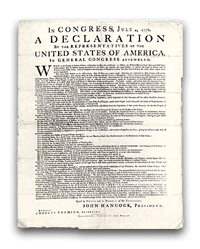
Take down that flag and for the love of God turn off that Lee Greenwood. Independence Day is not about the United States. (There was no such country in 1776, before or after the Declaration; the Declaration only claimed to absolve the former colonies from any allegiance to the Crown.) Least of all is this a day for the government or for its loyalists. 4 July is for rebels and radicals.

We hold these truths to be self-evident, that all men are created equal, that they are endowed by their Creator with certain unalienable Rights, that among these are Life, Liberty and the pursuit of Happiness. –That to secure these rights, Governments are instituted among Men, deriving their just powers from the consent of the governed, –That whenever any Form of Government becomes destructive of these ends, it is the Right of the People to alter or to abolish it …. [W]hen a long train of abuses and usurpations, pursuing invariably the same Object evinces a design to reduce them under absolute Despotism, it is their right, it is their duty, to throw off such Government, and to provide new Guards for their future security.

— Declaration of Independence, 4 July 1776

Jefferson, of course, claimed that the natural consequence of altering or abolishing government was to “institute new Government.” So much the worse for Jefferson (and especially for those whom he later came to govern), but that affects what’s entailed by the principles enunciated in the Declaration about as much as the fact that Jefferson pretended like he didn’t have a moral duty to immediately release his slaves from bondage affects the fact that the Declaration’s defense of complete equality and inalienable natural rights nevertheless condemned slavery beyond hope of appeal. Whatever Jefferson’s failings, his argument, if sound, is an argument against any form of coercive government whatsoever. If indeed we do have the “right to alter or abolish” government–any government–in virtue of our right to withdraw our consent to their authority, and we retain that right as free human beings no matter what institutions we may have been born into or roped into, then no government can ever rightly demand our allegiance against our will; we are, all of us, free to withdraw that allegiance and (thereby) remove ourselves from any obligation to any government at any time. The only question that remains is whether that right to alter or abolish government is a right that belongs to each of us, individually, or a right that has to be exercised collectively (by some group of us acting together). But if our right to refuse government authority derives from (1) our birthright to equal station as sovereign individuals, and (2) the natural and unalienable rights that follow from that, then it’s hard to see how these individually held rights could entail anything less than an individual right, as the political equal of any puffed-up prince or president on Earth, for you, personally, right now, to sever all political connections if you want, and to tell your would-be rulers just where they can go promulgate their law.

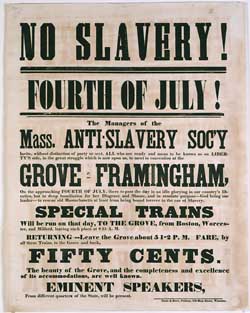
Over at Catallarchy they’ve been singing the praises of flag-burning. I might be more enthusiastic about it if I thought the flag were really the problem; but, aside from being even uglier than most of the world’s military colors, there’s not too much harm that you can say the flag itself has really done. But flags aren’t all that you can burn. Here’s how William Lloyd Garrison, for example, marked the occasion 151 years ago today, when Boston was outraged by the use of armed federal troops to force Anthony Burns back into Southern slavery:

The rally began with a prayer and a hymn. Then Garrison launched into one of the most controversial performances of his career. To-day, we are called to celebrate the seventy-eighth anniversary of American Independence. In what spirit? he asked, with what purpose? to what end? The Declaration of Independence had declared “that all men are created equal … It is not a declaration of equality of property, bodily strength or beauty, intellectually or moral development, industrial or inventive powers, but equality of RIGHTS–not of one race, but of all races.

Massachussets Historical Society, July 2005

We have proved recreant to our own faith, false to our own standard, treacherous to the trust committed to our hands; so that, instead of helping to extend the blessings of freedom, we have mightily served the cause of tyranny throughout the world. Garrison then spoke about the prospects for the success of the revolutionary spirit within the nation, prospects he regarded as dismal because of the insatiable greed, boundless rapacity, and profligate disregard of justice prevalent at the time. He concluded his speech by asserting, Such is our condition, such are our prospects, as a people, on the 4th of July, 1854! Setting aside his manuscript, he told the assembly that he should now proceed to perform an action which would be the testimony of his own soul to all present, of the estimation in which he held the pro-slavery laws and deeds of the nation

— from Thoreau: Lecture 43, 4 July, 1854

Producing a copy of the Fugitive Slave Law, he set fire to it, and it burst to ashes. Using an old and well-known phrase, he said, And let all the people say, Amen; and a unanimous cheer and shout of Amen burst from the vast audience. In like manner, Mr. Garrison burned the decision of Edward G. Loring in the case of Anthony Burns, and the late charge of Judge Benjamin R. Curtis to the United States Grand Jury in reference to the treasonable assault upon the Court House for the rescue of the fugitive–the multitude ratifying the fiery immolation with shouts of applause. Then holding up the U.S. Constitution, he branded it as the source and parent of all the other atrocities,–“a covenant with death, and an agreement with hell,”–and consumed it to ashes on the spot, exclaiming, So perish all compromises with tyranny! And let all the people say, Amen! A tremendous shout of Amen! went up to heaven in ratification of the deed, mingled with a few hisses and wrathful exclamations from some who were evidently in a rowdyish state of mind, but who were at once cowed by the popular feeling.

–from The Liberator, 7 July 1854 (boldface added)

Happy Independence Day.

Bolts from the Blue

(Links thanks to Marian Douglas [2005-06-07], Lew Rockwell [2005-06-06], and Edmund Burke [1757].)

Cops in America are heavily armed and trained to be bullies, and they routinely hurt people who are not posing any serious threat to anyone, in order to make sure that they stay in control of the situation. You already knew that they electrified children and suspected salad-bar thieves; you can also add to the list women who have committed the horrible crimes of driving on a suspended license and going 12 miles an hour over the speed limit, provided that they are (1) Black and (2) talk back to the cops, especially on points of legality. Note that being completely unarmed and doing nothing more dangerous than not getting out of the vehicle promptly on command will not stop them from using a 50,000 volt electric blast to immobilize you with pain two or three times in quick succession. Neither, incidentally, will being eight months pregnant.

This is getting repetitive, so let’s just review:

We already knew that Florida cops were willing to electrify a 6 year old boy and a 12 year old girl with a 50,000 volt blast from a taser. The 6 year old was distraught and threatening to hurt himself (after all, why hurt yourself when you can have a cop immobilize you with pain?); the 12 year old’s crime was playing hooky and maybe being a little tipsy, and the incredibly dangerous imminent threat she posed was that she ran away from the cop and so might have been able to skip school. Back when it happened, I mentioned that the main reaction from the police brass was to review the decision to equip cops with tasers–as if the equipment were the primary problem here. I also mentioned that we might be better served by scrutinizing the paramilitary police culture that we have, in which peace officers are trained to take control of every situation at all times, by any means necessary, and where any notion of proportionality between the possible harm and the violence used to maintain control is routinely chucked out the window in the name of law and order and winning the war on crime.

The cops, of course, continue to treat these cases as a P.R. management problem, not a public safety problem created by out-of-control cops. That’s because the cops aren’t out of control; they are doing what cops normally do in our society; we only know about it here because the victims were vulnerable enough that their caretakers were able to get the attention of the newsmedia and the civil courts. We are not talking about a few bad apples here; we are talking about a systematic feature of policing in our society.

— Geekery Today 2005-04-26: Peace Officers

Meanwhile. in Seattle:

Law enforcement officers have said they see Tasers as a tool that can benefit the public by reducing injuries to police and the citizens they arrest.

Seattle police officials declined to comment on this case, citing concerns that Brooks might file a civil lawsuit.

But King County sheriff’s Sgt. Donald Davis, who works on the county’s Taser policy, said the use of force is a balancing act for law enforcement.

It just doesn’t look good to the public, he said.

— Marian Douglas 2005-06-07: Police Taser pregnant woman 3 Times, Just happens to be Black

I’ve been at this for a while with more or less the same analysis applid in each of several different cases (1, 2, 3), so by now I probably ought to at least add a bit by way of a reply to Martin Striz’s complaints. In that direction, let me just say that my main concern here is the paramilitary stance that police forces take toward you and I, and the routine use of extreme violence that that fosters; and that my main difference from Martin has a lot to do with a difference over whether the institutional framework that cops work in is essentially or just accidentally connected with the abuses of power that rampaging cops display every day.

But there’s no need for me to dwell on this point about the hangman State when Edmund Burke already explained it better than I could, back in 1757:

These Evils are not accidental. Whoever will take the pains to consider the Nature of Society, will find they result directly from its Constitution. For as Subordination, or in other Words, the Reciprocation of Tyranny, and Slavery, is requisite to support these Societies, the Interest, the Ambition, the Malice, or the Revenge, nay even the Whim and Caprice of one ruling Man among them, is enough to arm all the rest, without any private Views of their own, to the worst and blackest Purposes; and what is at once lamentable and ridiculous, these Wretches engage under those Banners with a Fury greater than if they were animated by Revenge for their own proper Wrongs. …

To prove, that these Sort of policed Societies are a Violation offered to Nature, and a Constraint upon the human Mind, it needs only to look upon the sanguinary Measures, and Instruments of Violence which are every where used to support them. Let us take a Review of the Dungeons, Whips, Chains, Racks, Gibbets, with which every Society is abundantly stored, by which hundreds of Victims are annually offered up to support a dozen or two in Pride and Madness, and Millions in an abject Servitude, and Dependence. There was a Time, when I looked with a reverential Awe on these Mysteries of Policy; but Age, Experience, and Philosophy have rent the Veil; and I view this Sanctum Sanctorum, at least, without any enthusiastick Admiration. I acknowledge indeed, the Necessity of such a Proceeding in such Institutions; but I must have a very mean Opinion of Institutions where such Proceedings are necessary. …

I now plead for Natural Society against Politicians, and for Natural Reason against all three. When the World is in a fitter Temper than it is at present to hear Truth, or when I shall be more indifferent about its Temper; my Thoughts may become more publick. In the mean time, let them repose in my own Bosom, and in the Bosoms of such Men as are fit to be initiated in the sober Mysteries of Truth and Reason. My Antagonists have already done as much as I could desire. Parties in Religion and Politics make sufficient Discoveries concerning each other, to give a sober Man a proper Caution against them all. The Monarchic, Aristocratical, and Popular Partizans have been jointly laying their Axes to the Root of all Government, and have in their Turns proved each other absurd and inconvenient. In vain you tell me that Artificial Government is good, but that I fall out only with the Abuse. The Thing! the Thing itself is the Abuse!

— Edmund Burke (1757): A Vindication of Natural Society

Chapter IV and much, much Moore…

This is old news, but I was too busy packing for my temporary relocation to upstate New York to put a post up about it at the time: the transcription of G. E. Moore’s Principia Ethica proceeds apace, and this time I have not one, but three milestones to announce (!):

  1. Chapter III, Moore’s extended treatment of hedonism, which I mentioned around the time I was halfway through with it, is now completely transcribed. I’d already finished Moore’s dissection of naturalistic hedonism (that is, hedonism supported by the naturalistic fallacy, as in, for example, Mill’s Utilitarianism); the new passages carry on with Moore’s discussion of Sidgwick and intuitionistic hedonism (that is, hedonism supported by an appeal to ethical intuitions). I think this actually contains some of the best material in all of Moore’s work — including one of my favorite arguments in all of philosophy, the Two Planets argument against ethical hedonism. (It may seem like an intuition-pump, but it’s a beautiful intuition-pump. And also, actually, a successful one: many people worry that he’s just begging the question, but I’d argue that Moore completely refutes hedonism, and that the argument ought to be convincing whether your intuitions about the planets line up with Moore’s or not. Maybe I’ll go into the reasons why here a bit later.)

  2. Chapter IV, Moore’s discussion of what he calls Metaphysical Ethics, is also completely transcribed. This is one of the chapters where Moore’s partisan aims come through a bit more clearly than you might hope; the goal is honorable enough — to show that his British Idealist contemporaries are actually guilty of the same sort of fallacy that constitutes the naturalistic fallacy when used by naturalists, and that the fallacy is no less fallacious when good is reduced to some set of supernatural properties rather than some set of natural properties — but the effort to count some coup against British Idealists who cited their Continental predecessors ends up in a very weak bit of criticism against Kant, who never did anything to deserve it. (Unfortunately, this would not be the last time that this happened to Kant — and especially not to Hegel — among the Analytics.) Still, the chapter is well worth reading, and on somewhat firmer ground when Moore is doing philosophy (i.e., when he examines the conceptual contours of the doctrines he sets out) than when he is doing scholarship (i.e., when he starts making claims about where those doctrines came from).

  3. Finally, you may notice a technical change that I took a few days off from transcribing to implement: the text of the documents is now stored in machine-readable feeds and processed by a PHP script that I wrote for the purpose. Aside from some minor aesthetic improvements I made along the way, the main upshot of this for you is that you can now read and cite the text not only by chapter, but also by individual section (as I did above when I cited §50) or even by ranges of sections (such as, for example, the characterization of the naturalistic fallacy and the Open Question Argument in §§10–13). Of course, you can still read chapter-by-chapter if you prefer.

Next up is the transcription of Chapter V, Moore’s discussion of right and wrong conduct; a bit of the work has already begun and I’m trying to keep along at a steady clip of at least one passage per day. How well I’m able to keep up with that depends on how hectic my work schedule turns out to be; but if you’re interested in keeping up with the process, and happen to have an Atom/RSS newsreader handy, you can do so by subscribing to the Atom feed for Chapter V.

Let me know about any typos that you spot. Read; cite; enjoy!

Anticopyright. All pages written 1996–2026 by Rad Geek. Feel free to reprint if you like it. This machine kills intellectual monopolists.